


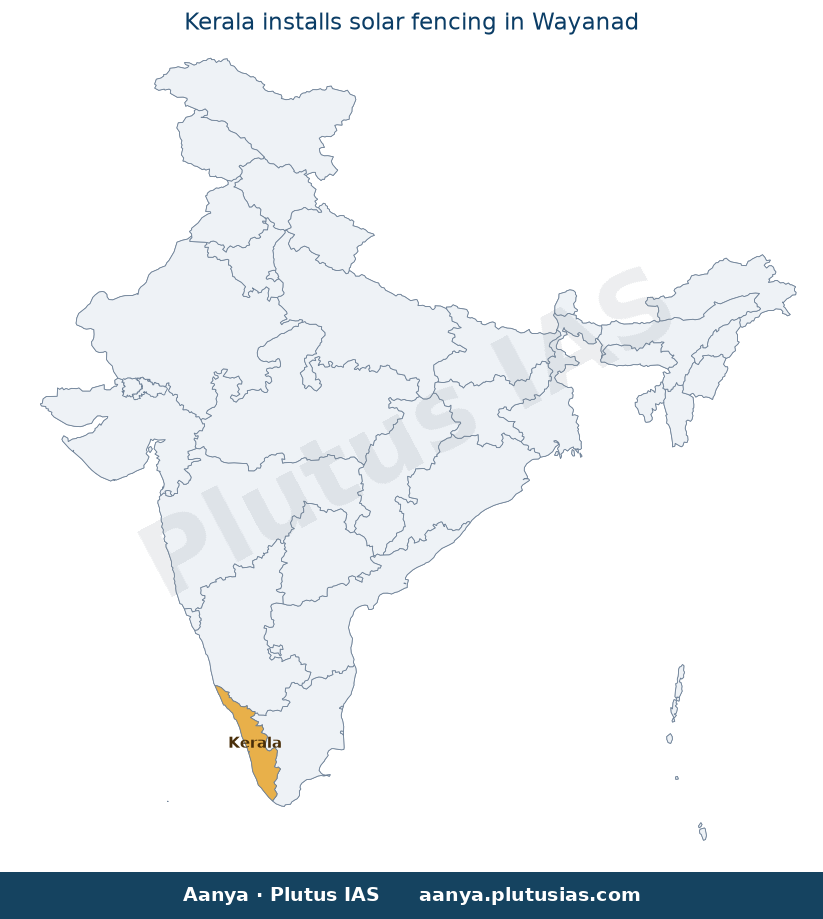
08 Aug Kerala to Install 60 km Solar Fencing in Wayanad to Curb Human-Wildlife Conflict
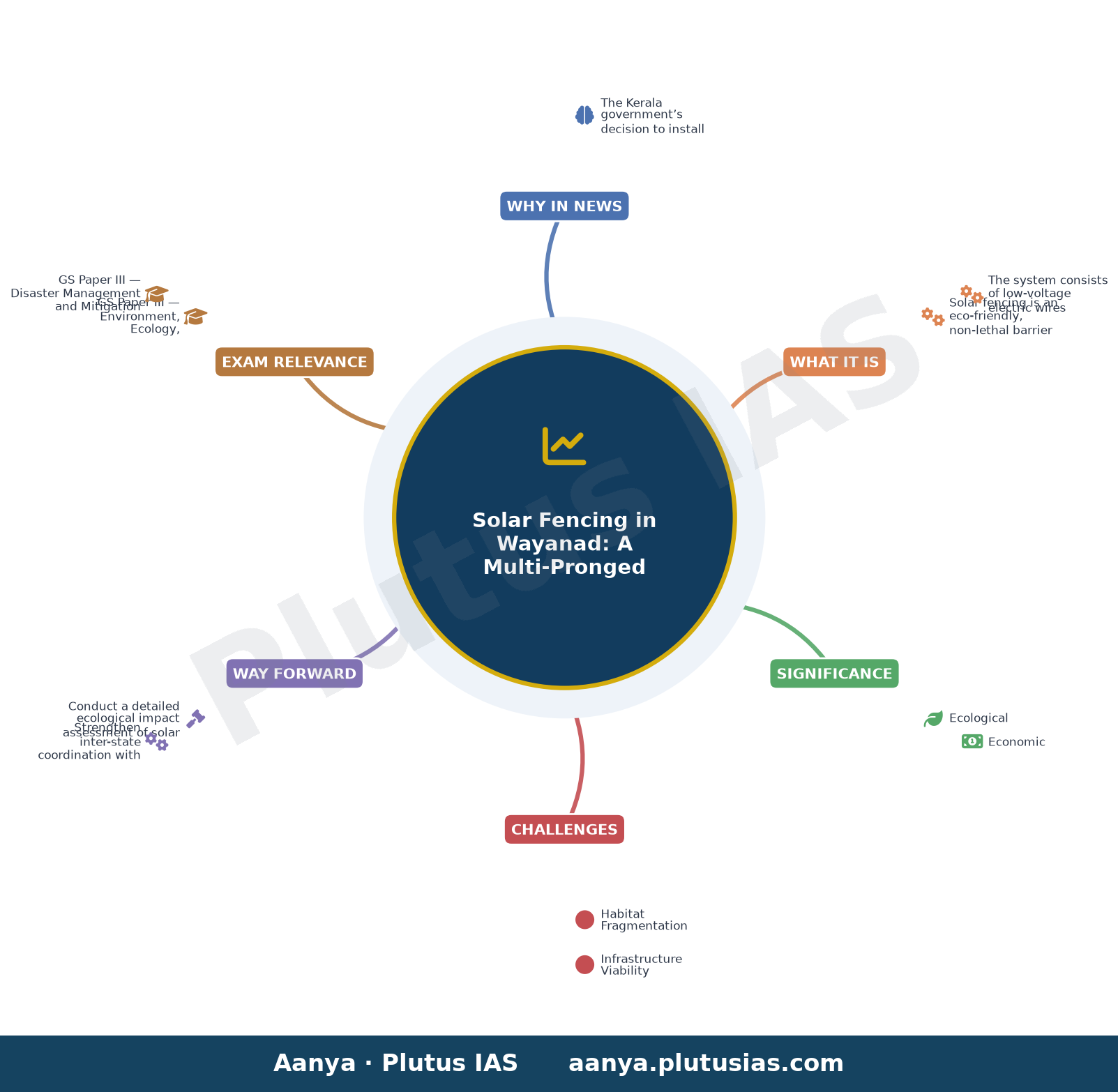
✎ Solar fencing is a solar-powered, low-voltage electric deterrent system used to mitigate human-wildlife conflict by creating a psychological barrier without harming animals, aligning with conservation laws and sustainable…
Subject Relevance — Where This Topic Fits
- GS Paper III — Environment, Ecology, Biodiversity and Climate Change | GS Paper III — Disaster Management and Mitigation
- Prelims: Human-Wildlife Conflict (HWC), Solar Fencing, Wayanad Wildlife Sanctuary, Wildlife Institute of India (WII), Carrying Capacity of Forests, Rapid Response Teams in Wildlife Management, 100-Day Action Programme of State Governments, Union Ministry of Environment, Forest and Climate Change (MoEFCC), Tiger Relocation Policy, Forest Rights Act, 2006
- Essay: Human-Wildlife Conflict: Balancing Conservation and Livelihoods, Sustainable Solutions for Coexistence in Biodiversity Hotspots
Quick Revision: Solar fencing is a solar-powered, low-voltage electric deterrent system used to mitigate human-wildlife conflict by creating a psychological barrier without harming animals, aligning with conservation laws and sustainable coexistence principles.
Why is this in the news?
The Kerala government’s decision to install 60 km of solar fencing in Wayanad, a district severely affected by human-wildlife conflict, underscores the escalating challenges posed by encroachment into wildlife habitats. Announced as part of the State’s 100-day action programme, the initiative integrates technological intervention with ecological assessment and institutional coordination, reflecting a contemporary approach to mitigating HWC while ensuring conservation objectives. The involvement of the Wildlife Institute of India (WII) for a carrying capacity study further highlights the scientific rigour being applied to long-term solutions.
Background
- Wayanad district in Kerala is a critical biodiversity hotspot, home to the Wayanad Wildlife Sanctuary and part of the Nilgiri Biosphere Reserve, which harbours significant populations of tigers, elephants, and other megafauna.
- Human-wildlife conflict (HWC) in Wayanad has intensified due to the expansion of agricultural lands, human settlements, and infrastructure into forest fringes, leading to frequent crop raids, property damage, and human casualties.
- Kerala has witnessed a rise in HWC incidents, with tigers and elephants being the primary species involved, necessitating proactive measures to reduce conflict and enhance coexistence.
- The State government’s 100-day action programme is a structured governance initiative aimed at expediting key projects, including wildlife management interventions, to address pressing socio-ecological challenges.
- The Wildlife Institute of India (WII), an autonomous institution under the MoEFCC, is tasked with conducting ecological assessments, including carrying capacity studies, to inform conservation and management policies.
- The Union Ministry of Environment, Forest and Climate Change (MoEFCC) plays a pivotal role in framing national wildlife policies, including guidelines for tiger relocation and habitat management.
What is Solar Fencing in the Context of Human-Wildlife Conflict?
- Solar fencing is an eco-friendly, non-lethal barrier system powered by solar energy, designed to deter wild animals from entering human settlements or agricultural lands without causing harm.
- The system consists of low-voltage electric wires energised by solar panels, creating a psychological deterrent while ensuring animal safety through controlled voltage levels (typically below 5 volts).
- Solar fencing is particularly effective in mitigating conflicts involving elephants and tigers, which are known to cause significant damage to crops and property in fringe areas.
- Unlike traditional physical barriers, solar fencing does not obstruct animal movement entirely but instead discourages entry into high-risk zones, thereby reducing both conflict and accidental injuries to wildlife.
- The technology is scalable and can be integrated with other mitigation measures such as early warning systems, rapid response teams, and habitat restoration initiatives.
- Solar fencing aligns with the principles of the Wildlife (Protection) Act, 1972, and the Forest Rights Act, 2006, by promoting coexistence while safeguarding both human livelihoods and wildlife habitats.
- The system requires minimal maintenance, operates autonomously, and is cost-effective in the long term, making it suitable for deployment in remote and ecologically sensitive areas like Wayanad.
- Kerala’s initiative builds on existing solar fencing projects in other states (e.g., Tamil Nadu and Karnataka) and reflects a growing trend towards technological solutions in wildlife management.
Key Features
| Feature | Significance |
|---|---|
| Installation of 60 km solar fencing | Mitigates human-wildlife conflict by creating a non-lethal barrier between settlements and forest fringes, reducing crop depredation and human casualties. |
| Repair of existing 25 km solar fencing | Enhances the effectiveness of existing mitigation infrastructure, ensuring continuity and reliability in conflict zones. |
| Carrying capacity study by WII | Provides empirical data on forest ecosystem limits, guiding sustainable wildlife management and habitat conservation policies. |
| Rapid Response Teams deployment | Strengthens emergency response capabilities for wildlife encounters, ensuring timely intervention to prevent escalation of conflicts. |
| Vegetation clearance along 100 km forest roads | Improves visibility for forest watchers and reduces habitat encroachment, facilitating safer human movement and wildlife monitoring. |
Why it Matters
Ecological
- Preserves biodiversity by reducing retaliatory killings of wildlife, particularly elephants and tigers, which are keystone species in Wayanad’s ecosystem.
- Supports habitat conservation through structured carrying capacity assessments, preventing over-exploitation of forest resources.
Economic
- Protects agricultural livelihoods by minimizing crop damage from wild herbivores, thereby reducing financial losses for farmers.
- Enhances tourism potential by ensuring safer human-wildlife interactions in ecotourism zones within Wayanad.
Administrative
- Demonstrates inter-departmental coordination between the Forest Department, local self-governments, and the Wildlife Institute of India for integrated wildlife management.
- Showcases the efficacy of state-led initiatives in addressing localized ecological challenges through targeted infrastructure and policy interventions.
Social
- Fosters community resilience by reducing human-wildlife conflict incidents, thereby improving quality of life in forest-fringe settlements.
- Encourages participatory governance through adalats and vigilance committees, empowering local stakeholders in conflict resolution.
Challenges
1. Habitat Fragmentation
- Expansion of human settlements near forest fringes exacerbates habitat fragmentation, increasing the frequency of human-wildlife encounters.
- Limited availability of contiguous forest corridors restricts wildlife movement, leading to higher incidences of crop raiding and human casualties.
UPSC Link: GS3: Conservation, Environmental Pollution
2. Infrastructure Viability
- Maintenance of solar fencing requires continuous monitoring and funding, posing long-term sustainability challenges for state resources.
- Technical failures or power disruptions in solar fencing could render it ineffective during critical conflict periods.
UPSC Link: GS3: Science and Technology
3. Stakeholder Resistance
- Relocation of tigers or other wildlife may face opposition from local communities due to perceived threats to livelihoods or cultural sentiments.
- Farmers may resist vegetation clearance along forest roads, viewing it as an encroachment on traditional practices.
UPSC Link: GS2: Governance, GS3: Agriculture
4. Data Gaps in Carrying Capacity
- Incomplete or outdated ecological data may compromise the accuracy of carrying capacity studies, leading to suboptimal policy decisions.
- Climate change-induced variations in forest productivity could render static carrying capacity assessments inadequate over time.
UPSC Link: GS3: Environment and Ecology
Challenges — UPSC Perspective
| Issue | Concern |
|---|---|
| Limited forest corridors | Increased human-wildlife conflict due to restricted wildlife movement |
| High maintenance costs | Sustainability challenges for state-funded solar fencing projects |
| Community opposition | Relocation or vegetation clearance may face resistance |
| Data inaccuracies | Carrying capacity studies may not reflect real-time ecological conditions |
Way Forward
- Conduct a detailed ecological impact assessment of solar fencing to evaluate its long-term effectiveness in reducing human-wildlife conflict.
- Strengthen inter-state coordination with Tamil Nadu and Karnataka to address transboundary wildlife movement and habitat connectivity.
- Develop a community-based compensation mechanism for crop losses to incentivize coexistence and reduce retaliatory killings.
- Expand the Rapid Response Teams with additional personnel and advanced monitoring equipment for real-time conflict mitigation.
- Integrate climate change projections into carrying capacity studies to ensure adaptive wildlife management strategies.
- Establish a dedicated fund for the maintenance and upkeep of solar fencing infrastructure to ensure operational reliability.
- Promote agroforestry practices in buffer zones to reduce dependency on forest resources and minimize human-wildlife interactions.
UPSC Value Addition
Keywords for Mains Answer-Writing
Human-Wildlife Conflict (HWC) · Solar Fencing Technology · Wildlife Institute of India (WII) · Carrying Capacity Study · 100-Day Action Programme · Waynad Wildlife Sanctuary · Project Tiger · Relocation of Tigers · Community-Based Conservation · Wildlife Conservation Strategies in India · Forest Rights and Land Ownership · Rapid Response Teams for Wildlife Management · Human Settlements in Forest Fringes · Wildlife Protection Act, 1972 · Institutional Coordination in Conservation
Concept Flow
Expansion of human settlements near forest fringes → Increased habitat fragmentation and human-wildlife encounters → State-led infrastructure interventions (solar fencing) → Mitigation of immediate conflict risks → Carrying capacity assessment by WII → Data-driven policy formulation for sustainable wildlife management → Deployment of Rapid Response Teams → Enhanced emergency response capabilities → Community participation through adalats and vigilance committees → Strengthened governance and conflict resolution → Long-term ecological balance → Preservation of biodiversity and livelihood security in Wayanad
Prelims Practice Questions
Q1. Consider the following statements regarding solar fencing as a mitigation measure for human-wildlife conflict:
1. Solar fencing is an electrified barrier that deters wild animals from entering human settlements.
2. The technology relies on solar energy to power electric fences, reducing operational costs.
3. Solar fencing is primarily used to protect crops from herbivorous animals like elephants and wild boars.
4. The Wildlife Protection Act, 1972 mandates the use of solar fencing in all forest-fringe areas across India.
How many of the above statements are correct?
- Only one
- Only two
- Only three
- All
Answer: Only three — Statements 1 and 2 are correct. Solar fencing uses solar-powered electric barriers to deter wild animals. Statement 3 is partially correct but not exclusively for herbivores, as it also targets carnivores like leopards and tigers. Statement 4 is incorrect; the Wildlife Protection Act does not mandate solar fencing universally.
Q2. Assertion (A): The Wildlife Institute of India (WII) is tasked with conducting carrying capacity studies in forest regions.
Reason (R): Carrying capacity studies assess the maximum population of wildlife that a habitat can sustain without degradation.
Options:
A. Both A and R are true, and R is the correct explanation of A.
B. Both A and R are true, but R is not the correct explanation of A.
C. A is true, but R is false.
D. A is false, but R is true.
Answer: ? — Both Assertion (A) and Reason (R) are true, and R correctly explains A. The WII is indeed mandated to conduct carrying capacity studies to determine sustainable wildlife populations in habitats like Wayanad.
Q3. Match the following initiatives with their respective objectives in the context of human-wildlife conflict mitigation:
Column I (Initiative) Column II (Objective)
A. Rapid Response Teams 1. Conducting population assessments of tigers and elephants
B. Carrying Capacity Study 2. Immediate intervention during human-wildlife encounters
C. Solar Fencing 3. Preventing wild animals from entering human settlements
D. Forest Department Road Vegetation Clearance 4. Enhancing accessibility for forest management and surveillance
Options:
A B C D
1 2 3 4
2 1 4 3
3 4 1 2
4 3 2 1
Answer: ? — A-2: Rapid Response Teams are deployed for immediate intervention. B-1: Carrying capacity studies assess wildlife populations. C-3: Solar fencing prevents wild animals from entering settlements. D-4: Vegetation clearance along forest roads enhances accessibility for management and surveillance.
Mains Practice Question
✍ Human-wildlife conflict (HWC) has emerged as a critical challenge in India, particularly in regions like Wayanad where human settlements abut forest fringes. In this context, critically examine the efficacy of technological interventions such as solar fencing and institutional measures like carrying capacity studies in mitigating HWC. Also, discuss the role of community participation and inter-institutional coordination in ensuring sustainable solutions. (15 Marks)
Approach: MODEL-ANSWER SKELETON:
1. **Introduction (2 marks)**
– Define Human-Wildlife Conflict (HWC) and its socio-economic and ecological impacts in India, citing Wayanad as a case study.
– Highlight the increasing encroachment of human settlements into forest areas due to developmental pressures.
2. **Technological Interventions (4 marks)**
– **Solar Fencing**: Explain its mechanism, advantages (solar-powered, cost-effective), and limitations (maintenance, ethical concerns regarding animal welfare).
– **Rapid Response Teams**: Discuss their role in immediate conflict resolution and data collection.
– **Vegetation Clearance**: Link to forest management and reduced human-wildlife encounters.
3. **Institutional Measures (4 marks)**
– **Carrying Capacity Studies**: Explain the methodology (WII’s role), objectives (sustainable wildlife populations), and challenges (data accuracy, political pressures).
– **Wildlife Protection Act, 1972**: Discuss provisions relevant to HWC (e.g., Section 27 for declaring protected areas).
– **Relocation of Tigers**: Critically assess the feasibility and ethical implications of tiger relocation as a solution.
4. **Community Participation and Coordination (3 marks)**
– Role of local self-government institutions, farmers, and vigilance committees in HWC mitigation.
– Challenges: Land ownership conflicts, compensation disputes, and lack of awareness.
– Success stories: Community-led conservation models (e.g., Hargila Army in Assam).
5. **Conclusion (2 marks)**
– Emphasise the need for a multi-pronged approach combining technology, institutional frameworks, and community engagement.
– Highlight the importance of long-term ecological studies and adaptive management in HWC mitigation.
Source: The Hindu
Generated by AanyaAi for educational purpose.

- मुस्लिम महिलाओं को विरासत में समान अधिकार: सुप्रीम कोर्ट ने केंद्र से पूछा जवाब - September 23, 2026
- Supreme Court Questions Muslim Women’s Inheritance Rights Under Personal Law - September 23, 2026
- सुप्रीम कोर्ट ने पटना हाईकोर्ट के बलात्कार फैसले पर लिया स्वतः संज्ञान - September 23, 2026

No Comments