


08 Aug UPSC Alert: National Tribunal Commission Bill Introduced in Lok Sabha
✎ The National Tribunal Commission Bill seeks to institutionalise transparency and independence in tribunal appointments by replacing the unconstitutional provisions of the Tribunal Reforms Act, 2021, in compliance with the Supreme…
Subject Relevance — Where This Topic Fits
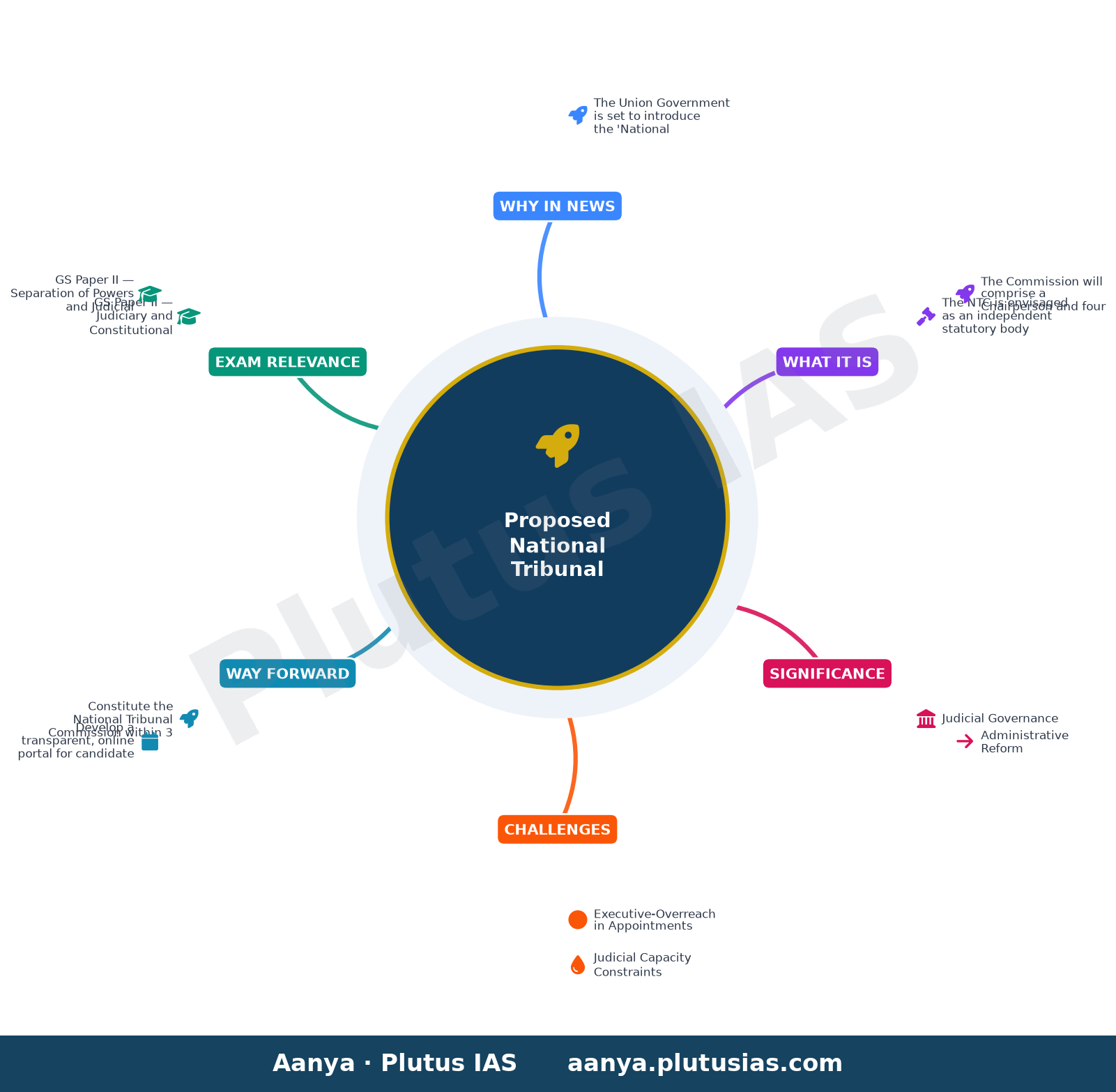
- GS Paper II — Judiciary and Constitutional Framework | GS Paper II — Separation of Powers and Judicial Independence
- Prelims: Tribunal Reforms Act, 2021, National Tribunal Commission (NTC), Supreme Court directives on tribunal appointments, Article 50 (Separation of Powers), Judicial Appointments Commission, Administrative Tribunals Act, 1985
Quick Revision: The National Tribunal Commission Bill seeks to institutionalise transparency and independence in tribunal appointments by replacing the unconstitutional provisions of the Tribunal Reforms Act, 2021, in compliance with the Supreme Court’s directives.
Why is this in the news?
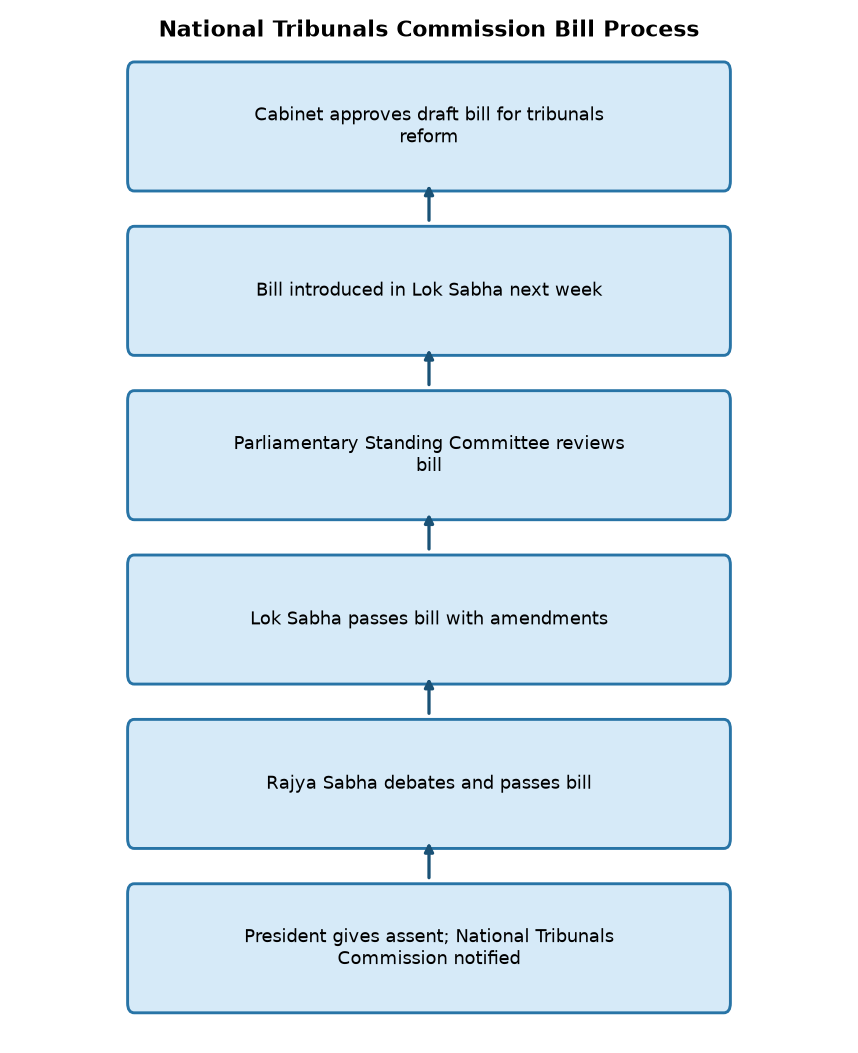
The Union Government is set to introduce the ‘National Tribunal Commission Bill’ in the Lok Sabha next week, aimed at overhauling the appointment process for tribunals by establishing an independent commission. This legislative initiative follows the Supreme Court’s recent observations declaring certain provisions of the Tribunal Reforms Act, 2021 unconstitutional, citing violations of the doctrine of separation of powers and lack of clarity in appointment standards. The proposed commission seeks to address these concerns by ensuring transparency, professional expertise, and institutional autonomy in tribunal appointments.
Background
- The Tribunal Reforms Act, 2021 was enacted to streamline the functioning of various tribunals and appellate bodies, including the National Company Law Appellate Tribunal (NCLAT), National Green Tribunal (NGT), and Income Tax Appellate Tribunal (ITAT).
- The proposed National Tribunal Commission Bill is a legislative response to the Supreme Court’s directive, aiming to replace the Tribunal Reforms Act, 2021 and introduce a robust mechanism for tribunal appointments.
- Tribunals in India operate as quasi-judicial bodies, adjudicating disputes under specific legislations, such as the Companies Act, 2013, the National Green Tribunal Act, 2010, and the Income Tax Act, 1961.
- The lack of a standardised and transparent appointment process has historically led to concerns regarding the independence and efficiency of tribunal members, necessitating structural reforms.
What is the Proposed National Tribunal Commission (NTC)?
- The NTC is envisaged as an independent statutory body tasked with the selection, appointment, and oversight of members for various tribunals in India, including the National Company Law Appellate Tribunal (NCLAT), National Green Tribunal (NGT), and Central Administrative Tribunal (CAT).
- The Commission will comprise a Chairperson and four members—two judicial members (retired Supreme Court judges or Chief Justices of High Courts) and two technical members with domain expertise relevant to the tribunals they oversee.
- The NTC will ensure that appointments are made on the basis of merit, transparency, and professional competence, thereby enhancing the credibility and efficiency of tribunals.
- The proposed body will also establish standardised eligibility criteria, including qualifications, experience, and ethical standards, for tribunal members to ensure uniformity across different tribunals.
- The NTC will function as a nodal agency for monitoring the performance and tenure of tribunal members, ensuring accountability and reducing delays in adjudication processes.
- The proposed legislation aligns with global best practices, such as the United Kingdom’s Tribunals (Scotland) Act, 2014, which establishes independent tribunals with standardised appointment processes.
Key Features
| Feature | Significance |
|---|---|
| Establishment of National Tribunal Commission (NTC) | Creates a statutory body to centralise appointment processes for tribunal chairs and members, ensuring uniformity across 26+ tribunals under Article 323B and 323A of the Constitution. |
| Composition: 1 Chairperson + 4 Members | Includes two judicial members (retired SC/HC judges) and two technical members (domain experts), balancing legal expertise with sectoral knowledge. |
| Transparent Selection Process | Introduces a merit-based, competitive selection mechanism with defined eligibility criteria, reducing executive discretion and enhancing credibility. |
| Fixed Tenure and Service Conditions | Prescribes fixed terms for tribunal members (typically 3-5 years) with removal safeguards, insulating appointments from political interference. |
| Alignment with Judicial Pronouncements | Complies with SC rulings (e.g., Rojer Mathew v. South India Bank Ltd., 2020) that struck down executive-dominated appointment systems as violative of separation of powers. |
Why it Matters
Judicial Governance
- Ensures institutional independence of tribunals by severing executive control over appointments, aligning with the doctrine of separation of powers.
- Standardises qualification benchmarks for tribunal members, reducing arbitrariness in selection and enhancing functional efficiency.
- Strengthens the rule of law by embedding judicial oversight in administrative tribunals, particularly in sectors like taxation, labour, and environment.
Administrative Reform
- Replaces fragmented appointment mechanisms with a unified, professionalised system, reducing delays in tribunal functioning.
- Enhances accountability by mandating public disclosure of selection criteria and candidate profiles, fostering public trust.
- Facilitates specialisation in tribunal adjudication, as technical members bring domain-specific expertise to complex disputes.
Constitutional Compliance
- Gives statutory force to the Supreme Court’s directive in Rojer Mathew (2020) to establish an independent commission for tribunal appointments.
- Operationalises Articles 323A (Administrative Tribunals) and 323B (Other Tribunals) by providing a structured appointment framework.
- Upholds the principle of judicial independence enshrined in Article 50 of the Constitution.
Challenges
1. Executive-Overreach in Appointments
- Risk of executive interference in the selection process despite the NTC’s independence, given the Centre’s role in funding and administrative oversight.
- Potential for bureaucratic delays in implementing the NTC’s recommendations, undermining its efficacy.
UPSC Link: GS-II: Separation of Powers
2. Judicial Capacity Constraints
- Limited pool of retired Supreme Court and High Court judges may lead to suboptimal appointments or prolonged vacancies in the NTC.
- Over-reliance on judicial members may sidetrack technical expertise required for specialised tribunals (e.g., National Green Tribunal).
UPSC Link: GS-II: Judicial Appointments
3. Federalism and State-Level Tribunals
- Exclusion of state-level tribunals (e.g., State Administrative Tribunals) from the NTC’s ambit may create inconsistencies in appointment standards across jurisdictions.
- State governments may resist centralised control, citing federal autonomy under the Seventh Schedule.
UPSC Link: GS-II: Federal Structure
4. Resource Allocation and Infrastructure
- Inadequate funding for the NTC’s operations may hinder its ability to conduct thorough background checks or maintain a robust database of eligible candidates.
- Lack of digital infrastructure for transparent, online selection processes could undermine the NTC’s credibility.
UPSC Link: GS-II: Governance
5. Judicial Review and Delays
- Overburdened judiciary may lead to protracted legal challenges against NTC appointments, delaying tribunal functioning.
- Potential for conflicting judicial interpretations of the NTC’s powers, creating legal uncertainty.
UPSC Link: GS-II: Judicial Review
Challenges — UPSC Perspective
| Issue | Concern |
|---|---|
| Executive Dominance | Risk of bureaucratic interference in NTC’s functioning despite statutory independence. |
| Judicial Bottleneck | Limited availability of retired judges may delay NTC appointments and tribunal operations. |
| Federal Tensions | State-level tribunals may resist centralised appointment systems, leading to jurisdictional conflicts. |
| Resource Constraints | Insufficient funding or digital infrastructure may hinder NTC’s operational efficiency. |
| Legal Ambiguity | Unclear demarcation of NTC’s powers may invite judicial scrutiny and delays in tribunal appointments. |
Way Forward
- Constitute the National Tribunal Commission within 3 months of the Bill’s enactment, ensuring timely operationalisation.
- Develop a transparent, online portal for candidate applications, with AI-assisted shortlisting to enhance meritocracy.
- Mandate annual public audits of the NTC’s appointment processes to ensure compliance with judicial standards.
- Establish a dedicated fund for tribunal infrastructure and capacity-building, in collaboration with state governments.
- Conduct capacity-building workshops for NTC members on emerging legal and technical domains (e.g., AI in adjudication).
- Strengthen inter-state coordination mechanisms to harmonise appointment standards for state-level tribunals.
- Introduce sunset clauses for tribunal members to prevent institutional stagnation and ensure periodic renewal.
UPSC Value Addition
Keywords for Mains Answer-Writing
Tribunals Reform Act 2021 · National Tribunal Commission · Judicial appointments · Separation of Powers · Supreme Court directives on tribunals · Administrative Tribunals Act 1985 · Judicial independence · Appointment criteria for tribunals · Constitutional validity of tribunal reforms · Executive-judicial balance in tribunals
Constitutional & Policy Linkages
- Article 50: Separation of Judiciary from Executive (ensures tribunal independence).
- Article 323A: Administrative Tribunals (provides constitutional basis for NTC’s jurisdiction).
- Article 323B: Tribunals for Other Matters (extends NTC’s ambit to non-administrative tribunals).
- Seventh Schedule: Division of Powers (federal implications for state-level tribunals).
Concept Flow
Supreme Court’s Rojer Mathew verdict (2020) → Strikes down executive-dominated appointment system → Directs establishment of independent commission → Government introduces Tribunal Reforms Bill → Proposes National Tribunal Commission (NTC) → NTC centralises appointments → Tribunals gain functional autonomy → Rule of law and judicial independence strengthened → Public trust in tribunal system restored.
Prelims Practice Questions
Q1. Consider the following statements regarding the proposed National Tribunal Commission (NTC):
1. The NTC will be headed by a retired Chief Justice of India or a retired Chief Justice of a High Court.
2. The NTC will have two judicial members and two technical members.
3. The NTC is mandated to oversee the appointment of Chairpersons and Members of tribunals exclusively.
4. The NTC is proposed to replace the Tribunal Reform Act 2021 entirely.
How many of the above statements are correct?
- Only one
- Only two
- Only three
- All four
Answer: All four — Statements 1, 2, and 4 are correct. Statement 3 is incorrect as the NTC will oversee appointments across multiple tribunals, not exclusively. The Tribunal Reform Act 2021 is proposed to be repealed upon the NTC’s establishment.
Q2. Assertion (A): The Supreme Court has directed the government to constitute a National Tribunal Commission to ensure transparency in judicial appointments.
Reason (R): The Tribunal Reform Act 2021 was struck down by the Supreme Court for violating the principle of separation of powers.
In the context of the above statements, which of the following is correct?
- Both A and R are true, and R is the correct explanation of A.
- Both A and R are true, but R is not the correct explanation of A.
- A is true, but R is false.
- A is false, but R is true.
Answer: Both A and R are true, but R is not the correct explanation of A. — Both the assertion and reason are true. The Supreme Court directed the creation of the NTC to ensure transparency and independence in tribunal appointments, and the Tribunal Reform Act 2021 was struck down for violating constitutional principles, including separation of powers.
Q3. Match the following tribunals with their primary functions:
Column I (Tribunal) Column II (Function)
A. National Green Tribunal (NGT) 1. Dispute resolution in tax matters
B. Income Tax Appellate Tribunal 2. Environmental protection and conservation
C. Telecom Disputes Settlement 3. Resolution of telecom sector disputes
D. Armed Forces Tribunal 4. Adjudication of disputes related to armed forces personnel
Select the correct match:
- A-2, B-1, C-3, D-4
- A-1, B-2, C-3, D-4
- A-2, B-3, C-1, D-4
- A-3, B-1, C-2, D-4
Answer: A-2, B-1, C-3, D-4 — The correct matches are: A-2 (NGT for environmental matters), B-1 (Income Tax Appellate Tribunal for tax disputes), C-3 (Telecom Disputes Settlement for telecom sector disputes), and D-4 (Armed Forces Tribunal for armed forces personnel disputes).
Mains Practice Question
✍ The Supreme Court has repeatedly underscored the necessity of insulating tribunal appointments from executive interference to uphold judicial independence. In this context, critically examine the constitutional and institutional framework proposed for the National Tribunal Commission (NTC). How far does the NTC address the concerns raised by the Supreme Court regarding the Tribunal Reform Act 2021? Also, discuss the implications of the NTC’s composition and functions for the separation of powers in India. (15 Marks)
Approach: MODEL-ANSWER SKELETON:
1. **Constitutional and Institutional Framework of NTC**:
– Constitutional basis: Article 50 (separation of judiciary from executive), Article 323B (power of Parliament to establish tribunals), and judicial precedents (e.g., Madras Bar Association v. Union of India, 2021).
– Institutional design: NTC as an independent body with a retired SC judge or HC CJ as Chairperson, two judicial members, and two technical members. Emphasise the need for domain expertise and transparency.
2. **Concerns Raised by the Supreme Court in Tribunal Reform Act 2021**:
– Violation of separation of powers: Executive dominance in appointments (e.g., Section 184 of the Act, which vested appointment powers with the Central Government).
– Lack of transparency and criteria: No clear eligibility or selection process for tribunal members.
– Judicial independence compromised: Potential for executive interference in tribunal functioning.
3. **How NTC Addresses These Concerns**:
– Independent appointment process: NTC to select tribunal members through a transparent, merit-based process, reducing executive interference.
– Clear eligibility criteria: Specified qualifications for judicial and technical members, ensuring professional competence.
– Institutional autonomy: NTC to function independently, with suo motu powers to oversee tribunal appointments and functioning.
4. **Implications for Separation of Powers**:
– Positive: Strengthens judicial independence by insulating appointments from executive control, aligning with constitutional principles.
– Challenges: Potential for NTC to become a new locus of power, necessitating checks and balances (e.g., judicial review, parliamentary oversight).
– Comparative perspective: Contrast with the UK’s Tribunals, Courts and Enforcement Act 2007, which established an independent tribunal system.
5. **Conclusion**:
– NTC is a step toward ensuring transparency and independence in tribunal appointments, but its effectiveness will depend on implementation, judicial scrutiny, and periodic reviews. The balance between judicial independence and executive accountability must be carefully maintained.
Source: amarujala.com
Generated by AanyaAi for educational purpose.

- महाराष्ट्र में त्योहार जुलूसों पर बॉम्बे हाईकोर्ट का बड़ा फैसला: पटाखे, लेजर और संगीत पर रोक - September 24, 2026
- Bombay HC Bans Firecrackers, Music in Maharashtra Processions: Key UPSC Analysis - September 24, 2026
- तमिलनाडु में महिला कर्मचारियों के लिए सवैतनिक माहवारी अवकाश नीति पर HC का आदेश - September 24, 2026

No Comments