


08 Aug BJP, CPI Protests: Cauvery Water Dispute & Karnataka Dam Row Explained for UPSC
Cauvery riverMekedatu damKuruvai cropCWDT awardDelta districts✎ The Cauvery Water Disputes Tribunal (CWDT) award of 2007 was made, but implementation remains contentious due to political and administrative challenges, with the Mekedatu dam project being a key flashpoint.
Subject Relevance — Where This Topic Fits
- GS Paper II — Functions and Responsibilities of the Union and the States, Issues and Challenges Pertaining to the Federal Structure, Devolution of Powers and Finances up to Local Levels and Challenges Therein | GS Paper III — Conservation, Environmental Pollution and Degradation, Environmental Impact Assessment
- Prelims: Cauvery Water Disputes Tribunal, Inter-State River Water Disputes Act, 1956, Mekedatu Project, Kuruvai Crop, Inter-State Water Disputes (Amendment) Bill, 2019, Cauvery Management Board, Article 262 of the Constitution
- Essay: Federalism in India: Challenges of Centre-State Relations and Cooperative Federalism, Water Security and Sustainable Development: Balancing Agricultural Needs and Ecological Concerns
Quick Revision: The Cauvery Water Disputes Tribunal (CWDT) award of 2007 was made, but implementation remains contentious due to political and administrative challenges, with the Mekedatu dam project being a key flashpoint.
Why is this in the news?
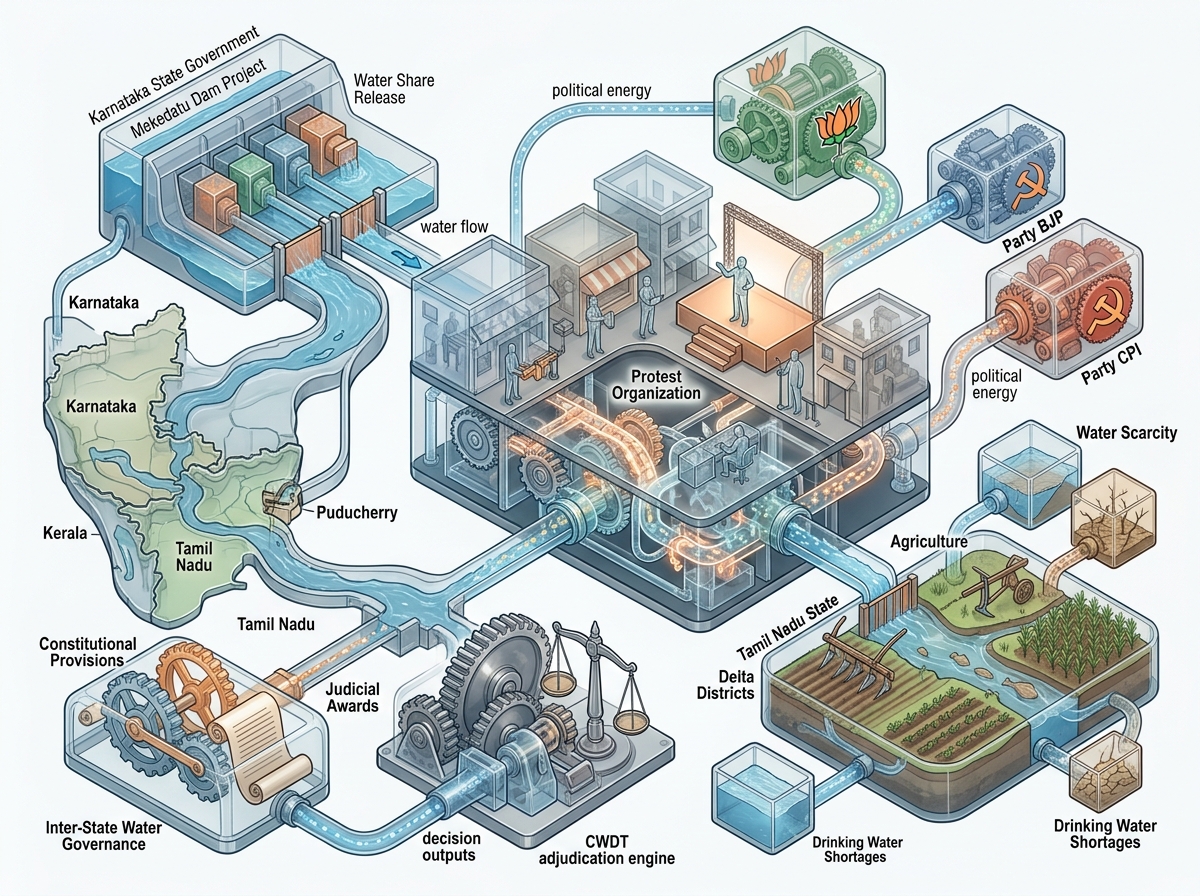
The Cauvery water dispute has resurfaced as political parties in Tamil Nadu, including the BJP and CPI, staged protests against the Karnataka government’s decision to proceed with the Mekedatu dam project and its failure to release Tamil Nadu’s due share of water, threatening the standing kuruvai crop and exacerbating drinking water shortages in Tamil Nadu’s delta districts. This development underscores the recurring tensions in inter-state water governance and the challenges in implementing judicial awards and constitutional provisions.
Background
- The Cauvery river, a trans-boundary river flowing through Karnataka, Tamil Nadu, Kerala, and the Union Territory of Puducherry, has been a source of inter-state disputes for over a century, primarily between Karnataka and Tamil Nadu.
- The Cauvery Water Disputes Tribunal (CWDT), constituted in 1990 under the Inter-State River Water Disputes Act, 1956, delivered its final award in 2007, allocating specific water shares to Karnataka, Tamil Nadu, Kerala, and Puducherry.
- The Tribunal’s award was notified by the Union Government in 2013, but implementation has been contentious, with Karnataka frequently citing drought conditions to withhold water releases.
- The Mekedatu project, proposed by Karnataka, involves constructing a dam across the Cauvery near Mekedatu in Ramanagara district, aimed at supplying drinking water to Bengaluru and generating hydroelectric power. Tamil Nadu opposes the project, arguing it violates the CWDT award and reduces water availability downstream.
- Political narratives in Tamil Nadu often highlight perceived discrimination by Karnataka governments, with accusations that Congress-led Karnataka governments withhold water, while BJP-led governments in Karnataka (2018–2023) are credited with releasing water.
- The kuruvai crop, a short-duration paddy variety cultivated during the summer months in Tamil Nadu’s delta districts, is highly dependent on Cauvery water releases and is critical for agricultural livelihoods.
What is the Cauvery Water Dispute?
- The Cauvery water dispute is a long-standing inter-state conflict primarily between Karnataka and Tamil Nadu over the sharing of Cauvery river waters, governed by the Cauvery Water Disputes Tribunal (CWDT) award of 2007 and subsequent judicial pronouncements.
- The dispute escalates during monsoon deficits or drought years, as Karnataka often cites its own water needs to justify reduced releases, while Tamil Nadu insists on adherence to the tribunal’s allocation.
- The Mekedatu project, proposed by Karnataka, is a key flashpoint. Tamil Nadu argues it violates the principle of prior appropriation and reduces downstream water availability, while Karnataka contends it is essential for Bengaluru’s water security and power generation.
- The Inter-State River Water Disputes Act, 1956, provides the legal framework for resolving inter-state water disputes, but its implementation is often delayed due to political and administrative challenges.
- The dispute also highlights broader issues of federalism, cooperative governance, and the need for integrated river basin management to balance competing demands for water, agriculture, and urbanisation.
Key Features
| Feature | Significance |
|---|---|
| Protest by BJP and CPI in Tamil Nadu | Highlights the political and electoral stakes in inter-state river disputes, particularly in Cauvery basin states. |
| Focus on Mekedatu dam construction | Represents Karnataka’s unilateral infrastructure development in the Cauvery basin, perceived as a threat to Tamil Nadu’s water rights. |
| Demand for immediate water release for kuruvai crop | Underscores the agricultural dependency of delta districts on Cauvery water for kharif season. |
| Accusations of political mismanagement | Political parties attribute water scarcity to governance failures, either by the Congress in Karnataka or the ruling dispensation in Tamil Nadu. |
| Inter-state river water governance framework | Demonstrates the operational gaps in the Cauvery Water Disputes Tribunal (CWDT) and Cauvery Management Board (CMB) mechanisms. |
Why it Matters
Economic
- Delta districts of Tamil Nadu rely on Cauvery water for kharif cultivation, particularly kuruvai paddy, which is a high-yield, water-intensive crop critical to rural livelihoods.
- Failure to release adequate water risks crop failure, leading to economic distress among farmers and potential food security concerns.
- Industrial and urban water supply in Tamil Nadu’s delta regions may face shortages, impacting economic activities dependent on water resources.
Political
- River water disputes serve as potent electoral issues, with parties leveraging them to mobilise regional sentiments and polarise voters along state lines.
- The BJP’s claim of uninterrupted water flow during its tenure in Karnataka (2018–2023) contrasts with the Congress-led government’s perceived failure, reflecting partisan narratives in water governance.
- Protests by opposition parties (BJP, CPI) against the ruling dispensation in Tamil Nadu indicate the politicisation of inter-state disputes for domestic political gains.
Legal/Institutional
- The dispute underscores the limitations of the Cauvery Water Disputes Tribunal (CWDT) and the Cauvery Management Board (CMB) in enforcing water-sharing agreements amid unilateral state actions.
- Mekedatu dam construction by Karnataka, despite pending Tribunal directives, highlights the erosion of institutional trust in inter-state water governance mechanisms.
- The absence of a permanent tribunal or binding enforcement mechanism exacerbates the recurrence of disputes, as seen in the 2018 Supreme Court verdict on Cauvery.
Environmental
- Unregulated dam construction and water extraction threaten the ecological balance of the Cauvery basin, affecting downstream flow and biodiversity.
- Prolonged water scarcity in delta regions may lead to groundwater depletion, further stressing the region’s water security.
Social
- Agrarian communities in Tamil Nadu’s delta districts face existential risks due to water scarcity, exacerbating rural distress and migration pressures.
- Urban and peri-urban populations may experience drinking water shortages, particularly in districts like Thanjavur and Tiruchirappalli, leading to public health concerns.
Challenges
1. Unilateral State Actions in Water Governance
- Karnataka’s decision to proceed with Mekedatu dam construction without prior consent from Tamil Nadu violates the spirit of inter-state cooperation enshrined in the Cauvery Water Disputes Tribunal (CWDT) award.
- Such actions erode trust in institutional mechanisms, leading to retaliatory measures and escalation of disputes.
- The absence of a binding enforcement framework allows states to bypass negotiated settlements, undermining the Cauvery Management Board (CMB).
UPSC Link: Inter-State Water Disputes Act, 1956
2. Politicisation of River Water Disputes
- River water issues are increasingly used as political tools to mobilise regional sentiments, complicating consensus-building and dialogue.
- Partisan narratives (e.g., BJP’s claim of uninterrupted water flow during its tenure) distort public perception and hinder objective policy responses.
- Opposition parties leveraging protests to target the ruling dispensation in Tamil Nadu reflect the electoralisation of water governance.
UPSC Link: Federalism and Centre-State Relations
3. Agricultural and Rural Distress
- Failure to release adequate water for kuruvai crop risks widespread crop failure, leading to financial losses for farmers and food security concerns.
- Delta districts, which are highly dependent on Cauvery water, face existential threats to livelihoods, exacerbating rural distress and migration.
UPSC Link: Agrarian Crisis and Farmer Suicides
4. Institutional Weaknesses in Water Governance
- The Cauvery Water Disputes Tribunal (CWDT) lacks enforcement powers, rendering its awards ineffective in preventing unilateral state actions.
- The Cauvery Management Board (CMB) faces operational challenges in monitoring and enforcing water-sharing agreements due to political resistance.
- Recurring disputes highlight the need for a permanent tribunal or an overarching legal framework to address inter-state water conflicts.
UPSC Link: Cauvery Water Disputes Tribunal (CWDT)
5. Ecological Degradation of River Basins
- Unregulated dam construction and water extraction disrupt the natural flow of the Cauvery, affecting downstream ecosystems and biodiversity.
- Prolonged water scarcity exacerbates groundwater depletion, leading to long-term environmental degradation in delta regions.
UPSC Link: Environmental Impact of Large Dams
Challenges — UPSC Perspective
| Issue | Concern |
|---|---|
| Mekedatu Dam Construction | Karnataka’s unilateral infrastructure development threatens Tamil Nadu’s water rights and violates inter-state agreements. |
| Failure to Release Cauvery Water | Inadequate water release for kuruvai crop risks agricultural failure and rural distress in Tamil Nadu’s delta districts. |
| Politicisation of Water Disputes | River water issues are used as political tools, complicating consensus-building and undermining institutional mechanisms. |
| Institutional Weaknesses in CWDT/CMB | The lack of enforcement powers and operational challenges hinder effective water governance and dispute resolution. |
| Ecological Degradation | Unregulated water extraction and dam construction disrupt river ecosystems, exacerbating environmental degradation. |
| Urban and Rural Water Shortages | Prolonged scarcity may lead to drinking water shortages in urban areas and existential threats to livelihoods in rural regions. |
Way Forward
- Strengthen the enforcement mechanisms of the Cauvery Management Board (CMB) to ensure compliance with Tribunal awards and prevent unilateral state actions.
- Establish a permanent tribunal or overarching legal framework for inter-state water disputes to provide binding resolutions and reduce recurring conflicts.
- Promote dialogue and consensus-building between Karnataka and Tamil Nadu through structured negotiations, involving stakeholders from both states.
- Invest in water conservation and efficiency measures in Tamil Nadu’s delta districts to mitigate agricultural and urban water shortages.
- Encourage participatory governance models, including farmer cooperatives and local water user associations, to enhance community stakeholder engagement in water management.
- Integrate climate-resilient agriculture practices in delta regions to reduce dependency on Cauvery water for high-yield, water-intensive crops like kuruvai paddy.
- Enhance public awareness campaigns to depoliticise river water disputes and foster a culture of cooperative federalism in water governance.
UPSC Value Addition
Keywords for Mains Answer-Writing
Inter-State River Water Disputes Act, 1956 · Cauvery Water Disputes Tribunal (CWDT) · Mekedatu Project · Inter-State Water Disputes (Amendment) Bill, 2019 · Kuruvai crop · Inter-State Coordination Mechanisms · Federalism in Water Governance · Article 262 of the Constitution · River Basin Management · Tamil Nadu-Karnataka Water Sharing · Inter-State Water Disputes Tribunal Awards · Environmental Impact Assessment (EIA) 2006
Constitutional & Policy Linkages
- [‘Article 262 – Adjudication of inter-state water disputes’, ‘Provides for the establishment of tribunals to resolve inter-state river water conflicts.’]
- [‘Article 263 – Inter-State Council’, ‘Facilitates coordination between states on issues like water sharing, though its role remains advisory.’]
Concept Flow
Political rhetoric in Karnataka (BJP/Congress) leads to unilateral decision-making on Mekedatu dam construction. → Tamil Nadu protests against Karnataka’s actions, citing violation of Cauvery Water Disputes Tribunal (CWDT) awards. → Failure to release adequate water for kuruvai crop triggers agricultural and rural distress in Tamil Nadu’s delta districts. → Urban and peri-urban water shortages exacerbate public health and economic concerns. → Politicisation of the dispute by opposition parties in Tamil Nadu (BJP, CPI) and ruling dispensation’s response. → Erosion of institutional trust in Cauvery Management Board (CMB) and CWDT due to lack of enforcement powers. → Recurring disputes highlight the need for a permanent tribunal or overarching legal framework for inter-state water governance.
Prelims Practice Questions
Q1. Consider the following statements regarding the Cauvery Water Disputes Tribunal (CWDT):
1. The CWDT was constituted under the Inter-State River Water Disputes Act, 1956.
2. The CWDT’s final award was notified by the Government of India in 2013.
3. The CWDT’s award is binding on the parties and cannot be challenged in any court.
4. The CWDT recommended the construction of a dam at Mekedatu to augment water storage.
How many of the above statements are correct?
- Only one
- Only two
- Only three
- All four
Answer: Only three — Statements 1 and 2 are correct. The CWDT was constituted under the Inter-State River Water Disputes Act, 1956, and its final award was notified in 2013. Statement 3 is incorrect as the Supreme Court has the power to review the tribunal’s award. Statement 4 is incorrect as the CWDT did not recommend the Mekedatu dam.
Q2. Assertion (A): The Mekedatu Project proposed by Karnataka is a dam construction project across the Cauvery River.
Reason (R): The project aims to augment drinking water supply to Bengaluru and generate hydroelectric power.
Options:
A. Both A and R are true, and R is the correct explanation of A.
B. Both A and R are true, but R is not the correct explanation of A.
C. A is true, but R is false.
D. A is false, but R is true.
Answer: ? — Both the Assertion (A) and Reason (R) are true. The Mekedatu Project is indeed a dam construction project across the Cauvery River, and its stated objectives include augmenting drinking water supply to Bengaluru and generating hydroelectric power. R correctly explains A.
Q3. Which of the following constitutional provisions empowers the Parliament to adjudicate inter-state water disputes?
- Article 262
- Article 253
- Article 32
- Article 246
Answer: Article 262 — Article 262 of the Constitution empowers the Parliament to adjudicate inter-state water disputes and to exclude the jurisdiction of all courts, including the Supreme Court, in such matters.
Mains Practice Question
✍ The Cauvery water dispute between Karnataka and Tamil Nadu exemplifies the challenges of federal water governance in India. Critically examine the efficacy of existing legal and institutional mechanisms in resolving inter-state river water disputes, with particular reference to the Cauvery case. (15 Marks)
Approach: MODEL-ANSWER SKELETON:
1. **Legal Framework**:
– Article 262 of the Constitution and the Inter-State River Water Disputes Act, 1956.
– Role of the Cauvery Water Disputes Tribunal (CWDT) and its final award (2013).
– Supreme Court’s 2018 judgment on the CWDT award and its binding nature.
2. **Institutional Mechanisms**:
– Limitations of the CWDT: Delay in adjudication, lack of enforcement powers.
– Role of the Inter-State Council and the Inter-State Water Disputes (Amendment) Bill, 2019.
– Federalism tensions: State autonomy vs. national interest in water governance.
3. **Contemporary Challenges**:
– Impact of climate change and erratic monsoons on water availability.
– Political economy of water: Urban vs. agricultural demands (e.g., Bengaluru’s water needs vs. Tamil Nadu’s kuruvai crop).
– Environmental concerns: EIA 2006 and ecological impacts of projects like Mekedatu.
4. **Way Forward**:
– Need for a permanent tribunal with binding powers.
– Integrated river basin management and data-sharing mechanisms.
– Role of cooperative federalism and inter-state agreements.
Balance of views: Highlight the judicial activism (Supreme Court’s intervention) vs. the need for legislative reforms. Conclude with a reasoned position on whether existing mechanisms suffice or require overhaul.
Source: The Hindu
Generated by AanyaAi for educational purpose.

- महाराष्ट्र में त्योहार जुलूसों पर बॉम्बे हाईकोर्ट का बड़ा फैसला: पटाखे, लेजर और संगीत पर रोक - September 24, 2026
- Bombay HC Bans Firecrackers, Music in Maharashtra Processions: Key UPSC Analysis - September 24, 2026
- तमिलनाडु में महिला कर्मचारियों के लिए सवैतनिक माहवारी अवकाश नीति पर HC का आदेश - September 24, 2026

No Comments