


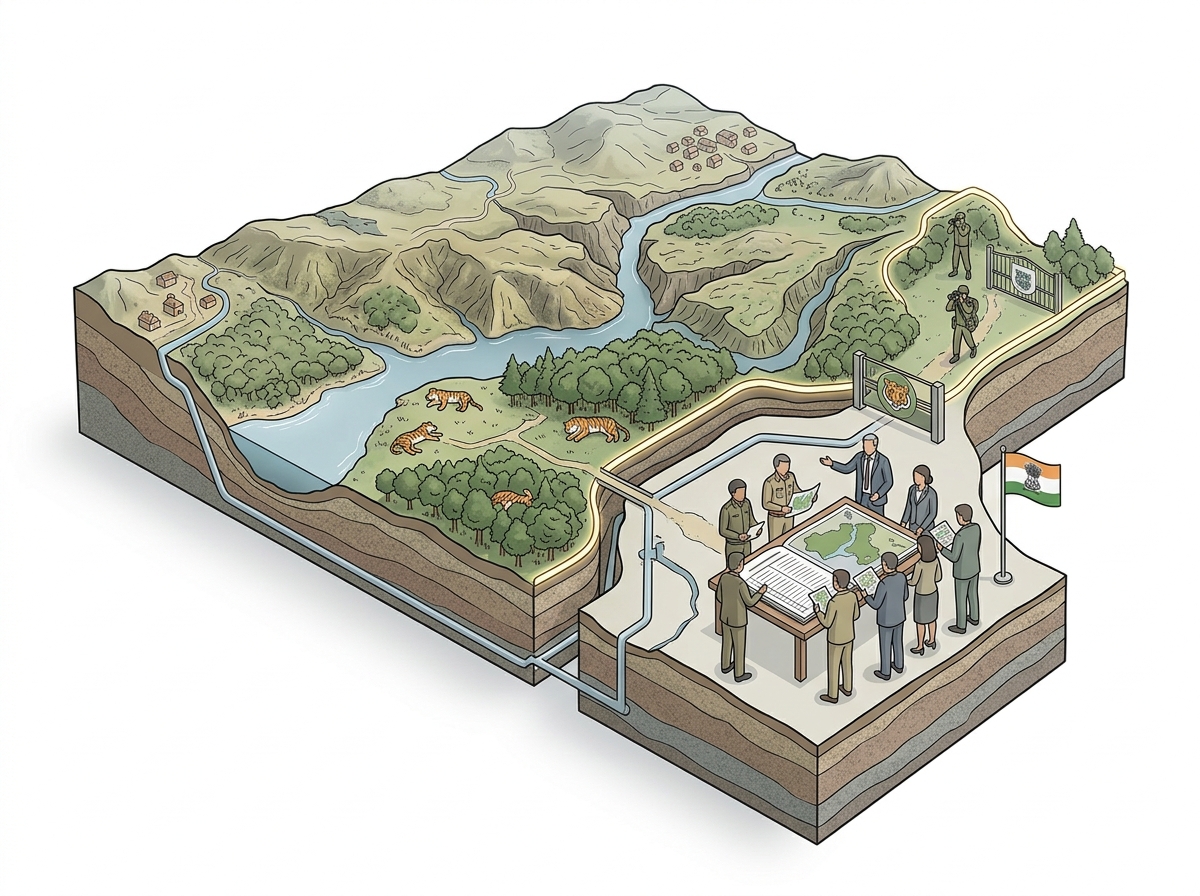
08 Aug Government inquiry into rising tiger deaths in Andhra Pradesh’s Srisailam Reserve
Inquiry committeeRetired IFS officerTiger reserveProject TigerForest areas✎ The inquiry into tiger deaths in the NSTR underscores the urgent need for robust habitat management, enhanced patrolling, and community-based conservation to mitigate human-wildlife conflict and ensure the long-term survival of…
Subject Relevance — Where This Topic Fits
- GS Paper III — Environment, Ecology, Biodiversity and Climate Change
- Prelims: Project Tiger, NTCA, Wildlife Protection Act 1972, Nagarjunasagar Srisailam Tiger Reserve, human-wildlife conflict, eco-tourism, poaching, wildlife corridors
- Essay: Conservation of India’s natural heritage: Balancing development and ecological integrity
Quick Revision: The inquiry into tiger deaths in the NSTR underscores the urgent need for robust habitat management, enhanced patrolling, and community-based conservation to mitigate human-wildlife conflict and ensure the long-term survival of India’s tiger populations.
Why is this in the news?
The Andhra Pradesh government has constituted a high-level inquiry committee, led by retired IFS officer P. Mallikharjuna Rao, to investigate the recent spate of tiger deaths in the Nagarjunasagar Srisailam Tiger Reserve (NSTR). Within a span of less than three weeks in July 2026, three tiger carcasses were recovered from deep forest areas, raising serious concerns about wildlife protection mechanisms, habitat integrity, and systemic conservation failures in one of India’s premier tiger reserves.
Background
- The Nagarjunasagar Srisailam Tiger Reserve (NSTR), spread across Andhra Pradesh and Telangana, is one of the largest tiger reserves in India, notified under Project Tiger in 1983.
- The reserve spans five districts: Kurnool, Prakasam, Guntur, Nandyal, and Mahabubnagar, and serves as a critical habitat for Bengal tigers, leopards, and a rich diversity of flora and fauna.
- The NSTR is part of the Eastern Ghats landscape and is ecologically significant due to its contiguous forest cover, which supports viable tiger populations and acts as a wildlife corridor connecting the Eastern and Western Ghats.
- The reserve has faced recurring challenges such as habitat fragmentation, illegal encroachments, mining activities, and escalating human-wildlife conflict due to expanding agricultural and infrastructural development.
- The National Tiger Conservation Authority (NTCA), established under the Wildlife (Protection) Act, 1972, monitors tiger populations and enforces conservation protocols across tiger reserves in India.
- In 2026, four tiger deaths have been officially recorded in Andhra Pradesh, all within the NSTR, indicating a potential systemic issue requiring urgent intervention.
What is the Nagarjunasagar Srisailam Tiger Reserve (NSTR)?
- NSTR is a notified tiger reserve under Project Tiger, established to ensure the conservation of the Bengal tiger (Panthera tigris tigris) and its habitat in the Eastern Ghats.
- It is the largest tiger reserve in India by area, covering approximately 3,568 square kilometers.
- The NSTR plays a crucial role in maintaining ecological connectivity between the Eastern and Western Ghats, facilitating gene flow and species migration.
- The reserve is divided into core and buffer zones, with the core area designated as inviolate for wildlife, while the buffer zone allows for limited human activities under strict regulatory oversight.
- The NSTR faces significant anthropogenic pressures, including illegal mining, encroachment for agriculture, and infrastructure projects such as roads and dams, which fragment habitats and increase human-wildlife conflict.
- The reserve is also a site for eco-tourism, which, while economically beneficial, must be managed sustainably to avoid stressing wildlife populations.
- The recent tiger deaths have highlighted systemic gaps in anti-poaching patrols, scientific monitoring, and habitat management within the reserve.
Key Features
| Feature | Significance |
|---|---|
| High-level inquiry committee | Constituted under G.O. Rt. No. 91 by the Andhra Pradesh government to investigate tiger deaths and recommend conservation measures within a strict timeline, demonstrating administrative urgency. |
| Multi-stakeholder panel composition | Includes retired IFS officers, wildlife conservationists (WWF-India), and technical experts, ensuring a blend of administrative experience and domain expertise for comprehensive analysis. |
| Temporal clustering of deaths | Three tiger deaths reported within three weeks in July 2026, raising concerns about potential systemic threats such as disease, habitat degradation, or poaching. |
| Deep forest investigation focus | Deaths reported from remote, inaccessible areas of the Nagarjunasagar Srisailam Tiger Reserve (NSTR), indicating challenges in real-time monitoring and forensic examination. |
| Long-term conservation mandate | Committee tasked with recommending measures beyond immediate causes, including anti-poaching, corridor conservation, and community engagement, aligning with India’s tiger conservation framework. |
Why it Matters
Ecological Significance
- The Nagarjunasagar Srisailam Tiger Reserve (NSTR) is a critical habitat for tigers and other keystone species, forming part of the Eastern Ghats landscape, which is vital for biodiversity conservation in peninsular India.
- Tiger mortality in core habitats like NSTR can disrupt ecological balance, leading to cascading effects on prey populations and forest regeneration.
- The reserve is part of the larger Central Indian Tiger Landscape, which is crucial for maintaining genetic connectivity among tiger populations across India.
Administrative Significance
- The constitution of a high-level committee under a retired IFS officer reflects the State’s commitment to addressing wildlife conservation challenges with urgency and technical rigor.
- The 72-hour report deadline and two-month conservation recommendations underscore the government’s prioritization of wildlife protection as a policy objective.
- The inclusion of international conservation bodies (e.g., WWF-India) and technical experts highlights the integration of global best practices in local conservation efforts.
Policy Relevance for UPSC
- This incident aligns with the broader theme of ‘Environmental Conservation and Biodiversity’ in the UPSC syllabus, particularly under the sub-topics of ‘Project Tiger’ and ‘Wildlife Protection Act, 1972’.
- The inquiry process exemplifies the implementation of the ‘National Tiger Conservation Authority (NTCA) Guidelines’ for tiger reserve management and mortality investigations.
- The case study can be used to illustrate challenges in ‘Wildlife Crime Control’ and ‘Human-Wildlife Conflict Mitigation’ under the Environment and Ecology section.
Challenges
1. Habitat Fragmentation and Degradation
- The NSTR faces pressure from anthropogenic activities such as mining, irrigation projects, and agricultural expansion, which fragment tiger habitats and reduce prey availability.
- Degradation of forest corridors due to developmental projects (e.g., dams, roads) isolates tiger populations, increasing vulnerability to inbreeding and disease.
- Climate change-induced shifts in vegetation patterns may further reduce the carrying capacity of the reserve for tigers and prey species.
UPSC Link: Forest Rights Act, 2006; Wildlife Protection Act, 1972
2. Poaching and Illegal Wildlife Trade
- Despite legal protections, poaching for body parts (e.g., skin, bones) remains a persistent threat to tiger populations in India, including in Andhra Pradesh.
- The remote and dense terrain of NSTR poses challenges for patrolling, making it susceptible to clandestine activities by poachers.
- The recent deaths could be linked to poaching, as forensic investigations often reveal traces of poison or snares in such cases.
UPSC Link: Wildlife Protection Act, 1972; CITES provisions
3. Human-Wildlife Conflict
- Expansion of human settlements into forest fringes increases encounters between tigers and local communities, leading to retaliatory killings or accidental deaths.
- Livestock grazing within the reserve depletes prey populations, forcing tigers to venture closer to human habitation in search of food.
- Poor implementation of compensation schemes for livestock losses exacerbates conflicts, as seen in several tiger range states.
UPSC Link: Wildlife Protection Act, 1972; Forest Rights Act, 2006
4. Disease Outbreaks and Genetic Isolation
- Tigers in isolated populations like NSTR are vulnerable to epizootics (e.g., canine distemper, feline panleukopenia) due to limited genetic diversity and lack of veterinary interventions.
- Inbreeding depression in small, isolated populations can lead to reduced fitness and increased susceptibility to diseases, as observed in other tiger reserves.
UPSC Link: Project Tiger Guidelines; Wildlife Disease Surveillance
5. Monitoring and Enforcement Gaps
- Inadequate patrolling infrastructure, including lack of trained staff and modern surveillance tools (e.g., camera traps, drones), hampers real-time detection of threats.
- Delayed forensic investigations in remote areas hinder the determination of exact causes of death, as seen in the recent cases.
UPSC Link: Wildlife Protection Act, 1972; NTCA Guidelines
Challenges — UPSC Perspective
| Issue | Concern |
|---|---|
| Anthropogenic pressures | Habitat fragmentation due to mining, dams, and agriculture reduces prey availability and isolates tiger populations. |
| Poaching and illegal trade | Remote terrain and weak patrolling enable poachers to target tigers for body parts, despite legal protections. |
| Human-wildlife conflict | Expanding settlements and livestock grazing increase encounters, leading to retaliatory killings. |
| Disease vulnerability | Isolated populations face risks from epizootics and inbreeding depression due to limited genetic diversity. |
| Monitoring deficiencies | Inadequate staffing and surveillance tools delay detection of threats and forensic investigations. |
| Policy-implementation gap | Despite national guidelines, on-ground enforcement remains weak due to resource constraints and bureaucratic delays. |
Way Forward
- Constitute dedicated rapid response teams with trained veterinarians and forensic experts to investigate wildlife mortality cases within 24 hours of detection.
- Deploy advanced surveillance technologies (e.g., camera traps, GPS collars, drones) in core and buffer zones of NSTR to monitor tiger movements and detect threats.
- Strengthen anti-poaching units by increasing staff deployment, providing modern equipment, and conducting regular training in wildlife crime detection and investigation.
- Implement structured community engagement programs to reduce human-wildlife conflict, including awareness campaigns, compensation schemes, and alternative livelihood support.
- Restore and secure critical wildlife corridors connecting NSTR to adjacent reserves (e.g., Rajiv Gandhi Wildlife Sanctuary) to enhance genetic flow and reduce isolation.
- Enhance scientific monitoring through periodic population surveys, prey base assessments, and disease surveillance to preempt outbreaks.
- Integrate climate change adaptation strategies into the reserve’s management plan, including habitat restoration and water resource management.
- Establish a dedicated fund for emergency wildlife interventions, including veterinary care, habitat restoration, and conflict mitigation measures.
UPSC Value Addition
Keywords for Mains Answer-Writing
Nagarjunasagar Srisailam Tiger Reserve (NSTR) · Project Tiger · National Tiger Conservation Authority (NTCA) · Wildlife Protection Act, 1972 · tiger conservation in India · human-wildlife conflict mitigation · wildlife corridors · anti-poaching measures · Srisailam Reserve tiger deaths · Andhra Pradesh forest governance · scientific wildlife monitoring · eco-tourism and conservation · retired IFS officer P. Mallikharjuna Rao committee
Concept Flow
Anthropogenic pressures (mining, agriculture) → Habitat fragmentation and prey depletion → Increased tiger-human encounters → Retaliatory killings or accidental deaths → Delayed forensic investigations → Inadequate conservation response → Further population decline → Systemic ecological imbalance
Prelims Practice Questions
Q1. Consider the following statements regarding the National Tiger Conservation Authority (NTCA):
1. It is a statutory body established under the Wildlife Protection Act, 1972.
2. It is chaired by the Prime Minister of India.
3. It is responsible for the implementation of Project Tiger.
4. It has no role in the declaration of Tiger Reserves in India.
How many of the above statements are correct?
- Only one
- Only two
- Only three
- All
Answer: Only three — Statements 1 and 3 are correct as NTCA is a statutory body under the Wildlife Protection Act, 1972, and implements Project Tiger. Statement 2 is incorrect as NTCA is chaired by the Minister of Environment, Forest and Climate Change. Statement 4 is incorrect as NTCA plays a key role in the declaration of Tiger Reserves.
Q2. Assertion (A): The Wildlife Protection Act, 1972, provides for the establishment of Tiger Reserves in India.
Reason (R): The Act empowers the State governments to notify Tiger Reserves in consultation with the National Tiger Conservation Authority (NTCA).
- Both A and R are true, and R is the correct explanation of A
- Both A and R are true, but R is NOT the correct explanation of A
- A is true, but R is false
- A is false, but R is true
Answer: Both A and R are true, but R is NOT the correct explanation of A — Assertion (A) is true as the Wildlife Protection Act, 1972, provides the legal framework for Tiger Reserves. Reason (R) is also true and correctly explains (A) as the Act empowers State governments to notify Tiger Reserves in consultation with NTCA.
Q3. Match the following pairs related to tiger conservation in India:
Column I (Committee/Body)
A. National Tiger Conservation Authority (NTCA)
B. Project Tiger
C. Wildlife Institute of India (WII)
D. Tiger Task Force
Column II (Role/Function)
1. Provides scientific and technical support for tiger conservation
2. Implements the centrally sponsored scheme for tiger conservation
3. Statutory body for tiger conservation under the Wildlife Protection Act, 1972
4. Advisory body constituted by the Prime Minister in 2005 for tiger conservation
- A-3, B-2, C-1, D-4; A-2, B-3, C-4, D-1; A-1, B-4, C-3, D-2; A-4, B-1, C-2, D-3
Answer: A-3, B-2, C-1, D-4; A-2, B-3, C-4, D-1; A-1, B-4, C-3, D-2; A-4, B-1, C-2, D-3 — Correct matching: A (NTCA) – 3 (Statutory body under Wildlife Protection Act, 1972), B (Project Tiger) – 2 (Centrally sponsored scheme), C (WII) – 1 (Scientific and technical support), D (Tiger Task Force) – 4 (Advisory body constituted in 2005).
Mains Practice Question
✍ The recent spate of tiger deaths in the Nagarjunasagar Srisailam Tiger Reserve (NSTR) has raised concerns about the efficacy of wildlife governance in India. Critically examine the institutional and ecological challenges in tiger conservation, with particular reference to the role of the National Tiger Conservation Authority (NTCA) and State forest departments. Also, suggest measures to strengthen tiger conservation efforts in the context of the recent committee constituted by the Andhra Pradesh government. (15 Marks)
Approach: MODEL-ANSWER SKELETON:
1. **Institutional Challenges**:
– Role of NTCA: Statutory body under the Wildlife Protection Act, 1972; functions include monitoring tiger populations, approving Tiger Reserves, and guiding State governments. Critique: Limited enforcement powers, reliance on State governments for implementation, and delays in decision-making.
– State Forest Departments: Fragmented governance, inadequate funding, and human-wildlife conflict management issues. Example: NSTR falls under Andhra Pradesh, which has faced criticism for poor forest governance.
– Recent Committee: High-level committee constituted by Andhra Pradesh under retired IFS officer P. Mallikharjuna Rao to investigate tiger deaths and recommend long-term measures. Highlight its composition (WWF-India, wildlife conservationists) and terms of reference (anti-poaching, community participation, eco-tourism).
2. **Ecological Challenges**:
– Habitat fragmentation and loss of wildlife corridors in NSTR due to anthropogenic pressures (e.g., infrastructure projects, agriculture).
– Human-wildlife conflict: Increasing encroachment into tiger habitats leading to retaliatory killings.
– Climate change impacts: Droughts and forest fires exacerbating habitat degradation.
3. **Measures to Strengthen Conservation**:
– Strengthening NTCA: Empower it with greater enforcement powers, including the ability to penalise States for non-compliance with conservation guidelines.
– State-level reforms: Enhance funding for forest departments, improve patrolling systems, and adopt technology (drones, camera traps) for monitoring.
– Community participation: Involve local communities in conservation efforts through eco-development initiatives and compensation mechanisms for human-wildlife conflict.
– Scientific monitoring: Expand the use of camera traps, GPS collaring, and genetic studies to track tiger populations and health.
– Mitigating human-wildlife conflict: Implement early warning systems, promote sustainable land-use planning, and establish dedicated wildlife corridors.
4. **Conclusion**: Balancing conservation with developmental pressures requires a multi-stakeholder approach, with NTCA playing a more proactive role and States adopting adaptive management strategies.
Source: The Hindu
Generated by AanyaAi for educational purpose.

- झारखंड में डिजिटल स्वास्थ्य क्रांति: 4 योजनाओं का शुभारंभ - September 30, 2026
- कर्नाटक उच्च न्यायालय में 2% सिनेमा टिकट सेस पर राज्य सरकार का आश्वासन - September 30, 2026
- DEPwAM partners MSME’s MSTC for E-waste Auction under Swachh Campaign 6.0 - September 30, 2026

No Comments