


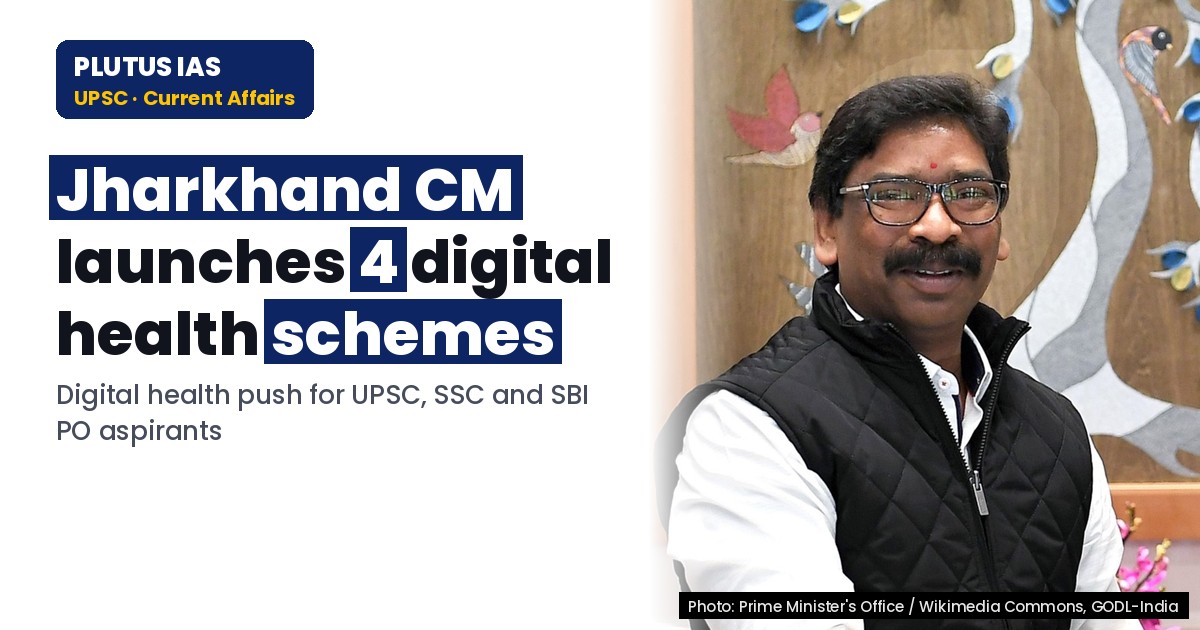
30 Sep झारखंड में डिजिटल स्वास्थ्य क्रांति: 4 योजनाओं का शुभारंभ
✎ Jharkhand’s Digital Health Conclave 2026 launched four key initiatives—CMDHS, Tele-ICU, HRIS Portal, and e-Health Portal—aimed at modernising healthcare delivery through digital governance, telemedicine, and AI integration.
Subject Relevance — Where This Topic Fits
- GS Paper II — Governance, Transparency and Accountability | GS Paper III — Science and Technology in Health Sector
- Prelims: Digital Health Mission, Telemedicine, Health Management Information System (HMIS), e-Health Portal, AI in Healthcare, Robotic Surgery, Public Health Infrastructure
- Essay: Role of Technology in Transforming Governance: The Case of Digital Health in India
Quick Revision: Jharkhand’s Digital Health Conclave 2026 launched four key initiatives—CMDHS, Tele-ICU, HRIS Portal, and e-Health Portal—aimed at modernising healthcare delivery through digital governance, telemedicine, and AI integration.
Why is this in the news?
The Jharkhand Digital Health Conclave 2026 marked the formal inauguration of four transformative digital health initiatives by the state government, aimed at modernising public health infrastructure through technology integration. This initiative is significant as it aligns with national digital health frameworks while addressing regional disparities in healthcare access through telemedicine, AI-driven diagnostics, and digital governance systems.
Background
- The National Digital Health Mission (NDHM), launched in 2020, envisions a digital health ecosystem for India, integrating health records, telemedicine, and e-pharmacies under a unified framework.
- Jharkhand, with a significant rural population and uneven healthcare distribution, faces challenges in delivering timely and quality healthcare services, particularly in remote and tribal areas.
- The COVID-19 pandemic underscored the necessity of digital health solutions, including telemedicine and remote diagnostics, to ensure continuity of care during disruptions.
- The state’s health infrastructure has historically relied on traditional models, with limited integration of digital tools in primary and secondary care facilities.
- The Digital Health Conclave 2026 follows global trends where countries like Estonia, Singapore, and the UK have successfully implemented national digital health strategies to improve efficiency and accessibility.
Key Components of Jharkhand’s Digital Health Initiatives
- Chief Minister’s Digital Health Scheme (CMDHS): A ₹300 crore flagship programme aimed at digitising health records, appointment scheduling, and payments through a unified platform. The scheme includes four pillars: connectivity, Health Management Information System (HMIS), CCTV-based monitoring, and a digital dashboard for real-time analytics.
- 10-Bedded Tele-ICU: A critical care unit enabled by telemedicine infrastructure, allowing intensivists to remotely monitor and manage ICU patients in rural and district hospitals, reducing the need for patient transfers.
- Human Resource Information System (HRIS) Portal: A digital repository for managing the entire lifecycle of healthcare personnel, from recruitment to retirement, ensuring optimal workforce deployment and reducing administrative bottlenecks.
- Jharkhand e-Health Portal: A centralised platform for patient registration, lab report access, and digital prescriptions, designed to streamline healthcare delivery and reduce paperwork.
- Telemedicine and AI Integration: Expansion of telemedicine services to provide specialist consultations to remote areas, with plans to incorporate AI for predictive diagnostics, robotic surgery support, and automated health alerts.
- CCTV-Based Monitoring: Deployment of surveillance systems in public health facilities to enhance transparency, patient safety, and operational oversight.
Key Features
| Feature | Significance |
|---|---|
| मुख्यमंत्री डिजिटल हेल्थ योजना | Provides a state-wide digital infrastructure for healthcare delivery, ensuring accessibility and efficiency in public health services. |
| 10-बेडेड टेली-आईसीयू | Enables remote critical care consultation and monitoring, particularly benefiting patients in rural and underserved areas. |
| एचआरआईएस पोर्टल | Digitises human resource management in the health sector, streamlining recruitment, service records, and workforce planning. |
| झारखंड ई-हेल्थ पोर्टल | Centralises patient data, appointment scheduling, and digital health records for seamless healthcare service delivery. |
Why it Matters
Public Health Governance
- Bridges the urban-rural divide in healthcare access through telemedicine and digital diagnostics.
- Enhances transparency and accountability in health service delivery via real-time monitoring and digital dashboards.
- Facilitates data-driven policymaking by integrating health records and workforce analytics.
Technological Integration
- Leverages AI for predictive analytics, resource optimisation, and personalised healthcare interventions.
- Promotes interoperability between public and private healthcare providers through standardised digital platforms.
- Supports advanced medical procedures such as robotic surgery through digital infrastructure.
Socio-Economic Impact
- Reduces out-of-pocket expenditure for patients by enabling remote consultations and digital prescriptions.
- Improves healthcare workforce efficiency through AI-driven HR management and training modules.
- Enhances employment opportunities in the health-tech sector, fostering local innovation.
Challenges
1. Digital Divide and Infrastructure Gaps
- Limited internet connectivity in remote tribal and hilly regions may hinder the adoption of digital health services.
- Inadequate last-mile delivery mechanisms for digital health tools in rural areas.
- Need for robust cybersecurity frameworks to protect sensitive health data from breaches.
UPSC Link: GS-II: Governance, GS-III: Science & Tech
2. Capacity Building and Training
- Insufficient training for healthcare workers in digital health tools and telemedicine protocols.
- Resistance to adoption due to lack of awareness or technological familiarity among frontline staff.
- Need for continuous upskilling to align with evolving digital health standards.
UPSC Link: GS-II: Human Resource Development
3. Data Privacy and Ethical Concerns
- Risk of unauthorised access to patient data due to weak data protection laws at the state level.
- Ethical dilemmas in AI-driven diagnostics, including algorithmic bias and accountability.
- Ensuring informed consent for data sharing and digital health interventions.
UPSC Link: GS-II: Governance, GS-IV: Ethics
4. Financial Sustainability
- High initial capital expenditure for digital infrastructure and maintenance costs.
- Dependence on centralised funding models, which may not align with state-specific priorities.
- Need for public-private partnerships to ensure long-term viability of digital health initiatives.
UPSC Link: GS-III: Economic Development
Challenges — UPSC Perspective
| Issue | Concern |
|---|---|
| Connectivity in remote areas | Limited internet access may exclude marginalised populations from digital health services. |
| Data privacy risks | Lack of stringent data protection laws could lead to breaches of sensitive health information. |
| Workforce adaptation | Healthcare staff may lack training or willingness to adopt digital tools effectively. |
| Cybersecurity threats | Vulnerabilities in digital systems could compromise patient safety and trust. |
| Financial viability | High costs of implementation and maintenance may strain state resources. |
Government Initiatives — Must-Memorise for Prelims
- मुख्यमंत्री डिजिटल हेल्थ योजना
- 10-बेडेड टेली-आईसीयू
- एचआरआईएस पोर्टल
- झारखंड ई-हेल्थ पोर्टल
Way Forward
- Establish a state-level digital health task force to oversee implementation and address bottlenecks.
- Conduct periodic audits of digital health infrastructure to ensure equitable access across districts.
- Develop standardised training modules for healthcare workers in digital health tools and telemedicine.
- Strengthen cybersecurity protocols and data protection laws to safeguard patient information.
- Promote public-private partnerships to augment funding and expertise for digital health initiatives.
- Integrate digital health records with national health schemes (e.g., Ayushman Bharat) for seamless interoperability.
- Launch awareness campaigns to educate rural and tribal communities on the benefits of digital health services.
UPSC Value Addition
Keywords for Mains Answer-Writing
Digital Health Mission · Telemedicine · Tele-ICU · Health Management Information System (HMIS) · Artificial Intelligence in healthcare · E-Health portals · Digital health infrastructure · Public health governance · Universal Health Coverage (UHC) · Digital public infrastructure · Tele-radiology · Robotic surgery · Health workforce management · AI-driven healthcare systems · Digital health equity
Concept Flow
State-level digital health infrastructure is conceptualised to address healthcare disparities. → Policy frameworks (e.g., Digital Health Mission) are aligned with national digital health strategies. → Technological interventions (e.g., telemedicine, AI) are deployed to enhance service delivery. → Human resource management systems (HRIS) are digitised for workforce optimisation. → Patient-centric portals (e.g., E-Health Portal) are developed for seamless healthcare access. → Real-time monitoring and data analytics enable evidence-based policymaking. → Sustainable models are established through public-private partnerships and capacity building.
Prelims Practice Questions
Q1. Consider the following statements regarding the Digital Health Mission in India:
1. The Digital Health Mission aims to create a seamless online platform for healthcare services.
2. The mission includes the implementation of Health Management Information Systems (HMIS) for patient registration and appointment scheduling.
3. The mission mandates the use of Artificial Intelligence (AI) in all clinical decision-making processes.
How many of the above statements are correct?
- Only one
- Only two
- All three
- None
Answer: Only two — Statements 1 and 2 are correct as the Digital Health Mission seeks to integrate digital health services and HMIS for patient management. Statement 3 is incorrect because AI is encouraged but not mandated for all clinical decisions.
Q2. Assertion (A): Tele-ICU services enable remote monitoring of critically ill patients by intensivists.
Reason (R): Tele-ICU relies on real-time data transmission and video conferencing to provide specialist care.
Select the correct option:
A. Both A and R are true, and R is the correct explanation of A.
B. Both A and R are true, but R is not the correct explanation of A.
C. A is true, but R is false.
D. A is false, but R is true.
- A
- B
- C
- D
Answer: A — Both the assertion and reason are true, and the reason correctly explains the assertion as Tele-ICU services use real-time data and video conferencing to enable remote specialist care.
Q3. Match the following components of the Digital Health Ecosystem in Jharkhand with their respective functions:
Column I (Component)
1. HMIS Portal
2. Tele-ICU
3. E-Health Portal
4. HRIS Portal
Column II (Function)
A. Digital record management for healthcare workforce
B. Online patient registration, appointment, and payment
C. Remote monitoring of critically ill patients
D. Centralized repository for health records and services
Select the correct match:
- 1-B, 2-C, 3-D, 4-A
- 1-A, 2-B, 3-C, 4-D
- 1-D, 2-A, 3-B, 4-C
- 1-C, 2-D, 3-A, 4-B
Answer: 1-B, 2-C, 3-D, 4-A — The correct match is: HMIS Portal (B) for patient services, Tele-ICU (C) for remote monitoring, E-Health Portal (D) for health records, and HRIS Portal (A) for workforce management.
Mains Practice Question
✍ The integration of digital technologies in healthcare delivery represents a paradigm shift towards achieving Universal Health Coverage (UHC) in India. In this context, critically analyse the role of the Digital Health Mission and associated initiatives such as Tele-ICU, HMIS, and AI-driven systems in bridging healthcare disparities. Also, examine the challenges in ensuring equitable access to these technologies across rural and urban populations. (15 Marks)
Approach: MODEL-ANSWER SKELETON:
1. **Introduction (2 Marks)**
– Define Digital Health Mission and its objectives under the Ayushman Bharat Digital Mission (ABDM).
– Highlight the constitutional mandate (Article 47: duty of the State to improve public health) and Sustainable Development Goal 3 (Good Health and Well-being).
2. **Role of Digital Health Initiatives (6 Marks)**
– **Tele-ICU**: Explain its mechanism (real-time monitoring, specialist consultation) and impact on reducing critical care mortality in remote areas.
– **HMIS**: Discuss its components (patient registration, appointment scheduling, digital lab reports) and contribution to reducing OPD wait times.
– **AI in Healthcare**: Cite examples of AI applications (diagnostic support, predictive analytics for disease outbreaks) and their potential to enhance efficiency.
– **E-Health Portals**: Explain their role in creating a unified health record system for seamless service delivery.
3. **Bridging Healthcare Disparities (4 Marks)**
– **Rural-Urban Divide**: Discuss infrastructure gaps (internet penetration, electricity, digital literacy) and their impact on adoption.
– **Socio-Economic Barriers**: Highlight affordability, language barriers, and trust deficits in digital health adoption.
– **Governance Mechanisms**: Mention the role of National Digital Health Mission (NDHM) and state-level initiatives (e.g., Jharkhand’s Digital Health Mission) in addressing disparities.
4. **Challenges and Way Forward (3 Marks)**
– **Technological Challenges**: Data privacy (PDP Act 2023), interoperability of systems, and cybersecurity risks.
– **Capacity Building**: Need for training healthcare workers and creating awareness among beneficiaries.
– **Policy Recommendations**: Suggest measures like public-private partnerships, subsidized internet access, and localized digital health literacy programs.
**Balanced View Required**: Acknowledge successes (e.g., reduction in maternal mortality in states with robust HMIS) and limitations (e.g., low adoption in tribal districts of Jharkhand).
Source: amarujala.com
Jharkhand PCS (JPSC) — State PCS Practice
Prelims: Which of the following is NOT one of the four major digital health initiatives launched by the Jharkhand Health Minister under the ‘Digital Health’ initiative in the state?
- A. Establishment of 100 Ayushman Arogya Mandirs with digital health infrastructure
- B. Launch of ‘Jharkhand Digital Health Card’ for universal health coverage
- C. Integration of all government health facilities with the Ayushman Bharat Digital Mission (ABDM) platform
- D. Implementation of a state-wide telemedicine network connecting all district hospitals with primary health centers
Answer: A. Establishment of 100 Ayushman Arogya Mandirs with digital health infrastructure — The four major digital health initiatives launched include the ‘Jharkhand Digital Health Card’, integration with ABDM, and a telemedicine network, but not the establishment of 100 Ayushman Arogya Mandirs as a standalone initiative.
Mains: Discuss the significance of the ‘Jharkhand Digital Health Card’ initiative in the context of tribal health governance and its potential impact on reducing health disparities in the state. Elaborate on the role of digital infrastructure in strengthening primary healthcare delivery in Jharkhand’s tribal-dominated districts.
Generated by AanyaAi for educational purpose.
Related guides on our sites
- Anthropology VS PSIR
- Best PSIR optional coaching
- Best PSIR optional coaching online
- Best PSIR optional teacher

- NAMASTE Scheme: Enhancing Sanitation Workers’ Livelihoods & Safety - November 14, 2026
- एमएसएमई का विशेष अभियान 6.0: स्वच्छता और लंबित मामलों का निपटारा - November 14, 2026
- Sea Vigil-26: Coastal Defence Drills Off Visakhapatnam - November 14, 2026

No Comments