


08 Aug Madras HC: Caste Certificate Verification Permissible Even After Retirement
✎ Verification of community certificates is legally permissible even after retirement, as appointments secured through fraud are void ab initio, and public employers must initiate verification processes within the initial years of…
Subject Relevance — Where This Topic Fits
- GS Paper II — Polity and Governance (Constitutional Provisions, Judicial Review, Administrative Law) | GS Paper IV — Ethics, Integrity and Aptitude (Accountability and Transparency in Public Service)
- Prelims: Community Certificate, Madras High Court Full Bench, Kumari Madhuri Patil case (1994), Constitutional accountability, Anthropological experts in verification, Retiral benefits, Ab initio void appointment, State Level Scrutiny Committee
- Essay: The interplay between constitutional morality and administrative efficiency in public service, The role of judicial intervention in upholding transparency and equity in governance
Quick Revision: Verification of community certificates is legally permissible even after retirement, as appointments secured through fraud are void ab initio, and public employers must initiate verification processes within the initial years of service to uphold constitutional accountability.
Why is this in the news?
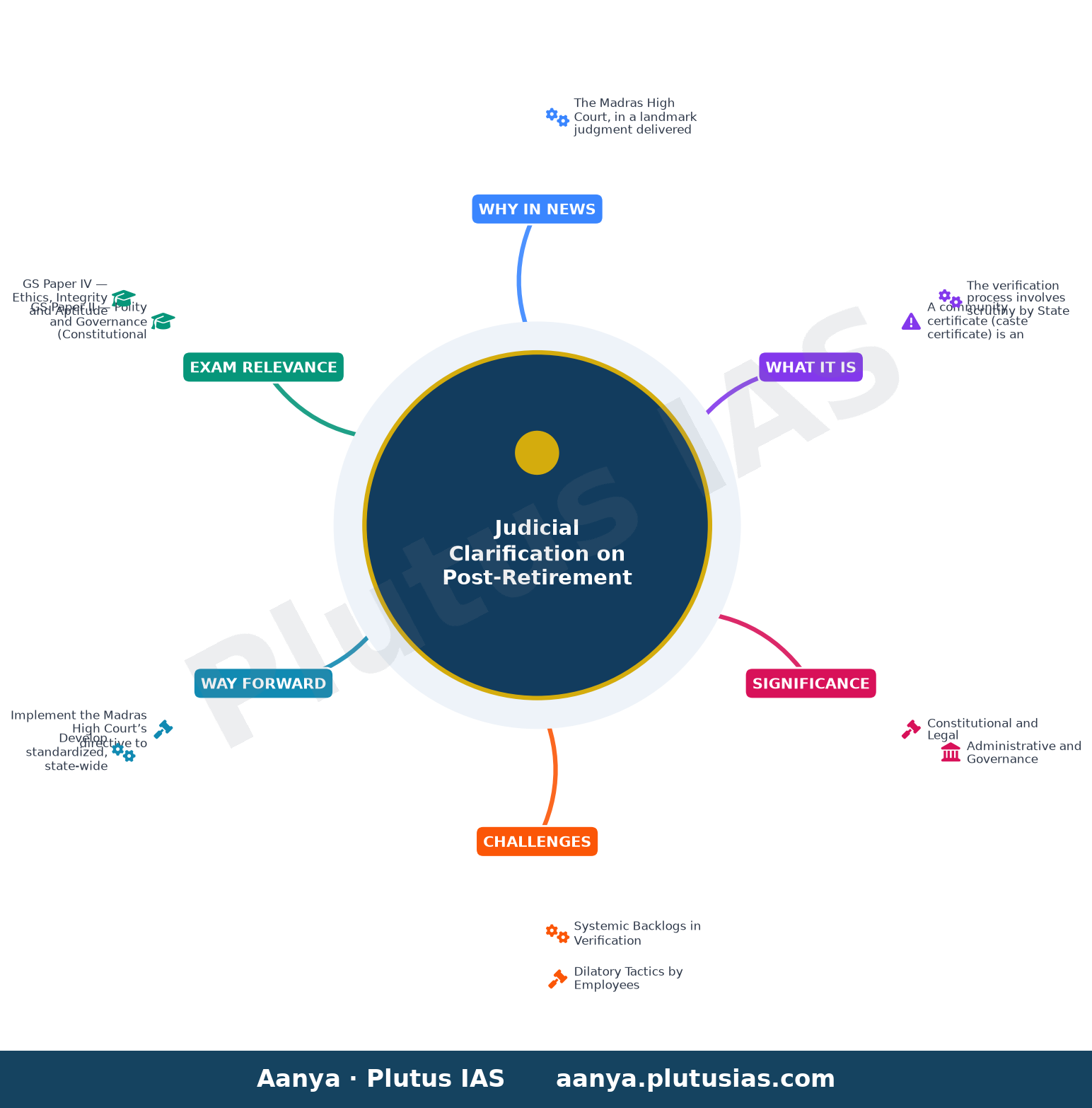
The Madras High Court, in a landmark judgment delivered on 30 July 2026, clarified that the verification of the genuineness of community certificates of government employees remains legally permissible even after retirement. This ruling resolves conflicting interpretations by Division Benches and reinforces the principle that appointments secured through fraud are void ab initio, thereby negating any protection of retiral benefits derived from such illegality. The judgment also underscores the obligation of public employers to initiate and complete verification processes within the initial years of service, ensuring systemic accountability and deterring dilatory tactics.
Background
- The issue arose from conflicting decisions by coordinate Division Benches of the Madras High Court regarding the permissibility of post-retirement verification of community certificates.
- The Supreme Court’s landmark judgment in *Kumari Madhuri Patil v. Additional Commissioner, Tribal Development* (1994) established a multi-point verification matrix for caste certificates, which has been widely cited in subsequent judicial pronouncements.
- The verification of community certificates is critical to prevent the misuse of reservation benefits and to uphold the constitutional mandate of equality and social justice.
- The Tamil Nadu government, like other states, operates State Level Scrutiny Committees and district-level vigilance committees to verify the authenticity of caste certificates submitted by employees.
- The judgment aligns with the broader judicial trend of ensuring that no fraudulent gains, including retiral benefits, are protected under the law, as such appointments are deemed void from inception.
- The ruling also addresses systemic inefficiencies, including backlogs and delays in verification processes, which have historically impeded administrative accountability.
What is the Verification of Community Certificates and its Legal Framework?
- A community certificate (caste certificate) is an official document issued by a competent authority to certify a person’s caste or community, which is essential for availing reservation benefits in public employment and education.
- The verification process involves scrutiny by State Level Scrutiny Committees and district-level vigilance committees to confirm the authenticity of the certificate and the eligibility of the individual.
- The Supreme Court’s judgment in *Kumari Madhuri Patil v. Additional Commissioner, Tribal Development* (1994) laid down a multi-point verification matrix, including field inquiries, cross-verification with community records, and anthropological assessments.
- An appointment secured through a fraudulent or forged community certificate is considered void ab initio, meaning it is treated as legally non-existent from the outset, and the individual is not entitled to any benefits derived from such an appointment.
- The Madras High Court’s judgment clarifies that the verification process can be initiated or continued even after an employee’s retirement, as the foundational illegality of the appointment is not extinguished by superannuation.
- Public employers are now mandated to initiate and complete verification processes within the initial years of an employee’s service to prevent dilatory tactics and ensure timely accountability.
- The judgment reinforces the principle that constitutional accountability and integrity must prevail over procedural delays or technicalities, particularly in cases involving fraudulent claims of reservation benefits.
- The court directed the strengthening of institutional mechanisms, including the appointment of adequate manpower and anthropological experts, to expedite verification processes and eliminate systemic backlogs.
Key Features
| Feature | Significance |
|---|---|
| Full Bench ruling on post-retirement verification | Establishes that caste certificate verification can proceed even after retirement, preventing fraud from being shielded by superannuation. |
| Continuity of verification process | Ensures that verification initiated before retirement cannot lapse, upholding constitutional accountability and preventing dilatory tactics. |
| Strengthening of scrutiny committees | Mandates immediate fortification of State and district-level committees with manpower and anthropological experts to eliminate systemic backlogs. |
| Multi-point verification matrix | Reinforces compliance with the Supreme Court’s Kumari Madhuri Patil (1994) framework, ensuring rigorous scrutiny of caste certificates. |
| Fast-track inquiries post-retirement | Directs that post-retirement verifications must be conducted expeditiously to avoid unnecessary harassment and delays. |
Why it Matters
Constitutional and Legal
- Upholds the principle that appointments obtained through fraud are ab initio void, thereby nullifying any legal protection granted to such appointments, including retirement benefits.
- Reinforces the constitutional mandate of equality and fairness by ensuring that no individual can evade accountability for falsified caste certificates, regardless of tenure or retirement status.
- Clarifies the legal ambiguity surrounding post-retirement verification, aligning with the Supreme Court’s directive in Kumari Madhuri Patil (1994) that fraud has no expiry date.
Administrative and Governance
- Strengthens the institutional framework for verifying caste certificates by mandating the fortification of scrutiny committees with specialized expertise, reducing systemic delays and backlogs.
- Ensures timely verification of community certificates during the initial years of service, preventing the accumulation of unverified cases and enhancing administrative efficiency.
- Promotes transparency and accountability in public employment by preventing the misuse of caste certificates to secure undue advantages in government jobs.
Social Justice
- Protects the integrity of reservation policies by preventing the dilution of their intended beneficiaries through fraudulent caste certificates, thereby upholding the constitutional goal of social justice.
- Ensures that genuine beneficiaries of reservation policies are not deprived of their rights due to the actions of a few individuals who manipulate the system through false claims.
Challenges
1. Systemic Backlogs in Verification
- The Madras High Court noted the existence of massive systemic backlogs in the verification of caste certificates, which undermines the timely resolution of disputes and the enforcement of accountability.
- The lack of adequate manpower and anthropological expertise in scrutiny committees exacerbates delays, leading to prolonged uncertainty for employees and the public.
UPSC Link: GS-II: Reservation Policies and Issues
2. Dilatory Tactics by Employees
- Employees facing verification may resort to delaying tactics, such as prolonged litigation or administrative inaction, to evade accountability for falsified caste certificates.
- Post-retirement verification, while legally permissible, may face resistance from employees who seek to avoid scrutiny after the conclusion of their service.
UPSC Link: GS-II: Administrative Ethics and Accountability
3. Balancing Fairness and Rigour
- The court emphasized the need to balance constitutional integrity with fairness, ensuring that verification processes are rigorous yet not unduly burdensome or harassing to employees.
- The challenge lies in designing verification mechanisms that are both effective in detecting fraud and respectful of the rights of employees, particularly those who may have genuinely obtained their certificates.
UPSC Link: GS-II: Fundamental Rights and DPSP
4. Institutional Capacity Constraints
- The fortification of scrutiny committees with additional manpower and expertise requires significant administrative and financial resources, which may pose challenges for state governments.
- The lack of standardized procedures across states for verifying caste certificates further complicates efforts to streamline the process and reduce delays.
UPSC Link: GS-II: Governance and Public Administration
Challenges — UPSC Perspective
| Issue | Concern |
|---|---|
| Systemic backlogs | Prolonged delays in verification due to lack of manpower and expertise in scrutiny committees. |
| Dilatory tactics | Employees may use legal or administrative delays to evade post-retirement verification. |
| Resource constraints | Insufficient administrative and financial resources to fortify scrutiny committees and expedite verifications. |
| Standardization gaps | Lack of uniform procedures across states for verifying caste certificates, leading to inconsistencies. |
| Balancing fairness and rigour | Ensuring verification processes are rigorous yet not unduly burdensome or harassing to employees. |
| Constitutional accountability | Preventing fraud from being shielded by superannuation or procedural lapses. |
Way Forward
- Implement the Madras High Court’s directive to immediately fortify State and district-level scrutiny committees with additional manpower and anthropological experts.
- Develop standardized, state-wide procedures for verifying caste certificates to eliminate inconsistencies and ensure uniformity in the process.
- Initiate and complete verification of community certificates within the initial years of an employee’s service to prevent accumulation of unverified cases.
- Establish fast-track mechanisms for post-retirement verifications to ensure expeditious resolution without unnecessary harassment.
- Conduct periodic audits of scrutiny committees to assess their efficiency and address systemic bottlenecks in the verification process.
- Sensitize government employees about the legal and ethical implications of falsifying caste certificates and the consequences of such actions.
- Strengthen inter-departmental coordination to ensure seamless sharing of data and records required for verification processes.
- Promote transparency by publishing annual reports on the status of caste certificate verifications, including the number of cases verified, pending, and resolved.
UPSC Value Addition
Keywords for Mains Answer-Writing
Madras High Court Full Bench verdict on community certificate verification · Kumari Madhuri Patil case 1994 · Constitutional accountability and fraud in appointments · State Level Scrutiny Committee and district vigilance committees · Retirement and verification of caste certificates · Supreme Court directives on caste verification · Government service appointments obtained by fraud · Anthropological experts in verification committees · Public employer obligations under constitutional law · Ab initio void appointments and retiral benefits
Constitutional & Policy Linkages
- Article 14: Equality before law and equal protection of laws (ensuring no immunity for fraudulent appointments).
- Article 16(4): Permissibility of reservation for backward classes (protecting the integrity of reservation policies).
- Article 341: Power of the President to specify socially and educationally backward classes (framework for caste-based reservations).
Concept Flow
Issue of falsified caste certificates in government employment → Supreme Court’s Kumari Madhuri Patil (1994) judgment establishes multi-point verification matrix → Conflicting Division Bench rulings create legal ambiguity → Full Bench of Madras High Court resolves ambiguity by ruling post-retirement verification is permissible → Court directs fortification of scrutiny committees and fast-track verifications → Institutional strengthening and timely verifications ensure constitutional accountability and social justice.
Prelims Practice Questions
Q1. Consider the following statements regarding the verification of community certificates in India:
1. The Supreme Court in Kumari Madhuri Patil v. Additional Commissioner (1994) established a multi-point verification matrix for caste certificates.
2. The Madras High Court Full Bench (2026) held that verification of community certificates can be initiated even after an employee’s retirement.
3. The Full Bench opined that fraud in appointments does not lapse with retirement and retiral benefits cannot be protected in such cases.
How many of the above statements are correct?
- Only one
- Only two
- All three
- None
Answer: All three — Statements 1 and 3 are correct. Statement 2 is correct as the Full Bench explicitly ruled that verification can proceed post-retirement. The verification matrix was indeed established in Kumari Madhuri Patil (1994).
Q2. Assertion (A): The Madras High Court Full Bench (2026) held that an appointment obtained by fraud is void ab initio.
Reason (R): The court stated that retirement does not absolve the foundational illegality of such appointments.
Options:
A. Both A and R are true, and R is the correct explanation of A.
B. Both A and R are true, but R is not the correct explanation of A.
C. A is true but R is false.
D. A is false but R is true.
- A
- B
- C
- D
Answer: A — Both the assertion and reason are true. The court held that fraudulent appointments are void ab initio and that retirement does not protect such illegality, making R the correct explanation of A.
Q3. Match the following committees with their respective roles in the verification of community certificates:
Column I (Committee) | Column II (Role)
1. State Level Scrutiny Committee | A. Conducts verification at the district level
2. District Vigilance Committee | B. Empowered to verify caste certificates irrespective of the year of issuance
3. Supreme Court in Kumari Madhuri Patil | C. Establishes the verification matrix for caste certificates
4. Public Employer | D. Responsible for initiating and completing verification within initial years of service
Options:
1-B, 2-A, 3-C, 4-D
1-A, 2-B, 3-C, 4-D
1-C, 2-A, 3-B, 4-D
1-D, 2-C, 3-A, 4-B
- 1-B, 2-A, 3-C, 4-D
- 1-A, 2-B, 3-C, 4-D
- 1-C, 2-A, 3-B, 4-D
- 1-D, 2-C, 3-A, 4-B
Answer: 1-B, 2-A, 3-C, 4-D — The correct pairing is: State Level Scrutiny Committee (1-B), District Vigilance Committee (2-A), Supreme Court in Kumari Madhuri Patil (3-C), and Public Employer (4-D).
Mains Practice Question
✍ The Madras High Court Full Bench (2026) has held that verification of community certificates can be initiated even after an employee’s retirement and that fraud in appointments does not lapse with superannuation. Critically examine the constitutional and legal implications of this verdict with reference to the Supreme Court’s directives in Kumari Madhuri Patil (1994) and the doctrine of void ab initio appointments. Also, discuss the institutional measures suggested by the court to ensure compliance with the verification process. (15 Marks)
Approach: MODEL-ANSWER SKELETON:
1. **Constitutional and Legal Implications**:
– Explain the doctrine of void ab initio appointments and its constitutional basis (Articles 14, 16, and 38).
– Link the Full Bench’s ruling to the Supreme Court’s directives in Kumari Madhuri Patil (1994), which established a multi-point verification matrix for caste certificates.
– Discuss the rationale: fraud in appointments undermines constitutional equality and meritocracy; retirement cannot confer immunity.
– Cite the court’s observation: ‘Fraud has no expiry date’ and retiral benefits cannot protect foundational illegality.
2. **Supreme Court’s Framework (Kumari Madhuri Patil, 1994)**:
– Highlight the verification matrix: scrutiny of community certificates by scrutiny committees, anthropological verification, and cross-checking with government records.
– Emphasise the court’s insistence on rigid compliance to prevent misuse of reservations.
3. **Institutional Measures Suggested**:
– Strengthening of State Level Scrutiny Committee and district vigilance committees with manpower and anthropological experts (as directed by the Full Bench).
– Mandate for public employers to initiate and complete verification within the initial years of service.
– Fast-track inquiries post-retirement to prevent dilatory tactics.
4. **Balancing Constitutional Integrity and Fairness**:
– Discuss the court’s caution against using delayed procedures as ‘dangling swords’ or tools for harassment.
– Argue that the verdict reinforces constitutional accountability while ensuring procedural fairness.
5. **Critical Perspective**:
– Potential challenges: backlog in verification, resource constraints, and delays in institutional strengthening.
– Counter-argument: the verdict upholds the integrity of the reservation system and prevents misuse, which is essential for social justice.
Source: The Hindu
Generated by AanyaAi for educational purpose.


No Comments