


09 Aug NCP-SP MPs to Meet PM Modi: Key Issues & FCRA Bill Opposition
✎ The NCP (SP) delegation, led by Supriya Sule, has announced its opposition to the Foreign Contribution (Regulation) Amendment Bill, 2026, in its present form, citing the need for either its withdrawal or referral to a Joint…
Subject Relevance — Where This Topic Fits
- GS Paper II — Polity and Governance (Fundamental Rights, Role of Parliament, Centre-State Relations) | GS Paper III — Economy (Role of NGOs in Development, Foreign Contributions, Fiscal Policy)
- Prelims: Foreign Contribution (Regulation) Act, 2010, Article 19(1)(c) of the Constitution, Parliamentary Joint Committee, FCRA Amendment Bill 2026, Supreme Court jurisprudence on FCRA
- Essay: The tension between sovereignty and civil society in democratic governance, Balancing development and dissent: The role of NGOs in India
Why is this in the news?
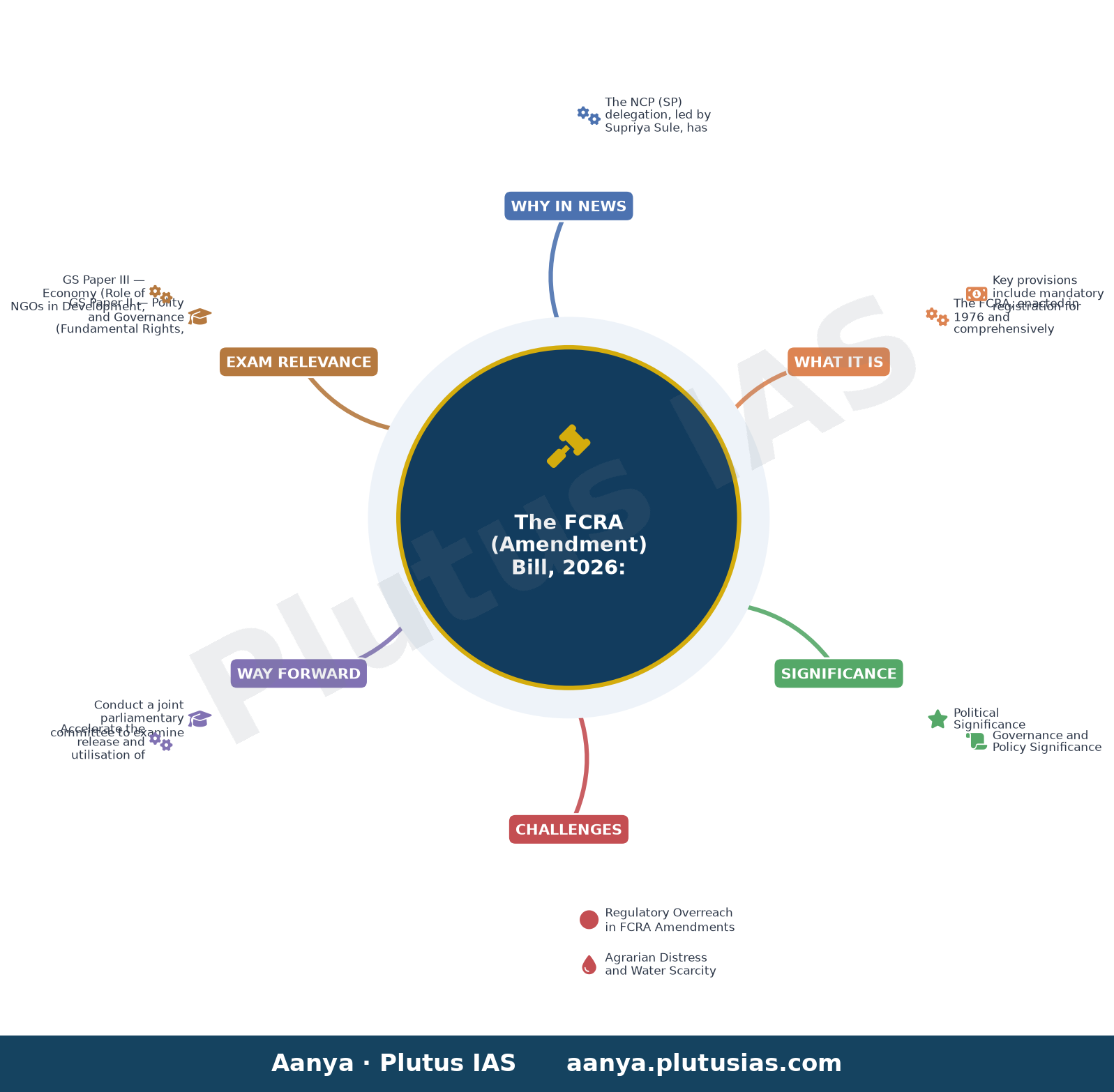
The NCP (SP) delegation, led by Supriya Sule, has announced its opposition to the Foreign Contribution (Regulation) Amendment Bill, 2026, in its present form, citing the need for either its withdrawal or referral to a Joint Parliamentary Committee. This development underscores the ongoing debate surrounding the FCRA framework, particularly its impact on non-governmental organisations, state-level utilisation of foreign funds, and the broader implications for civil society participation in governance.
Background
- The Foreign Contribution (Regulation) Act (FCRA), 2010, regulates the acceptance and utilisation of foreign contributions by individuals, associations, and companies in India, with the stated objective of ensuring transparency and preventing foreign interference in domestic affairs.
- The FCRA was amended in 2020, introducing provisions such as reduced administrative expenses for NGOs, mandatory opening of bank accounts in the State Bank of India, and restrictions on sub-granting foreign funds, which were challenged in the Supreme Court.
- The Supreme Court, in *Noel Harper v. Union of India* (2023), upheld the constitutional validity of the 2020 amendments but directed the Union government to ensure that FCRA registrations are not arbitrarily suspended or cancelled without due process.
- FCRA compliance has been a recurring issue in Centre-State relations, particularly in states governed by opposition parties, where utilisation of foreign funds for local development has faced bureaucratic hurdles.
- The FCRA framework is often juxtaposed with Article 19(1)(c) of the Constitution, which guarantees the right to form associations, raising debates on the balance between regulatory oversight and fundamental freedoms.
What is the Foreign Contribution (Regulation) Act (FCRA)?
- The FCRA, enacted in 1976 and comprehensively amended in 2010, regulates the inflow and utilisation of foreign contributions to individuals, associations, and companies in India, with the primary aim of preventing foreign interference in domestic political processes.
- Key provisions include mandatory registration for entities receiving foreign funds, restrictions on utilisation for activities detrimental to national interest, and prohibitions on acceptance of foreign funds by political parties or organisations engaged in religious or communal activities.
- The 2020 amendments introduced stricter compliance norms, including a cap on administrative expenses (20% of total foreign contributions), mandatory opening of FCRA accounts in the State Bank of India, and enhanced scrutiny of NGOs receiving foreign funds.
- The Act empowers the Union government to suspend or cancel FCRA registrations if an organisation is found to be violating its provisions, a power that has been subject to judicial review in recent years.
- The FCRA framework is administered by the Ministry of Home Affairs, which is responsible for granting, renewing, or cancelling FCRA registrations, as well as monitoring compliance through annual returns and audits.
- The Act does not prohibit foreign contributions per se but imposes conditions to ensure transparency, accountability, and alignment with national interest, particularly in sectors such as health, education, and social welfare.
- Judicial precedents, such as the *Noel Harper* case (2023), have clarified that while the FCRA is a reasonable restriction under Article 19(2) of the Constitution, procedural safeguards must be followed to prevent arbitrary action against NGOs.
Key Features
| Feature | Significance |
|---|---|
| Inter-Party Delegation Meeting with PM | Demonstrates parliamentary practice of raising state-specific issues through formal channels, highlighting cooperative federalism. |
| Opposition to FCRA Bill, 2026 | Signals concerns over regulatory overreach in foreign funding, particularly its impact on state-level socio-economic initiatives. |
| Water Crisis and Farmer Suicides | Reflects critical agrarian distress in Maharashtra, a recurring theme in UPSC GS Paper III (agriculture, irrigation, and rural development). |
| Utilisation of MPLADS Funds | Highlights administrative bottlenecks in fund disbursal, relevant for GS Paper II (governance, transparency, and public policy). |
| Urbanisation Challenges | Underscores the need for sustainable urban planning, a key topic in GS Paper I (geography, urbanisation, and infrastructure). |
Why it Matters
Political Significance
- The meeting underscores the role of opposition parties in addressing state-centric grievances within the parliamentary framework, despite ideological differences.
- Supriya Sule’s insistence on the meeting’s non-political motive reflects a strategic attempt to depoliticise state issues, aligning with constitutional norms of cooperative governance.
- The opposition to the FCRA Bill’s present form indicates a broader concern over legislative processes that may bypass parliamentary scrutiny or state consultations.
Governance and Policy Significance
- The FCRA Bill, 2026, if enacted as proposed, could alter the regulatory landscape for NGOs and state-level welfare initiatives, impacting grassroots development.
- Delays in MPLADS fund utilisation highlight systemic inefficiencies in fund release and utilisation, a recurring governance challenge in India.
- The discussion on water scarcity and farmer suicides aligns with the Union Government’s obligations under the National Water Policy and agricultural distress mitigation frameworks.
Economic Significance
- Farmer suicides and water crises in Maharashtra directly affect agricultural productivity, a critical sector for India’s GDP and rural employment.
- Urbanisation challenges in Maharashtra, including infrastructure bottlenecks, have macroeconomic implications for industrial growth and employment generation.
Constitutional and Legal Significance
- The FCRA Bill’s provisions may intersect with Article 19(1)(c) (freedom to form associations) and Article 21 (right to livelihood), raising constitutional questions on proportionality and judicial review.
- The meeting’s focus on state-specific issues reflects the constitutional principle of federalism, as enshrined in Article 1 (Union of States) and the Seventh Schedule (State List).
Challenges
1. Regulatory Overreach in FCRA Amendments
- The FCRA Bill, 2026, if passed without adequate debate, risks undermining the autonomy of NGOs and state-level welfare initiatives, particularly in Maharashtra where civil society plays a pivotal role in drought relief and farmer support.
- Lack of consensus on the Bill may lead to legal challenges under Article 14 (equality before law) and Article 19(1)(g) (freedom to practise any profession).
- The Bill’s provisions on
UPSC Link: GS Paper II: Governance, Transparency & Accountability
2. Agrarian Distress and Water Scarcity
- Maharashtra’s recurring water crises, exacerbated by poor monsoon patterns and unsustainable agricultural practices, require long-term solutions under the National Water Policy and Integrated Watershed Management Programmes.
- Farmer suicides, often linked to debt cycles and crop failures, necessitate a multi-pronged approach combining financial inclusion (e.g., Kisan Credit Cards), crop insurance (PMFBY), and institutional support.
- The state’s dependence on sugarcane cultivation, a water-intensive crop, highlights the need for crop diversification and water-use efficiency measures.
UPSC Link: GS Paper III: Agriculture, Irrigation & Rural Development
3. MPLADS Fund Utilisation Bottlenecks
- Delays in MPLADS fund release and utilisation stem from procedural hurdles, lack of state government coordination, and bureaucratic inertia, undermining local development.
- The scheme’s objectives—bridging infrastructure gaps and promoting grassroots welfare—require streamlined fund flow mechanisms and real-time monitoring to prevent misutilisation.
- The issue reflects broader challenges in decentralised governance, where local representatives often lack the administrative capacity to implement projects efficiently.
UPSC Link: GS Paper II: Governance, Transparency & Accountability
4. Urbanisation and Infrastructure Deficits
- Rapid urbanisation in Maharashtra, particularly in Mumbai and Pune, strains urban infrastructure, leading to housing shortages, traffic congestion, and environmental degradation.
- The lack of integrated urban planning exacerbates socio-economic inequalities, requiring interventions under the Atal Mission for Rejuvenation and Urban Transformation (AMRUT) and Smart Cities Mission.
- Climate resilience must be integrated into urban policies to mitigate risks from heat islands, flooding, and air pollution.
UPSC Link: GS Paper I: Urbanisation, Infrastructure & Disaster Management
5. Federalism and Centre-State Coordination
- The delegation’s emphasis on state-specific issues highlights the need for robust Centre-State coordination, particularly in fiscal federalism and policy implementation.
- Conflicts over fund utilisation (e.g., MPLADS) and legislative oversight (e.g., FCRA) underscore the importance of the Inter-State Council and the NITI Aayog in resolving disputes.
- The absence of a formal mechanism for state-level grievance redressal risks eroding trust in parliamentary democracy.
UPSC Link: GS Paper II: Federalism & Centre-State Relations
Challenges — UPSC Perspective
| Issue | Concern |
|---|---|
| FCRA Bill, 2026 | Potential erosion of NGO autonomy and state-level welfare initiatives due to restrictive foreign funding regulations. |
| Water Scarcity in Maharashtra | Chronic droughts and poor water governance threaten agricultural productivity and rural livelihoods. |
| Farmer Suicides | Indebtedness and crop failures, exacerbated by climate change, require systemic reforms in agricultural policy and financial inclusion. |
| MPLADS Fund Delays | Bureaucratic inefficiencies and lack of state coordination hinder local development and infrastructure projects. |
| Urbanisation Challenges | Unplanned urban growth leads to infrastructure deficits, environmental degradation, and socio-economic inequalities. |
| Centre-State Coordination | Lack of formal mechanisms for state-level grievance redressal undermines cooperative federalism. |
Way Forward
- Conduct a joint parliamentary committee to examine the FCRA Bill, 2026, with inputs from state governments and civil society to ensure balanced legislation.
- Accelerate the release and utilisation of MPLADS funds through digital tracking systems and real-time monitoring to prevent delays and misutilisation.
- Implement integrated water resource management plans in Maharashtra, combining rainwater harvesting, micro-irrigation, and crop diversification to mitigate drought risks.
- Strengthen agricultural distress mitigation by expanding the coverage of PMFBY, promoting climate-resilient crops, and enhancing rural credit access.
- Develop climate-resilient urban policies under AMRUT 2.0 and Smart Cities Mission, focusing on sustainable infrastructure, green spaces, and disaster preparedness.
- Establish a formal Centre-State grievance redressal mechanism, such as a revamped Inter-State Council, to address state-specific issues proactively.
- Enhance transparency in fund utilisation by mandating quarterly audits of MPLADS projects and publishing progress reports on government portals.
UPSC Value Addition
Keywords for Mains Answer-Writing
Foreign Contribution (Regulation) Act, 2010 · Foreign Contribution (Regulation) Amendment Bill, 2026 · Parliamentary scrutiny of legislation · Federalism and Centre-State relations · Non-Governmental Organisations (NGOs) · Foreign funding of political parties · Joint Committee of Parliament · Supreme Court on FCRA · Political funding and transparency · Legislative process and public consultation
Constitutional & Policy Linkages
- Article 1 (Union of States) – Federal structure and Centre-State relations.
- Article 21 (Right to Life) – Link to agrarian distress and farmer suicides.
- Article 19(1)(c) (Freedom to form associations) – Potential impact of FCRA amendments on NGOs.
- Seventh Schedule (State List) – Water, agriculture, and local governance fall under state jurisdiction.
Concept Flow
Maharashtra’s agrarian distress and water scarcity → Political mobilisation by NCP-SP MPs → Formal delegation meeting with PM to raise state-specific issues. → Opposition to FCRA Bill, 2026 in present form → Concerns over regulatory overreach and impact on civil society → Call for joint parliamentary scrutiny. → MPLADS fund utilisation bottlenecks → Administrative inefficiencies → Delays in local development projects. → Rapid urbanisation in Maharashtra → Infrastructure deficits and environmental degradation → Need for integrated urban planning. → Centre-State coordination challenges → Lack of formal grievance redressal mechanisms → Erosion of trust in parliamentary democracy.
Prelims Practice Questions
Q1. Consider the following statements regarding the Foreign Contribution (Regulation) Act, 2010:
1. The Act regulates the acceptance and utilisation of foreign contributions by individuals, associations, and companies.
2. The Act prohibits foreign contributions to political parties.
3. The Act mandates that all foreign contributions must be received only through designated banks.
4. The Act empowers the Central Government to prohibit the utilisation of foreign contributions for activities detrimental to the public interest.
How many of the above statements are correct?
- Only one
- Only two
- Only three
- All
Answer: All — Statements 1, 2, and 4 are correct. Statement 3 is incorrect as the Act does not mandate that all foreign contributions must be received only through designated banks; it permits receipt through any scheduled bank with prior permission.
Q2. Assertion (A): The Foreign Contribution (Regulation) Amendment Bill, 2026 seeks to prohibit the receipt of foreign contributions by associations engaged in public advocacy.
Reason (R): The Bill aims to enhance transparency and accountability in the utilisation of foreign funds by NGOs.
Options:
A. Both A and R are true, and R is the correct explanation of A.
B. Both A and R are true, but R is not the correct explanation of A.
C. A is true, but R is false.
D. A is false, but R is true.
- A
- B
- C
- D
Answer: A — Both A and R are true. The Bill does prohibit receipt of foreign contributions by associations engaged in public advocacy (A), and it aims to enhance transparency and accountability (R). However, R is not the correct explanation of A, as the prohibition is a specific provision, not a direct consequence of the broader transparency measures.
Q3. Match the following provisions of the Foreign Contribution (Regulation) Act, 2010 with their respective descriptions:
Column I (Provisions)
1. Section 17
2. Section 18
3. Section 23
4. Section 32
Column II (Descriptions)
A. Prohibition on acceptance of foreign contribution by certain persons.
B. Utilisation of foreign contribution for purposes other than those for which it was received.
C. Power of Central Government to prohibit receipt of foreign contribution.
D. Requirement to open a designated bank account for receipt of foreign contribution.
Options:
A. 1-D, 2-C, 3-A, 4-B
B. 1-A, 2-B, 3-C, 4-D
C. 1-D, 2-A, 3-B, 4-C
D. 1-C, 2-D, 3-A, 4-B
- A
- B
- C
- D
Answer: A — 1-D: Section 17 requires opening a designated bank account for receipt of foreign contribution. 2-C: Section 18 empowers the Central Government to prohibit receipt of foreign contribution. 3-A: Section 23 prohibits acceptance of foreign contribution by certain persons. 4-B: Section 32 pertains to utilisation of foreign contribution for purposes other than those for which it was received.
Mains Practice Question
✍ Critically examine the constitutional and parliamentary dimensions of the Foreign Contribution (Regulation) Amendment Bill, 2026. How does the Bill reflect tensions between transparency in foreign funding and the autonomy of civil society organisations? Also, analyse the implications of the Bill for federalism and Centre-State relations. (15 Marks)
Approach: MODEL-ANSWER SKELETON:
1. **Constitutional Dimensions**:
– Article 19(1)(c) (freedom to form associations) and Article 21 (right to livelihood) vis-à-vis reasonable restrictions under Article 19(2)-(6).
– Doctrine of proportionality: SC’s stance in *Common Cause v. Union of India* (2013) and *Indian Social Action Forum (INSAF) v. Union of India* (2017).
– Balance between public interest (transparency) and civil liberties (autonomy of NGOs).
2. **Parliamentary Scrutiny and Legislative Process**:
– Role of Joint Committee of Parliament in examining the Bill (as demanded by NCP-SP MPs).
– Principles of legislative drafting: clarity, necessity, and public consultation.
– Contrast with the 2020 Amendment Act’s provisions (e.g., prohibition of foreign funding to political parties, Aadhaar linkage).
3. **Tensions in the Bill**:
– **Transparency vs. Autonomy**: Provisions like mandatory Aadhaar seeding (Section 12) and restrictions on utilisation (Section 8) may stifle advocacy work.
– **Civil Society Space**: Impact on grassroots organisations working on human rights, environment, and governance issues.
– **Judicial Precedents**: SC’s emphasis on ‘structured proportionality’ in *Joseph Shine v. Union of India* (2018) and *Anuradha Bhasin v. Union of India* (2020).
4. **Federalism and Centre-State Relations**:
– **State Autonomy**: Issues raised by regional parties (e.g., NCP-SP) regarding utilisation of development funds and lack of state support.
– **Overreach of Central Government**: Powers under Section 12(4) and 32 to prohibit or regulate utilisation of funds.
– **Cooperative Federalism**: Need for consultation with states before imposing restrictions on NGOs operating in state domains.
5. **Way Forward**:
– Recommendations of the 2020 Standing Committee on FCRA (207th Report).
– Role of the Election Commission in monitoring foreign funding to political parties.
– Need for a balanced approach: enhancing transparency without eroding civil society’s operational freedom.
Source: The Indian Express
Generated by AanyaAi for educational purpose.

- यूपीएससी/पीसीएस के लिए दूरसंचार विनिर्माण में निवेश: ग्वालियर टीएमजेड के अवसर - September 23, 2026
- Bengaluru Investor Meet: ₹5,500 Cr Investment Proposed for Gwalior Telecom Manufacturing Zone - September 23, 2026
- एल नीनो: दुनिया के सामने जलवायु अनुकूलन की चुनौती - September 23, 2026

No Comments