


08 Aug Policy Support Crucial to Save India’s Traditional Occupations from Extinction
✎ Traditional occupations in India are under threat from mechanisation and market distortions, necessitating policy interventions to ensure social inclusion, dignified livelihoods, and constitutional safeguards for artisans.
Subject Relevance — Where This Topic Fits
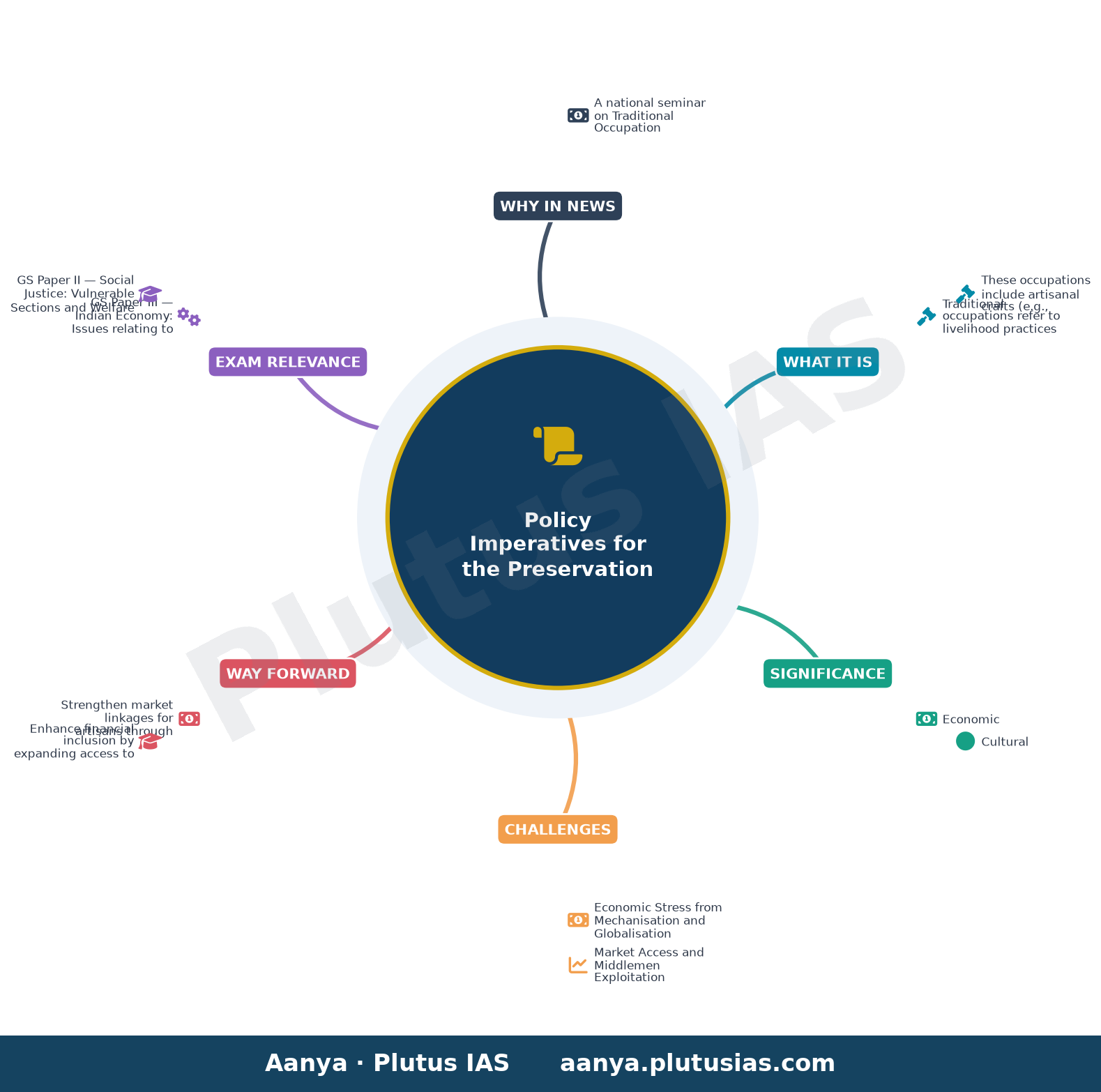
- GS Paper III — Indian Economy: Issues relating to Planning, Mobilisation of Resources, Growth, Development and Employment | GS Paper II — Social Justice: Vulnerable Sections and Welfare Schemes
- Prelims: Artisan communities, Social inclusion, Inclusive development, Middlemen exploitation, Constitutional safeguards, GST and customs, Mechanisation impact, Welfare measures
- Essay: The interplay between economic modernisation and cultural preservation: A case for inclusive policy design
Quick Revision: Traditional occupations in India are under threat from mechanisation and market distortions, necessitating policy interventions to ensure social inclusion, dignified livelihoods, and constitutional safeguards for artisans.
Why is this in the news?
A national seminar on Traditional Occupation Communities in a Changing Economy, held at Andhra University, underscored the urgent need for policy interventions to safeguard traditional livelihoods amid mechanisation, market distortions, and social exclusion. The event highlighted the economic vulnerability of artisans, with nearly 30% reportedly displaced from their occupations, and called for structural reforms to ensure dignified livelihoods and inclusive growth.
Background
- Traditional occupations in India, including handloom weaving, pottery, blacksmithing, and carpentry, are integral to the country’s cultural heritage and rural economy.
- Mechanisation and factory-produced goods have eroded the market for artisanal products, reducing demand and profitability for traditional artisans.
- Dependence on middlemen in supply chains exacerbates income disparities, as artisans often receive a fraction of the final sale price of their products.
- Welfare schemes such as the Pradhan Mantri Kaushal Vikas Yojana (PMKVY) and the National Handloom Development Programme (NHDP) have been implemented but face implementation gaps and limited reach.
- Social discrimination against certain artisan communities, particularly those from marginalised backgrounds, persists, further marginalising traditional livelihoods.
- The Constitution of India, through Articles 21 (Right to Life and Dignity), 41 (Right to Work), and 46 (Promotion of Educational and Economic Interests of Scheduled Castes, Scheduled Tribes, and Other Weaker Sections), provides a legal framework for safeguarding traditional occupations.
What are Traditional Occupations?
- Traditional occupations refer to livelihood practices passed down through generations, rooted in indigenous knowledge, skills, and cultural practices.
- These occupations include artisanal crafts (e.g., handloom weaving, pottery, metalwork), traditional agriculture, fishing, and indigenous healthcare practices.
- They are characterised by low mechanisation, high skill intensity, and strong community-based knowledge systems.
- Traditional occupations contribute significantly to India’s GDP, particularly in rural and semi-urban economies, while preserving cultural diversity and heritage.
- The decline of traditional occupations is linked to globalisation, urbanisation, and the dominance of mass-produced goods in markets.
- Artisans in traditional occupations often face precarious livelihoods due to irregular income, lack of access to credit, and inadequate infrastructure.
- The preservation of traditional occupations is essential for maintaining India’s intangible cultural heritage and ensuring inclusive economic growth.
- Policy interventions must address market access, skill upgradation, financial inclusion, and social empowerment to sustain these livelihoods.
Key Features
| Feature | Significance |
|---|---|
| Policy Support for Traditional Occupations | Ensures preservation of cultural heritage and sustainable livelihoods by addressing economic vulnerabilities of artisans and traditional workers. |
| Market Access and Middlemen Regulation | Reduces exploitation by intermediaries and enhances earnings through direct market linkages and fair pricing mechanisms. |
| Social Inclusion and Anti-Discrimination Measures | Promotes equitable participation in economic activities and safeguards marginalised communities from social exclusion. |
| Constitutional Safeguards for Livelihood Rights | Upholds Articles 19(1)(g) and 21 to protect occupational freedom and dignified living conditions for traditional workers. |
| Empowerment through Education and Skill Development | Enhances adaptability and competitiveness of traditional communities in evolving economic landscapes. |
Why it Matters
Economic
- Traditional occupations contribute significantly to India’s GDP, particularly in rural and semi-urban economies, through artisanal, handicraft, and indigenous production sectors.
- Preservation of these occupations sustains employment for millions, especially women and marginalised groups, in sectors like handloom, pottery, and traditional metalwork.
- Cultural and economic value of traditional products is a unique competitive advantage in global markets, particularly in niche segments like handmade textiles and handicrafts.
Cultural
- Traditional occupations are repositories of indigenous knowledge, craftsmanship, and cultural identity, forming an intangible cultural heritage protected under UNESCO conventions.
- They serve as living links to historical practices, fostering intergenerational transmission of skills and traditions.
- Cultural tourism and heritage conservation are directly linked to the viability of traditional occupations, enhancing local economies through sustainable tourism models.
Social
- Traditional occupational communities often face social discrimination, caste-based exclusion, and gender disparities, necessitating targeted policy interventions.
- Empowerment of these communities aligns with Sustainable Development Goals (SDG 8: Decent Work and Economic Growth, SDG 10: Reduced Inequalities).
- Inclusive development ensures equitable access to resources, markets, and opportunities, reducing socio-economic vulnerabilities.
Challenges
1. Economic Stress from Mechanisation and Globalisation
- Mechanisation and factory-produced goods undermine the competitiveness of traditional products, leading to declining demand and income erosion.
- Globalisation exposes artisans to low-cost imports and volatile market conditions, exacerbating economic instability.
- Irregular incomes and lack of financial buffers make traditional workers highly vulnerable to economic shocks.
UPSC Link: GS Paper 3: Indian Economy and issues relating to employment
2. Market Access and Middlemen Exploitation
- Dependence on middlemen results in exploitation, as intermediaries capture a disproportionate share of profits, leaving artisans with minimal earnings.
- Lack of direct market access limits visibility and bargaining power, forcing artisans to accept lower prices for their products.
- Inadequate infrastructure for storage, transportation, and e-commerce integration hampers market reach and scalability.
UPSC Link: GS Paper 3: Issues relating to MSMEs and informal sector
3. Social Discrimination and Caste-Based Exclusion
- Traditional occupational communities, particularly those from marginalised castes, face systemic discrimination in access to resources and opportunities.
- Social stigma associated with certain occupations perpetuates cycles of poverty and exclusion, limiting upward mobility.
- Lack of representation in policy-making bodies and institutions further marginalises these communities.
UPSC Link: GS Paper 1: Social empowerment and issues relating to vulnerable sections
4. Policy Implementation Gaps and Welfare Scheme Leakages
- Despite numerous welfare schemes, poor implementation, lack of awareness, and bureaucratic hurdles reduce their effectiveness.
- Leakages in fund disbursement and corruption divert resources away from intended beneficiaries, exacerbating socio-economic disparities.
- Fragmented policy frameworks and lack of convergence between central and state initiatives hinder holistic development.
UPSC Link: GS Paper 2: Governance and issues relating to development
5. Skill Erosion and Intergenerational Disengagement
- Declining interest among younger generations in traditional occupations due to perceived low income and lack of prestige reduces transmission of skills.
- Inadequate skill development programmes fail to modernise traditional practices, making them less competitive in contemporary markets.
- Absence of formal recognition of traditional skills in formal education systems devalues these occupations.
UPSC Link: GS Paper 3: Skill development and employment
Challenges — UPSC Perspective
| Issue | Concern |
|---|---|
| Mechanisation and Factory Production | Undermines competitiveness of traditional products, leading to declining demand and income erosion. |
| Middlemen Exploitation | Captures disproportionate profits, leaving artisans with minimal earnings and limited bargaining power. |
| Social Discrimination | Perpetuates cycles of poverty and exclusion, limiting access to resources and opportunities. |
| Policy Implementation Gaps | Poor execution and corruption reduce effectiveness of welfare schemes, exacerbating disparities. |
| Skill Erosion | Declining interest among youth reduces transmission of traditional knowledge and practices. |
| Market Access Constraints | Limited infrastructure and e-commerce integration restrict visibility and scalability of traditional products. |
Government Initiatives — Must-Memorise for Prelims
- Deendayal Antyodaya Yojana – National Urban Livelihoods Mission (DAY-NULM)
- Pradhan Mantri Kaushal Vikas Yojana (PMKVY)
- Handloom Weavers’ Comprehensive Welfare Scheme
- Stand Up India Scheme
- Skill India Mission
Way Forward
- Strengthen market linkages for artisans through e-commerce platforms, government procurement policies, and direct buyer-seller networks to eliminate middlemen exploitation.
- Enhance financial inclusion by expanding access to credit, insurance, and savings schemes tailored for traditional occupational communities.
- Implement skill development programmes that blend traditional craftsmanship with modern techniques to enhance competitiveness and sustainability.
- Establish dedicated grievance redressal mechanisms for artisans to address issues related to payments, quality control, and market access.
- Promote convergence between central and state welfare schemes to ensure holistic support, including housing, healthcare, and education.
- Encourage public-private partnerships to develop infrastructure for storage, transportation, and marketing of traditional products.
- Raise awareness through campaigns highlighting the cultural and economic value of traditional occupations to foster community pride and intergenerational engagement.
- Integrate traditional knowledge systems into formal education curricula to ensure recognition and preservation of indigenous skills.
UPSC Value Addition
Keywords for Mains Answer-Writing
Traditional occupations · inclusive development · social inclusion · artisan communities · policy support for livelihoods · Constitutional safeguards for marginalised groups · market access for traditional artisans · mechanisation and traditional livelihoods · Centre for Study of Social Inclusion (CSSI) · occupational freedom and dignified livelihoods · welfare measures for artisans · economic stress on traditional occupations · social discrimination and marginalisation
Constitutional & Policy Linkages
- Article 19(1)(g): Right to practise any profession, or to carry on any occupation, trade or business.
- Article 21: Right to life and personal liberty, including the right to a dignified livelihood.
- Article 46: Promotion of educational and economic interests of weaker sections of the people.
- Article 38: Directive Principle of State Policy promoting welfare of the people and reducing inequalities in income.
Concept Flow
Changing market conditions (mechanisation, globalisation) → Erosion of traditional livelihoods → Economic stress and declining incomes → Policy support gaps → Social exclusion and discrimination → Loss of cultural heritage and intergenerational skill erosion → Need for targeted interventions to restore viability and dignity of traditional occupations.
Prelims Practice Questions
Q1. Consider the following statements regarding traditional occupations in India:
1. Mechanisation and factory-made products have significantly reduced the economic viability of traditional occupations.
2. Nearly 30% of artisans have been pushed out of their traditional occupations due to changing market conditions.
3. The Centre for Study of Social Inclusion (CSSI) is a statutory body under the Ministry of Social Justice and Empowerment.
How many of the above statements are correct?
- Only one
- Only two
- All three
- None
Answer: All three — Statements 1 and 2 are correct as per the news report. Statement 3 is incorrect because CSSI is not a statutory body; it is an academic institution affiliated with Andhra University.
Q2. Assertion (A): The Constitution of India explicitly guarantees occupational freedom and dignified livelihoods to traditional occupational communities.
Reason (R): Articles 19(1)(g) and 21 of the Constitution provide the legal framework for occupational freedom and dignified livelihoods, respectively.
- Both A and R are true, and R is the correct explanation of A
- Both A and R are true, but R is NOT the correct explanation of A
- A is true, but R is false
- A is false, but R is true
Answer: Both A and R are true, but R is NOT the correct explanation of A — Assertion (A) is true as the Constitution guarantees occupational freedom under Article 19(1)(g) and the right to life and personal liberty under Article 21, which includes dignified livelihoods. Reason (R) correctly explains the constitutional basis for A.
Q3. Match the following traditional occupations with their associated challenges:
Column I (Traditional Occupation) | Column II (Challenge)
1. Handloom weaving | A. Dependence on middlemen and inadequate market access
2. Pottery | B. Mechanisation and factory-made alternatives
3. Blacksmithing | C. Lack of access to raw materials and modern tools
4. Folk art (e.g., Madhubani painting) | D. Social discrimination and cultural erosion
Select the correct match:
- 1-A, 2-B, 3-C, 4-D
- 1-B, 2-A, 3-C, 4-D
- 1-A, 2-C, 3-B, 4-D
- 1-D, 2-A, 3-C, 4-B
Answer: 1-A, 2-B, 3-C, 4-D — 1-A: Handloom weavers face dependence on middlemen and market access issues. 2-B: Pottery faces competition from mechanised alternatives. 3-C: Blacksmithing struggles with modern tools and raw material access. 4-D: Folk artists face social discrimination and cultural erosion.
Mains Practice Question
✍ The preservation of traditional occupations is not merely an economic imperative but a constitutional and cultural obligation. Critically examine the challenges faced by traditional occupational communities in India and the role of policy interventions in ensuring their social inclusion and economic sustainability. (15 Marks)
Approach: MODEL-ANSWER SKELETON:
1. **Introduction (2 marks)**: Define traditional occupations and their significance in India’s socio-economic fabric, citing the constitutional obligation under Articles 19(1)(g) (right to practice any profession) and 21 (right to life and dignity). Highlight their contribution to cultural heritage and inclusive development.
2. **Challenges (5 marks)**:
– **Economic pressures**: Mechanisation, factory-made alternatives, and irregular incomes (as cited in the news report).
– **Market distortions**: Dependence on middlemen, inadequate market access, and exploitation (e.g., low earnings for artisans).
– **Social barriers**: Discrimination, marginalisation, and lack of empowerment (e.g., caste-based occupational hierarchies).
– **Institutional gaps**: Weak implementation of welfare schemes (e.g., PM Vishwakarma Kaushal Samman, Stand-Up India) and lack of skilling programmes tailored to traditional trades.
3. **Policy Interventions (5 marks)**:
– **Constitutional safeguards**: Articles 19(1)(g), 21, and Directive Principles (Article 46: promotion of educational and economic interests of weaker sections).
– **Government schemes**: PM Vishwakarma Kaushal Samman (2023), Stand-Up India, Mudra Yojana, and GeM portal for artisans.
– **Institutional mechanisms**: Role of CSSI (Centre for Study of Social Inclusion) in research and advocacy; recommendations of the NITI Aayog’s ‘Strategy for New India @75’ for traditional industries.
– **Judicial precedents**: Supreme Court’s emphasis on occupational freedom (e.g., Common Cause v. Union of India, 2018) and right to livelihood (Olga Tellis v. Bombay Municipal Corporation, 1985).
4. **Critical Analysis (3 marks)**:
– **Gaps in implementation**: Despite schemes, challenges persist due to bureaucratic delays, lack of awareness, and inadequate funding.
– **Need for holistic approach**: Policies must integrate economic support (credit, market linkages) with social inclusion (education, anti-discrimination measures).
– **Balancing modernity and tradition**: Policies should promote innovation (e.g., digital platforms for artisans) without eroding traditional skills.
5. **Conclusion (2 marks)**: Reiterate the need for a multi-dimensional policy framework that aligns economic sustainability with constitutional and cultural imperatives, ensuring dignified livelihoods for traditional occupational communities.
Source: The Hindu
Generated by AanyaAi for educational purpose.

- केरल उच्च न्यायालय ने नौसेना नियमों में न्यायाधिकरण नियुक्त करने के नियम को बरकरार रखा - September 24, 2026
- Kerala HC upholds Navy rule: IO can be prosecutor in court-martial cases - September 24, 2026
- उत्तराखंड में मतदाता सूची मिलान: डीएसई-पीएसई अभियान शुरू, जानें प्रक्रिया - September 24, 2026

No Comments