


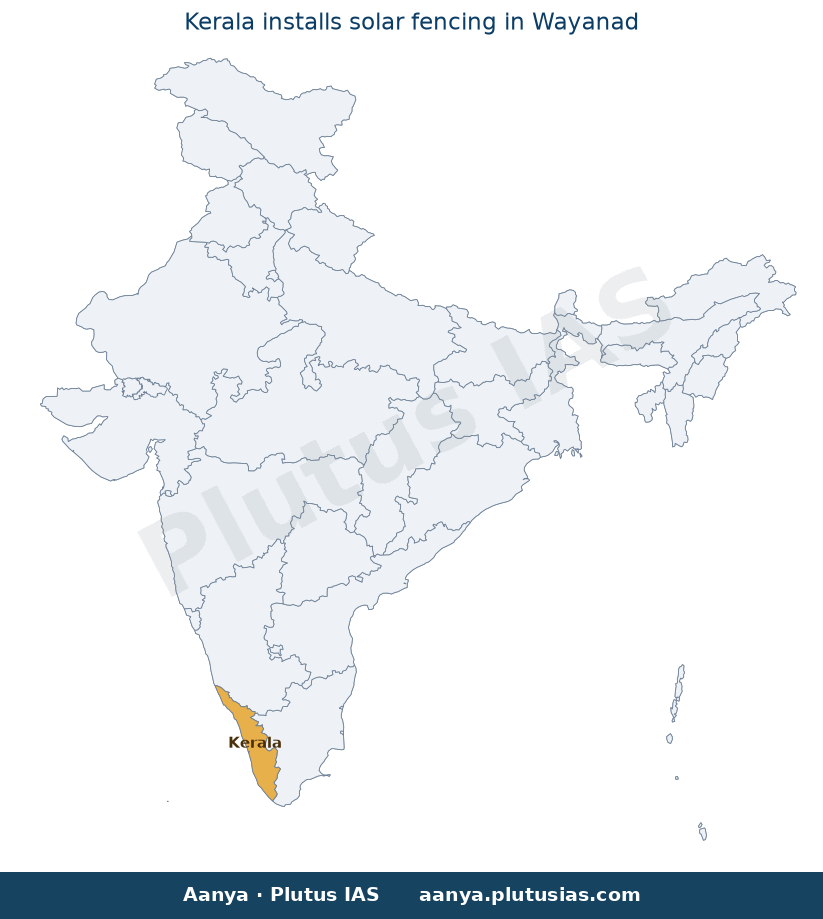
08 Aug Kerala to install 60 km solar fencing in Wayanad to curb human-wildlife conflict
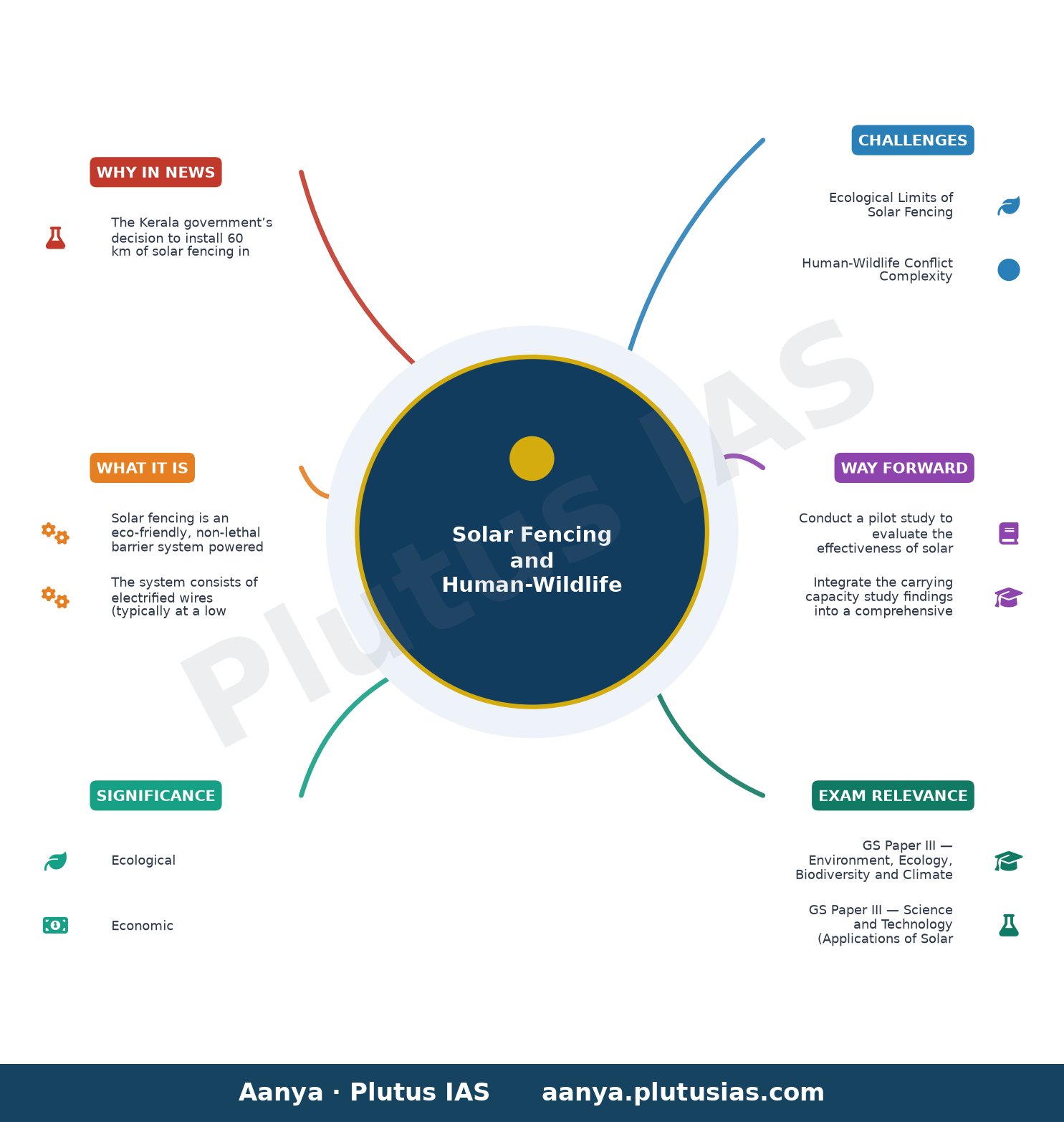
✎ Solar fencing is a non-lethal, solar-powered barrier system designed to deter wild animals from entering human settlements, thereby mitigating human-wildlife conflict while ensuring ecological sustainability.
Subject Relevance — Where This Topic Fits
- GS Paper III — Environment, Ecology, Biodiversity and Climate Change | GS Paper III — Science and Technology (Applications of Solar Energy) | GS Paper IV — Ethics in Governance (Public Participation and Stakeholder Coordination)
- Prelims: Solar fencing, Human-Wildlife Conflict (HWC), Waynad Wildlife Sanctuary, Wildlife Institute of India (WII), Carrying capacity of forests, Rapid Response Teams (RRTs), 100-day action programme, Forest fringes, Relocation of tigers, Adalats for forest-related disputes
- Essay: Human-Wildlife Conflict: Balancing Conservation and Livelihoods, Role of Technology in Sustainable Development: The Case of Solar Fencing in Wayanad
Quick Revision: Solar fencing is a non-lethal, solar-powered barrier system designed to deter wild animals from entering human settlements, thereby mitigating human-wildlife conflict while ensuring ecological sustainability.
Why is this in the news?
The Kerala government’s decision to install 60 km of solar fencing in Wayanad district, along with a comprehensive carrying capacity study by the Wildlife Institute of India (WII) and the deployment of Rapid Response Teams (RRTs), underscores the escalating human-wildlife conflict (HWC) in the region. This initiative is part of the State’s 100-day action programme and reflects a coordinated approach to mitigate conflicts while ensuring ecological balance and community participation. The announcement highlights the intersection of technological solutions, ecological research, and governance in addressing a critical conservation challenge.
Background
- Wayanad district in Kerala is one of the most ecologically sensitive regions in South India, harbouring significant populations of tigers, elephants, and other wildlife species within its forest fringes.
- The district has witnessed a sharp increase in human-wildlife conflict (HWC) due to the expansion of human settlements into forest peripheries, leading to crop depredation, property damage, and human casualties.
- Historically, traditional mitigation measures such as physical barriers, early warning systems, and compensation schemes have proven inadequate in addressing the scale and intensity of HWC in Wayanad.
- The Wildlife Institute of India (WII), a premier autonomous institution under the Ministry of Environment, Forest and Climate Change (MoEFCC), has been entrusted with conducting a carrying capacity study to assess the ecological sustainability of wildlife populations in Wayanad.
- The Kerala government’s 100-day action programme is a short-term, outcome-driven initiative aimed at addressing pressing environmental and social challenges through targeted interventions and stakeholder engagement.
What is Solar Fencing and How Does It Address Human-Wildlife Conflict?
- Solar fencing is an eco-friendly, non-lethal barrier system powered by solar energy, designed to deter wild animals from entering human settlements or agricultural fields without harming them.
- The system consists of electrified wires (typically at a low voltage of 5–10 kV) powered by solar panels, creating a psychological deterrent through mild electric shocks that do not cause injury or permanent harm to animals.
- Unlike conventional electric fences, solar fencing is sustainable, cost-effective, and requires minimal maintenance, making it ideal for remote and forested areas with limited access to grid electricity.
- Solar fencing has been successfully implemented in several Indian states, including Karnataka, Tamil Nadu, and Assam, to mitigate human-elephant conflicts and reduce crop raiding by wild boars and other herbivores.
- The technology is particularly effective in areas where wildlife corridors intersect with human habitation, as it allows for controlled movement of animals while preventing direct conflicts.
- Solar fencing is complemented by other measures such as habitat enrichment, community awareness campaigns, and compensation mechanisms to ensure holistic conflict mitigation.
- The deployment of solar fencing in Wayanad is part of a broader strategy that includes vegetation clearance along forest roads, the establishment of Rapid Response Teams (RRTs), and the organisation of adalats (local dispute resolution forums) to address pending complaints.
- The initiative also underscores the importance of inter-departmental coordination, involving the Forest Department, local self-government institutions, and public vigilance committees, to ensure its success.
Key Features
| Feature | Significance |
|---|---|
| Installation of 60 km solar fencing | Mitigates human-wildlife conflict by creating a non-lethal barrier between forest fringes and human settlements, reducing crop raiding and property damage. |
| Repair of existing 25 km solar fencing | Enhances the effectiveness of existing infrastructure to ensure continuous protection against wildlife incursions. |
| Carrying capacity study by Wildlife Institute of India (WII) | Assesses the ecological limits of Wayanad’s forests to balance wildlife populations with human habitation and resource availability. |
| Deployment of four Rapid Response Teams | Strengthens emergency response capabilities for immediate mitigation of human-wildlife conflicts and wildlife-related emergencies. |
| Vegetation clearance along 100 km of forest department roads | Improves visibility and accessibility for forest patrols, reducing ambush risks and enhancing monitoring efficiency. |
Why it Matters
Ecological
- Promotes coexistence between human communities and wildlife by reducing retaliatory killings and habitat fragmentation.
- Supports biodiversity conservation by maintaining ecological integrity of Wayanad’s forests, a critical tiger and elephant habitat.
- Enables systematic assessment of wildlife populations (tigers and elephants) to inform evidence-based conservation policies.
Economic
- Reduces financial losses incurred by farmers due to crop depredation by wild animals, thereby improving rural livelihoods.
- Lowers the economic burden on the state exchequer by minimizing compensation payouts for wildlife-induced damages.
- Enhances agricultural productivity by protecting crops from wildlife incursions, contributing to food security.
Social
- Fosters community trust in state-led conservation initiatives by addressing immediate threats to human safety and livelihoods.
- Encourages participatory governance through coordination among farmers, forest officials, and local self-government institutions.
- Mitigates human-wildlife conflict-induced migration or displacement by securing human settlements near forest boundaries.
Administrative
- Demonstrates proactive governance through structured 100-day action plans and inter-departmental collaboration.
- Sets a precedent for integrating scientific research (WII study) into policy formulation for wildlife management.
- Enhances institutional capacity by upgrading equipment for forest watchers and deploying specialized response teams.
Challenges
1. Ecological Limits of Solar Fencing
- Solar fencing may disrupt wildlife movement corridors, particularly for wide-ranging species like elephants, potentially leading to habitat fragmentation.
- High maintenance requirements due to vegetation overgrowth or technical failures, necessitating sustained funding and manpower.
- Limited effectiveness in densely forested or hilly terrains where fencing installation is logistically challenging.
UPSC Link: GS3: Conservation, Environmental Pollution
2. Human-Wildlife Conflict Complexity
- Underlying causes such as habitat loss, encroachment into forest areas, and resource scarcity are not addressed by fencing alone.
- Retaliatory killings and poaching may persist if communities perceive fencing as inadequate or if compensation mechanisms remain weak.
- Cultural and socio-economic factors, including traditional land-use practices, may hinder the acceptance of fencing solutions.
UPSC Link: GS3: Animal Husbandry, Wildlife Protection Act
3. Implementation and Coordination Gaps
- Coordination among multiple stakeholders (forest department, local bodies, farmers) may face bureaucratic or logistical delays.
- Ensuring equitable benefit-sharing among affected communities, especially marginalized groups, remains a persistent challenge.
- Monitoring and evaluation mechanisms to assess the long-term impact of fencing on wildlife behavior and human-wildlife conflict reduction are often lacking.
UPSC Link: GS2: Governance, Decentralization
4. Scientific and Technical Constraints
- Carrying capacity studies are time-consuming and may not account for dynamic ecological changes, such as climate-induced shifts in wildlife distribution.
- Limited expertise in India for large-scale deployment of solar fencing in ecologically sensitive zones like Wayanad.
- Data gaps on wildlife population dynamics and human-wildlife interaction patterns may undermine the effectiveness of interventions.
UPSC Link: GS3: Environmental Impact Assessment
Challenges — UPSC Perspective
| Issue | Concern |
|---|---|
| Habitat fragmentation | Solar fencing may isolate wildlife populations, reducing genetic diversity and increasing vulnerability to extinction. |
| Community resistance | Farmers may oppose fencing due to perceived loss of access to forest resources or cultural practices. |
| Technical failures | Solar fencing systems are prone to damage from wildlife, weather, or human interference, requiring constant repairs. |
| Compensation delays | Weak or delayed compensation mechanisms for wildlife-induced damages may erode trust in government initiatives. |
| Monitoring challenges | Real-time tracking of wildlife movements post-fencing installation is difficult without advanced technology. |
Way Forward
- Conduct a pilot study to evaluate the effectiveness of solar fencing in reducing human-wildlife conflict before scaling up the project.
- Integrate the carrying capacity study findings into a comprehensive wildlife management plan for Wayanad, including habitat restoration and corridor mapping.
- Strengthen compensation mechanisms by digitizing claim processes and ensuring timely disbursement to affected communities.
- Launch awareness campaigns to educate farmers and local communities on the benefits of solar fencing and participatory conservation models.
- Collaborate with research institutions (e.g., WII) to develop adaptive management strategies based on real-time wildlife movement data.
- Establish a dedicated fund for maintenance and upgrades of solar fencing infrastructure to ensure long-term sustainability.
- Promote alternative livelihoods (e.g., eco-tourism, organic farming) to reduce dependence on forest resources and minimize human-wildlife interactions.
UPSC Value Addition
Keywords for Mains Answer-Writing
Human-Wildlife Conflict (HWC) · Solar fencing technology · Waynad district ecological context · Wildlife Institute of India (WII) · Carrying capacity of forests · Forest fringe human settlements · 100-day action programme · Rapid Response Teams in wildlife management · Relocation of tigers · Community-based conservation models · Wildlife Protection Act, 1972 · National Wildlife Action Plan (NWAP) 2017-2031
Concept Flow
Human settlements encroaching into forest fringes → Increased human-wildlife interactions → Escalation of crop raiding and property damage → Retaliatory killings and habitat fragmentation → State intervention via solar fencing → Short-term reduction in conflict → Long-term ecological and social sustainability challenges → Need for integrated wildlife management and community participation.
Prelims Practice Questions
Q1. Consider the following statements regarding human-wildlife conflict (HWC) in India:
1. Solar fencing is an electrical barrier that deters wild animals without causing permanent harm.
2. The Wildlife Protection Act, 1972, mandates the relocation of all conflict-prone wild animals to designated reserves.
3. The National Wildlife Action Plan (NWAP) 2017-2031 prioritises mitigation of HWC through technological interventions.
How many of the above statements are correct?
- Only one
- Only two
- All three
- None
Answer: All three — Statements 1 and 3 are correct. Statement 2 is incorrect as the Wildlife Protection Act, 1972 does not mandate relocation of all conflict-prone animals; relocation is case-specific and governed by ecological assessments.
Q2. Assertion (A): The Wildlife Institute of India (WII) conducts carrying capacity studies to assess the maximum sustainable population of wildlife species in a given habitat.
Reason (R): Carrying capacity studies are essential for mitigating human-wildlife conflict by ensuring ecological balance and reducing pressure on forest fringes.
Options:
A. Both A and R are true, and R is the correct explanation of A.
B. Both A and R are true, but R is not the correct explanation of A.
C. A is true, but R is false.
D. A is false, but R is true.
Answer: ? — Both Assertion (A) and Reason (R) are true, and R correctly explains A. Carrying capacity studies by WII determine sustainable wildlife populations, which directly informs HWC mitigation strategies.
Q3. Match the following pairs related to wildlife conservation in India:
Column I
1. Solar fencing
2. Carrying capacity study
3. Rapid Response Teams
4. Relocation of tigers
Column II
A. Wildlife Institute of India
B. Wildlife Protection Act, 1972
C. Technological intervention for deterrence
D. Emergency wildlife management
Options:
A. 1-C, 2-A, 3-D, 4-B
B. 1-A, 2-B, 3-C, 4-D
C. 1-D, 2-C, 3-B, 4-A
D. 1-B, 2-D, 3-A, 4-C
Answer: ? — Correct match: 1-C (Solar fencing is a technological intervention), 2-A (Carrying capacity studies are conducted by WII), 3-D (Rapid Response Teams are for emergency wildlife management), 4-B (Relocation of tigers is governed by the Wildlife Protection Act, 1972).
Mains Practice Question
✍ Human-wildlife conflict (HWC) in India has intensified due to anthropogenic pressures on forest fringes. Critically examine the efficacy of technological interventions such as solar fencing in mitigating HWC, with special reference to the Wayanad initiative. Also, analyse the role of carrying capacity studies in sustainable wildlife management. (15 Marks)
Approach: MODEL-ANSWER SKELETON:
1. **Introduction (2 Marks)**: Define HWC and its drivers (deforestation, agricultural expansion, fragmentation of habitats). Mention Wayanad as a microcosm of this crisis in Kerala.
2. **Technological Interventions (5 Marks)**:
– **Solar fencing**: Mechanism (electrical deterrence without harm), advantages (cost-effective, low maintenance), limitations (power dependency, animal habituation).
– **Waynad initiative**: 60 km installation + repair of 25 km existing fencing under 100-day action plan; coordination with Rapid Response Teams.
– **Critique**: Short-term solution; does not address root causes (habitat loss, encroachment). Cite examples from other states (e.g., Tamil Nadu’s solar fencing in Coimbatore).
3. **Carrying Capacity Studies (5 Marks)**:
– **Role of WII**: Methodology (population density, resource availability, ecological thresholds).
– **Link to HWC**: Determines sustainable wildlife populations; informs relocation/translocation policies (e.g., Project Tiger guidelines).
– **Limitations**: Static nature of studies; dynamic ecological changes (climate change, invasive species) not fully captured.
4. **Sustainable Wildlife Management (3 Marks)**:
– **Multi-pronged approach**: Habitat restoration, community participation (e.g., eco-development committees), compensation mechanisms (Wildlife Protection Act, 1972, Section 66).
– **Waynad’s 100-day plan**: Vegetation clearance along forest roads, adalats for grievance redressal.
– **Conclusion**: Technological solutions are necessary but insufficient; must be integrated with ecological and socio-economic measures. Emphasise the need for long-term policy coherence (National Wildlife Action Plan 2017-2031).
Source: The Hindu
Generated by AanyaAi for educational purpose.

- महाराष्ट्र में त्योहार जुलूसों पर बॉम्बे हाईकोर्ट का बड़ा फैसला: पटाखे, लेजर और संगीत पर रोक - September 24, 2026
- Bombay HC Bans Firecrackers, Music in Maharashtra Processions: Key UPSC Analysis - September 24, 2026
- तमिलनाडु में महिला कर्मचारियों के लिए सवैतनिक माहवारी अवकाश नीति पर HC का आदेश - September 24, 2026

No Comments