


08 Aug Andhra Pradesh-Australia MoUs: Boosting Clean Energy & Education for UPSC 2026
✎ The Andhra Pradesh-Australia MoUs of August 2026 represent a strategic convergence of clean energy innovation, inclusive education, and skill development, positioning Andhra Pradesh as a key player in India’s renewable energy…
Subject Relevance — Where This Topic Fits
- GS Paper II — International Relations (Bilateral Agreements, Soft Power, Global Partnerships) | GS Paper III — Economy (Renewable Energy, Skill Development, Advanced Manufacturing, FDI)
- Prelims: Memorandum of Understanding (MoU), Centre of Excellence (CoE), Solar Manufacturing, Neurodiverse Learning, Skill Development, Clean Energy Transition, Foreign Direct Investment (FDI), Renewable Energy Capacity
- Essay: India’s Renewable Energy Transition: Opportunities and Challenges, Global Partnerships in Higher Education and Skill Development: A Pathway to Inclusive Growth
Quick Revision: The Andhra Pradesh-Australia MoUs of August 2026 represent a strategic convergence of clean energy innovation, inclusive education, and skill development, positioning Andhra Pradesh as a key player in India’s renewable energy transition and global educational partnerships.
Why is this in the news?
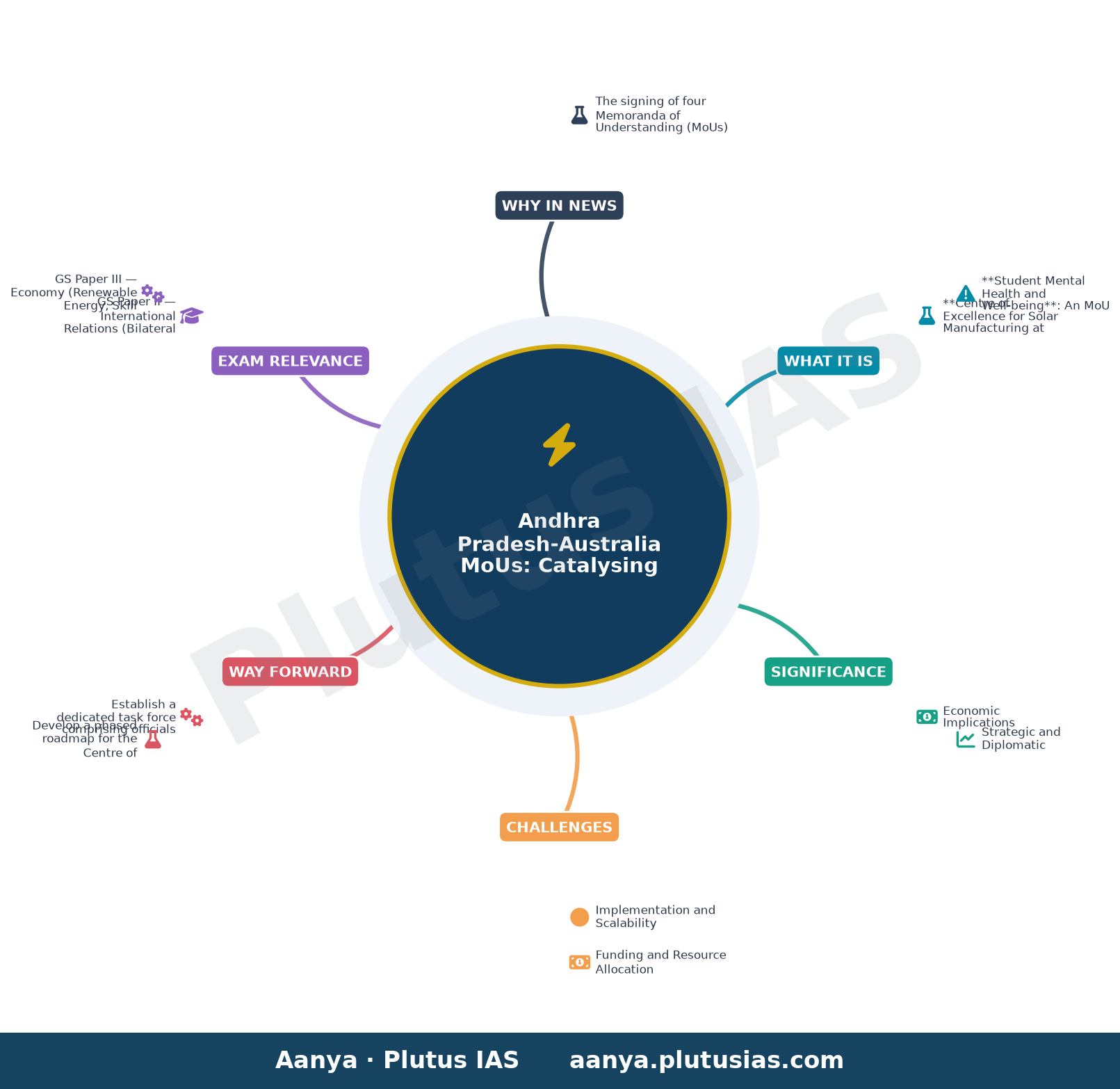
The signing of four Memoranda of Understanding (MoUs) between Andhra Pradesh and Australia on August 8, 2026, marks a significant stride in bilateral cooperation, focusing on clean energy, advanced manufacturing, inclusive education, and skill development. These agreements, signed in the presence of senior ministers from both regions, underscore Andhra Pradesh’s ambition to emerge as a global hub for solar manufacturing and research, while also addressing critical gaps in inclusive education and workforce development. The initiatives are strategically aligned with India’s broader renewable energy targets and the State’s economic growth trajectory, making them a pivotal development in India’s clean energy transition and international educational collaborations.
Background
- The State’s Centre of Excellence for Energy Transition (CoEET) serves as a nodal agency for research, innovation, and policy formulation in clean energy, collaborating with national and international institutions.
- Australia, a global leader in renewable energy technologies and research, has been actively seeking international partnerships to expand its influence in the Indo-Pacific region, particularly in the clean energy sector.
- The bilateral relationship between India and Australia has strengthened in recent years, with a focus on education, trade, and technology transfer, as evidenced by the India-Australia Comprehensive Economic Cooperation Agreement (CECA) negotiations.
- The visit of Australia’s Assistant Minister for International Education and Citizenship, Julian Hill, to Amaravati in August 2026, reflects the growing strategic importance of Andhra Pradesh in India’s economic and educational landscape.
- The MoUs follow discussions initiated by Andhra Pradesh’s Minister for Education, IT, and Electronics, Nara Lokesh, during his visit to Australia in October 2025, highlighting the State’s proactive approach to international collaborations.
Key Features of the Andhra Pradesh-Australia MoUs
- **Centre of Excellence for Solar Manufacturing at IIT-Tirupati**: A tripartite MoU between the State’s CoEET, IIT-Tirupati, and the University of New South Wales (UNSW) Sydney to establish a dedicated centre for solar manufacturing. The CoE will focus on cutting-edge research, technology development, and workforce training, aligning with Andhra Pradesh’s clean energy ambitions and India’s renewable energy targets.
- **Student Mental Health and Well-being**: An MoU to develop frameworks for mental health support in educational institutions, addressing the growing concerns of student stress and anxiety in higher education, particularly in STEM fields.
- **Skill Development and Advanced Manufacturing**: Agreements to foster joint research, faculty exchange programmes, and industry-academia collaborations in advanced manufacturing, with a focus on skill development for the green economy. This includes training programmes for engineers, technicians, and entrepreneurs in solar energy, battery storage, and allied sectors.
- **Research and Innovation Ecosystem**: The partnerships aim to create a robust research ecosystem by leveraging UNSW’s expertise in renewable energy and IIT-Tirupati’s strengths in engineering and technology. This includes joint laboratories, pilot projects, and industry-linked internships for students.
- **Governance and Implementation Framework**: The agreements include provisions for regular monitoring, joint steering committees, and periodic reviews to ensure the timely and effective implementation of the outlined initiatives.
- **Cultural and Diplomatic Exchange**: The visit of the Australian delegation, including the ceremonial presentation of a traditional shawl and Araku Coffee, underscores the cultural diplomacy aspect of the agreements, strengthening people-to-people ties between the two regions.
Key Features
| Feature | Significance |
|---|---|
| Centre of Excellence for Solar Manufacturing at IIT-Tirupati | Establishes a dedicated research and innovation hub for solar energy, fostering indigenous technology development and workforce training to support India’s clean energy transition. |
| MoU for inclusive education | Focuses on teacher training and support systems for neurodiverse learners, enhancing equitable access to quality education in Andhra Pradesh. |
| Skill development partnership | Aims to align vocational training with industry needs, particularly in clean energy and advanced manufacturing sectors, to create a skilled workforce. |
| Student mental health initiative | Introduces collaborative frameworks to address psychological well-being of students, ensuring holistic development in educational institutions. |
| Bilateral investment facilitation | Strengthens economic ties between Andhra Pradesh and Australia, promoting foreign direct investment in innovation-driven sectors. |
Why it Matters
Economic Implications
- Andhra Pradesh positions itself as a global hub for clean energy innovation, attracting investments and fostering high-tech manufacturing industries.
- Skill development initiatives will bridge the gap between academic training and industry requirements, enhancing employability in emerging sectors.
- Strengthened bilateral ties with Australia may lead to technology transfer, joint ventures, and export opportunities in renewable energy and advanced manufacturing.
Strategic and Diplomatic
- The agreements reinforce India’s commitment to global climate goals under the Paris Agreement by accelerating solar energy adoption.
- Deepens strategic partnerships with Australia, a key player in clean energy and education, enhancing India’s geopolitical influence in the Indo-Pacific region.
- Demonstrates Andhra Pradesh’s proactive approach to international collaboration, setting a precedent for other Indian states.
Educational and Social
- Inclusive education initiatives will improve learning outcomes for neurodiverse students, aligning with the Rights of Persons with Disabilities Act, 2016.
- Research collaborations between IIT-Tirupati and UNSW will elevate India’s position in global academic rankings and innovation ecosystems.
- Student mental health programs address a critical yet often overlooked aspect of educational policy, promoting holistic well-being.
Challenges
1. Implementation and Scalability
- Ensuring seamless integration of research outcomes into industrial applications to avoid academic-industry disconnect.
- Scaling skill development programs to meet the demand of a rapidly evolving job market in clean energy and advanced manufacturing.
- Addressing language and cultural barriers in inclusive education initiatives to ensure equitable participation.
UPSC Link: GS Paper 2: Governance
2. Funding and Resource Allocation
- Securing sustained financial resources for long-term research and infrastructure development at the Centre of Excellence.
- Balancing public and private sector investments to avoid over-reliance on foreign funding, which may pose sovereignty concerns.
UPSC Link: GS Paper 3: Economy
3. Policy Coordination
- Aligning state-level policies with national initiatives such as the National Education Policy (NEP) 2020 and the National Skill Development Mission.
- Ensuring inter-departmental coordination between education, energy, and skill development ministries to avoid siloed implementation.
UPSC Link: GS Paper 2: Polity
4. Technology Transfer and IPR
- Navigating intellectual property rights (IPR) frameworks to facilitate equitable technology transfer and commercialization.
- Overcoming regulatory hurdles in cross-border collaborations to expedite project execution.
UPSC Link: GS Paper 3: Science & Tech
Challenges — UPSC Perspective
| Issue | Concern |
|---|---|
| Long-term funding sustainability | Risk of project discontinuation due to budgetary constraints or political changes. |
| Industry-academia collaboration gaps | Potential mismatch between academic research outputs and industry expectations. |
| Regulatory compliance in technology transfer | Delays in approvals and legal frameworks for joint ventures and IPR sharing. |
| Inclusive education accessibility | Ensuring reach to rural and marginalized communities, particularly in remote areas of Andhra Pradesh. |
| Skill development relevance | Adapting training programs to rapid technological advancements in clean energy and manufacturing. |
Way Forward
- Establish a dedicated task force comprising officials from education, energy, and skill development ministries to oversee implementation and address bottlenecks.
- Develop a phased roadmap for the Centre of Excellence, prioritizing high-impact research areas such as perovskite solar cells and energy storage systems.
- Launch pilot programs in inclusive education and student mental health, with measurable KPIs for scalability and replication across other states.
- Facilitate industry-led workshops and internships to bridge the skill gap, involving Australian and Indian companies in curriculum design.
- Strengthen IPR frameworks through bilateral agreements to ensure fair and transparent technology transfer mechanisms.
- Conduct periodic reviews of MoU progress with stakeholders, including academic institutions, industry partners, and civil society organizations.
- Promote public-private partnerships (PPPs) to attract investment in clean energy infrastructure and vocational training centers.
- Enhance digital infrastructure to support remote learning and research collaborations, leveraging India’s growing digital ecosystem.
UPSC Value Addition
Keywords for Mains Answer-Writing
Andhra Pradesh-Australia MoUs · Centre of Excellence for Solar Manufacturing · clean energy transition · IIT-Tirupati · University of New South Wales · inclusive education · neurodiverse learning needs · skill development partnerships · Centre of Excellence for Energy Transition · State-led innovation ecosystems · bilateral education cooperation · advanced manufacturing
Concept Flow
Bilateral MoUs signed between Andhra Pradesh and Australia → Focus on clean energy, education, and skill development. → Establishment of Centre of Excellence for Solar Manufacturing at IIT-Tirupati → Drives research, innovation, and workforce development. → Inclusive education initiatives → Training teachers to support neurodiverse learners, aligning with disability rights frameworks. → Skill development programs → Align vocational training with industry needs in clean energy and advanced manufacturing. → Strengthened bilateral ties → Enhances India’s strategic position in the Indo-Pacific and accelerates climate action. → Implementation challenges → Requires coordinated policy efforts, funding, and regulatory support for sustained impact.
Prelims Practice Questions
Q1. Consider the following statements regarding the Centre of Excellence for Solar Manufacturing established under the recent Andhra Pradesh-Australia MoUs:
1. It is a collaboration between IIT-Tirupati and the University of New South Wales, Sydney.
2. The Centre is exclusively focused on theoretical research in solar energy.
3. The initiative aligns with Andhra Pradesh’s broader clean energy transition goals.
How many of the above statements are correct?
- Only one
- Only two
- All three
- None
Answer: All three — Statement 1 is correct as the MoU explicitly names IIT-Tirupati and UNSW Sydney as partners. Statement 2 is incorrect because the Centre aims to drive both research and technology development, not just theoretical research. Statement 3 is correct as the initiative supports Andhra Pradesh’s renewable energy ambitions.
Q2. Assertion (A): The recent Andhra Pradesh-Australia MoUs include provisions for strengthening inclusive education.
Reason (R): One of the MoUs specifically targets improving teacher capacity to support children with autism and other neurodiverse learning needs.
In the context of the above two statements, which one of the following is correct?
- Both A and R are true, and R is the correct explanation of A.
- Both A and R are true, but R is not the correct explanation of A.
- A is true, but R is false.
- A is false, but R is true.
Answer: Both A and R are true, but R is not the correct explanation of A. — Assertion (A) is true as the MoUs include provisions for inclusive education. Reason (R) is also true and correctly explains (A) by citing the specific MoU on neurodiverse learning needs.
Q3. Which of the following institutions is NOT a signatory to the MoU establishing the Centre of Excellence for Solar Manufacturing in Andhra Pradesh?
- Indian Institute of Technology-Tirupati
- University of New South Wales, Sydney
- Centre of Excellence for Energy Transition (CoEET), Andhra Pradesh
- Sri Padmavati Mahila Visvavidyalayam
Answer: Sri Padmavati Mahila Visvavidyalayam — The Centre of Excellence for Solar Manufacturing is established through an MoU between IIT-Tirupati, the University of New South Wales (UNSW), Sydney, and the Centre of Excellence for Energy Transition (CoEET), Andhra Pradesh. Sri Padmavati Mahila Visvavidyalayam is a signatory to a separate MoU on inclusive education.
Mains Practice Question
✍ The recent Andhra Pradesh-Australia MoUs represent a strategic partnership model for advancing clean energy, education, and skill development. Critically analyse the significance of such bilateral collaborations in fostering innovation ecosystems and achieving sustainable development goals. (15 Marks)
Approach: MODEL-ANSWER SKELETON:
1. **Introduction (2 marks)**: Define bilateral collaborations and innovation ecosystems; contextualise with the Andhra Pradesh-Australia MoUs as a case study.
2. **Significance of Bilateral Collaborations (5 marks)**:
– **Technology Transfer and R&D**: Cite the Centre of Excellence for Solar Manufacturing (IIT-Tirupati + UNSW) as an example of joint research, advanced manufacturing, and workforce development.
– **Skill Development**: Highlight the role of MoUs in creating a skilled workforce aligned with global standards (e.g., clean energy, advanced manufacturing).
– **Inclusive Education**: Discuss the MoU on neurodiverse learning needs as a step toward equitable education.
– **Economic Growth and Investment**: Link partnerships to State-led economic development and foreign direct investment (FDI) attraction.
3. **Challenges and Limitations (4 marks)**:
– **Implementation Gaps**: Potential delays in execution due to bureaucratic hurdles or funding constraints.
– **Sustainability**: Long-term viability of partnerships post-MoU phase.
– **Equity Concerns**: Ensure benefits reach marginalised sections, especially in inclusive education.
4. **Comparative Perspective (2 marks)**: Compare with other successful bilateral partnerships (e.g., India-France in solar energy, India-Germany in vocational training).
5. **Conclusion (2 marks)**: Summarise the transformative potential of such collaborations while acknowledging the need for robust monitoring and policy support.
Source: The Hindu
Generated by AanyaAi for educational purpose.

- हैती: UN में PM ने कहा- अंतरराष्ट्रीय बल की पूरी मदद ज़रूरी, सुरक्षा बलों को मज़बूत करना होगा - September 26, 2026
- Haiti’s PM Urges UN for Full Backing Against Gangs at UNGA 2026 - September 26, 2026
- सुपर एल नीनो: 4.51 लाख अतिरिक्त मौतों के अनुमान की गणना कैसे हुई? - September 26, 2026

No Comments