


08 Aug Andhra Pradesh Faces 52.4% Rainfall Deficit: Drought Looms for UPSC 2026
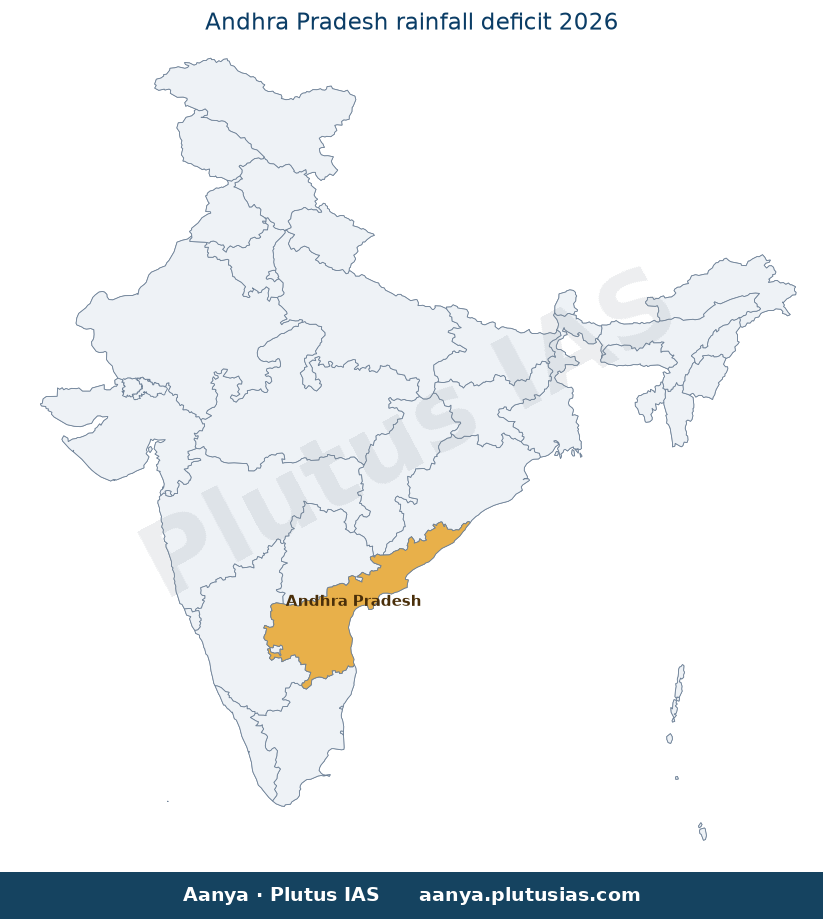
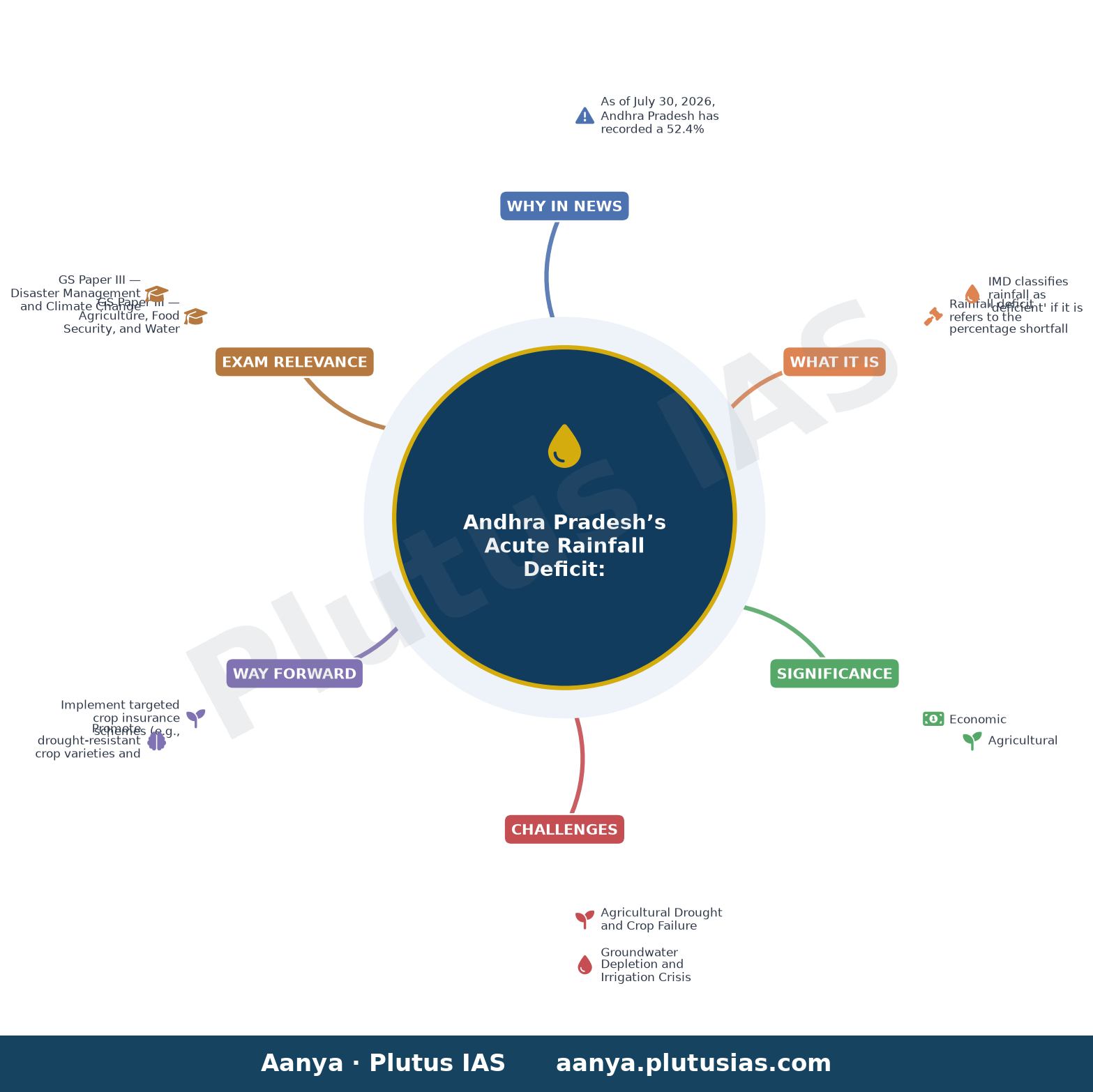
✎ As of July 30, 2026, Andhra Pradesh has recorded a 52.4% rainfall deficit, with no district reporting normal rainfall, triggering concerns over agricultural output, water scarcity, and rural livelihoods.
Subject Relevance — Where This Topic Fits
- GS Paper III — Agriculture, Food Security, and Water Resources | GS Paper III — Disaster Management and Climate Change
- Prelims: Rainfall deficit, IMD classification of drought, El Niño, Krishna and Godavari basins, Andhra Pradesh Drought Declaration Policy, Mahatma Gandhi National Rural Employment Guarantee Scheme (MGNREGS), Pradhan Mantri Fasal Bima Yojana (PMFBY), National Agricultural Cooperative Marketing Federation of India (NAFED), Integrated Watershed Management Programme (IWMP), State Action Plan on Climate Change
- Essay: Climate Change and Agricultural Resilience in India, Federalism and Disaster Management: Lessons from Andhra Pradesh
Why is this in the news?
As of July 30, 2026, Andhra Pradesh has recorded a 52.4% rainfall deficit, with no district reporting normal rainfall, triggering concerns over agricultural output, water scarcity, and rural livelihoods. The deficit, exacerbated by the absence of significant monsoon activity despite a deep depression in the Bay of Bengal, has prompted calls for drought declarations and comprehensive relief measures. The situation underscores the vulnerability of rainfed agriculture in the state and the need for adaptive policy frameworks in the context of climate variability.
Background
- Andhra Pradesh is predominantly agrarian, with 60% of its net sown area dependent on rainfall, particularly in the Krishna and Godavari basins.
- The state receives 75% of its annual rainfall during the southwest monsoon (June–September), making deficits critical for kharif crops like paddy, groundnut, and pulses.
- The current deficit of 52.4% is among the highest in recent decades, surpassing the threshold for drought conditions as per the India Meteorological Department (IMD) classification.
- The El Niño-Southern Oscillation (ENSO) phenomenon has been linked to reduced monsoon rainfall in peninsular India, with a 60% probability of El Niño conditions persisting through 2026.
- Historically, Andhra Pradesh has declared droughts in 2015–16 and 2018–19, with the latter leading to the implementation of the Andhra Pradesh Drought Declaration Policy.
- The state’s water infrastructure, including major and medium irrigation projects like the Polavaram and Srisailam dams, is designed to mitigate short-term deficits, but prolonged dry spells strain storage levels.
What is Rainfall Deficit and How is it Classified?
- Rainfall deficit refers to the percentage shortfall in actual rainfall compared to the Long Period Average (LPA), calculated over a 50-year baseline by the IMD.
- IMD classifies rainfall as ‘deficient’ if it is 20–59% below LPA.
- A cumulative deficit of 25% or more across a meteorological sub-division (e.g., Coastal Andhra Pradesh, Rayalaseema) triggers drought-like conditions, necessitating state interventions.
- The deficit is monitored at the district level, with mandals (sub-district units) also tracked for localized drought declarations under the Andhra Pradesh Drought Declaration Policy.
- Rainfall data is sourced from the Directorate of Economics and Statistics (DES) and IMD’s Automatic Weather Stations (AWS) network, ensuring real-time updates.
- The deficit’s impact is assessed using the Standardized Precipitation Index (SPI), which quantifies meteorological drought severity over 1, 3, 6, or 12-month scales.
- Deficient rainfall disrupts the soil moisture regime, delaying sowing, reducing crop yields, and increasing pest incidences, particularly in rainfed regions.
- The deficit also affects groundwater recharge, with implications for drinking water supply and irrigation in the rabi season.
Key Features
| Feature | Significance |
|---|---|
| Rainfall Deficit of 52.4% | Indicates severe hydrological stress, disrupting agricultural cycles, water availability, and socio-economic stability in Andhra Pradesh. |
| Districts with Large Deficit (Prakasam, East Godavari, Visakhapatnam, Annamayya, Chittoor) | High vulnerability in major agricultural and coastal districts, threatening kharif sowing and livelihoods. |
| El Niño Threat | Increases probability of prolonged deficient rainfall, compounding drought risks and necessitating adaptive agricultural and water management strategies. |
| Deep Depression over Bay of Bengal (Odisha/Chhattisgarh) | Shifts monsoon dynamics away from Andhra Pradesh, reducing rainfall prospects and exacerbating deficit conditions. |
| Surface Winds (40-50 kmph) in Coastal Andhra & Rayalaseema | Indicates high evaporation rates and potential for soil moisture loss, further stressing rainfed agriculture. |
Why it Matters
Economic
- Disruption of kharif sowing cycle may reduce agricultural output, impacting GDP growth and rural incomes.
- Increased reliance on groundwater for irrigation raises long-term sustainability concerns and energy costs for farmers.
- Potential rise in food inflation due to reduced crop yields, affecting inflation targeting and monetary policy.
Agricultural
- Delayed or failed sowing in rainfed areas threatens food security and farmer livelihoods, particularly in districts like Prakasam and Chittoor.
- Livestock and dairy sectors face feed shortages, reducing productivity and income for marginal farmers.
- Increased pest and disease incidence in stressed crops due to suboptimal rainfall conditions.
Environmental
- Groundwater depletion accelerates, risking long-term water security and ecosystem degradation in aquifer-dependent regions.
- Reduced river flows and reservoir levels threaten hydroelectric power generation and urban water supply.
Social
- Migration pressures may rise as rural households seek alternative livelihoods due to crop failures.
- Increased indebtedness among farmers due to higher input costs (e.g., diesel for groundwater pumping) and lower yields.
Challenges
1. Agricultural Drought and Crop Failure
- Failure of kharif sowing in rainfed areas may lead to zero or minimal yields, threatening food security.
- Livestock mortality and reduced milk production due to fodder shortages in deficit districts.
UPSC Link: GS3: Drought Management and Farmer Welfare
2. Groundwater Depletion and Irrigation Crisis
- Over-reliance on groundwater for irrigation during deficient rainfall depletes aquifers, risking long-term agricultural sustainability.
- Increased energy costs for farmers due to deeper borewells and higher electricity consumption for pumping.
UPSC Link: GS3: Water Conservation and Groundwater Recharge
3. Food Inflation and Supply Chain Disruptions
- Reduced agricultural output may lead to supply shortages, driving food prices upward and affecting vulnerable populations.
- Potential hoarding and black marketing in deficit regions, exacerbating inflationary pressures.
UPSC Link: GS3: Food Security and Inflation Control
4. Socio-Economic Distress and Farmer Suicides
- Increased indebtedness and loss of livelihoods may push marginal farmers toward distress migration or extreme measures.
- Rise in farmer suicides in regions with persistent drought conditions, as seen in past El Niño years.
UPSC Link: GS1: Rural Development and Farmer Welfare
5. Hydroelectric Power Shortfalls
- Reduced river flows and reservoir levels may lead to lower hydroelectric power generation, affecting energy security.
- Increased dependence on thermal power, raising carbon emissions and energy costs.
UPSC Link: GS3: Energy Security and Climate Change
6. Urban Water Supply Constraints
- Depleted reservoirs and groundwater levels may lead to water rationing in urban areas, affecting quality of life.
- Increased competition for water between agricultural and urban sectors, necessitating prioritization.
UPSC Link: GS2: Urban Governance and Water Management
Challenges — UPSC Perspective
| Issue | Concern |
|---|---|
| Rainfed Agriculture Failure | Zero or minimal yields in districts like Prakasam and Chittoor, threatening food security. |
| Groundwater Over-Exploitation | Accelerated depletion due to increased pumping, risking long-term water availability. |
| Food Price Volatility | Supply shortages may drive inflation, affecting vulnerable populations and macroeconomic stability. |
| Farmer Distress and Migration | Increased indebtedness and loss of livelihoods may lead to rural-urban migration. |
| Energy Shortfalls | Lower hydroelectric generation may increase dependence on fossil fuels, raising emissions. |
| Urban Water Scarcity | Rationing and competition for water may affect urban populations and industrial activities. |
Way Forward
- Implement targeted crop insurance schemes (e.g., PMFBY) to mitigate financial losses for farmers in deficit districts.
- Promote drought-resistant crop varieties and water-efficient irrigation techniques (e.g., drip irrigation) to adapt to deficient rainfall.
- Accelerate groundwater recharge programs (e.g., MGNREGA-funded water conservation structures) to replenish aquifers.
- Enhance real-time monitoring of rainfall and soil moisture using satellite data and AI-driven predictive models for early warning.
- Strengthen inter-state coordination with Odisha and Chhattisgarh to optimize monsoon dynamics and water sharing.
- Launch community-based fodder banks and livestock support programs to mitigate fodder shortages.
- Expand public distribution system (PDS) coverage to ensure food security for vulnerable populations in deficit regions.
- Conduct farmer awareness campaigns on climate-resilient agriculture and water conservation practices.
UPSC Value Addition
Keywords for Mains Answer-Writing
Andhra Pradesh rainfall deficit · Southwest Monsoon variability · El Niño impact on India · Drought management in India · Agricultural distress · IMD rainfall classification · National Disaster Response Framework (NDRF) · Constitutional provisions for drought relief · Inter-State water disputes · Climate change and monsoon patterns · Crop insurance schemes · Farmers’ distress mitigation · Bay of Bengal depressions · Rayalaseema and Coastal Andhra Pradesh rainfall · Agricultural contingency plans
Concept Flow
Deficient monsoon rainfall in Andhra Pradesh → Reduced soil moisture and delayed kharif sowing → Agricultural drought and crop failure → Food security risks and rural distress → Groundwater over-exploitation for irrigation → Long-term water scarcity → Increased energy costs and hydroelectric shortfalls → Urban water rationing and inflationary pressures → Socio-economic instability and migration pressures
Prelims Practice Questions
Q1. Consider the following statements regarding rainfall classification by the India Meteorological Department (IMD):
1. Normal rainfall is defined as rainfall within ±19% of the Long Period Average (LPA).
2. Deficient rainfall is defined as rainfall between 19% below and 59% below the LPA.
3. Large deficient rainfall is defined as rainfall below 59% of the LPA.
4. Excess rainfall is defined as rainfall above 20% of the LPA.
How many of the above statements are correct?
- Only one
- Only two
- Only three
- All four
Answer: Only three — Statements 1 and 4 are correct. Statement 2 is incorrect because deficient rainfall is defined as between 19% and 59% below the LPA, while statement 3 is incorrect because large deficient rainfall is defined as below 59% of the LPA (not ‘below 59% of the LPA’).
Q2. Assertion (A): The South-West Monsoon in India is primarily influenced by the El Niño-Southern Oscillation (ENSO) phenomenon.
Reason (R): El Niño events are associated with warmer sea surface temperatures in the central and eastern Pacific Ocean, which disrupt the normal monsoon circulation patterns over India.
Options:
A. Both A and R are true, and R is the correct explanation of A.
B. Both A and R are true, but R is NOT the correct explanation of A.
C. A is true, but R is false.
D. A is false, but R is true.
Answer: ? — Both the assertion and reason are correct, and the reason accurately explains the assertion. El Niño events are known to suppress monsoon rainfall over India due to altered wind patterns and reduced moisture transport.
Q3. Match the following pairs related to drought management in India:
Column I (Institutions/Mechanisms)
A. National Disaster Response Framework (NDRF)
B. National Agricultural Drought Assessment and Monitoring System (NADAMS)
C. National Rainfed Area Authority (NRAA)
D. Mahatma Gandhi National Rural Employment Guarantee Scheme (MGNREGS)
Column II (Functions)
1. Provides real-time drought monitoring using remote sensing and GIS.
2. Implements employment generation schemes to mitigate rural distress during droughts.
3. Coordinates multi-agency response to disasters, including droughts.
4. Promotes sustainable agriculture in rainfed areas through policy and programme integration.
Options:
A. A-3, B-1, C-4, D-2
B. A-1, B-3, C-2, D-4
C. A-4, B-2, C-1, D-3
D. A-2, B-4, C-3, D-1
Answer: ? — Correct matching: A-3 (NDRF coordinates disaster response), B-1 (NADAMS provides real-time drought monitoring), C-4 (NRAA promotes sustainable agriculture in rainfed areas), D-2 (MGNREGS provides employment generation).
Mains Practice Question
✍ Critically analyse the causes and consequences of the deficient rainfall in Andhra Pradesh, with particular reference to the El Niño phenomenon and its impact on the Southwest Monsoon. Also examine the constitutional and institutional mechanisms available in India for drought management and relief. (15 Marks)
Approach: MODEL-ANSWER SKELETON:
1. **Causes of Deficient Rainfall in Andhra Pradesh (4 Marks)**
– El Niño-Southern Oscillation (ENSO): Explain the mechanism of El Niño and its correlation with suppressed monsoon rainfall over India (cite IMD and recent studies).
– Bay of Bengal Depression: Discuss the formation and movement of depressions (e.g., the deep depression over Chhattisgarh in July 2026) and their limited impact on Andhra Pradesh.
– Climate Change: Briefly link long-term trends in monsoon variability to anthropogenic climate change.
2. **Consequences for Andhra Pradesh (5 Marks)**
– Agricultural Distress: Impact on kharif crops (e.g., paddy, groundnut, pulses) and resultant economic losses for farmers.
– Water Scarcity: Depletion of groundwater and surface water resources, affecting irrigation and drinking water supply.
– Socio-Economic Impact: Migration, indebtedness, and stress on rural livelihoods (cite CPI’s demand for declaring drought-hit mandals).
– Regional Disparities: Contrast between Coastal Andhra Pradesh and Rayalaseema in terms of rainfall and vulnerability.
3. **Constitutional and Institutional Mechanisms for Drought Management (6 Marks)**
– **Constitutional Provisions:**
– Article 297 (State control over natural resources), Article 39 (Directive Principles of State Policy on livelihood), and Article 47 (duty to raise the level of nutrition).
– Seventh Schedule (State List: water supply and agriculture).
– **Institutional Frameworks:**
– National Disaster Management Authority (NDMA) and National Disaster Response Framework (NDRF) for coordinated drought response.
– National Agricultural Drought Assessment and Monitoring System (NADAMS) for real-time monitoring.
– Mahatma Gandhi National Rural Employment Guarantee Scheme (MGNREGS) for rural employment during droughts.
– National Rainfed Area Authority (NRAA) for sustainable agriculture in rainfed regions.
– **State-Level Mechanisms:**
– Andhra Pradesh State Disaster Management Authority (APSDMA) and local drought relief committees.
– Crop insurance schemes (e.g., PMFBY) and agricultural contingency plans.
4. **Conclusion (Balanced View):**
– Highlight the need for integrated drought management combining meteorological forecasting, agricultural resilience, and social protection.
– Emphasise the role of climate adaptation policies and inter-state cooperation in water-sharing disputes.
Source: The Hindu
Generated by AanyaAi for educational purpose.

- महाराष्ट्र में त्योहार जुलूसों पर बॉम्बे हाईकोर्ट का बड़ा फैसला: पटाखे, लेजर और संगीत पर रोक - September 24, 2026
- Bombay HC Bans Firecrackers, Music in Maharashtra Processions: Key UPSC Analysis - September 24, 2026
- तमिलनाडु में महिला कर्मचारियों के लिए सवैतनिक माहवारी अवकाश नीति पर HC का आदेश - September 24, 2026

No Comments