


08 Nov Andhra Pradesh: Drought to Deluge & Cyclones Impact
✎ Andhra Pradesh's recent experience of drought followed by severe cyclonic deluges exemplifies the escalating challenges posed by extreme weather variability and underscores the critical need for enhanced disaster preparedness and…
Subject Relevance — Where This Topic Fits
- GS Paper I — Geography of India and the World, Disaster Management | GS Paper III — Disaster Management, Indian Economy and issues relating to Planning, Mobilization of Resources, Growth, Development and Employment
- Prelims: Monsoon variability, Cyclones ‘Arnab’ and ‘Murasu’, Drought declaration, Disaster management, Climate change impacts, Coastal vulnerability
- Essay: Climate Change and its Socio-Economic Ramifications in India, Disaster Preparedness and Mitigation: A National Imperative
Quick Revision: Andhra Pradesh’s recent experience of drought followed by severe cyclonic deluges exemplifies the escalating challenges posed by extreme weather variability and underscores the critical need for enhanced disaster preparedness and climate change adaptation strategies.
Why is this in the news?
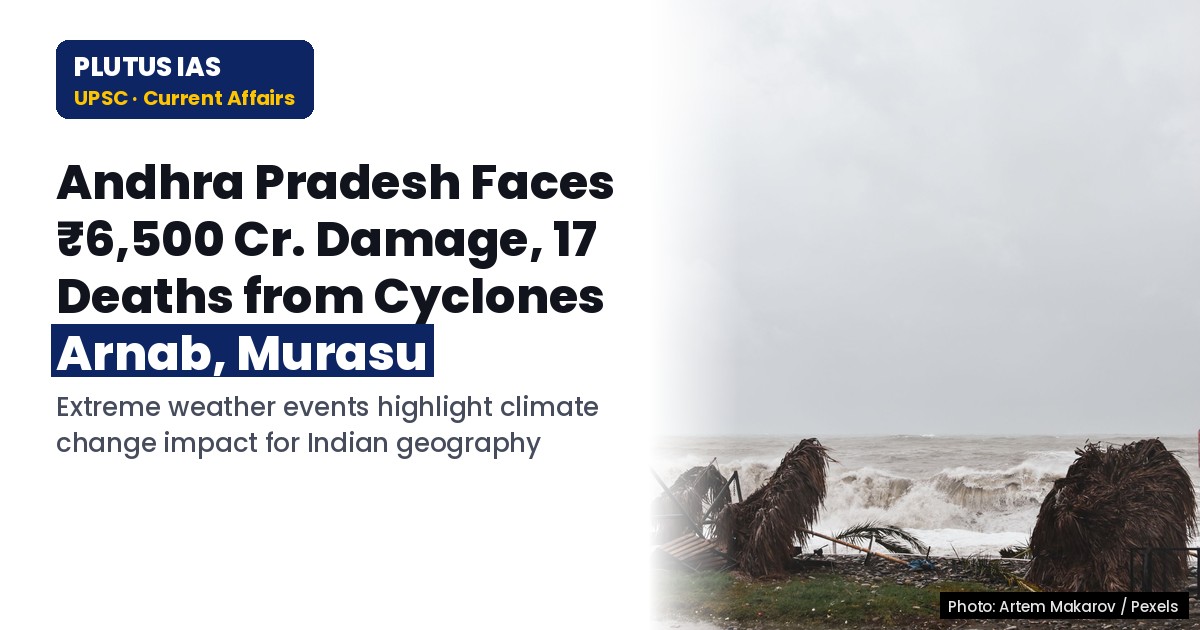
Andhra Pradesh has recently experienced a significant meteorological paradox, transitioning from widespread drought conditions in the initial monsoon months of June and July to severe flooding caused by two successive cyclonic storms, ‘Arnab’ and ‘Murasu’, between October 28 and November 3. This sequence of events has resulted in an estimated ₹6,500 crore in damages, 17 fatalities, extensive destruction of infrastructure and agricultural lands, particularly impacting the Godavari belt’s coconut and paddy cultivators, highlighting the state’s vulnerability to extreme weather phenomena.
Background
- The Indian monsoon, a critical determinant of the nation’s agricultural economy, exhibits significant spatial and temporal variability, leading to both drought and flood conditions in different regions or within the same region at different times.
- Coastal states like Andhra Pradesh are particularly susceptible to tropical cyclones originating in the Bay of Bengal, which frequently intensify during the post-monsoon season (October-November) due to favourable sea surface temperatures.
- The declaration of drought by state governments is typically based on a combination of meteorological, hydrological, agricultural, and socio-economic indicators, triggering relief measures and resource allocation.
- Extreme weather events, including intense rainfall spells and powerful cyclones, are increasingly being linked to global climate change, raising concerns about their frequency and intensity.
- The economic impact of such disasters is profound, affecting agricultural productivity, infrastructure, livelihoods, and necessitating substantial recovery and rehabilitation efforts.
- Historical data indicates that Andhra Pradesh has previously experienced similar dual challenges, with cyclones like Helen and Lehar in 2013, and other significant events in 1987 and 1976, underscoring a recurring pattern of vulnerability.
Understanding Cyclones and Drought in the Indian Context
- Tropical cyclones are intense low-pressure systems forming over warm tropical oceans, characterized by strong winds, heavy rainfall, and storm surges, primarily affecting coastal areas.
- The Bay of Bengal is one of the most active basins for tropical cyclone formation globally, with two peak seasons: pre-monsoon (April-May) and post-monsoon (October-November).
- Drought is a prolonged period of abnormally low rainfall, leading to water scarcity, crop failure, and environmental stress, classified into meteorological, hydrological, agricultural, and socio-economic types.
- The India Meteorological Department (IMD) monitors monsoon rainfall and issues advisories for drought and heavy rainfall, utilizing a network of observatories and satellite data.
- The National Disaster Management Authority (NDMA) and State Disaster Management Authorities (SDMAs) are responsible for disaster preparedness, response, and mitigation, including early warning systems and relief operations.
- Climate change is projected to increase the frequency and intensity of extreme weather events, including both prolonged dry spells and concentrated heavy rainfall events, exacerbating existing vulnerabilities.
- Crop damage from cyclones and droughts severely impacts agricultural income, food security, and rural livelihoods, often requiring government intervention through compensation and rehabilitation schemes.
- Infrastructure damage, particularly to electricity poles, roads, and communication networks, disrupts essential services and hampers recovery efforts, necessitating robust disaster-resilient infrastructure development.
Key Features
| Feature | Significance |
|---|---|
| Dual Extremes | Andhra Pradesh experienced both drought conditions in early monsoon (June-July) and subsequent deluges due to heavy rainfall and cyclones (October-November), highlighting climate variability. |
| Cyclonic Impact | Two consecutive severe cyclones, ‘Arnab’ and ‘Murasu’, caused extensive damage, including loss of life, infrastructure destruction, and agricultural devastation. |
| Agricultural Vulnerability | Crops like paddy, cotton, and chilli were flattened, and coconut trees uprooted, particularly in the Godavari belt, indicating significant agricultural losses and prolonged recovery periods for farmers. |
| Economic Repercussions | Estimated damage of approximately ₹6,500 crore underscores the substantial economic burden imposed by such extreme weather events on regional economies. |
| Infrastructure Damage | Hundreds of electricity poles were uprooted and roads damaged, disrupting essential services and connectivity, necessitating immediate repair and restoration efforts. |
Why it Matters
Environmental Significance
- The occurrence of both drought and intense cyclonic activity within a single year underscores the increasing variability and unpredictability of monsoon patterns, potentially linked to climate change.
- The severe impact on coastal ecosystems, including agricultural lands and natural barriers, highlights the vulnerability of these regions to extreme weather phenomena.
Socio-Economic Significance
- The significant financial losses and damage to livelihoods, particularly for farmers and fishermen, demonstrate the profound socio-economic disruption caused by natural disasters.
- The prolonged recovery period for agricultural sectors, such as coconut farming, indicates long-term implications for rural economies and food security.
- Loss of life and displacement of communities necessitate robust disaster preparedness and response mechanisms to safeguard human well-being.
Governance and Policy Significance
- The need for comprehensive disaster risk reduction strategies, including early warning systems, resilient infrastructure development, and effective post-disaster rehabilitation, is reinforced.
- The events highlight the importance of inter-agency coordination and resource mobilization for effective disaster management and recovery operations.
- The debate surrounding climate change’s role in these events emphasizes the urgency of climate adaptation and mitigation policies at both national and sub-national levels.
Challenges
1. Climate Change and Variability
- Increased frequency and intensity of extreme weather events, including droughts and cyclones, pose significant challenges to agricultural productivity and infrastructure resilience.
- Unpredictable monsoon patterns complicate agricultural planning and water resource management, leading to economic instability for farming communities.
UPSC Link: GS-I: Climatology; GS-III: Disaster Management
2. Agricultural Vulnerability and Livelihood Security
- Extensive crop damage and destruction of perennial trees like coconuts lead to substantial economic losses for farmers, exacerbating rural distress.
- The long recovery periods for certain crops impact farmers’ income stability and food security, requiring sustained support mechanisms.
UPSC Link: GS-III: Agriculture; GS-III: Economy
3. Infrastructure Resilience and Restoration
- Damage to critical infrastructure such as electricity poles and roads disrupts essential services and hinders relief efforts, necessitating rapid and resilient reconstruction.
- The cost of rebuilding and repairing damaged infrastructure places a significant financial burden on state resources.
UPSC Link: GS-III: Infrastructure; GS-III: Disaster Management
4. Disaster Preparedness and Response
- Effective early warning systems, evacuation protocols, and post-disaster relief operations are crucial but often face logistical and resource constraints.
- Ensuring timely and adequate compensation and rehabilitation for affected populations remains a persistent challenge.
UPSC Link: GS-III: Disaster Management
Challenges — UPSC Perspective
| Issue | Concern |
|---|---|
| Monsoon Extremes | Simultaneous occurrence of drought and deluge within a single year indicates heightened climate variability and unpredictability. |
| Cyclonic Damage | Back-to-back severe cyclones causing extensive destruction to life, property, and livelihoods. |
| Agricultural Losses | Significant damage to standing crops and perennial trees, leading to long-term economic hardship for farmers. |
| Infrastructure Breakdown | Disruption of power supply and road networks, impeding relief efforts and daily life. |
| Economic Burden | Estimated ₹6,500 crore damage underscores the massive financial cost of disaster recovery and reconstruction. |
Way Forward
- Strengthen climate-resilient agriculture practices, including drought-resistant crop varieties and improved irrigation techniques, to mitigate the impact of monsoon variability.
- Enhance early warning systems for cyclones and extreme rainfall events, coupled with robust evacuation and communication protocols, to minimize loss of life and property.
- Invest in resilient infrastructure development, particularly in coastal areas, ensuring that electricity grids, roads, and housing can withstand severe weather events.
- Implement comprehensive disaster risk financing mechanisms, including crop insurance schemes and disaster relief funds, to provide timely compensation and support to affected communities.
- Promote diversification of livelihoods in vulnerable regions to reduce over-reliance on climate-sensitive sectors like agriculture and fisheries.
- Foster inter-agency coordination and capacity building at all levels of government for effective disaster preparedness, response, and rehabilitation.
- Integrate climate change adaptation strategies into regional development planning, focusing on sustainable land use, water management, and coastal zone protection.
UPSC Value Addition
Keywords for Mains Answer-Writing
Cyclonic Storms · Drought Conditions · Climate Change Impacts · Disaster Management · Agricultural Vulnerability · Coastal Resilience · Early Warning Systems · Post-Disaster Recovery
Concept Flow
Monsoon variability causes initial drought conditions. → Subsequent heavy rainfall and cyclonic activity. → Extreme weather events lead to widespread damage. → Agricultural losses and infrastructure destruction occur. → Economic impact and livelihood disruption for communities. → Increased focus on disaster management and climate adaptation.
Prelims Practice Questions
Q1. Consider the following statements regarding tropical cyclones in India:
1. Tropical cyclones typically form over warm ocean waters and are characterised by low atmospheric pressure at their centre.
2. The Bay of Bengal experiences fewer cyclonic storms compared to the Arabian Sea due to its geographical characteristics.
3. The India Meteorological Department (IMD) is responsible for naming tropical cyclones in the North Indian Ocean region.
How many of the above statements are correct?
- Only one
- Only two
- Only three
- None
Answer: Only two — Statement 1 is correct: Tropical cyclones require warm sea surface temperatures (typically above 26.5°C) and low atmospheric pressure at their core. Statement 2 is incorrect: The Bay of Bengal is significantly more active than the Arabian Sea in terms of cyclonic storm formation, accounting for about 80% of the total. Statement 3 is incorrect: While IMD issues advisories, the naming of cyclones in the North Indian Ocean is done by a panel of 13 countries, including India, following a rotational system.
Q2. Which of the following bodies is primarily responsible for coordinating disaster response and relief operations at the national level in India?
- National Disaster Management Authority (NDMA)
- National Institute of Disaster Management (NIDM)
- State Disaster Management Authority (SDMA)
- District Disaster Management Authority (DDMA)
Answer: National Disaster Management Authority (NDMA) — The National Disaster Management Authority (NDMA), headed by the Prime Minister, is the apex body for disaster management in India, responsible for laying down policies, plans, and guidelines for disaster management. NIDM focuses on training and capacity building, while SDMAs and DDMAs operate at state and district levels respectively.
Mains Practice Question
✍ Examine the multi-faceted challenges posed by extreme weather events, such as droughts and cyclones, to agricultural livelihoods and coastal communities in India. Discuss the efficacy of existing disaster management frameworks in mitigating these impacts and suggest measures for enhancing resilience. (15 Marks)
Approach: MODEL-ANSWER SKELETON:
1. Introduction: Briefly define extreme weather events (droughts, cyclones) and their increasing frequency/intensity in India, referencing recent events like those in Andhra Pradesh.
2. Challenges to Agricultural Livelihoods:
a. Crop damage: Paddy, cotton, chilli, coconut (specific examples from news).
b. Economic losses: Estimated monetary damage, recovery period for farmers.
c. Food security implications: Impact on production and supply chains.
d. Farmer distress: Debt, migration, mental health.
3. Challenges to Coastal Communities:
a. Infrastructure damage: Roads, electricity poles, housing.
b. Livelihood disruption: Fishing, tourism.
c. Loss of life and displacement.
d. Environmental degradation: Coastal erosion, salinisation.
4. Efficacy of Existing Disaster Management Frameworks:
a. Institutional framework: NDMA, SDMA, DDMA (mention roles).
b. Legal framework: Disaster Management Act, 2005.
c. Early warning systems: IMD’s role in cyclone prediction.
d. Response mechanisms: NDRF, SDRF, community participation.
e. Gaps/Limitations: Funding, last-mile connectivity, climate change adaptation, rehabilitation challenges.
5. Measures for Enhancing Resilience:
a. Climate-resilient agriculture: Crop diversification, drought-resistant varieties, improved irrigation.
b. Coastal protection: Mangrove restoration, seawalls, shelterbelts.
c. Robust infrastructure: Cyclone-resistant housing, underground cabling.
d. Enhanced early warning and communication systems.
e. Community-based disaster preparedness.
f. Financial mechanisms: Crop insurance (e.g., PMFBY), disaster relief funds.
g. Long-term climate change adaptation and mitigation strategies.
6. Conclusion: Summarise the need for an integrated, proactive, and multi-stakeholder approach to build resilience against extreme weather events.
Source: The Hindu
Generated by AanyaAi for educational purpose.
Related guides on our sites
- How to prepare for GS paper 1 for UPSC CSE mains exam
- Best UPSC coaching for IFOS exam
- Best geography optional coaching
- Best geography optional coaching

- Andhra Pradesh: Drought to Deluge & Cyclones Impact - November 8, 2026
- नरसिंहपुर एनकाउंटर: सीबीआई जांच, राज्य सरकार की अनुशंसा - November 8, 2026
- Strait of Hormuz & Gulf of Oman Incidents: UPSC Geography - November 8, 2026

No Comments