


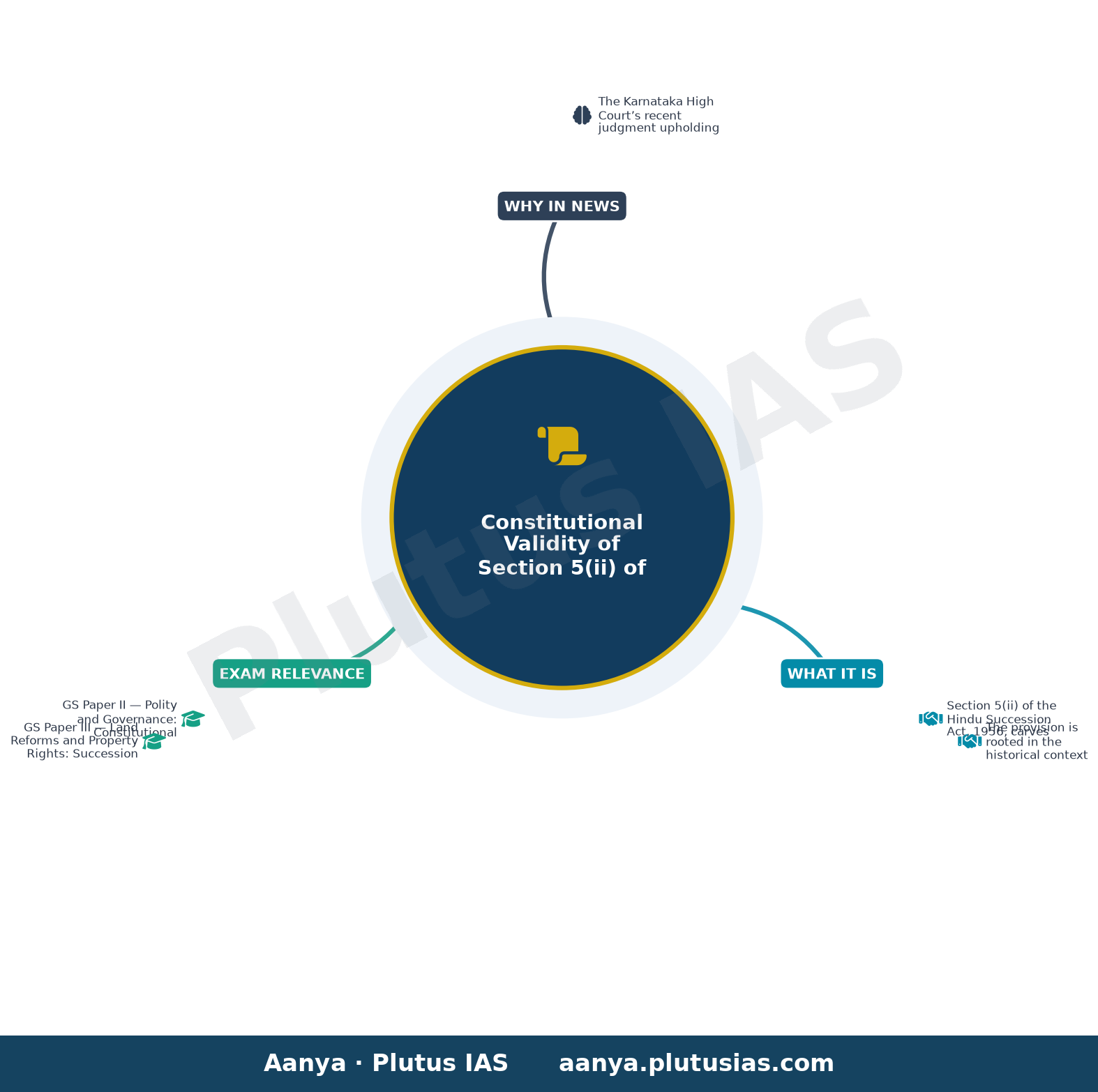
08 Aug Karnataka HC Upholds Royal Estates’ Exclusion from Succession Law Despite Privy Purse Abolition
✎ Section 5(ii) of the Hindu Succession Act, 1956, exempts impartible estates of former princely states from partition, as these estates descend to a single heir under pre-Independence agreements, even after the abolition of privy…
Subject Relevance — Where This Topic Fits
- GS Paper II — Polity and Governance: Constitutional Amendments, Fundamental Rights, and Special Provisions for Former Princely States | GS Paper III — Land Reforms and Property Rights: Succession Laws and Customary Practices
- Prelims: Hindu Succession Act, 1956; Article 363-A; Privy Purse; Impartible Estate; Gaddi; Article 291; Article 362; 26th Amendment Act, 1971; Mysore State Merger Agreement; Sandur State Merger Agreement
- Essay: The interplay between constitutional morality and customary practices in governance, Land reforms and the preservation of historical estates: Balancing equity and tradition
Quick Revision: Section 5(ii) of the Hindu Succession Act, 1956, exempts impartible estates of former princely states from partition, as these estates descend to a single heir under pre-Independence agreements, even after the abolition of privy purses and royal privileges.
Why is this in the news?
The Karnataka High Court’s recent judgment upholding the constitutional validity of Section 5(ii) of the Hindu Succession Act, 1956, despite the abolition of privy purses and royal privileges under the 26th Amendment Act, 1971, has significant implications for the interpretation of succession laws vis-à-vis former princely states. The ruling reaffirms the distinction between the abolished constitutional guarantees (privy purses and privileges) and the private property rights of erstwhile rulers, particularly concerning impartible estates and the concept of the *Gaddi* (ceremonial throne). This decision underscores the enduring legal recognition of pre-Independence agreements governing succession to royal estates, even in the absence of formal royal privileges.
Background
- The Hindu Succession Act, 1956, was enacted to codify and unify succession laws across India, replacing diverse customary and religious practices with a uniform statutory framework.
- The 26th Amendment Act, 1971, abolished the privy purses and privileges of erstwhile rulers of princely states, as guaranteed under Articles 291 and 362 of the Constitution, through the insertion of Article 363-A.
- Section 5(ii) of the Hindu Succession Act, 1956, exempts certain estates that descend to a single heir by the terms of a covenant or agreement entered into by the ruler of an Indian State with the Government of India or by the terms of any pre-1956 enactment.
- The merger agreements of the former States of Mysore and Sandur with the Government of India explicitly distinguished between privy purses, private properties, and succession to the *Gaddi*, ensuring the continuity of the latter despite the abolition of other privileges.
- The petitioners in the case sought the deletion of Section 5(ii), arguing that its relevance had diminished with the abolition of privy purses and the loss of meaning of the *Gaddi* concept.
- The court’s ruling reaffirms the principle that constitutional amendments abolishing specific privileges do not ipso facto invalidate private property rights or customary succession practices established under pre-Independence agreements.
What is Section 5(ii) of the Hindu Succession Act, 1956, and its relevance to former princely states?
- Section 5(ii) of the Hindu Succession Act, 1956, carves out an exception to the general rules of succession under the Act. It exempts estates that descend to a single heir by the terms of a covenant or agreement entered into by the ruler of an Indian State with the Government of India or by the terms of any pre-1956 enactment.
- The provision is rooted in the historical context of princely states, where certain estates were designated as *impartible*—i.e., they could not be partitioned among heirs and were to be inherited by a single successor, often tied to the *Gaddi* (ceremonial throne).
- The *Gaddi* represents not merely a physical throne but a symbolic and customary authority associated with the ruler’s lineage, often linked to the governance and cultural heritage of the erstwhile state.
- The merger agreements of princely states with the Government of India (e.g., Mysore and Sandur) explicitly preserved the customs governing succession to the *Gaddi* and impartible estates, even as privy purses and other privileges were abolished.
- The 26th Amendment Act, 1971, abolished Articles 291 (privy purse) and 362 (rights and privileges of rulers), but it did not invalidate the private property rights or customary succession practices established under pre-Independence agreements.
- The court’s ruling clarifies that the abolition of privy purses and privileges does not affect the validity of Section 5(ii), as the provision pertains to the succession of estates, not the conferment of royal privileges.
- The distinction between *public* rights (privy purses, titles) and *private* rights (property and succession) is critical. While the former were abolished, the latter continue to be governed by the terms of the merger agreements and Section 5(ii).
- The judgment reinforces the principle that customary practices, when codified into law or agreement, retain legal sanctity unless explicitly repealed by subsequent legislation.
UPSC Value Addition
Keywords for Mains Answer-Writing
Hindu Succession Act, 1956 · Section 5(ii) of Hindu Succession Act · Princely States and private property · Impartible estate · Gaddi (ceremonial throne) · Articles 291 and 362 of the Constitution · 26th Constitutional Amendment Act, 1971 · Karnataka High Court judgment · Privatisation of royal estates · Customary succession laws in India
Prelims Practice Questions
Q1. Consider the following statements regarding the Hindu Succession Act, 1956:
1. Section 5(ii) exempts certain estates from partition under the Act.
2. The provision is applicable to all private properties of erstwhile rulers.
3. The provision is linked to the abolition of privy purses under Articles 291 and 362 of the Constitution.
How many of the above statements are correct?
- Only one
- Only two
- All three
- None
Answer: Only one — Statement 1 is correct as Section 5(ii) exempts certain estates from partition. Statement 2 is incorrect because the provision applies only to specific estates governed by pre-Independence agreements, not all private properties. Statement 3 is incorrect because the provision’s validity is independent of the abolition of privy purses under Articles 291 and 362.
Q2. Assertion (A): The 26th Constitutional Amendment Act, 1971, abolished the privy purses and privileges of erstwhile rulers.
Reason (R): The amendment also invalidated Section 5(ii) of the Hindu Succession Act, 1956, which protected certain royal estates from partition.
Options:
A. Both A and R are true, and R is the correct explanation of A.
B. Both A and R are true, but R is not the correct explanation of A.
C. A is true, but R is false.
D. A is false, but R is true.
- A
- B
- C
- D
Answer: B — Assertion (A) is true as the 26th Amendment did abolish privy purses and privileges. However, Reason (R) is false because the amendment did not invalidate Section 5(ii); the court in the Karnataka High Court judgment held that Section 5(ii) remains valid despite the abolition.
Mains Practice Question
✍ The Karnataka High Court has recently reaffirmed the validity of Section 5(ii) of the Hindu Succession Act, 1956, despite the abolition of privy purses and privileges through the 26th Constitutional Amendment Act, 1971. Critically examine the legal and constitutional basis for this provision, and analyse its implications for the customary succession laws governing royal estates in India. (15 Marks)
Approach: MODEL-ANSWER SKELETON:
1. **Introduction**: Briefly explain Section 5(ii) of the Hindu Succession Act, 1956, and its purpose of protecting certain estates from partition.
2. **Constitutional Context**: Discuss Articles 291 and 362 of the Constitution, which guaranteed privy purses and privileges to erstwhile rulers, and their abolition via the 26th Amendment (1971).
3. **Judicial Reasoning**: Analyse the Karnataka High Court’s reasoning that Section 5(ii) is distinct from privy purses and privileges, as it pertains to customary succession and pre-Independence agreements.
4. **Customary Succession vs. Uniform Civil Code**: Compare the provision with the broader debate on uniform civil laws in India, highlighting the tension between customary practices and constitutional uniformity.
5. **Implications**: Discuss the implications for royal families, property rights, and the preservation of cultural heritage. Mention the distinction between ‘Gaddi’ (ceremonial throne) and private property.
6. **Critique**: Evaluate whether Section 5(ii) perpetuates feudal privileges or protects legitimate customary rights. Include views from legal scholars or precedents (e.g., State of Kerala v. Thomas, 1976).
7. **Conclusion**: Summarise the balance between constitutional equality and cultural preservation, and suggest whether the provision requires reform.
Source: The Hindu
Generated by AanyaAi for educational purpose.

- महाराष्ट्र में त्योहार जुलूसों पर बॉम्बे हाईकोर्ट का बड़ा फैसला: पटाखे, लेजर और संगीत पर रोक - September 24, 2026
- Bombay HC Bans Firecrackers, Music in Maharashtra Processions: Key UPSC Analysis - September 24, 2026
- तमिलनाडु में महिला कर्मचारियों के लिए सवैतनिक माहवारी अवकाश नीति पर HC का आदेश - September 24, 2026

No Comments