


08 Aug Kerala HC Orders Panchayat to Compensate Stray Dog Attack Victim: Key UPSC Polity Insight
✎ Local self-government institutions are constitutionally and statutorily obligated to manage stray dog populations under the 12th Schedule of the Constitution and the Prevention of Cruelty to Animals Act, 1960; failure to…
Subject Relevance — Where This Topic Fits
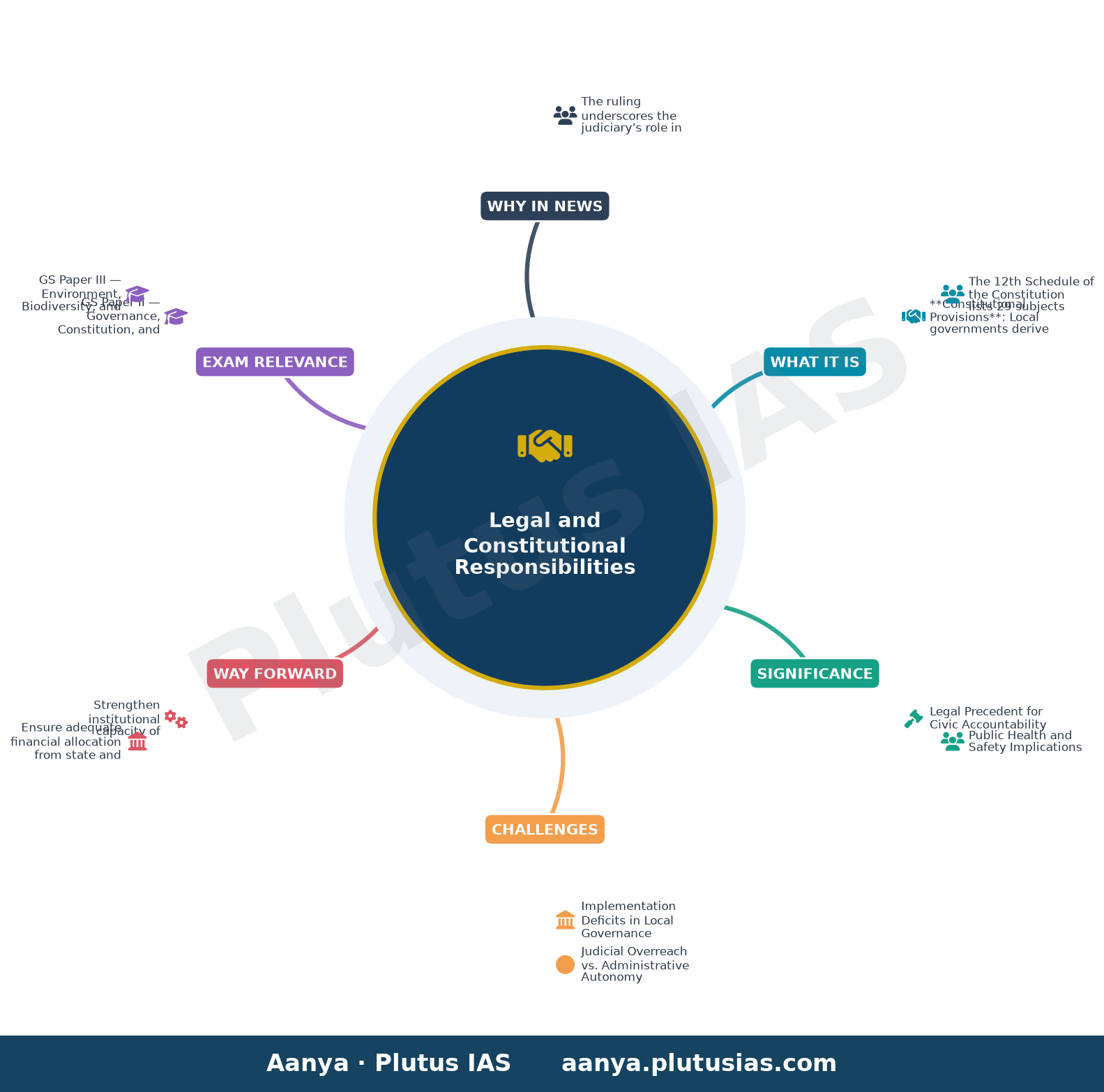
- GS Paper II — Governance, Constitution, and Polity (Local Governance and Fundamental Duties) | GS Paper III — Environment, Biodiversity, and Animal Welfare
- Prelims: Local self-government institutions, Fundamental Duties (Article 51A(g)), Prevention of Cruelty to Animals Act, 1960, Birth Control (Dogs) Rules, 2001, Compensatory jurisprudence, Judicial review of administrative actions, Panchayati Raj Institutions (PRIs), Municipal functions under 12th Schedule (Constitution), Doctrine of vicarious liability, Public nuisance under IPC Section 268
- Essay: The balance between individual rights and state obligations in public health emergencies, The role of local governance in ensuring citizen welfare: A case study of stray dog management
Quick Revision: Local self-government institutions are constitutionally and statutorily obligated to manage stray dog populations under the 12th Schedule of the Constitution and the Prevention of Cruelty to Animals Act, 1960; failure to discharge these duties may result in vicarious liability for compensation in case of public harm.
Why is this in the news?
The ruling underscores the judiciary’s role in enforcing constitutional and statutory obligations of local bodies, particularly in matters of public health and safety, and signals a shift toward greater accountability in local governance.
Background
- The Prevention of Cruelty to Animals Act, 1960 (PCA Act), is the primary legislation governing animal welfare in India, including the regulation of stray dog populations through sterilization and vaccination programs.
- The Birth Control (Dogs) Rules, 2001, framed under the PCA Act, mandate local authorities—including panchayats—to implement stray dog control measures, including licensing of domestic dogs, sterilization of stray dogs, and vaccination against rabies.
- Local self-government institutions, such as grama panchayats, are constitutionally mandated under the 73rd Amendment Act, 1992, to perform functions related to public health, sanitation, and animal husbandry as per the 12th Schedule of the Constitution.
- Stray dog attacks pose a significant public health risk, particularly in terms of rabies transmission, which remains endemic in many parts of India despite national elimination programs.
- The Kerala High Court’s judgment aligns with the Supreme Court’s observations in *Animal Welfare Board of India v. A. Nagaraja* (2014), which emphasized the state’s duty to protect animals while balancing public safety concerns.
- The case highlights the tension between local governments’ financial constraints and their statutory obligations, a recurring issue in India’s decentralized governance model.
Legal and Constitutional Framework Governing Stray Dog Management in India
- **Constitutional Provisions**: Local governments derive their authority from the 73rd and 74th Constitutional Amendments, which assign responsibilities such as public health, sanitation, and animal husbandry to panchayats and municipalities.
- The 12th Schedule of the Constitution lists 29 subjects that local bodies must manage, including ‘public health and sanitation’ and ‘animal husbandry’, which encompass stray dog control measures.
- The **Prevention of Cruelty to Animals Act, 1960 (PCA Act)** is the apex legislation governing animal welfare, including provisions for the regulation of stray dogs through sterilization, vaccination, and humane capture.
- The **Birth Control (Dogs) Rules, 2001**, framed under the PCA Act, impose specific duties on local authorities, including the issuance of licenses for domestic dogs, sterilization of stray dogs, and vaccination against rabies within their jurisdiction.
- The **Supreme Court’s Directive in *Animal Welfare Board of India v. A. Nagaraja* (2014)** held that animals are entitled to constitutional protection under Article 21 (right to life) and Article 51A(g) (Fundamental Duty to protect animals), reinforcing the state’s obligation to manage stray dog populations humanely.
- Local governments are expected to implement **rabies control programs** in collaboration with state animal husbandry departments, including mass vaccination drives and sterilization of stray dogs under the **National Rabies Control Programme (NRCP)**.
- The ruling also underscores the **doctrine of judicial review**, wherein courts can intervene to enforce constitutional and statutory obligations of local governments when they fail to act in the public interest.
Key Features
| Feature | Significance |
|---|---|
| Statutory Duty of Panchayats under Prevention of Cruelty to Animals Act, 1960 | Panchayats are legally obligated to implement animal welfare measures, including control of stray dogs, to protect public health and safety under Section 11(1)(i) of the Act. |
| Birth Control Rules for Stray Dogs | Mandates sterilisation and immunisation of stray dogs to curb population growth and reduce human-dog conflicts, as per the Animal Birth Control (Dogs) Rules, 2001. |
| Judicial Interpretation of Local Body Liability | High Court’s ruling establishes that local bodies can be held financially liable for failure to discharge statutory duties, setting a precedent for civic accountability. |
| Foreseeability of Dog Attacks | The court recognised stray dog attacks as a foreseeable consequence of negligence in statutory compliance, linking omission to direct harm. |
| Judicial Review of Administrative Inaction | The ruling underscores the judiciary’s role in reviewing administrative failures, ensuring that local governance adheres to legal mandates. |
Why it Matters
Legal Precedent for Civic Accountability
- Establishes that local bodies can be held financially liable for statutory breaches, reinforcing the principle of ‘duty of care’ in public administration.
- Expands the scope of judicial review over administrative inaction, particularly in matters of public health and safety.
- Creates a deterrent against negligence in implementing animal welfare laws, aligning governance with legal obligations.
Public Health and Safety Implications
- Highlights the nexus between stray dog population control and public health, particularly in rural and semi-urban areas.
- Emphasises the need for proactive measures by local bodies to prevent zoonotic diseases and injuries.
- Reinforces the role of panchayats in implementing One Health approaches at the grassroots level.
Judicial Activism in Governance
- Demonstrates the judiciary’s proactive stance in ensuring administrative accountability, even in matters of local governance.
- Sets a benchmark for future cases involving statutory breaches by local bodies, particularly in welfare-oriented legislation.
- Encourages citizens to seek legal recourse for administrative failures, thereby strengthening democratic accountability.
Policy Implementation Gaps
- Reveals systemic gaps in the implementation of animal welfare laws at the local level, despite clear statutory mandates.
- Underscores the need for capacity-building and financial support to local bodies for effective policy execution.
- Highlights the disparity between legal provisions and ground-level realities in rural governance.
Challenges
1. Implementation Deficits in Local Governance
- Inadequate enforcement of animal birth control and sterilisation programmes by panchayats.
- Lack of financial and logistical resources to manage stray dog populations effectively.
- Absence of standardised protocols for monitoring and reporting stray dog incidents.
- Insufficient awareness among local officials about statutory duties under animal welfare laws.
UPSC Link: GS-II: Local Governance and Public Health
2. Judicial Overreach vs. Administrative Autonomy
- Risk of courts substituting administrative discretion with judicial directives, potentially undermining local governance.
- Balancing judicial activism with respect for the autonomy of local bodies in policy implementation.
- Ensuring that judicial interventions do not lead to excessive litigation or administrative paralysis.
UPSC Link: GS-II: Separation of Powers
3. Public Health Risks from Stray Dogs
- Increased incidence of dog bites and zoonotic diseases due to unchecked stray dog populations.
- Potential for rabies transmission, a fatal yet preventable disease, in areas with poor stray dog management.
- Public perception of insecurity and health risks in communities affected by stray dog attacks.
UPSC Link: GS-II: Public Health and One Health Approach
4. Financial Constraints in Rural Local Bodies
- Limited fiscal capacity of panchayats to fund stray dog control programmes without state or central assistance.
- Dependence on external funding sources, which may not always be reliable or timely.
- Competition for limited resources among various welfare and developmental priorities at the local level.
UPSC Link: GS-II: Decentralised Planning and Finance
5. Legal Ambiguities in Liability
- Uncertainty in determining the extent of liability for local bodies in cases of statutory breaches.
- Potential for conflicting interpretations of statutory duties under animal welfare laws.
- Need for clearer guidelines on the liability of local bodies in cases of public harm due to administrative inaction.
UPSC Link: GS-II: Legal Framework and Accountability
Challenges — UPSC Perspective
| Issue | Concern |
|---|---|
| Enforcement of Animal Birth Control Rules | Panchayats often fail to implement sterilisation and immunisation drives due to resource constraints and lack of political will. |
| Judicialisation of Administrative Functions | Excessive judicial intervention may lead to administrative overload and reduce the autonomy of local bodies in policy execution. |
| Public Health Risks from Stray Dogs | Uncontrolled stray dog populations pose significant risks of rabies and other zoonotic diseases, particularly in rural areas. |
| Financial Dependence on Higher Authorities | Panchayats lack sufficient funds to manage stray dog populations independently, relying on state or central grants. |
| Legal Ambiguities in Liability | The extent of liability for local bodies in cases of statutory breaches remains unclear, leading to disputes and litigation. |
| Public Perception and Trust in Governance | Frequent dog attacks and administrative failures erode public trust in local governance and welfare institutions. |
Way Forward
- Strengthen institutional capacity of panchayats through targeted training on animal welfare laws and their enforcement mechanisms.
- Ensure adequate financial allocation from state and central governments for stray dog control programmes, including sterilisation and vaccination drives.
- Develop standardised protocols for reporting, monitoring, and responding to stray dog incidents at the local level.
- Enhance inter-departmental coordination between panchayats, veterinary departments, and public health agencies to address zoonotic risks.
- Promote community awareness programmes to educate citizens on responsible pet ownership and preventive measures against dog attacks.
- Establish a grievance redressal mechanism at the district level to address administrative failures in a timely manner.
- Encourage panchayats to adopt a proactive approach in implementing animal birth control rules, with regular audits and performance reviews.
- Foster collaboration between local bodies and non-governmental organisations to supplement government efforts in stray dog management.
UPSC Value Addition
Keywords for Mains Answer-Writing
Local Self-Government · Constitutional and Statutory Duties of Panchayats · Prevention of Cruelty to Animals Act, 1960 · Birth Control Rules for Stray Dogs · Judicial Review of Administrative Actions · Compensatory Jurisprudence · Doctrine of Reasonable Foreseeability · Public Interest Litigation · Decentralisation and Local Governance · Animal Welfare and Legal Accountability · Kerala High Court Judgments · Doctrine of Vicarious Liability in Local Bodies · Fundamental Duties of State · Administrative Negligence · Compensation for Victims of Negligence
Concept Flow
Failure of Eruvessy grama panchayat to implement statutory duties under Prevention of Cruelty to Animals Act, 1960 and Animal Birth Control Rules → Unchecked growth of stray dog population → Increased risk of dog attacks on citizens → Victim sustains injuries in 2007 attack → Panchayat fails to provide compensation or preventive measures → Victim files claim in Munsiff Court, Thaliparamba → Munsiff Court holds panchayat liable for negligence → Panchayat appeals to Sub-court, Payyannur, which reaffirms liability → Panchayat appeals to Kerala High Court → High Court upholds liability, orders compensation of ₹10,000 → Sets judicial precedent for civic accountability in statutory breaches → Reinforces need for effective local governance and public health measures.
Prelims Practice Questions
Q1. Consider the following statements regarding the constitutional and statutory framework governing local self-government institutions in India:
1. The Eleventh Schedule of the Constitution lists the functions of Panchayats, including the control of stray dogs.
2. The Birth Control Rules for stray dogs are framed under the Prevention of Cruelty to Animals Act, 1960.
3. The Kerala High Court, in the case of Tankappan v. Eruvessy grama panchayat, held that the panchayat’s failure to capture and sterilize stray dogs amounted to administrative negligence.
How many of the above statements are correct?
- Only one
- Only two
- All three
- None
Answer: All three — Statements 2 and 3 are correct. Statement 1 is incorrect as the Eleventh Schedule does not explicitly list the control of stray dogs; this function is derived from the Prevention of Cruelty to Animals Act, 1960, and state-specific rules.
Q2. Assertion (A): The Prevention of Cruelty to Animals Act, 1960, overrides the provisions of the Kerala Panchayat Raj Act, 1994, in matters relating to the control of stray dogs.
Reason (R): The Kerala Panchayat Raj Act, 1994, confers specific powers on panchayats to manage public health and sanitation, including the control of stray animals.
In the context of the above statements, which of the following is correct?
- Both A and R are true, and R is the correct explanation of A.
- Both A and R are true, but R is not the correct explanation of A.
- A is true, but R is false.
- A is false, but R is true.
Answer: A is true, but R is false. — Both A and R are true, but R is not the correct explanation of A. The Prevention of Cruelty to Animals Act, 1960, is a central legislation that imposes duties on local bodies, including panchayats, to control stray dogs, but the Kerala Panchayat Raj Act, 1994, provides the institutional framework for discharging these duties.
Mains Practice Question
✍ The Kerala High Court’s ruling in Tankappan v. Eruvessy grama panchayat underscores the principle that local self-government institutions are not merely administrative bodies but bear constitutional and statutory obligations to protect citizens from foreseeable harm. Critically examine the legal and administrative implications of this judgment for panchayats in India, with reference to their duties under the Constitution, the Prevention of Cruelty to Animals Act, 1960, and the Birth Control Rules for stray dogs. Also, analyse the potential consequences for local governance if such obligations are not discharged. (15 Marks)
Approach: MODEL-ANSWER SKELETON:
1. **Introduction (2 marks)**
– Briefly state the facts of the case: Kerala High Court’s order directing Eruvessy grama panchayat to compensate ₹10,000 for failing to control stray dogs, leading to a dog attack in 2007.
– Highlight the legal basis: Articles 21 (Right to Life) and 51A(g) (Fundamental Duty to protect animals), read with the Prevention of Cruelty to Animals Act, 1960, and the Birth Control Rules.
2. **Constitutional and Statutory Framework (4 marks)**
– **Constitutional Provisions**:
– Article 243G (Eleventh Schedule) empowers panchayats to manage public health, sanitation, and animal husbandry.
– Article 21 imposes a positive obligation on the State to protect life and personal liberty.
– Article 51A(g) imposes a Fundamental Duty on citizens (including local bodies) to protect and improve the natural environment, including animals.
– **Statutory Provisions**:
– Prevention of Cruelty to Animals Act, 1960: Sections 3, 11, and 38 impose duties on local authorities to prevent cruelty to animals and control stray dogs.
– Birth Control Rules (2001): Mandate the capture, sterilization, and vaccination of stray dogs by local bodies.
3. **Judicial Reasoning and Legal Principles (4 marks)**
– **Doctrine of Reasonable Foreseeability**: The court held that the panchayat’s failure to discharge its statutory duties made the dog attack a foreseeable consequence.
– **Compensatory Jurisprudence**: The judgment aligns with the principle of compensatory liability for administrative negligence, as seen in cases like *Nilabati Behera v. State of Orissa* (1993).
– **Doctrine of Vicarious Liability**: Panchayats, as local authorities, are vicariously liable for their failure to discharge statutory duties.
4. **Administrative Implications (3 marks)**
– **Enhanced Accountability**: Panchayats must now proactively implement stray dog control measures, including licensing, sterilization, and vaccination.
– **Resource Allocation**: The judgment may necessitate increased funding and capacity-building for local bodies to comply with statutory duties.
– **Inter-Institutional Coordination**: Strengthened collaboration between panchayats, state animal husbandry departments, and municipal bodies.
5. **Potential Consequences of Non-Discharge (2 marks)**
– **Legal Consequences**: Courts may award compensation to victims, leading to increased litigation and financial burden on local bodies.
– **Administrative Consequences**: Loss of public trust, erosion of local governance credibility, and potential intervention by higher authorities or courts.
– **Social Consequences**: Increased public health risks, zoonotic diseases, and social unrest due to unchecked stray dog populations.
6. **Conclusion (2 marks)**
– Summarize the judgment’s significance in reinforcing the accountability of local self-government institutions.
– Emphasize the need for a balanced approach that balances animal welfare with public safety and administrative feasibility.
Source: The Hindu
Generated by AanyaAi for educational purpose.

- महाराष्ट्र में त्योहार जुलूसों पर बॉम्बे हाईकोर्ट का बड़ा फैसला: पटाखे, लेजर और संगीत पर रोक - September 24, 2026
- Bombay HC Bans Firecrackers, Music in Maharashtra Processions: Key UPSC Analysis - September 24, 2026
- तमिलनाडु में महिला कर्मचारियों के लिए सवैतनिक माहवारी अवकाश नीति पर HC का आदेश - September 24, 2026

No Comments