


08 Aug Why Policy Support is Crucial to Save India’s Traditional Occupations in 2026
✎ Traditional occupations are vital for cultural preservation, inclusive growth, and sustainable development, but they face existential threats from mechanisation, market displacement, and social exclusion, necessitating robust…
Subject Relevance — Where This Topic Fits
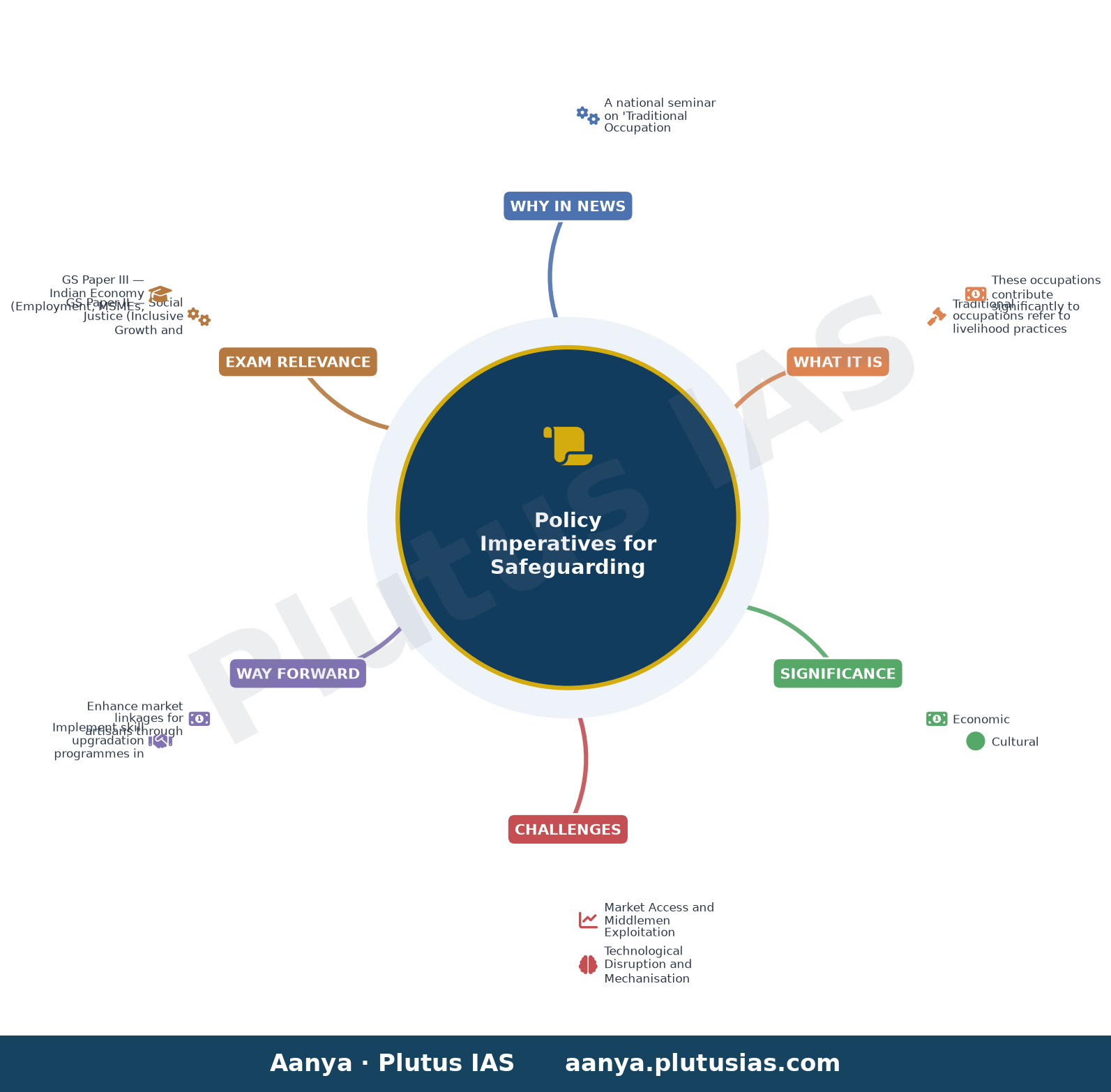
- GS Paper II — Social Justice (Inclusive Growth and Sustainable Development) | GS Paper III — Indian Economy (Employment, MSMEs, and Informal Sector)
- Prelims: Artisan communities, Middleman exploitation, Social exclusion, Constitutional safeguards (Article 21, Directive Principles), MSMEs, Informal sector vulnerabilities
- Essay: The erosion of traditional livelihoods: A challenge to India’s cultural and economic heritage, Balancing economic growth with social equity: The case for protecting India’s artisans
Quick Revision: Traditional occupations are vital for cultural preservation, inclusive growth, and sustainable development, but they face existential threats from mechanisation, market displacement, and social exclusion, necessitating robust policy support and constitutional safeguards.
Why is this in the news?
A national seminar on ‘Traditional Occupation Communities in a Changing Economy’ highlighted the severe economic stress faced by artisans due to mechanisation, market displacement, and social discrimination. The event underscored the urgent need for policy interventions to preserve traditional occupations, which are critical for India’s cultural heritage and inclusive development. The seminar’s discussions on constitutional safeguards and occupational freedom further amplify the relevance of this issue for UPSC aspirants, particularly in the context of social justice and economic policies.
Background
- Traditional occupations in India, including handloom weaving, pottery, blacksmithing, and carpentry, have sustained livelihoods for centuries and are deeply intertwined with the country’s cultural identity.
- The advent of mechanisation and factory-produced goods has led to a decline in demand for artisanal products, pushing many artisans out of their traditional professions.
- Welfare measures have provided limited relief, but structural challenges like market access and middleman exploitation persist.
- The informal nature of traditional occupations exposes artisans to irregular incomes, lack of social security, and vulnerability to economic shocks.
- Social discrimination and exclusion continue to marginalise certain artisan communities, exacerbating their economic hardships.
- Constitutional provisions, including Article 21 (Right to Livelihood) and Directive Principles of State Policy (Articles 38, 39, 41, and 43), mandate state intervention to protect and promote traditional livelihoods.
What are Traditional Occupations and Why Do They Matter?
- Traditional occupations refer to livelihood practices passed down through generations, often involving artisanal skills, indigenous knowledge, and cultural heritage.
- These occupations contribute significantly to India’s economy, particularly in the informal sector, and are a source of employment for millions, especially in rural and semi-urban areas.
- They play a pivotal role in preserving India’s cultural diversity, with each region boasting unique art forms, crafts, and techniques that reflect local traditions and identities.
- Traditional occupations are often sustainable and eco-friendly, aligning with India’s commitments to sustainable development and climate action.
- The decline of these occupations threatens not only livelihoods but also the loss of intangible cultural heritage, including oral traditions, rituals, and community knowledge systems.
- Artisans and traditional workers face systemic challenges such as lack of access to credit, inadequate infrastructure, and competition from mass-produced goods.
- Government policies aim to promote traditional occupations but require stronger implementation and monitoring.
- The preservation of traditional occupations is essential for achieving the Sustainable Development Goals (SDGs), particularly SDG 8 (Decent Work and Economic Growth) and SDG 12 (Responsible Consumption and Production).
Key Features
| Feature | Significance |
|---|---|
| Mechanisation and factory production | Disrupts traditional livelihoods by reducing demand for artisanal products and increasing competition from mass-produced goods. |
| Market access constraints | Limits artisans’ ability to sell directly to consumers, forcing dependence on middlemen who exploit their bargaining power. |
| Irregular income streams | Exposes traditional occupational communities to financial instability due to seasonal or demand-based fluctuations in earnings. |
| Social discrimination | Perpetuates exclusion of marginalised communities from equitable economic opportunities and dignified livelihoods. |
| Policy interventions | Government support is critical to mitigate market failures and structural inequities affecting traditional occupations. |
Why it Matters
Economic
- Traditional occupations contribute to India’s GDP through niche products, cultural exports, and employment in rural and semi-urban economies.
- Preservation of these occupations ensures livelihood security for millions, particularly in informal sectors with limited formal employment alternatives.
- Diversification of economic activities through traditional crafts can enhance resilience against global supply chain disruptions.
Cultural
- Traditional occupations are repositories of indigenous knowledge, craftsmanship, and cultural heritage, safeguarding intangible cultural assets.
- They foster social cohesion by maintaining community identities and intergenerational transmission of skills and traditions.
- Global interest in handmade and sustainable products provides an avenue for cultural diplomacy and soft power.
Social
- Upholding dignified livelihoods for marginalised communities aligns with the constitutional mandate of social justice and equality.
- Empowerment of traditional occupational communities reduces socio-economic disparities and promotes inclusive growth.
- Preservation of these occupations mitigates urban migration pressures by offering sustainable rural livelihoods.
Challenges
1. Market Access and Middlemen Exploitation
- Artisans lack direct market linkages, relying on intermediaries who control pricing and distribution, eroding their profit margins.
- Absence of branding and marketing infrastructure limits the visibility and competitiveness of traditional products in national and global markets.
- Digital divide exacerbates exclusion, as artisans struggle to leverage e-commerce platforms without technical or financial support.
UPSC Link: GS-II: Inclusive growth & issues arising from it
2. Technological Disruption and Mechanisation
- Mass production and automation reduce demand for handcrafted goods, rendering traditional occupations economically unviable.
- Lack of access to modern tools and training prevents artisans from adapting to evolving market demands.
- Policy neglect in integrating traditional crafts with modern supply chains accelerates obsolescence of these occupations.
UPSC Link: GS-III: Technology missions & employment
3. Irregular Income and Financial Vulnerability
- Seasonal nature of traditional occupations leads to periodic income gaps, exacerbating poverty and debt cycles.
- Inadequate financial literacy and access to credit hinder artisans’ ability to invest in skill upgradation or alternative livelihoods.
- Absence of social security nets leaves artisans vulnerable to shocks such as pandemics or economic downturns.
UPSC Link: GS-II: Welfare schemes for vulnerable sections
4. Social Discrimination and Marginalisation
- Caste-based occupational hierarchies perpetuate exclusion, restricting upward mobility and dignified livelihoods for certain communities.
- Stereotypes and stigma associated with traditional occupations discourage youth from pursuing these livelihoods, leading to skill erosion.
- Lack of representation in policy-making bodies marginalises the voices of traditional occupational communities in decision-making.
UPSC Link: GS-II: Social empowerment & inclusion
5. Policy Implementation Gaps
- Schemes targeting traditional occupations often suffer from poor implementation, leakages, and lack of monitoring mechanisms.
- Fragmented governance between central and state authorities leads to duplication of efforts and inefficiencies.
- Absence of data on artisans and their socio-economic conditions hampers evidence-based policymaking.
UPSC Link: GS-II: Government policies & interventions
Challenges — UPSC Perspective
| Issue | Concern |
|---|---|
| Dependence on middlemen | Exploitation through unfair pricing and delayed payments reduces artisans’ earnings. |
| Lack of digital literacy | Inability to utilise e-commerce platforms limits market reach and competitiveness. |
| Seasonal unemployment | Irregular income streams create financial instability and debt traps. |
| Caste-based discrimination | Perpetuates exclusion and limits access to dignified livelihoods. |
| Policy fragmentation | Overlapping schemes and poor implementation dilute the impact of welfare measures. |
| Skill obsolescence | Inability to adapt to modern market demands threatens the viability of traditional occupations. |
Way Forward
- Enhance market linkages for artisans through dedicated e-commerce platforms, rural haats, and trade fairs to reduce middlemen dependency.
- Implement skill upgradation programmes in collaboration with vocational training institutes to modernise traditional crafts without diluting heritage.
- Strengthen financial inclusion by providing low-interest credit, insurance, and social security schemes tailored to artisans’ needs.
- Promote branding and certification of traditional products to enhance their market value and global competitiveness.
- Establish a national database of artisans to enable targeted policy interventions and monitor the impact of welfare schemes.
- Integrate traditional occupations into school curricula to foster intergenerational transmission of skills and pride in heritage crafts.
- Encourage public-private partnerships to invest in infrastructure such as common facility centres for artisans.
- Enforce anti-discrimination measures and sensitisation programmes to address social exclusion and caste-based barriers.
UPSC Value Addition
Keywords for Mains Answer-Writing
Traditional Occupation Communities · Social Inclusion · Inclusive Development · Artisan Livelihoods · Policy Support for Traditional Occupations · Constitutional Safeguards · Market Access for Artisans · Middlemen Exploitation · Mechanisation and Traditional Livelihoods · Centre for Study of Social Inclusion (CSSI) · Andhra University Seminar on Traditional Occupations · Economic Stress on Artisans · Occupational Freedom · Dignified Livelihoods
Constitutional & Policy Linkages
- [‘Article 21: Right to livelihood and dignity’]
- [‘Article 46: Promotion of educational and economic interests of SCs/STs’]
- [‘Article 38: Directive Principles of State Policy on social and economic justice’]
- [‘Seventh Schedule: Concurrent List (Entry 26: Welfare of labour including conditions of work)’]
Concept Flow
Market liberalisation and globalisation → Increased competition from mass-produced goods → Decline in demand for traditional products → Economic stress on artisans. → Technological advancement and mechanisation → Reduced reliance on handcrafted goods → Obsolescence of traditional skills → Loss of livelihoods. → Social discrimination and caste-based hierarchies → Exclusion from dignified livelihoods → Marginalisation of traditional communities → Erosion of cultural heritage. → Policy neglect and fragmented governance → Poor implementation of welfare schemes → Inadequate market access and financial support → Vulnerability to shocks. → Lack of digital infrastructure and branding → Limited market reach → Dependence on exploitative middlemen → Reduced earnings and financial instability. → Government intervention and inclusive policies → Enhanced livelihood security → Preservation of traditional occupations → Sustainable rural development.
Prelims Practice Questions
Q1. Consider the following statements regarding traditional occupation communities in India:
1. Mechanisation and factory-made products have placed traditional occupational communities under severe economic stress.
2. Nearly 30% of artisans have been pushed out of their traditional occupations owing to changing market conditions.
3. The Constitution of India does not provide any safeguards for traditional occupation communities.
How many of the above statements are correct?
- Only one
- Only two
- All three
- None
Answer: Only two — Statements 1 and 2 are correct as per the news report. Statement 3 is incorrect because the Constitution provides safeguards under Articles 15, 16, 29, and 30 for marginalised and traditional communities.
Q2. Assertion (A): Policy support is crucial to preserve traditional occupations.
Reason (R): Traditional occupations contribute significantly to India’s economy, culture, and social development.
In the context of the above statements, which of the following is correct?
- Both A and R are true, and R is the correct explanation of A.
- Both A and R are true, but R is not the correct explanation of A.
- A is true, but R is false.
- A is false, but R is true.
Answer: Both A and R are true, and R is the correct explanation of A. — Both A and R are true, and R correctly explains why policy support is crucial. Traditional occupations are vital for economic, cultural, and social development, necessitating policy interventions.
Mains Practice Question
✍ The preservation of traditional occupation communities is essential for inclusive development and social cohesion in India. Critically examine the challenges faced by these communities and evaluate the role of policy interventions in safeguarding their livelihoods. (15 Marks)
Approach: MODEL-ANSWER SKELETON:
1. **Introduction (2 Marks)**
– Define traditional occupation communities and their significance in India’s socio-economic fabric.
– Highlight the constitutional and cultural importance (Articles 15, 16, 29, 30; cultural heritage).
2. **Challenges Faced (5 Marks)**
– **Economic Stress**: Mechanisation, factory-made products, and irregular incomes (as cited in the seminar).
– **Market Access**: Dependence on middlemen and lack of direct market linkages reducing artisan earnings.
– **Social Discrimination**: Marginalisation and exclusion of certain communities from mainstream economic activities.
– **Policy Gaps**: Inadequate implementation of welfare measures and lack of targeted support.
3. **Role of Policy Interventions (6 Marks)**
– **Constitutional Safeguards**: Articles 15, 16, 29, and 30; empowerment through reservation and affirmative action.
– **Welfare Schemes**: Mention of existing schemes (e.g., PM Vishwakarma Yojana, Deendayal Antyodaya Yojana) and their limitations.
– **Market Reforms**: Need for direct market access, e-commerce integration, and elimination of middlemen.
– **Institutional Support**: Role of institutions like CSSI, Andhra University, and government agencies in research and advocacy.
4. **Critical Evaluation (2 Marks)**
– Assess the effectiveness of current policies in addressing the challenges.
– Highlight gaps such as lack of awareness, bureaucratic hurdles, and insufficient funding.
5. **Conclusion (2 Marks)**
– Reiterate the need for a multi-dimensional approach combining policy, institutional support, and societal awareness.
– Emphasise the role of traditional occupations in preserving cultural heritage and promoting inclusive growth.
Source: The Hindu
Generated by AanyaAi for educational purpose.

- UPSC Civil Services (Main) Examination 2026 — Mechanical Engineering Optional Paper I: Question Paper | Plutus IAS - September 24, 2026
- सुप्रीम कोर्ट ने टीएमसी नाम और चुनाव चिह्न विवाद पर चुनाव आयोग से समयसीमा मांगी, 28 सितंबर को सुनवाई - September 24, 2026
- UPSC Civil Services (Main) Examination 2026 — Chemistry Optional Paper I: Questions with Model Answers | Plutus IAS - September 24, 2026

No Comments