


08 Aug Mysuru Sugarcane Farmers Urge PM to Uphold Ethanol Policy for Farmers’ Welfare
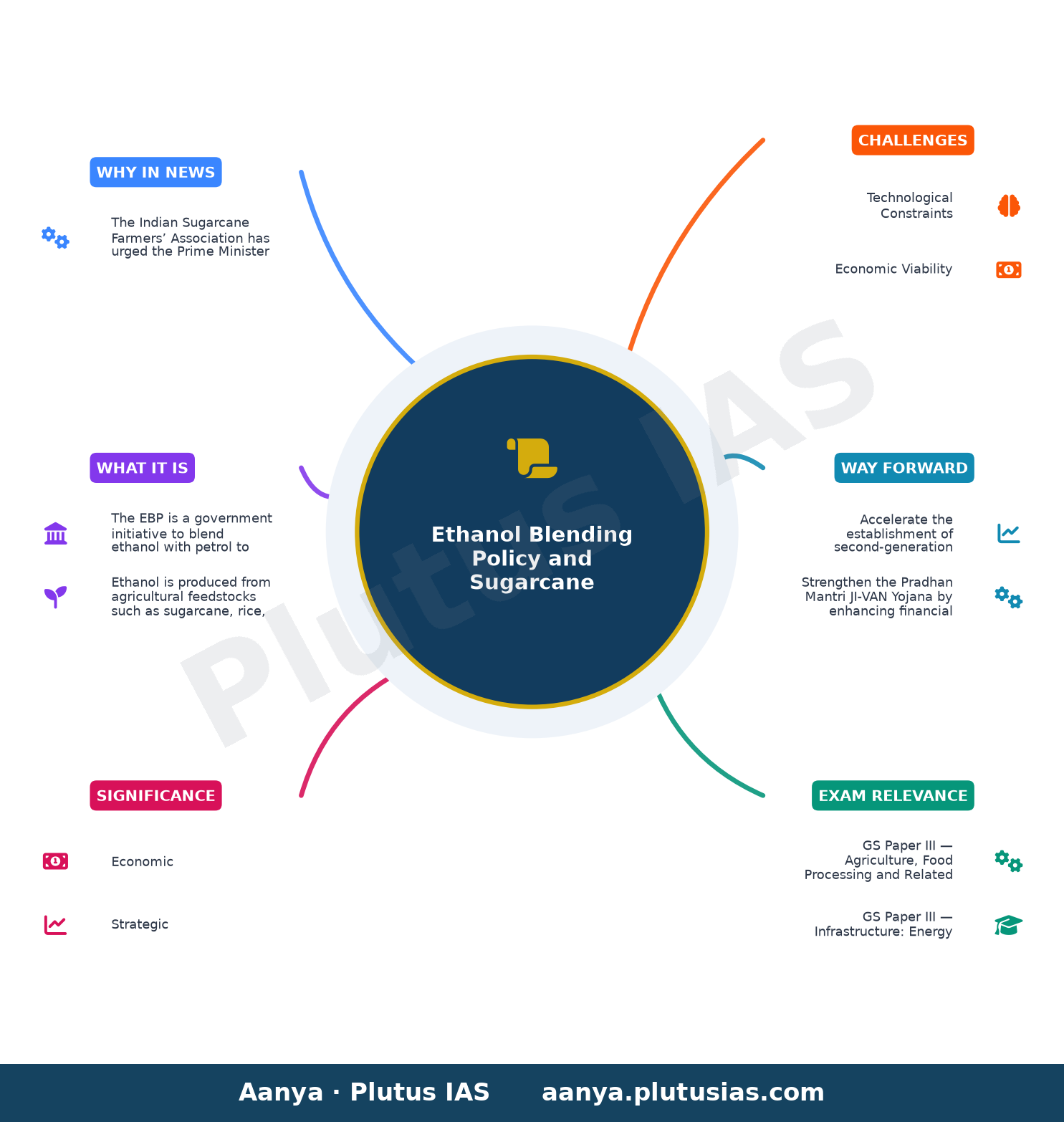
✎ The Indian Sugarcane Farmers’ Association has urged the Prime Minister to maintain the Centre’s ethanol policy, emphasizing its role in enhancing farmers’ incomes, reducing crude oil imports, and promoting energy self-reliance.
Subject Relevance — Where This Topic Fits
- GS Paper III — Agriculture, Food Processing and Related Industries | GS Paper III — Infrastructure: Energy
- Prelims: Ethanol Blending Programme (EBP), Ethanol Blending Targets, Sugarcane Pricing Policy, National Policy on Biofuels 2018, Doubling Farmers’ Income, Sugar Industry Reforms, Crude Oil Import Bill, Renewable Energy
- Essay: Energy Transition: Balancing Economic Growth and Environmental Sustainability, Agrarian Distress and Policy Interventions: The Case for Sustainable Agricultural Practices
Why is this in the news?
The Indian Sugarcane Farmers’ Association has urged the Prime Minister to maintain the Centre’s ethanol policy, emphasizing its role in enhancing farmers’ incomes, reducing crude oil imports, and promoting energy self-reliance. The development underscores the policy’s significance amid criticism over its impact on vehicle engines and fuel efficiency, highlighting the intersection of agricultural policy, energy security, and economic sustainability.
Background
- Sugarcane is a key feedstock for ethanol production in India, alongside rice, maize, and other agricultural residues.
- The sugar industry in India is highly regulated, with pricing and procurement policies influencing ethanol production decisions.
- Critics argue that ethanol blending may reduce fuel efficiency and damage vehicle engines, while supporters highlight its potential to enhance farmers’ incomes and reduce crude oil imports.
- The ethanol policy is part of broader efforts to achieve energy transition, reduce carbon emissions, and promote sustainable agricultural practices.
What is the Ethanol Blending Programme (EBP)?
- The EBP is a government initiative to blend ethanol with petrol to reduce crude oil imports and promote the use of renewable energy sources.
- Ethanol is produced from agricultural feedstocks such as sugarcane, rice, maize, and agricultural residues, aligning with the ‘waste-to-wealth’ principle.
- Ethanol blending is incentivized through pricing policies, procurement mechanisms, and subsidies to encourage production and use.
- The programme supports the sugar industry by providing an alternative revenue stream for sugarcane growers, particularly during surplus production periods.
- Ethanol blending reduces greenhouse gas emissions by substituting fossil fuels with a cleaner, renewable alternative.
- The policy also addresses agricultural distress by linking ethanol production to farm incomes, particularly in sugarcane-growing regions.
- Challenges include feedstock availability, pricing conflicts between sugar and ethanol production, and infrastructure constraints for ethanol distribution.
Key Features
| Feature | Significance |
|---|---|
| Ethanol Blending Policy | Promotes domestic production of ethanol from agricultural feedstocks like sugarcane, rice, and maize, reducing crude oil import dependency and enhancing farmers’ income. |
| Sugarcane as Feedstock | Provides a stable revenue stream for sugarcane farmers, aligning agricultural productivity with energy security objectives. |
| Environmentally Friendly Fuel | Ethanol emits lower greenhouse gases compared to fossil fuels, contributing to India’s climate commitments under international agreements. |
| Foreign Exchange Savings | Reduces crude oil imports, conserving foreign exchange reserves estimated at ₹4 lakh crore annually, which can be redirected to public infrastructure. |
| Farmer Welfare Focus | Ensures remunerative prices for sugarcane growers by integrating agricultural produce into the energy supply chain. |
Why it Matters
Economic
- Enhances farmers’ income through assured demand for sugarcane and other feedstocks, reducing agrarian distress.
- Reduces fiscal burden by curbing crude oil imports, freeing resources for developmental expenditure.
- Stimulates rural employment through ethanol production units and ancillary industries.
- Boosts the ethanol industry, creating a new revenue stream for agro-based enterprises.
Strategic
- Reduces India’s vulnerability to global oil price volatility and geopolitical supply disruptions.
- Strengthens energy security by diversifying the fuel mix with indigenous ethanol production.
- Supports India’s commitment to reduce carbon emissions under the Paris Agreement.
Environmental
- Ethanol-blended petrol emits fewer particulate matter and greenhouse gases compared to conventional fuels.
- Promotes sustainable agricultural practices by incentivising crop residue utilisation for ethanol production.
- Contributes to India’s Nationally Determined Contributions (NDCs) under the UNFCCC.
Social
- Empowers sugarcane farmers by providing a stable market linkage, addressing long-standing price fluctuations.
- Encourages cooperative models in ethanol production, fostering rural entrepreneurship.
- Aligns agricultural policies with climate action, ensuring long-term sustainability.
Challenges
1. Technological Constraints
- Limited ethanol production capacity in India, necessitating scaling up of distilleries and infrastructure.
- Dependence on sugarcane, which has high water requirements, raising concerns over resource sustainability.
- Need for advanced technologies for second-generation ethanol from agricultural residues like rice straw and maize stover.
UPSC Link: Science & Tech – Biofuels
2. Economic Viability
- Fluctuating global sugar prices may impact ethanol production economics, requiring price stabilisation mechanisms.
- High initial capital investment for ethanol plants, deterring private sector participation without fiscal incentives.
- Competition between food, fuel, and fodder uses of agricultural produce, necessitating balanced policy design.
UPSC Link: Economy – Agricultural Marketing
3. Policy and Regulatory Hurdles
- Inconsistent implementation of ethanol blending targets across states, leading to uneven adoption.
- Lack of a unified regulatory framework for ethanol pricing, procurement, and distribution.
- Opposition from vested interests in the fossil fuel sector, creating lobbying pressures against ethanol adoption.
UPSC Link: Polity – Centre-State Relations
4. Environmental Concerns
- Indiscriminate sugarcane cultivation may lead to soil degradation and groundwater depletion in water-stressed regions.
- Burning of agricultural residues for ethanol production could offset environmental benefits if not managed sustainably.
- Potential for increased monoculture farming, reducing biodiversity in agricultural landscapes.
UPSC Link: Environment – Sustainable Agriculture
5. Public Perception and Misinformation
- Widespread misconceptions about ethanol’s impact on vehicle engines and fuel efficiency, requiring awareness campaigns.
- Skepticism among consumers regarding ethanol-blended fuel quality and performance.
- Political polarisation around ethanol policy, complicating consensus-building for long-term implementation.
UPSC Link: Sociology – Rural Development
Challenges — UPSC Perspective
| Issue | Concern |
|---|---|
| Feedstock Availability | Sugarcane is water-intensive; maize and rice may compete with food security, necessitating crop diversification. |
| Infrastructure Gaps | Inadequate storage, transport, and processing facilities for ethanol, particularly in rural areas. |
| Price Volatility | Sugarcane pricing linked to sugar demand; ethanol policy must insulate farmers from market fluctuations. |
| Technology Adoption | Second-generation ethanol requires R&D investment and technology transfer, currently limited in India. |
| Policy Coherence | Inconsistent state-level implementation of ethanol blending targets, undermining national objectives. |
| Consumer Acceptance | Lack of awareness about ethanol-blended fuel benefits, leading to resistance in adoption. |
Government Initiatives — Must-Memorise for Prelims
- Pradhan Mantri JI-VAN Yojana
- Ethanol Blended Petrol (EBP) Programme
Way Forward
- Accelerate the establishment of second-generation ethanol plants to utilise agricultural residues like rice straw and maize stover.
- Strengthen the Pradhan Mantri JI-VAN Yojana by enhancing financial incentives and streamlining approval processes for ethanol projects.
- Develop a national framework for ethanol pricing, procurement, and distribution to ensure consistency across states.
- Launch targeted awareness campaigns to educate farmers and consumers about the benefits of ethanol-blended fuel.
- Invest in R&D for drought-resistant sugarcane varieties and water-efficient ethanol production technologies.
- Promote cooperative models for ethanol production to ensure equitable benefits for small and marginal farmers.
- Integrate ethanol policy with agricultural diversification programmes to reduce reliance on water-intensive crops.
- Enhance monitoring mechanisms to track ethanol blending targets and address implementation gaps at the state level.
UPSC Value Addition
Keywords for Mains Answer-Writing
Ethanol Blending Policy · Sugarcane farmers’ welfare · Energy transition in India · Ethanol production from agricultural produce · Sustainable fuel alternatives · Farmers’ income augmentation · Crude oil import substitution · National Biofuel Policy 2018 · Ethanol blending targets · Environmental sustainability · Agrarian distress mitigation · Renewable energy in India · Public policy and farmer livelihoods · Foreign exchange savings
Constitutional & Policy Linkages
- Article 39(b) – Directive Principles of State Policy (Promotion of welfare of the people)
- Article 48 – Directive Principles of State Policy (Organisation of agriculture and animal husbandry)
Concept Flow
Cane growers face price volatility and delayed payments due to surplus sugar production → Centre introduces ethanol blending policy to utilise sugarcane for fuel → Policy incentivises ethanol production, enhancing farmer income → Increased ethanol supply reduces crude oil imports, saving foreign exchange → Lower emissions from ethanol-blended fuel contribute to climate goals → Opposition spreads misinformation about engine damage, creating policy resistance → Farmers urge PM to sustain ethanol policy, citing economic and environmental benefits → Policy refinements needed to address feedstock sustainability and technological gaps.
Prelims Practice Questions
Q1. Consider the following statements regarding the National Biofuel Policy 2018 of India:
1. It mandates a 20% ethanol blending target by 2030.
2. It allows ethanol production from sugarcane juice, sugar, and damaged foodgrains.
3. It excludes maize and rice as feedstock for ethanol production.
How many of the above statements are correct?
- Only one
- Only two
- All
- None
Answer: Only two — Statement 1 is correct as the policy sets a 20% ethanol blending target by 2030. Statement 2 is correct as it permits ethanol production from sugarcane juice, sugar, and damaged foodgrains. Statement 3 is incorrect as maize and rice are explicitly included as feedstocks.
Q2. Assertion (A): The ethanol blending policy in India is primarily aimed at reducing the fiscal burden of crude oil imports.
Reason (R): Ethanol blending reduces the quantity of petrol required, thereby lowering the import bill for crude oil.
Options:
A. Both A and R are true, and R is the correct explanation of A.
B. Both A and R are true, but R is not the correct explanation of A.
C. A is true, but R is false.
D. A is false, but R is true.
- A
- B
- C
- D
Answer: A — Both the assertion and reason are true. The ethanol blending policy reduces petrol consumption, which in turn lowers crude oil imports and the fiscal burden. The reason correctly explains the assertion.
Q3. Match the following agricultural feedstocks with their respective ethanol production processes:
Column I (Feedstock) | Column II (Process)
1. Sugarcane juice | A. Fermentation of molasses
2. Rice | B. Direct fermentation
3. Maize | C. Starch hydrolysis followed by fermentation
4. Damaged foodgrains | D. Fermentation of sugar-rich syrup
- 1-D, 2-B, 3-C, 4-A; 1-A, 2-D, 3-B, 4-C; 1-D, 2-A, 3-C, 4-B; 1-B, 2-D, 3-C, 4-A
Answer: 1-D, 2-B, 3-C, 4-A; 1-A, 2-D, 3-B, 4-C; 1-D, 2-A, 3-C, 4-B; 1-B, 2-D, 3-C, 4-A — Sugarcane juice is fermented directly into ethanol (1-D). Rice is first converted into sugar and then fermented (2-B). Maize requires starch hydrolysis before fermentation (3-C). Damaged foodgrains are typically fermented via molasses (4-A).
Mains Practice Question
✍ The National Biofuel Policy 2018 envisages a significant shift towards ethanol blending in India’s energy matrix. In this context, critically examine the potential of ethanol blending to address agrarian distress while ensuring energy security. Also, analyse the challenges in achieving the ethanol blending targets. (15 Marks)
Approach: MODEL-ANSWER SKELETON:
1. **Introduction (2 Marks)**: Define ethanol blending and its objectives under the National Biofuel Policy 2018. Highlight the dual goals of farmer welfare and energy security.
2. **Ethanol Blending and Agrarian Distress (5 Marks)**:
– Explain how ethanol production from sugarcane, rice, and maize can augment farmers’ income by creating additional demand for agricultural produce.
– Cite the role of Minimum Support Price (MSP) and procurement mechanisms for ethanol feedstocks.
– Reference the Union Budget 2023-24 allocations for ethanol blending and their impact on rural economies.
– Discuss the potential for cooperative models in ethanol production to empower small and marginal farmers.
3. **Ethanol Blending and Energy Security (5 Marks)**:
– Quantify the potential reduction in crude oil imports and foreign exchange savings (e.g., ₹4 lakh crore as cited in the news).
– Explain how ethanol blending contributes to India’s commitments under the Paris Agreement and its Nationally Determined Contributions (NDCs).
– Discuss the role of ethanol in reducing vehicular emissions and improving air quality.
4. **Challenges in Achieving Targets (3 Marks)**:
– Highlight the constraints in feedstock availability, including seasonal variations and competition with food security.
– Discuss the infrastructure gaps in ethanol storage, transportation, and distribution.
– Address the technical challenges in vehicle compatibility and fuel efficiency concerns raised by critics.
– Mention the role of government incentives, such as the Ethanol Interest Subvention Scheme, and their effectiveness.
5. **Conclusion (2 Marks)**: Provide a balanced view on the feasibility of ethanol blending targets and suggest policy measures to overcome the challenges.
Source: The Hindu
Generated by AanyaAi for educational purpose.

- महाराष्ट्र में त्योहार जुलूसों पर बॉम्बे हाईकोर्ट का बड़ा फैसला: पटाखे, लेजर और संगीत पर रोक - September 24, 2026
- Bombay HC Bans Firecrackers, Music in Maharashtra Processions: Key UPSC Analysis - September 24, 2026
- तमिलनाडु में महिला कर्मचारियों के लिए सवैतनिक माहवारी अवकाश नीति पर HC का आदेश - September 24, 2026

No Comments