


09 Aug Kannada groups demand action against BCC over Mahajan Commission delay
✎ The Mahajan Commission's recommendations, accepted by the Union government and upheld by the Supreme Court, legally establish Belagavi as an integral part of Karnataka; urban local bodies must align their actions with these…
Subject Relevance — Where This Topic Fits
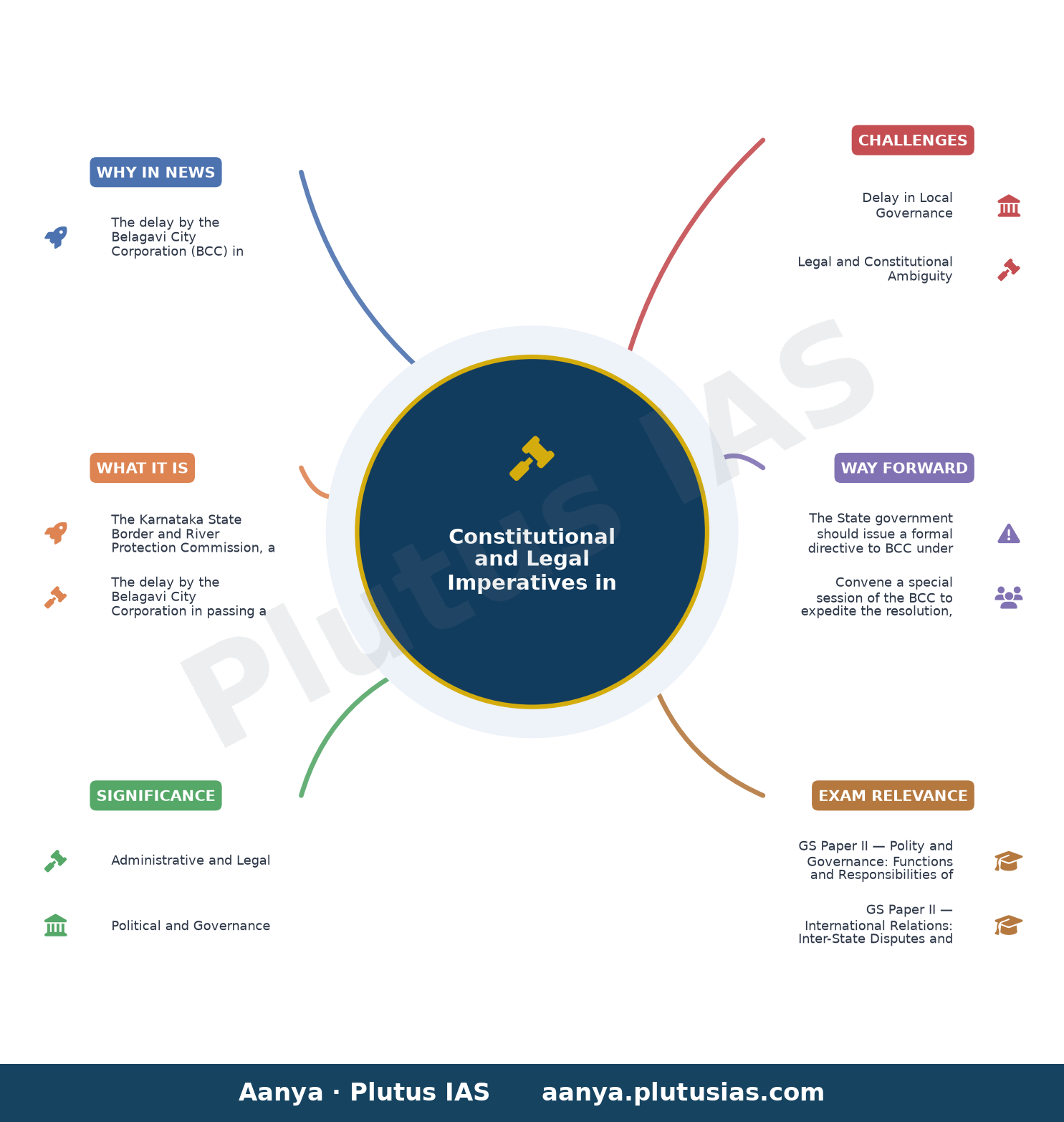
- GS Paper II — Polity and Governance: Functions and Responsibilities of the Union and the States, Federalism, Local Government | GS Paper II — International Relations: Inter-State Disputes and Constitutional Safeguards
- Prelims: Mahajan Commission Report, Article 3 of the Constitution, Inter-State Water Disputes Act, 1956, Urban Local Bodies (ULBs), Karnataka State Border and River Protection Commission, Article 243W of the Constitution, State Legislative Assembly Resolutions
- Essay: Federalism and Cooperative Governance: Lessons from Inter-State Border Disputes
Quick Revision: The Mahajan Commission’s recommendations, accepted by the Union government and upheld by the Supreme Court, legally establish Belagavi as an integral part of Karnataka; urban local bodies must align their actions with these constitutional and judicial mandates.
Why is this in the news?
The delay by the Belagavi City Corporation (BCC) in passing a resolution affirming Belagavi as an integral part of Karnataka, despite the Mahajan Commission’s recommendations and the State government’s explicit endorsement, has reignited constitutional and legal debates regarding the role of urban local bodies in inter-state border disputes. This issue underscores the tension between local autonomy and state sovereignty, as well as the necessity for constitutional compliance in matters of territorial integrity.
Background
- The Mahajan Commission, constituted in 1966, was tasked with resolving the border dispute between Karnataka and Maharashtra, particularly concerning Belagavi (then Belgaum), which was a part of the erstwhile Bombay Presidency.
- Despite the Union government’s acceptance, the dispute persisted due to political and legal challenges, with Maharashtra challenging the decision in the Supreme Court.
- The Karnataka State Border and River Protection Commission, chaired by Justice Nagamohan Das, has consistently reiterated that Belagavi is an integral part of Karnataka, with no legal impediments to such a declaration.
- Urban local bodies, such as the Belagavi City Corporation, are constitutional entities under Article 243W of the Constitution, tasked with functions including urban planning and development, but their role in matters of territorial integrity is limited and must align with state and Union government policies.
What is the Mahajan Commission and its relevance to the Belagavi dispute?
- The Karnataka State Border and River Protection Commission, a state-level body, functions under the State government and is tasked with monitoring and protecting Karnataka’s borders, including Belagavi.
- The delay by the Belagavi City Corporation in passing a resolution affirming Belagavi’s status as part of Karnataka is not a legal necessity but a political and administrative failure to align with constitutional and judicial mandates.
- The issue highlights the principle of cooperative federalism, where local bodies must function within the framework of state and Union government policies, especially in matters of national importance such as territorial integrity.
Key Features
| Feature | Significance |
|---|---|
| Belagavi City Corporation (BCC) resolution on Mahajan Commission | A formal declaration by BCC affirming Belagavi as an integral part of Karnataka, reinforcing state sovereignty and administrative unity. |
| Justice M.C. Mahajan Commission recommendations | Historical judicial validation of Karnataka’s claim over Belagavi, resolving a long-standing border dispute with Maharashtra. |
| State government’s legal opinion on resolution | Clarifies the absence of legal impediments to passing the resolution, ensuring constitutional compliance. |
| Kannada organisations’ agitation | Civil society mobilisation to pressure local authorities and uphold linguistic and regional identity. |
| Mayor’s referral to State government | Demonstrates procedural delay and lack of autonomy in local governance, despite clear state directives. |
Why it Matters
Administrative and Legal
- The resolution would legally entrench Belagavi’s status within Karnataka, preventing future territorial disputes or administrative ambiguity.
- Affirms the primacy of judicial commissions (Mahajan Commission) in resolving inter-state border issues, setting a precedent for federal governance.
- Ensures alignment between local bodies (BCC) and state policies, reducing administrative fragmentation.
Political and Governance
- Highlights the tension between local self-governance (74th Constitutional Amendment) and state directives in sensitive border regions.
- Demonstrates the role of civil society in holding local institutions accountable for constitutional obligations.
- Exposes governance gaps where elected representatives (Mayor) delay or obstruct legally sound resolutions.
Societal and Cultural
- Reinforces the cultural and linguistic identity of Kannada-speaking populations in Belagavi, a region historically contested.
- Serves as a unifying symbol for regional pride and state integration, countering external claims.
Challenges
1. Delay in Local Governance
- BCC’s failure to pass the resolution despite state and judicial clarity reflects institutional inertia and political reluctance.
- Mayor’s referral to the State government for a legal opinion, already provided, indicates procedural obfuscation rather than necessity.
- Repeated protests and arrests suggest a breakdown in democratic engagement and institutional responsiveness.
UPSC Link: 74th CAA – local governance delays
2. Legal and Constitutional Ambiguity
- Perceived or actual lack of clarity in local bodies’ obligations under the Constitution (Article 243W) regarding border resolutions.
- Risk of misinterpretation of state directives by local authorities, leading to administrative paralysis.
UPSC Link: Article 243W – municipal functions
3. Civil Society Mobilisation vs. Institutional Resistance
- Agitation by Kannada organisations highlights the role of pressure groups in enforcing constitutional compliance.
- Potential for escalation if unresolved, including demands for supersession of local bodies or fund withdrawal.
UPSC Link: Pressure groups – role in governance
4. Inter-State Border Disputes
- Belagavi’s contested status exemplifies broader challenges in inter-state border resolution under Article 3 of the Constitution.
- Delays in local resolutions can exacerbate tensions and undermine federal trust.
UPSC Link: Article 3 – formation of new states
Challenges — UPSC Perspective
| Issue | Concern |
|---|---|
| Procedural Delay by BCC | Institutional reluctance to act despite clear state and judicial directives. |
| Mayor’s Referral to State Government | Unnecessary bureaucratic layering, delaying a legally straightforward resolution. |
| Civil Society Protests and Arrests | Erosion of democratic engagement and potential escalation of unrest. |
| Demands for Supersession of BCC | Risk of undermining local self-governance in pursuit of administrative compliance. |
| Funds Withdrawal Threats | Punitive measures that could disrupt local development and exacerbate grievances. |
| Legal Ambiguity Perception | Misunderstanding of constitutional obligations by local authorities. |
Way Forward
- The State government should issue a formal directive to BCC under Article 243W, mandating the passage of the resolution within a stipulated timeline.
- Convene a special session of the BCC to expedite the resolution, with participation from all stakeholders to ensure transparency.
- Conduct a public awareness campaign to clarify the legal and constitutional basis for Belagavi’s inclusion in Karnataka, reducing misinformation.
- Explore mechanisms to strengthen local governance accountability, such as performance audits of municipal bodies in border regions.
- Engage with civil society organisations to channel protests into constructive dialogue, avoiding coercive measures like arrests.
- Establish a grievance redressal mechanism for border-related disputes to pre-empt future delays in local resolutions.
- Review the 74th Constitutional Amendment’s implementation in border regions to address governance gaps.
UPSC Value Addition
Keywords for Mains Answer-Writing
Belagavi border dispute · Mahajan Commission recommendations · Karnataka-Karnataka border issues · Belagavi City Corporation (BCC) · Karnataka State border and river protection commission · urban local bodies and state sovereignty · federalism in India · inter-state boundary disputes · Article 263 of the Constitution · Justice M.C. Mahajan Commission · institutional delays in governance · local self-government and constitutional provisions · Maharashtra-Karnataka border · Kannada organisations and regional identity · public administration and accountability of local bodies
Constitutional & Policy Linkages
- Article 243W – Functions of Municipalities (local governance obligations)
- Article 3 – Parliament’s power to form new states and alter boundaries (border disputes context)
Concept Flow
Belagavi’s historical claim contested by Maharashtra → Mahajan Commission (1966) validates Karnataka’s claim → State government endorses commission’s recommendations → BCC delays resolution despite state and judicial clarity → Kannada organisations protest → State government reaffirms stance but local body remains inert → Civil society escalates pressure → Demands for legal action or institutional reform emerge.
Prelims Practice Questions
Q1. Consider the following statements regarding the Mahajan Commission recommendations on the Belagavi border dispute:
1. The Mahajan Commission was constituted to resolve the inter-state boundary dispute between Karnataka and Maharashtra.
2. The Commission recommended that Belagavi be included within the territorial jurisdiction of Karnataka.
3. The Commission’s recommendations have been unanimously accepted by the Parliament of India.
How many of the above statements are correct?
- Only one
- Only two
- All three
- None
Answer: Only two — Statement 1 is correct as the Mahajan Commission was indeed constituted to resolve the Karnataka-Maharashtra border dispute. Statement 2 is correct as the Commission recommended Belagavi’s inclusion in Karnataka. Statement 3 is incorrect as the recommendations have been accepted by the Karnataka State legislature but not necessarily by Parliament.
Q2. Assertion (A): The Belagavi City Corporation (BCC) is constitutionally obligated to pass resolutions endorsing the Mahajan Commission’s recommendations.
Reason (R): The Mahajan Commission’s recommendations are binding on all local bodies within the disputed territory as per Article 263 of the Constitution of India.
Options:
A. Both A and R are true, and R is the correct explanation of A.
B. Both A and R are true, but R is NOT the correct explanation of A.
C. A is true but R is false.
D. A is false but R is true.
Answer: ? — Assertion (A) is true as the BCC, being a local body, is expected to align with state policy, including the Mahajan Commission’s recommendations. However, Reason (R) is false because Article 263 does not make the Commission’s recommendations binding on local bodies; they are advisory and subject to state government approval.
Q3. Match the following pairs regarding the Belagavi border dispute and its institutional resolution:
Column I (Institution/Body)
1. Belagavi City Corporation (BCC)
2. Karnataka State border and river protection commission
3. Mahajan Commission
4. Supreme Court of India
Column II (Role/Function)
A. Constituted by the Government of India to resolve the inter-state boundary dispute
B. Local urban local body responsible for municipal governance in Belagavi
C. Apex judicial body that can adjudicate inter-state disputes
D. State-level commission constituted to protect state borders and rivers
Select the correct match:
- 1-B, 2-D, 3-A, 4-C
- 1-D, 2-B, 3-A, 4-C
- 1-A, 2-D, 3-B, 4-C
- 1-C, 2-A, 3-D, 4-B
Answer: 1-B, 2-D, 3-A, 4-C — The correct matches are: 1-B (BCC is a local urban body), 2-D (Karnataka State border and river protection commission is a state-level body), 3-A (Mahajan Commission was constituted by the Government of India), and 4-C (Supreme Court is the apex judicial body for inter-state disputes).
Mains Practice Question
✍ The delay by the Belagavi City Corporation (BCC) in passing a resolution endorsing the Mahajan Commission’s recommendations on the Belagavi border dispute raises critical questions about the interplay between local self-government and state sovereignty in India. Critically examine the constitutional and administrative dimensions of this issue, with particular reference to the role of urban local bodies in inter-state boundary disputes. (15 Marks)
Approach: MODEL-ANSWER SKELETON:
1. **Constitutional Framework**:
– Article 243W (74th Amendment Act) vests urban local bodies with functions related to urban governance, but state sovereignty over inter-state disputes is derived from Article 263 and the **Inter-State Water Disputes Act, 1956**.
– The **Mahajan Commission (1966)** was constituted under the **States Reorganisation Act, 1956**, and its recommendations are advisory, not binding (as affirmed in *State of Karnataka v. State of Maharashtra*, 2006).
2. **Role of Urban Local Bodies**:
– BCC, as a **municipal corporation**, is a **local self-government institution** under the **Karnataka Municipal Corporations Act, 1976**, but its resolutions must align with state policy (Article 256: Duty of States to comply with Union directions).
– The **Karnataka State border and river protection commission** (constituted under state law) has opined that there is no legal hurdle to passing the resolution, reinforcing the state’s stance.
3. **Administrative and Political Dimensions**:
– **Delay as Governance Failure**: The BCC’s inaction reflects institutional apathy, undermining the state’s constitutional obligation to uphold the Mahajan Commission’s recommendations (as per *State of Punjab v. State of Haryana*, 2016).
– **Federalism and Accountability**: The issue highlights the tension between **local autonomy** (74th Amendment) and **state authority** in inter-state matters. The **Supreme Court’s stance** (e.g., in *State of Kerala v. State of Tamil Nadu*, 2021) suggests that such disputes are political, not judicial, and require executive resolution.
4. **Possible Solutions and Consequences**:
– **Legal Remedies**: The state government can issue directions under **Article 256** or **Article 355** (duty to protect states from internal disturbance) to compel the BCC to act.
– **Constitutional Supersession**: If the BCC continues to defy state policy, the state may consider **superseding the corporation** under **Article 243UE** (provisions for dissolution of municipal bodies).
– **Public Pressure and Protests**: The role of **Kannada organisations** (e.g., Vatal Nagaraj’s agitation) demonstrates the **democratic deficit** when institutions fail to reflect popular sentiment.
5. **Balanced View**:
– **Pro-State Sovereignty**: The state’s obligation to resolve inter-state disputes (Article 263) overrides local resistance.
– **Pro-Local Autonomy**: The 74th Amendment promotes decentralisation, but local bodies cannot obstruct state policy on national integration issues.
6. **Conclusion**: The BCC’s delay is a symptom of **institutional inertia** and **federal tensions**. The state must balance **local governance** with **constitutional obligations**, while ensuring **accountability** in urban local bodies.
Source: The Hindu
Generated by AanyaAi for educational purpose.

- RBI to Sell ₹25,000 Crore Govt Securities via OMO on Sept 28, 2026 - September 23, 2026
- भारत-श्रीलंका नौसैनिक अभ्यास ‘स्लाईनेक्स-26’: विशाखापत्तनम में संपन्न, जानें प्रमुख बिंदु - September 23, 2026
- SLINEX-26: India-Sri Lanka Maritime Exercise Enhances Naval Cooperation - September 23, 2026

No Comments