


09 Aug Madras HC to Hear VC Appointment Cases on Sept 2: Key UPSC Polity Insights
✎ The Madras High Court has scheduled a final hearing on September 2, 2026, for two writ petitions challenging the constitutional validity of amendments to university statutes that transferred the power to appoint Vice-Chancellors…
Subject Relevance — Where This Topic Fits
- GS Paper II — Constitutional and Statutory Bodies (Governor, State Legislatures) | GS Paper II — Judiciary and Judicial Review | GS Paper IV — Ethical Issues in Governance (Appointment Processes)
Why is this in the news?
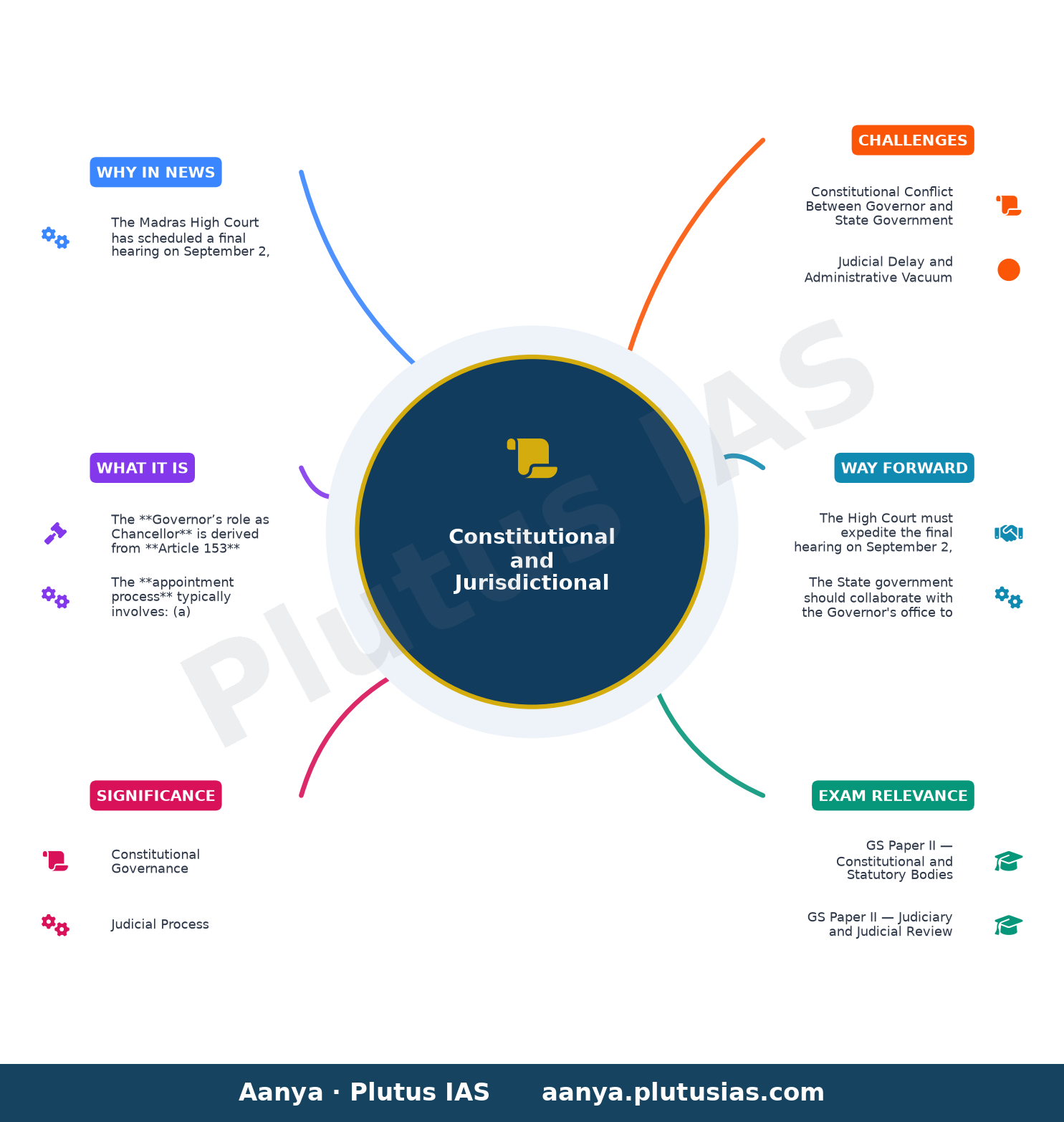
The Madras High Court has scheduled a final hearing on September 2, 2026, for two writ petitions challenging the constitutional validity of amendments to university statutes that transferred the power to appoint Vice-Chancellors from the Governor (as Chancellor) to the State government. The case raises critical questions about the balance of executive and constitutional authority in higher education governance, the role of the judiciary in reviewing legislative amendments, and the operational continuity of universities during disputes over appointing authorities.
Background
- The amendments were challenged through a writ petition (K. Venkatachalapathy v. State of Tamil Nadu) in the Madras High Court, which stayed the operation of the amendments on May 21, 2025, citing potential constitutional infirmities.
- The Supreme Court stayed the High Court’s interim order on appeal by the State government, directing that no Vice-Chancellors be appointed until the High Court’s final decision on the writ petition.
- A second writ petition (P. Bhaskar v. State of Tamil Nadu) was filed in 2026, highlighting the absence of Vice-Chancellors in most state-run universities due to the dispute over appointing authority.
- The Advocate General of Tamil Nadu argued that the amendments were valid and operational, and that the State government should be permitted to appoint Vice-Chancellors from a panel of three names recommended by search committees.
- The High Court, noting incomplete pleadings, deferred interim relief and listed the cases for final hearing on September 2, 2026.
What is the constitutional and legal framework governing Vice-Chancellor appointments in state universities?
- The **Governor’s role as Chancellor** is derived from **Article 153** (Governor of a State) and **Article 163** (Council of Ministers to aid and advise the Governor), read with the **University Acts** of respective states.
- The **appointment process** typically involves: (a) constitution of a search committee, (b) shortlisting candidates, (c) recommendation to the Chancellor, and (d) formal appointment by the Chancellor.
- The **Madras University Act, 1923**, and other state-specific university acts govern the appointment, removal, and tenure of Vice-Chancellors in Tamil Nadu.
- The **Governor’s discretion** in appointing Vice-Chancellors is subject to judicial review, particularly when legislative amendments alter the constitutional balance of power.
Key Features
| Feature | Significance |
|---|---|
| Judicial intervention in university appointments | Highlights the judiciary’s role in resolving executive-legislative disputes over institutional autonomy and governance. |
| Stay on amendments to university statutes | Demonstrates the judicial power to halt legislative actions pending constitutional validity assessment. |
| Supreme Court’s interim stay on High Court order | Illustrates the hierarchy of judicial forums and the binding nature of apex court directives. |
| State government’s claim over appointment authority | Reflects the executive’s assertion of constitutional powers under the Seventh Schedule (State List, Entry 32). |
| Search panels for Vice-Chancellor selection | Underscores the procedural safeguards in higher education governance to ensure merit-based appointments. |
Why it Matters
Constitutional Governance
- The case underscores the delicate balance between the Governor’s role as Chancellor and the State government’s executive authority under Article 162 and the Seventh Schedule.
- The dispute highlights the constitutional principle of ‘institutional autonomy’ in higher education, as envisaged in Article 29 and 30, read with the University Grants Commission (UGC) Act, 1956.
- The Supreme Court’s intervention exemplifies the doctrine of judicial review over legislative actions, as per Article 13 and Article 226.
Judicial Process
- The High Court’s decision to defer interim orders reflects the principle of judicial restraint and the need for complete pleadings before adjudication.
- The case exemplifies the writ jurisdiction under Article 226, where citizens can challenge executive actions affecting public interest.
- The timeline—from High Court stay (May 2025) to Supreme Court stay and final hearing listing (September 2026)—demonstrates the prolonged judicial process in constitutional matters.
Higher Education Governance
- The absence of Vice-Chancellors in state universities due to the dispute raises concerns about administrative continuity and academic leadership.
- The case highlights the need for transparent and merit-based selection processes for Vice-Chancellors, as mandated by UGC regulations.
- The reliance on search panels for recommendations aligns with the UGC’s guidelines for appointing Vice-Chancellors to ensure objectivity.
Challenges
1. Constitutional Conflict Between Governor and State Government
- The dispute arises from conflicting interpretations of the Governor’s role as Chancellor versus the State government’s executive authority in university governance.
- The amendments to university statutes, which transfer appointment powers from the Governor to the State government, are being challenged for potential violation of constitutional provisions.
- The Supreme Court’s stay on the High Court’s order creates a legal vacuum, delaying the resolution of the dispute.
UPSC Link: Article 154, Article 163, Seventh Schedule
2. Judicial Delay and Administrative Vacuum
- The prolonged judicial process (since 2025) has left state universities without Vice-Chancellors, affecting academic and administrative functioning.
- The absence of interim arrangements, despite the Supreme Court’s stay, exacerbates the leadership crisis in higher education institutions.
- The High Court’s decision to defer interim orders further delays the resolution, risking prolonged governance disruptions.
UPSC Link: Article 226, Doctrine of Judicial Review
3. Ensuring Meritocracy in Vice-Chancellor Appointments
- The reliance on search panels for recommendations must ensure transparency and meritocracy, avoiding political interference.
- The case highlights the need for a robust mechanism to prevent arbitrary or politically motivated appointments in higher education.
- The absence of Vice-Chancellors for extended periods undermines the academic standards and credibility of state universities.
UPSC Link: UGC Act, 1956, Section 12
4. Balancing Executive Authority and Institutional Autonomy
- The State government’s claim over appointment authority must be balanced with the need to preserve the autonomy of universities.
- The Governor’s role as Chancellor, while largely ceremonial, must not be undermined in a manner that affects institutional governance.
- The case underscores the need for a clear constitutional framework to delineate the roles of the executive and the Chancellor in university appointments.
UPSC Link: Article 29, Article 30, UGC Regulations
Challenges — UPSC Perspective
| Issue | Concern |
|---|---|
| Constitutional conflict over appointment powers | Potential violation of federal principles and institutional autonomy. |
| Judicial delay in resolving the dispute | Prolonged absence of Vice-Chancellors disrupting university governance. |
| Risk of politically motivated appointments | Undermining meritocracy and academic standards in higher education. |
| Administrative vacuum in state universities | Adverse impact on academic programs, research, and student welfare. |
| Conflicting interpretations of the Governor’s role | Erosion of the ceremonial and constitutional role of the Chancellor. |
Way Forward
- The High Court must expedite the final hearing on September 2, 2026, to resolve the constitutional conflict and restore administrative continuity in universities.
- The State government should collaborate with the Governor’s office to evolve a consensus on the appointment process, ensuring compliance with constitutional provisions.
- The search panels for Vice-Chancellor appointments must function transparently, with clear criteria for merit and experience to avoid political interference.
- The UGC should issue guidelines to state universities on interim arrangements for governance during leadership vacancies, ensuring minimal disruption.
- The Supreme Court, if approached, should provide clarity on the Governor’s role as Chancellor versus the State government’s executive authority in university appointments.
- State universities should proactively engage in capacity-building for interim leadership to mitigate the impact of prolonged vacancies.
- A constitutional amendment or legislative clarification may be considered to delineate the roles of the Governor and State government in university governance, ensuring long-term stability.
UPSC Value Addition
Keywords for Mains Answer-Writing
Vice-Chancellor appointment · Madras High Court · Governor vs State Government · University statutes · Constitutional amendment · Judicial review · Interim orders · Search panels · Vice-Chancellor selection process · Federalism in higher education · Judicial activism · State legislature powers · Governor’s discretionary powers · Appointment of statutory authorities · Judicial intervention in executive functions
Constitutional & Policy Linkages
- Article 154: Executive power of the State.
- Article 163: Council of Ministers to aid and advise the Governor.
- Article 226: High Court’s power of judicial review.
- Seventh Schedule: State List (Entry 32: Universities).
- Article 29: Protection of interests of minorities in educational institutions.
Concept Flow
State legislature amends university statutes to transfer Vice-Chancellor appointment powers from Governor to State government → High Court stays the amendments and restores Governor’s appointment authority (May 2025) → Supreme Court stays High Court’s order, allowing State government to appoint Vice-Chancellors pending final disposal (2025) → Writ petitions challenge the amendments and the absence of Vice-Chancellors in state universities (2025-2026) → High Court defers interim orders due to incomplete pleadings; lists final hearing for September 2, 2026 → State government argues for its authority to appoint Vice-Chancellors via search panels, citing Supreme Court’s stay → Final judicial resolution required to restore constitutional balance and institutional autonomy
Prelims Practice Questions
Q1. Consider the following statements regarding the appointment of Vice-Chancellors in State-run universities in India:
1. The Governor of a State is the sole authority responsible for appointing Vice-Chancellors under the Constitution.
2. The State legislature can amend university statutes to vest the power of appointment with the State government.
3. The Supreme Court can stay the operation of a High Court’s interim order if it deems necessary.
4. The Madras High Court has the power to appoint Vice-Chancellors directly in case of disputes.
How many of the above statements are correct?
- Only one
- Only two
- Only three
- All
Answer: Only three — Statements 2 and 3 are correct. Statement 1 is incorrect as the Governor’s role is often subject to statutory provisions and judicial interpretation. Statement 4 is incorrect as the High Court does not appoint Vice-Chancellors directly but may issue directions or stay orders.
Q2. Assertion (A): The Supreme Court of India can stay the operation of a High Court’s interim order if it deems such an order to be against public interest.
Reason (R): The Supreme Court is the final interpreter of the Constitution and has the power of judicial review under Article 136 of the Constitution.
- A. Both A and R are true, and R is the correct explanation of A
- B. Both A and R are true, but R is not the correct explanation of A
- C. A is true, but R is false
- D. A is false, but R is true
Answer: B. Both A and R are true, but R is not the correct explanation of A — Both the Assertion and Reason are true. The Supreme Court, under Article 136, can grant special leave to appeal and stay the operation of any order, including interim orders passed by High Courts. The Reason correctly explains the Assertion.
Q3. Match the following institutions with their respective roles in the appointment of Vice-Chancellors in State-run universities:
Column I (Institution)
A. Governor
B. State Legislature
C. High Court
D. Supreme Court
Column II (Role)
1. Can amend university statutes to alter appointment powers
2. Can issue interim orders or stay proceedings related to appointments
3. Can appoint Vice-Chancellors directly in case of disputes
4. Can grant special leave to appeal and stay High Court orders
- A-1, B-2, C-3, D-4
- A-4, B-1, C-2, D-3
- A-2, B-4, C-1, D-3
- A-1, B-4, C-2, D-3
Answer: A-1, B-2, C-3, D-4 — A-1: The Governor’s role is often defined by statutory provisions, which can be amended by the State Legislature. B-4: The State Legislature can amend university statutes, altering appointment powers. C-2: The High Court can issue interim orders or stay proceedings. D-3: The Supreme Court can grant special leave to appeal and stay High Court orders.
Mains Practice Question
✍ The Madras High Court’s decision to defer interim orders on Vice-Chancellor appointments and schedule a final hearing for September 2026 underscores the tension between judicial review and executive prerogative in higher education governance. Critically examine the constitutional and statutory framework governing the appointment of Vice-Chancellors in State-run universities, with particular reference to the roles of the Governor, State legislature, and judiciary. Also, analyse the implications of such judicial interventions for the principle of federalism in India. (15 Marks)
Approach: MODEL-ANSWER SKELETON:
1. **Constitutional and Statutory Framework**:
– Article 124(2) and 217 (appointment of Governors); Article 166 (executive power of State Government).
– University Grants Commission (UGC) Regulations, 2018 (Section 12(1) and 12(2)) on qualifications and appointment processes.
– State Universities Acts (e.g., Tamil Nadu Private Universities Act, 2019; Tamil Nadu State Universities Act) governing appointment powers.
– The 7th Schedule (State List, Entry 25: ‘Education, including universities’).
2. **Governor’s Role**:
– Position as Chancellor under university statutes (e.g., Tamil Nadu State Universities Act, 1975).
– Discretionary powers under Article 163 (Council of Ministers’ aid and advice) and Article 161 (pardon powers).
– Judicial precedents: *B.P. Singhal v. Union of India* (2010) on Governor’s discretion; *Rameshwar Prasad v. Union of India* (2006) on gubernatorial powers.
3. **State Legislature’s Role**:
– Power to amend university statutes under Entry 25, State List.
– Recent amendments in Tamil Nadu (e.g., 2025 amendments vesting appointment power with State Government).
– Federalism implications: Centre-State relations and cooperative federalism.
4. **Judicial Review and Interventions**:
– Power of judicial review under Article 226 (High Courts) and Article 32 (Supreme Court).
– *Madras High Court’s interim order (May 2025)*: Stay on amendments vesting power with State Government.
– *Supreme Court’s stay (2026)*: Recording State Government’s submission not to appoint Vice-Chancellors until final disposal.
– Judicial activism vs. judicial restraint: *S.P. Gupta v. Union of India* (1981) on judicial review.
5. **Implications for Federalism**:
– Balance between State autonomy (education under State List) and Centre’s regulatory role (UGC).
– Potential for judicial overreach in executive functions.
– Impact on university autonomy and academic freedom.
– Comparative perspective: Appointment processes in other States (e.g., Maharashtra, Karnataka).
6. **Conclusion**:
– Need for a clear constitutional/statutory framework to delineate roles.
– Role of collegium systems (e.g., UGC’s search committees) in ensuring transparency.
– Recommendations: Codification of appointment processes, judicial restraint in executive matters, and strengthening of State-level statutory bodies.
Source: The Hindu
Generated by AanyaAi for educational purpose.


No Comments