


09 Aug UPSC Alert: Bill to Ban Social Media Accounts for Kids Under 13
✎ The SHIELD Bill, 2025, proposes mandatory age verification, parental consent for minors under 13, and strict restrictions on personalised advertising and harmful content exposure on social media and gaming platforms.
Subject Relevance — Where This Topic Fits
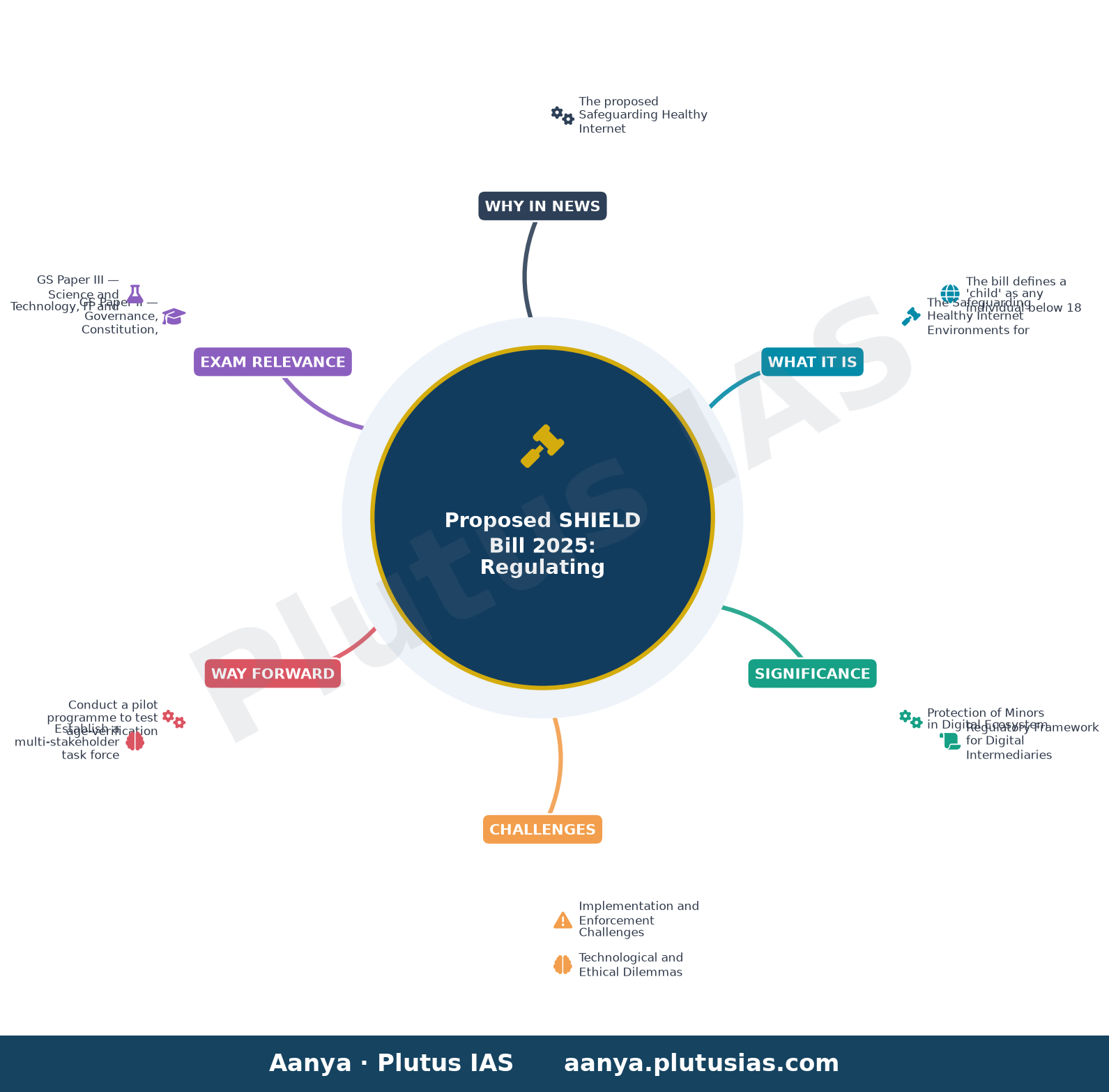
- GS Paper II — Governance, Constitution, Polity, Social Justice and International Relations | GS Paper III — Science and Technology, IT and Computers
- Prelims: Digital Personal Data Protection Act, 2023, Information Technology (Intermediary Guidelines and Digital Media Ethics Code) Rules, 2021, Section 69A of the IT Act, UN Convention on the Rights of the Child, Parental consent mechanisms, Age verification systems, Personalised advertising restrictions, Online gaming regulations
- Essay: The ethical and regulatory challenges of digital governance in the age of artificial intelligence and social media, Balancing child protection with digital freedom: A framework for responsible internet governance
Quick Revision: The SHIELD Bill, 2025, proposes mandatory age verification, parental consent for minors under 13, and strict restrictions on personalised advertising and harmful content exposure on social media and gaming platforms.
Why is this in the news?
The proposed Safeguarding Healthy Internet Environments for Little Digital-Natives (SHIELD) Bill, 2025, introduced by BJP MP Baijayant Panda in Parliament, seeks to prohibit children under 13 from creating accounts on social media and gaming platforms without verified parental consent. The bill also aims to restrict personalised advertising targeting minors and mandates age-verification systems, parental-control dashboards, and penalties for non-compliance, reflecting growing concerns over digital harms to children and the inadequacy of existing regulatory frameworks.
Background
- The exponential growth of social media and online gaming platforms has raised significant concerns regarding child safety, privacy, and exposure to harmful content such as violence, extremism, and pornography.
- India’s Information Technology (Intermediary Guidelines and Digital Media Ethics Code) Rules, 2021, impose obligations on intermediaries to remove unlawful content but lack specific provisions for child protection and age verification.
- The Digital Personal Data Protection Act, 2023, provides a framework for data privacy but does not address the unique vulnerabilities of minors in digital spaces.
- Globally, jurisdictions such as the European Union (under the Digital Services Act) and the United States (Children’s Online Privacy Protection Act) have implemented stricter regulations to protect minors online.
- Private member’s bills in India have historically faced low success rates, with only about a dozen passing since Independence, highlighting the procedural and political challenges in enacting such legislation.
- The proposed bill aligns with broader efforts to regulate digital spaces, including the pending AI regulation bill and ongoing debates on online gaming and content moderation.
What is the SHIELD Bill, 2025?
- The Safeguarding Healthy Internet Environments for Little Digital-Natives (SHIELD) Bill, 2025, is a private member’s bill introduced to regulate the digital exposure of minors on social media, gaming, and other online platforms.
- The bill defines a ‘child’ as any individual below 18 years of age, expanding the scope beyond the traditional threshold of 13 years used in some international frameworks.
- It mandates age-verification systems to ensure that platforms can verify the age of users and obtain verified parental consent for account creation by children under 13.
- The bill prohibits social media and gaming platforms from tracking, profiling, or using personalised advertising for minors, addressing concerns over data exploitation and manipulative algorithms.
- Platforms are required to implement parental-control dashboards, enabling guardians to monitor activity, manage privacy settings, and restrict screen time, thereby empowering parents in digital parenting.
- The bill imposes obligations on platforms to prevent exposure to harmful content, including pornography, gambling, extremist material, and drug-related content, through algorithmic and human moderation.
- The bill reflects a proactive approach to digital governance, aligning with global best practices while addressing India’s unique socio-technological landscape.
Key Features
| Feature | Significance |
|---|---|
| Age verification systems | Mandates robust mechanisms to verify user age, ensuring compliance with the proposed age threshold of 13 years for account creation. |
| Parental consent requirement | Introduces verified parental consent as a prerequisite for minors under 13 to create accounts, aligning with international safeguarding standards. |
| Prohibition of personalised advertising | Bans tracking, profiling, and targeted advertising for minors, reducing exposure to manipulative content and commercial exploitation. |
| Parental-control dashboards | Provides guardians with tools to monitor activity, adjust privacy settings, and enforce screen-time limits, enhancing digital supervision. |
| Content moderation obligations | Imposes duties on platforms to prevent exposure to pornography, gambling, extremist material, and drug-related content for minors. |
| Penal provisions | Specifies penalties up to ₹10 crore for violations, with potential suspension or blocking of services under Section 69A of the IT Act for repeated offences. |
Why it Matters
Protection of Minors in Digital Ecosystem
- Addresses the vulnerability of children in online environments by introducing structural safeguards against exploitation, manipulation, and exposure to harmful content.
- Aligns with global best practices, such as the Children’s Online Privacy Protection Act (COPPA) in the USA and the General Data Protection Regulation (GDPR) in the EU, which prioritise child safety in digital spaces.
- Recognises the developmental stage of minors, where cognitive immaturity and susceptibility to external influences necessitate protective legislative frameworks.
Regulatory Framework for Digital Intermediaries
- Expands the ambit of digital regulation beyond traditional content moderation to include age verification, consent mechanisms, and parental oversight, setting a precedent for future legislation.
- Shifts the burden of compliance from reactive enforcement to proactive systemic design, requiring platforms to embed safeguards during platform development.
- Introduces a tiered enforcement mechanism, combining financial penalties with service restrictions, to ensure accountability for systemic failures.
Public Health and Social Implications
- Targets the adverse effects of personalised advertising on minors, which has been linked to mental health issues, body image disorders, and addictive behaviours.
- Aims to mitigate the risks of early exposure to pornography, gambling, and extremist content, which can distort developmental trajectories and socialisation processes.
- Promotes healthier digital habits by empowering parents to regulate screen time and content consumption, addressing concerns over digital addiction.
Legal and Institutional Precedents
- Builds on existing provisions under the Information Technology Act, 2000 (e.g., Section 69A for blocking content) by integrating them into a child-centric regulatory framework.
- Reflects a growing trend in Indian jurisprudence towards recognising digital rights and protections for vulnerable groups, as seen in the Digital Personal Data Protection Act, 2023.
- Highlights the role of private member’s bills in shaping legislative discourse, even if their passage remains rare, by bringing critical issues to parliamentary attention.
Challenges
1. Implementation and Enforcement Challenges
- Age verification systems may face resistance due to privacy concerns, as robust verification could require sharing sensitive personal data, potentially violating privacy rights under the Digital Personal Data Protection Act, 2023.
- The requirement for verified parental consent introduces logistical hurdles, particularly for children in single-parent households, foster care, or situations where parental access is restricted.
- Platforms may exploit loopholes in age verification, such as using proxy measures (e.g., self-declaration) that fail to accurately determine a user’s age.
- Enforcement mechanisms, including penalties and service suspensions, may prove ineffective if platforms operate from jurisdictions with lax regulatory oversight or utilise decentralised architectures.
UPSC Link: GS Paper 2: Governance, Administration and Challenges
2. Technological and Ethical Dilemmas
- Balancing child safety with privacy rights poses a fundamental ethical challenge, as stringent verification systems may inadvertently create surveillance states or exclude vulnerable children from essential digital services.
- The prohibition of personalised advertising for minors could disrupt the revenue models of platforms reliant on targeted advertising, potentially leading to reduced investment in child-friendly content or features.
- AI-driven content moderation systems may struggle to accurately identify and filter harmful content for minors, risking both over-censorship and under-protection due to algorithmic biases.
UPSC Link: GS Paper 3: Science and Technology, Ethics
3. Socio-Cultural and Economic Barriers
- Digital literacy gaps among parents, particularly in rural and marginalised communities, may limit the effective utilisation of parental-control dashboards and oversight tools.
- Economic disparities could exacerbate digital exclusion, as children from lower-income households may lack access to devices or internet connectivity, rendering age-verification systems irrelevant for them.
- Cultural attitudes towards parental control and child autonomy may vary widely across regions, leading to resistance or non-compliance in certain communities.
UPSC Link: GS Paper 1: Society, Social Justice
4. Jurisdictional and Cross-Border Issues
- Global platforms operating in India may face conflicts between domestic laws and the regulatory frameworks of their home jurisdictions, complicating compliance and enforcement.
- Cross-border data flows and the use of foreign servers could undermine India’s ability to enforce age-verification and content moderation requirements, necessitating international cooperation.
- The bill’s extraterritorial applicability may raise sovereignty concerns if foreign platforms resist compliance or challenge the law’s validity under international law.
UPSC Link: GS Paper 2: International Relations, Governance
5. Stakeholder Resistance and Compliance Costs
- Social media and gaming platforms may lobby against stringent provisions, arguing that they impose disproportionate compliance costs or stifle innovation in digital services.
- Small and medium-sized enterprises (SMEs) in the digital sector may lack the resources to implement age-verification systems, leading to market consolidation in favour of larger players.
- Civil society organisations and child rights advocates may criticise the bill for not going far enough, particularly in addressing issues like cyberbullying, online grooming, or data exploitation by third parties.
UPSC Link: GS Paper 2: Governance, Administration
Challenges — UPSC Perspective
| Issue | Concern |
|---|---|
| Privacy vs. Safety Trade-off | Age verification systems may infringe on privacy rights, particularly if they require biometric data or extensive personal information. |
| Parental Consent Logistics | Verified consent mechanisms may exclude children in non-traditional family structures or those without parental access. |
| Platform Compliance Burden | Smaller platforms may struggle to implement age-verification and content moderation systems, leading to market inequities. |
| Cross-Border Enforcement | Global platforms may evade compliance by operating from jurisdictions with weaker regulatory frameworks. |
| Algorithmic Bias in Moderation | AI-driven content filtering may fail to accurately identify harmful content for minors, risking both over- and under-censorship. |
| Digital Divide Amplification | Children in rural or low-income households may be excluded from digital services if age-verification systems are not accessible. |
Way Forward
- Conduct a pilot programme to test age-verification systems and parental-control dashboards in select states, assessing feasibility and user feedback before nationwide implementation.
- Establish a multi-stakeholder task force comprising child psychologists, technologists, legal experts, and platform representatives to refine the bill’s provisions and address implementation challenges.
- Develop standardised guidelines for age-verification mechanisms, ensuring they are privacy-preserving, accessible, and resistant to circumvention by minors.
- Expand digital literacy programmes for parents and children, focusing on safe online practices, privacy management, and the responsible use of digital platforms.
- Strengthen collaboration with international bodies and foreign governments to harmonise age-verification standards and address cross-border enforcement issues.
- Introduce a graded penalty system for platforms, incentivising compliance through reduced penalties for proactive measures and stricter penalties for repeated violations.
- Mandate regular audits of platforms’ compliance with child safety provisions, with findings published in an accessible format to enhance transparency and accountability.
- Explore public-private partnerships to subsidise the implementation of age-verification systems for smaller platforms, ensuring equitable access to digital services.
UPSC Value Addition
Keywords for Mains Answer-Writing
Digital Personal Data Protection Act 2023 · Age verification mechanisms · Parental consent in digital platforms · Personalised advertising to minors · SHIELD Bill 2025 · Information Technology (Intermediary Guidelines and Digital Media Ethics Code) Rules 2021 · Section 69A of the IT Act · UN Convention on the Rights of the Child · Data localisation and child safety · Online gaming regulations in India
Constitutional & Policy Linkages
- [‘Article 21: Right to Privacy’, ‘Balancing child safety with privacy rights under the right to life and personal liberty.’]
- [‘Article 14: Equality Before Law’, ‘Ensuring non-discriminatory access to digital platforms for all children, regardless of socio-economic background.’]
- [‘Article 19(1)(a): Freedom of Speech’, ‘Limiting commercial exploitation of minors while preserving their right to access information.’]
- [‘Article 39(f): Child Development’, ‘Protecting children from exploitation and ensuring their moral and material welfare.’]
Concept Flow
Rising concerns over child exploitation in digital spaces → Proposal of SHIELD Bill to regulate social media and gaming platforms → Mandate for age verification and parental consent → Prohibition of personalised advertising for minors → Obligation to moderate harmful content → Enforcement through penalties and service suspensions → Potential challenges in implementation and compliance → Way forward through pilot programmes and multi-stakeholder collaboration
Prelims Practice Questions
Q1. Consider the following statements regarding the proposed SHIELD Bill, 2025:
1. The bill seeks to prohibit social media platforms from tracking or profiling children under 18.
2. It mandates parental consent for account creation by children under 13.
3. Platforms violating the bill may face penalties up to ₹10 crore and suspension under Section 69A of the IT Act.
4. The bill defines a child as anyone below 16 years of age.
How many of the above statements are correct?
- Only one
- Only two
- Only three
- All four
Answer: Only three — Statements 1, 2, and 3 are correct. Statement 4 is incorrect as the bill defines a child as anyone below 18 years of age.
Q2. Which of the following provisions is NOT included in the proposed SHIELD Bill, 2025?
A. Mandatory age-verification systems for platforms accessible to minors.
B. Prohibition of personalised advertising targeted at children.
C. Imposition of a blanket ban on all social media platforms for users under 18.
D. Parental-control dashboards to monitor and manage children’s digital activity.
- A
- B
- C
- D
Answer: C — Option C is incorrect as the bill does not impose a blanket ban on social media platforms for users under 18; it regulates account creation and content exposure.
Q3. Assertion (A): The SHIELD Bill, 2025, proposes to prohibit platforms from exposing children to pornography, gambling, or violent content.
Reason (R): The bill aims to safeguard children’s mental and psychological well-being by regulating harmful digital content.
In the context of the above two statements, which of the following is correct?
- Both A and R are true, and R is the correct explanation of A.
- Both A and R are true, but R is not the correct explanation of A.
- A is true, but R is false.
- A is false, but R is true.
Answer: Both A and R are true, and R is the correct explanation of A. — Both the assertion and reason are true, and the reason correctly explains the assertion as the bill includes provisions to prevent exposure to harmful content.
Mains Practice Question
✍ The proposed SHIELD Bill, 2025, seeks to regulate digital platforms to safeguard children from online harms. Critically examine the constitutional and statutory framework governing child safety in the digital ecosystem. Also, analyse the challenges in implementing age-verification mechanisms and the role of parental consent in ensuring a balanced regulatory approach. (15 Marks)
Approach: MODEL-ANSWER SKELETON:
1. **Constitutional and Statutory Framework**:
– Article 14 (Right to Equality) and Article 21 (Right to Privacy) of the Constitution as interpreted in *Puttaswamy v. Union of India* (2017).
– Digital Personal Data Protection Act 2023: Provisions on data localisation, consent, and penalties for data breaches.
– Information Technology (Intermediary Guidelines and Digital Media Ethics Code) Rules 2021: Due diligence requirements for intermediaries.
– UN Convention on the Rights of the Child (1989): India’s obligations under Article 16 (right to privacy) and Article 17 (access to information).
2. **Provisions of the SHIELD Bill, 2025**:
– Definition of a child (below 18 years).
– Mandatory parental consent for account creation by children under 13.
– Prohibition of tracking, profiling, or personalised advertising for children.
– Parental-control dashboards and age-verification systems.
– Penalties (up to ₹10 crore) and suspension under Section 69A of the IT Act for violations.
3. **Challenges in Implementation**:
– **Technical Feasibility**: Reliability of age-verification systems (biometric verification, government IDs) and privacy concerns.
– **Digital Divide**: Access disparities may exclude marginalised children from essential services.
– **Enforcement**: Jurisdictional challenges and cross-border data flows.
– **Balancing Rights**: Tension between child protection and freedom of expression (Article 19(1)(a)).
4. **Role of Parental Consent**:
– **Pros**: Empowers parents to monitor and regulate digital activity.
– **Cons**: May infringe on the child’s autonomy and privacy; potential for misuse (e.g., over-restriction).
– **Alternatives**: Graduated consent models or self-declaration systems with strict penalties for misrepresentation.
5. **Conclusion**:
– The SHIELD Bill represents a progressive step but requires robust safeguards to balance protection with rights.
– Recommendations: Pilot testing of age-verification systems, stakeholder consultations, and periodic reviews.
Source: Hindustan Times
Generated by AanyaAi for educational purpose.

- यूपी में पहली बार तेंदुओं का बधियाकरण: मानव-वन्यजीव संघर्ष रोकेगा अभियान - September 24, 2026
- UP’s Groundbreaking Leopard Sterilization Plan to Curb Human-Wildlife Conflict - September 24, 2026
- महाराष्ट्र में त्योहार जुलूसों पर बॉम्बे हाईकोर्ट का बड़ा फैसला: पटाखे, लेजर और संगीत पर रोक - September 24, 2026

No Comments