


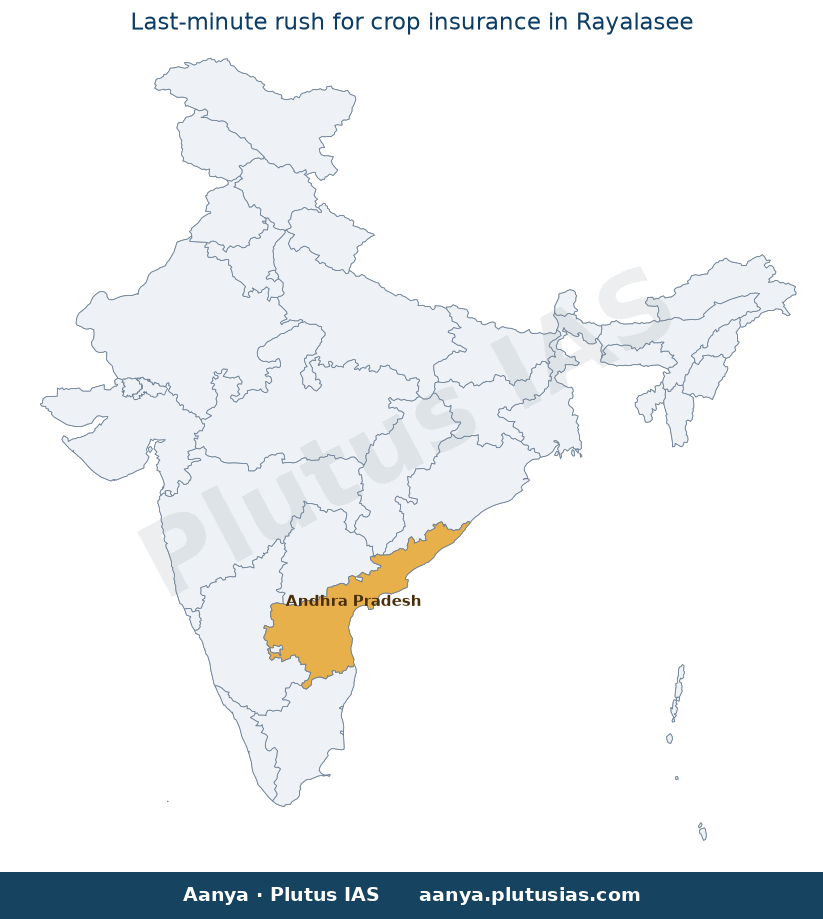
09 Aug July 31 Deadline: Last-Minute Rush for Crop Insurance in Rayalaseema
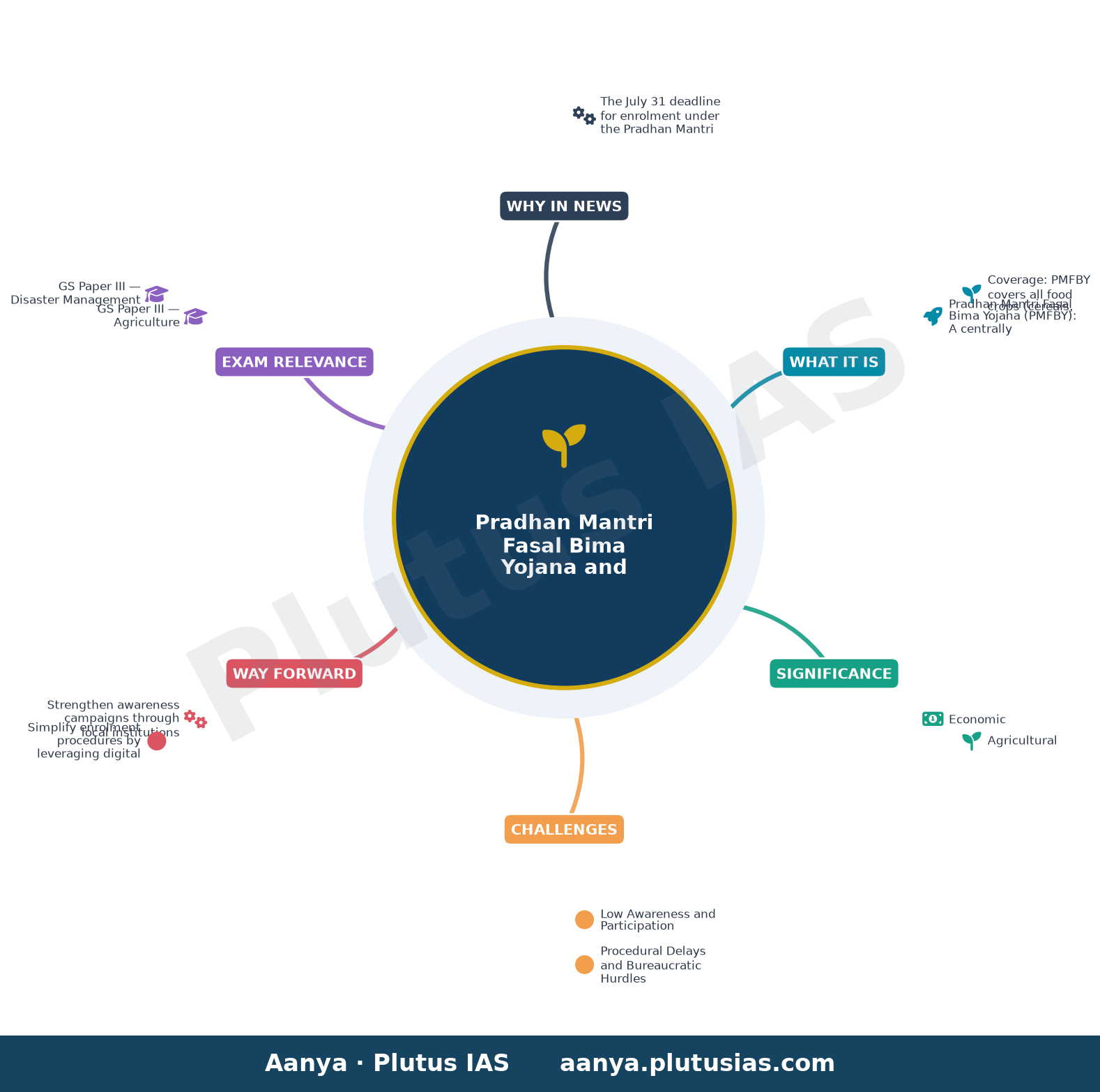
✎ PMFBY and RWBCIS are complementary schemes designed to mitigate agricultural risk in rainfed regions like Rayalaseema, where monsoon variability and El Niño-induced droughts pose existential threats to small and marginal farmers.
Subject Relevance — Where This Topic Fits
- GS Paper III — Agriculture | GS Paper III — Disaster Management | GS Paper III — Government Schemes and Policies
- Prelims: PMFBY, RWBCIS, Rayalaseema, El Niño, monsoon variability, crop insurance, agricultural distress, weather-based insurance
- Essay: Agricultural resilience in the face of climate change: The role of institutional safety nets, Sustainable livelihoods in rainfed regions: Balancing risk and reward
Quick Revision: PMFBY and RWBCIS are complementary schemes designed to mitigate agricultural risk in rainfed regions like Rayalaseema, where monsoon variability and El Niño-induced droughts pose existential threats to small and marginal farmers.
Why is this in the news?
The July 31 deadline for enrolment under the Pradhan Mantri Fasal Bima Yojana (PMFBY) and the Restructured Weather-Based Crop Insurance Scheme (RWBCIS) has triggered a last-minute surge in registrations across Sri Sathya Sai, Chittoor, and Annamayya districts of Andhra Pradesh’s Rayalaseema region. This urgency underscores the heightened vulnerability of rainfed agriculture in the face of delayed monsoons and the projected El Niño impact, which has exacerbated dry spells and unseasonal rainfall in recent decades. The scramble highlights both the criticality of crop insurance as a financial safety net and the systemic challenges in ensuring last-mile coverage for marginal farmers.
Background
- Rayalaseema’s agrarian economy is predominantly rainfed, with agriculture contributing significantly to rural livelihoods despite high climatic variability.
- The region has historically faced delayed monsoons, prolonged dry spells, and erratic rainfall, leading to recurrent crop failures and distress among small and marginal farmers.
- The El Niño-Southern Oscillation (ENSO) phenomenon, associated with warmer Pacific Ocean temperatures, often disrupts the Indian monsoon, increasing the risk of droughts in peninsular India, including Rayalaseema.
- The Government of India launched the Pradhan Mantri Fasal Bima Yojana (PMFBY) in 2016 to replace earlier crop insurance schemes, aiming to provide comprehensive insurance coverage against yield losses due to natural calamities.
- Rayalaseema districts—Sri Sathya Sai, Chittoor, and Annamayya—are among the most agriculturally productive yet climatically vulnerable regions in Andhra Pradesh, with horticulture (e.g., mango, tomato, banana) forming a critical component of the local economy.
What are PMFBY and RWBCIS?
- Pradhan Mantri Fasal Bima Yojana (PMFBY): A centrally sponsored crop insurance scheme launched in 2016, replacing the National Agricultural Insurance Scheme (NAIS) and Modified National Agricultural Insurance Scheme (MNAIS). It provides financial support to farmers in the event of yield loss due to natural calamities such as drought, flood, hailstorm, cyclone, and pest attacks.
- Coverage: PMFBY covers all food crops (cereals, millets, pulses) and oilseeds, as well as commercial/horticultural crops, subject to farmer’s choice and premium payment. It is voluntary for farmers but mandatory for loanee farmers (those availing crop loans from banks).
- Premium Structure: Farmers pay a subsidised premium of 2% for kharif crops, 1.5% for rabi crops, and 5% for commercial/horticultural crops, with the balance premium subsidised by the Central and State Governments in a 50:50 ratio (75:25 for North-Eastern states).
- Claims and Settlements: Claims are triggered by yield loss exceeding 50% of the threshold yield (as per Crop Cutting Experiments) or by area-based triggers for specific calamities. Settlements are processed within 30 days of the completion of the Crop Cutting Experiment.
- Restructured Weather-Based Crop Insurance Scheme (RWBCIS): Introduced in 2016, RWBCIS is a parametric insurance scheme that compensates farmers based on weather parameters (e.g., rainfall deficit, temperature extremes) rather than actual crop loss. This reduces the need for field-level assessments and accelerates claim settlements.
- Coverage: RWBCIS covers the same crops as PMFBY but uses weather indices (e.g., cumulative rainfall, number of dry days) as triggers for payouts. It is implemented in addition to PMFBY and is particularly useful for regions with high climatic variability.
- Objectives: Both schemes aim to (i) provide financial stability to farmers, (ii) encourage adoption of modern agricultural practices, and (iii) reduce the burden on the exchequer by minimising distress sales and post-harvest losses.
- Implementation: The schemes are implemented through empanelled insurance companies, with the State Government acting as the implementing agency. Enrolment is facilitated through Common Service Centres (CSCs), banks, and agricultural department offices.
Key Features
| Feature | Significance |
|---|---|
| Pradhan Mantri Fasal Bima Yojana (PMFBY) | A centrally sponsored crop insurance scheme providing financial support to farmers in case of crop failure due to natural calamities, pests, or diseases, ensuring income security. |
| Restructured Weather-Based Crop Insurance Scheme (RWBCIS) | A scheme that insures crops based on weather parameters such as rainfall deficit, excess rainfall, or temperature variations, reducing the risk of crop loss due to adverse weather conditions. |
| Last-minute enrolment drive | A time-bound effort by government officials to maximise farmer participation in crop insurance schemes before the deadline, addressing low awareness and procedural delays. |
| Rayalaseema region’s monsoon dependency | Historically, the Rayalaseema region relies heavily on monsoon rainfall for agriculture, making it highly vulnerable to delayed or erratic monsoons, dry spells, and unseasonal rainfall. |
| Small and marginal farmers | The majority of farmers in the region are small and marginal landholders, whose livelihoods are critically dependent on timely and adequate crop insurance coverage to mitigate financial risks. |
Why it Matters
Economic
- Crop insurance schemes like PMFBY and RWBCIS provide a financial safety net for farmers, reducing the risk of debt and distress sales in the event of crop failure.
- The schemes stabilise rural incomes, particularly in regions like Rayalaseema, where agriculture is the primary livelihood, thereby supporting local economies.
- Insurance coverage encourages investment in agricultural inputs and technology adoption by reducing the perceived risk of crop loss.
- Timely payouts under these schemes can prevent large-scale migration from rural areas to urban centres due to agricultural distress.
Agricultural
- The schemes address the vulnerability of rain-fed agriculture in Rayalaseema, where monsoon variability directly impacts crop yields and farmer incomes.
- By covering horticulture crops (e.g., mango, tomato, banana), the schemes protect high-value crops that contribute significantly to the regional agrarian economy.
- Weather-based insurance (RWBCIS) aligns with the increasing unpredictability of monsoon patterns, offering a more responsive risk mitigation tool compared to traditional yield-based insurance.
Policy and Governance
- The last-minute enrolment drive highlights the need for proactive awareness campaigns and streamlined enrolment processes to ensure broader coverage.
- The involvement of district-level officials underscores the role of local governance in implementing national agricultural policies effectively.
- The rush to meet deadlines reflects systemic challenges in policy implementation, including low initial awareness and bureaucratic hurdles.
Challenges
1. Low Awareness and Participation
- Many small and marginal farmers remain unaware of the benefits and enrolment procedures of crop insurance schemes, leading to low participation rates.
- Language barriers, digital illiteracy, and lack of access to information dissemination channels further exacerbate the issue.
UPSC Link: GS3: Agricultural Marketing
2. Procedural Delays and Bureaucratic Hurdles
- Complex enrolment processes, including documentation requirements and verification steps, deter farmers from enrolling, especially during peak agricultural seasons.
- Last-minute enrolment drives indicate systemic inefficiencies in policy implementation and outreach.
UPSC Link: GS2: Government Policies and Interventions
3. Climate Variability and Risk Assessment
- The increasing unpredictability of monsoon patterns, exacerbated by phenomena like El Niño, complicates risk assessment for insurers and farmers alike.
- Traditional crop insurance models may not fully account for the rapid changes in weather patterns, necessitating more adaptive insurance frameworks.
UPSC Link: GS3: Environmental Pollution and Degradation
4. Financial Sustainability of Schemes
- The high cost of premium subsidies and payouts under PMFBY and RWBCIS raises concerns about the long-term financial sustainability of these schemes.
- Balancing affordability for farmers with the financial viability of insurance providers remains a critical challenge.
UPSC Link: GS3: Food Security
5. Coverage Gaps for Horticulture Crops
- While PMFBY primarily covers food crops, horticulture crops like mango and tomato often face underinsurance due to their high value and specific risk profiles.
- The lack of tailored insurance products for horticulture crops limits their protection against market fluctuations and weather-related losses.
UPSC Link: GS3: Technology Missions
Challenges — UPSC Perspective
| Issue | Concern |
|---|---|
| Low farmer awareness | Limited understanding of insurance benefits and enrolment processes hinders participation. |
| Procedural complexity | Bureaucratic hurdles and documentation requirements deter timely enrolment. |
| Climate unpredictability | Increasing monsoon variability complicates risk assessment and insurance payouts. |
| Financial sustainability | High premium subsidies and payouts pose challenges to the long-term viability of schemes. |
| Horticulture underinsurance | Inadequate coverage for high-value horticulture crops increases financial risks for farmers. |
Government Initiatives — Must-Memorise for Prelims
- Pradhan Mantri Fasal Bima Yojana (PMFBY)
Way Forward
- Strengthen awareness campaigns through local institutions (e.g., Panchayats, Krishi Vigyan Kendras) to educate farmers about insurance benefits and enrolment processes.
- Simplify enrolment procedures by leveraging digital platforms (e.g., mobile apps, e-KYC) to reduce bureaucratic delays and improve accessibility.
- Develop tailored insurance products for horticulture crops to address their unique risk profiles and market volatility.
- Enhance climate-resilient agricultural practices (e.g., drought-resistant varieties, water conservation techniques) to mitigate the impact of monsoon variability.
- Improve risk assessment models by incorporating real-time weather data and predictive analytics to enhance the accuracy of insurance payouts.
- Ensure timely disbursal of insurance claims by streamlining verification and payout processes to build farmer trust in the schemes.
- Promote public-private partnerships to share the financial burden of premium subsidies and improve the efficiency of insurance delivery.
- Integrate crop insurance with other agricultural support schemes (e.g., soil health cards, PM-KISAN) to create a comprehensive safety net for farmers.
UPSC Value Addition
Keywords for Mains Answer-Writing
Pradhan Mantri Fasal Bima Yojana (PMFBY) · Restructured Weather-Based Crop Insurance Scheme (RWBCIS) · Rayalaseema region vulnerability · El Nino impact on agriculture · Monsoon-dependent agriculture · Small and marginal farmers · Agricultural insurance as risk mitigation · Agricultural distress in Andhra Pradesh · Climate-resilient agriculture · Farm income stabilization mechanisms
Concept Flow
Monsoon variability and climate change → Increased risk of crop failure in rain-fed regions like Rayalaseema → Government introduces PMFBY and RWBCIS to provide financial protection to farmers against crop loss → Low awareness and procedural hurdles lead to under-enrolment, particularly among small and marginal farmers → Last-minute enrolment drives are initiated to maximise coverage before the deadline → Challenges such as financial sustainability, climate unpredictability, and horticulture underinsurance persist → Way forward: Awareness campaigns, digital enrolment, tailored insurance products, and climate-resilient practices are proposed to address these issues
Prelims Practice Questions
Q1. Consider the following statements regarding the Pradhan Mantri Fasal Bima Yojana (PMFBY):
1. It is a voluntary scheme for all farmers.
2. The premium rates are uniform across all crops and states.
3. It covers post-harvest losses due to cyclones and unseasonal rainfall.
4. The scheme is implemented by the Ministry of Agriculture and Farmers’ Welfare.
How many of the above statements are correct?
- Only one
- Only two
- Only three
- All four
Answer: Only three — Statements 1, 3, and 4 are correct. Statement 2 is incorrect as premium rates vary by crop and state.
Q2. Assertion (A): The Restructured Weather-Based Crop Insurance Scheme (RWBCIS) is designed to insure farmers against adverse weather events rather than crop loss.
Reason (R): RWBCIS uses weather parameters such as rainfall deficit or excess to trigger payouts, independent of actual crop damage assessment.
Options:
A. Both A and R are true, and R is the correct explanation of A.
B. Both A and R are true, but R is not the correct explanation of A.
C. A is true, but R is false.
D. A is false, but R is true.
- A
- B
- C
- D
Answer: A — Both A and R are true, and R correctly explains A as RWBCIS relies on weather indices rather than crop damage.
Q3. Match the following crop insurance schemes with their key features:
Column I
1. Pradhan Mantri Fasal Bima Yojana (PMFBY)
2. Restructured Weather-Based Crop Insurance Scheme (RWBCIS)
3. National Agricultural Insurance Scheme (NAIS)
4. Comprehensive Crop Insurance Scheme (CCIS)
Column II
A. Covers yield losses due to natural calamities
B. Uses weather parameters for payout triggers
C. Voluntary participation with uniform premium rates
D. Focuses on post-harvest losses due to cyclones
Options:
1. 1-A, 2-B, 3-C, 4-D
2. 1-C, 2-B, 3-A, 4-D
3. 1-B, 2-A, 3-C, 4-D
4. 1-D, 2-B, 3-A, 4-C
- 1
- 2
- 3
- 4
Answer: 2 — 1-C (PMFBY is voluntary with uniform premium rates), 2-B (RWBCIS uses weather parameters), 3-A (NAIS covers yield losses), 4-D (CCIS focuses on post-harvest losses).
Mains Practice Question
✍ “Crop insurance schemes, while designed to mitigate agricultural risks, often fail to reach the most vulnerable farmers due to structural and implementation gaps.” Critically examine this statement with reference to the Pradhan Mantri Fasal Bima Yojana (PMFBY) and the Restructured Weather-Based Crop Insurance Scheme (RWBCIS). Also, discuss the role of climate change in exacerbating the need for such schemes. (15 Marks)
Approach: MODEL-ANSWER SKELETON:
1. Introduction (2 marks):
– Define PMFBY and RWBCIS, their objectives, and the context of Rayalaseema’s vulnerability.
– Highlight the role of climate change (El Nino, delayed monsoons) in increasing agricultural risks.
2. Structural gaps in implementation (5 marks):
– **Coverage gaps**: Small and marginal farmers in Rayalaseema face barriers due to lack of awareness, documentation issues, and digital literacy.
– **Premium affordability**: While premiums are subsidized, the remaining burden may still be high for marginal farmers.
– **Claim settlement delays**: Bureaucratic hurdles and delayed assessments reduce the scheme’s effectiveness.
– **Exclusion of tenant farmers and sharecroppers**: Many vulnerable farmers lack land titles, making them ineligible.
3. Design limitations (4 marks):
– **PMFBY**: Focuses on yield loss but struggles with accurate crop cutting experiments (CCEs) and data discrepancies.
– **RWBCIS**: Relies on weather indices but may not capture localized micro-climatic variations, leading to under-compensation.
– **Lack of crop diversification**: Schemes often prioritize staple crops, ignoring horticulture (e.g., mango, tomato in Chittoor).
4. Climate change exacerbation (3 marks):
– Increasing frequency of extreme weather events (droughts, unseasonal rainfall) necessitates adaptive insurance models.
– Need for integration with climate-resilient agriculture (e.g., drought-resistant varieties, precision farming).
– Role of technology (remote sensing, AI) in improving risk assessment and claim processing.
5. Conclusion (1 mark):
– Emphasize the need for targeted reforms: awareness campaigns, simplified enrollment, and climate-smart insurance models.
– Suggest convergence with other schemes (e.g., PM-KISAN, soil health cards) for holistic risk mitigation.
Source: The Hindu
Generated by AanyaAi for educational purpose.

- महाराष्ट्र में त्योहार जुलूसों पर बॉम्बे हाईकोर्ट का बड़ा फैसला: पटाखे, लेजर और संगीत पर रोक - September 24, 2026
- Bombay HC Bans Firecrackers, Music in Maharashtra Processions: Key UPSC Analysis - September 24, 2026
- तमिलनाडु में महिला कर्मचारियों के लिए सवैतनिक माहवारी अवकाश नीति पर HC का आदेश - September 24, 2026

No Comments