


09 Aug APEDA facilitates first GI-tagged Mithila Makhana export to Australia via sea route
✎ Mithila Makhana, a GI-tagged agricultural product from Bihar, has been exported to Australia via sea route for the first time, facilitated by APEDA, enhancing farmers' incomes and strengthening India's agricultural export…
Subject Relevance — Where This Topic Fits
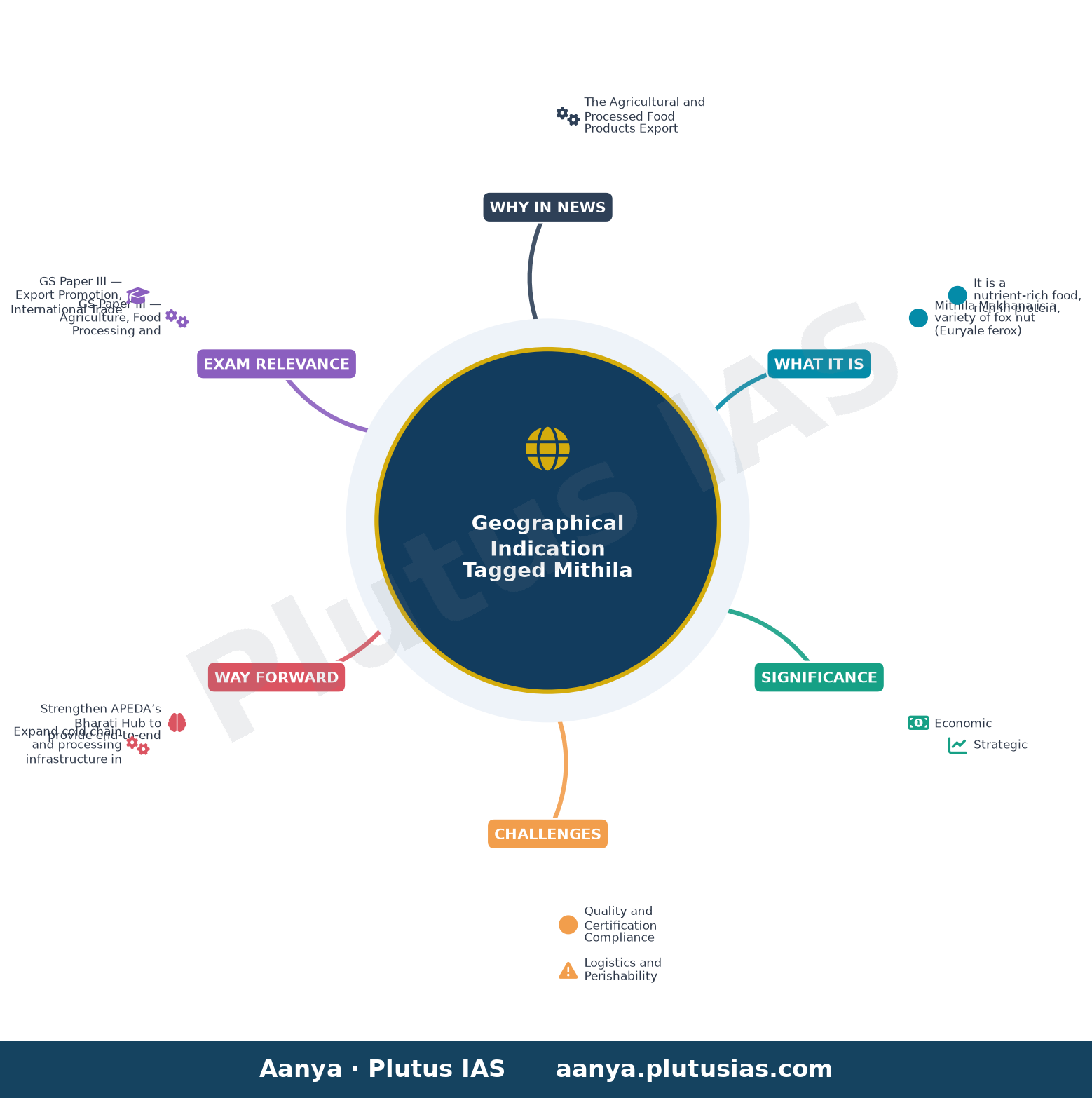
- GS Paper III — Agriculture, Food Processing and Related Industries | GS Paper III — Export Promotion, International Trade and Logistics | GS Paper II — Role of Government in Promoting Economic Welfare
- Prelims: Geographical Indication (GI) Tag, APEDA, Mithila Makhana, HS Code for Makhana, Sea Cargo Export, FPOs (Farmer Producer Organisations), Agri-Export Zones, Bihar Agriculture, Agri-Startups under APEDA’s BHARAT Hub
- Essay: Agricultural Exports as a Catalyst for Rural Prosperity: The Case of Mithila Makhana, Sustainable Livelihoods through Geographical Indication: Lessons from Bihar’s Mithila Makhana
Quick Revision: Mithila Makhana, a GI-tagged agricultural product from Bihar, has been exported to Australia via sea route for the first time, facilitated by APEDA, enhancing farmers’ incomes and strengthening India’s agricultural export competitiveness.
Why is this in the news?
The Agricultural and Processed Food Products Export Development Authority (APEDA), under the Ministry of Commerce and Industry, facilitated the first-ever commercial consignment of 18 metric tonnes of Geographical Indication (GI)-tagged Mithila Makhana from Bihar to Australia via sea route. This export, originating from Darbhanga district and processed in Bihar’s Bihar Industrial Area Development Authority (BIADA) industrial zone, Bihata, marks a significant milestone in enhancing the global market presence of Bihar’s agricultural produce, particularly the GI-tagged specialty crop, and is expected to augment farmers’ incomes by approximately 18% compared to prevailing market rates.
Background
- Mithila Makhana is a premium variety of fox nut cultivated predominantly in the Mithila region of Bihar, known for its nutritional and cultural significance.
- Bihar accounts for approximately 85% of India’s total makhana production, making it a critical agricultural commodity for the state’s economy.
- Mithila Makhana is GI-tagged, recognising its unique geographical origin, traditional processing methods, and cultural heritage.
- India’s agricultural exports, including makhana, have been growing, with over 7,000 metric tonnes exported to more than 20 countries in FY 2025-26, including the USA, Middle East, and Africa.
- The introduction of a separate Harmonised System (HS) code for makhana in July 2025 under the Finance Bill, 2025, aims to streamline trade data, enhance market transparency, and facilitate export growth.
- APEDA, established under the Agricultural and Processed Food Products Export Development Authority Act, 1985, plays a pivotal role in promoting agricultural exports through capacity building, market development, and export facilitation.
What is Mithila Makhana?
- Mithila Makhana is a variety of fox nut (Euryale ferox) cultivated primarily in the Mithila region of northern Bihar, including districts such as Darbhanga, Madhubani, and Samastipur.
- It is a nutrient-rich food, rich in protein, fibre, magnesium, and antioxidants, and is traditionally consumed during religious and cultural ceremonies in Bihar and other parts of India.
- Mithila Makhana is GI-tagged, certifying its unique geographical origin, traditional processing techniques, and cultural significance, which distinguish it from other varieties of makhana.
- The traditional processing of Mithila Makhana involves hand-harvesting, drying, and roasting, followed by manual grading and sorting, which preserves its nutritional integrity and texture.
- Mithila Makhana is recognised for its superior quality, larger size, and distinct flavour compared to other varieties, making it a premium agricultural product with high export potential.
- The crop is cultivated in shallow water bodies such as ponds and lakes, and its production is labour-intensive, providing livelihood support to thousands of farmers and artisans in Bihar.
- The export of Mithila Makhana is facilitated by APEDA through initiatives such as BHARATI (भारत) (India’s Agi-tech, Resilience, Advancement and Incubation Hub for Export Innovation), which supports agri-startups, logistics providers, and exporters in enhancing the value chain.
Key Features
| Feature | Significance |
|---|---|
| Geographical Indication (GI) Tag for Mithila Makhana | Ensures authenticity, protects traditional knowledge, and enhances marketability of the product, enabling premium pricing in international markets. |
| First Commercial Maritime Export of GI-Tagged Mithila Makhana to Australia | Demonstrates India’s capability to meet global quality standards via sea routes, reducing logistics costs and carbon footprint compared to air freight. |
| Direct Procurement from Farmers in Darbhanga District | Strengthens farmer-producer linkages, ensures fair remuneration, and reduces intermediation costs, thereby increasing farmer income. |
| APEDA’s Role in Facilitating Export | Provides end-to-end support including certification, market access, and logistical coordination, aligning with India’s export promotion strategy. |
| Logistics Support by AgriTech Startup (Bharati Hub) | Leverages innovation in supply chain management to ensure timely, cost-effective, and compliant export of perishable agricultural products. |
Why it Matters
Economic
- Enhances foreign exchange earnings through high-value agricultural exports, contributing to India’s trade balance.
- Increases farmer income by 18% through direct market access and premium pricing, aligning with the goal of doubling farmer incomes.
- Strengthens Bihar’s agricultural economy, given its 85% share in India’s makhana production, and creates sustainable export opportunities.
Strategic
- Diversifies India’s agricultural export basket by adding a niche, high-value product to global markets.
- Demonstrates India’s adherence to international quality standards (e.g., SPS measures) for agricultural products.
- Expands India’s footprint in the Oceania region, a growing market for premium food products.
Social
- Preserves traditional knowledge and livelihoods of the Mithila community, particularly women involved in makhana processing.
- Promotes inclusive growth by integrating small and marginal farmers into global value chains.
Environmental
- Promotes sustainable logistics by prioritizing sea freight over air transport, reducing carbon emissions per unit of export.
Challenges
1. Quality and Certification Compliance
- Ensuring consistent adherence to international food safety and quality standards (e.g., HACCP, ISO 22000) for GI-tagged products.
- Managing traceability from farm to export to meet stringent import regulations in target markets like Australia.
UPSC Link: GS III: Food Processing and Technology
2. Logistics and Perishability
- Mitigating risks of spoilage and quality degradation during long-duration sea transport for a perishable product like makhana.
- Coordinating multi-modal logistics (road-sea) to ensure timely delivery while maintaining cost efficiency.
UPSC Link: GS III: Logistics and Supply Chain
3. Market Penetration and Competition
- Overcoming non-tariff barriers (e.g., labeling, packaging norms) in new markets like Australia.
- Competing with established alternatives (e.g., lotus seeds from other regions) in international markets.
UPSC Link: GS III: Agricultural Marketing
4. Farmer Awareness and Capacity Building
- Educating farmers on global quality standards, certification processes, and export-oriented production practices.
- Ensuring equitable participation of small and marginal farmers in export value chains.
UPSC Link: GS III: Agriculture and Farmers’ Welfare
5. Policy and Institutional Coordination
- Streamlining coordination between APEDA, state agencies (e.g., Bihar Agriculture Department), and private stakeholders for seamless exports.
- Addressing gaps in infrastructure (e.g., cold chain facilities) in production hubs like Bihar.
UPSC Link: GS II: Government Policies and Interventions
Challenges — UPSC Perspective
| Issue | Concern |
|---|---|
| Adherence to International Standards | Risk of rejection at ports of entry due to non-compliance with SPS or quality norms. |
| High Logistics Costs for Perishable Goods | Long transit times via sea may require additional investments in packaging and preservation. |
| Limited Market Intelligence in New Regions | Lack of data on consumer preferences and regulatory nuances in Australia. |
| Farmer Fragmentation | Small landholdings and lack of aggregation mechanisms hinder bulk export readiness. |
| Climate Vulnerability | Erratic weather patterns in Bihar may impact makhana crop quality and yield. |
Way Forward
- Strengthen APEDA’s Bharati Hub to provide end-to-end export facilitation, including certification, logistics, and market intelligence.
- Expand cold chain and processing infrastructure in Bihar’s makhana hubs (e.g., Bihar Sharif, Darbhanga) to reduce post-harvest losses.
- Conduct targeted capacity-building programs for farmers on global quality standards, GAP (Good Agricultural Practices), and export protocols.
- Leverage the new HS code for makhana (introduced in July 2025) to streamline trade data collection and policy interventions.
- Collaborate with research institutions (e.g., ICAR) to develop climate-resilient makhana varieties and post-harvest technologies.
- Establish Farmer Producer Organizations (FPOs) to aggregate supply, improve bargaining power, and ensure traceability.
- Explore diversification into value-added makhana products (e.g., roasted, flavored) to enhance export competitiveness.
- Enhance bilateral trade agreements with Australia to reduce tariff and non-tariff barriers for agricultural products.
UPSC Value Addition
Keywords for Mains Answer-Writing
Geographical Indications (GI) Tag · Mithila Makhana · APEDA (Agricultural and Processed Food Products Export Development Authority) · Export promotion of agricultural produce · Bihar’s agricultural economy · Global market access for GI-tagged products · Sustainable agricultural exports · GI-tagged products and farmers’ income · India-Australia trade relations · Maritime export logistics · Farmers’ Producer Organizations (FPOs) · Value addition in agricultural exports
Constitutional & Policy Linkages
- [‘Article 39(b): Directive Principle of State Policy on equitable distribution of resources to promote welfare.’]
- [‘Entry 33 (List III, Concurrent List): Regulation of trade and commerce in agricultural products.’]
Concept Flow
GI Tagging of Mithila Makhana → Authenticity and premium market positioning → Increased demand in global markets. → Farmer production in Darbhanga → Direct procurement by exporters → Higher farmer income (18% premium). → APEDA facilitation → Certification, logistics, market access → First maritime export to Australia. → Logistics via Bharati Hub → Cost-effective sea route → Reduced carbon footprint and timely delivery. → Export success → Strengthened Bihar’s agricultural economy → Sustainable export opportunities. → Policy support (HS code 2025) → Better trade data and targeted interventions → Scalability of exports.
Prelims Practice Questions
Q1. Consider the following statements regarding the Geographical Indications (GI) Tag in India:
1. The GI tag is a sign used on products that have a specific geographical origin and possess qualities or a reputation that are due to that origin.
2. The registration of a GI is valid for a period of 10 years, renewable thereafter.
3. The Agricultural and Processed Food Products Export Development Authority (APEDA) is the nodal agency for the registration of GI tags in India.
How many of the above statements are correct?
- Only one
- Only two
- All
- None
Answer: Only two — Statement 1 is correct as per the definition of GI tags under the Geographical Indications of Goods (Registration and Protection) Act, 1999. Statement 2 is correct as the registration is valid for 10 years and renewable. Statement 3 is incorrect because the nodal agency for GI registration is the Controller General of Patents, Designs and Trade Marks (CGPDTM), not APEDA.
Q2. Assertion (A): The export of GI-tagged Mithila Makhana to Australia marks a significant step in enhancing Bihar’s agricultural exports.
Reason (R): GI tags ensure premium pricing and market access for agricultural products, thereby benefiting farmers directly.
- Both A and R are true, and R is the correct explanation of A
- Both A and R are true, but R is not the correct explanation of A
- A is true, but R is false
- A is false, but R is true
Answer: Both A and R are true, and R is the correct explanation of A — Both the Assertion (A) and Reason (R) are true. The export of GI-tagged Mithila Makhana to Australia indeed enhances Bihar’s agricultural exports (A). The Reason (R) correctly explains that GI tags ensure premium pricing and market access, directly benefiting farmers.
Q3. Which of the following is NOT a function of the Agricultural and Processed Food Products Export Development Authority (APEDA)?
- Facilitating the registration of GI tags for agricultural products
- Promoting export-oriented production and development of scheduled products
- Providing financial assistance to exporters
- Setting and maintaining standards for the export of scheduled products
Answer: Facilitating the registration of GI tags for agricultural products — APEDA does not facilitate the registration of GI tags; this is the responsibility of the Controller General of Patents, Designs and Trade Marks (CGPDTM). APEDA focuses on export promotion, financial assistance, and standard-setting for scheduled products.
Mains Practice Question
✍ The export of GI-tagged Mithila Makhana to Australia via maritime routes represents a transformative opportunity for India’s agricultural sector. Critically examine the significance of this development for India’s export-oriented agricultural policies, farmers’ income, and global competitiveness. Also, analyse the role of APEDA in facilitating such exports and the challenges that may impede the scaling up of such initiatives. (15 Marks)
Approach: MODEL-ANSWER SKELETON:
1. **Introduction (2 Marks)**
– Define Geographical Indications (GIs) and their economic significance for agricultural products.
– Contextualise the export of GI-tagged Mithila Makhana to Australia as a milestone in India’s agricultural export journey.
2. **Significance for India’s Export-Oriented Agricultural Policies (4 Marks)**
– **Policy Alignment**: Discuss how this aligns with India’s broader goals under the ‘Atmanirbhar Bharat’ initiative and the ‘Doubling Farmers’ Income’ scheme.
– **Market Diversification**: Highlight the importance of diversifying export markets beyond traditional destinations (e.g., USA, Middle East) to include niche markets like Australia.
– **Value Addition and Branding**: Explain how GI tags enhance the brand value of agricultural products, making them more competitive globally.
– **Sustainable Export Growth**: Link the initiative to India’s commitment to sustainable agricultural practices and climate-resilient exports.
3. **Impact on Farmers’ Income and Rural Economy (4 Marks)**
– **Premium Pricing**: Discuss how GI tags enable farmers to command higher prices for their produce, as seen in the 18% increase in earnings for Mithila Makhana farmers.
– **Direct Market Access**: Explain how export-oriented value chains reduce dependency on middlemen and enhance farmers’ bargaining power.
– **Employment Generation**: Analyse the potential for job creation in processing, packaging, and logistics sectors in Bihar.
– **Women Empowerment**: Highlight the role of women in Mithila Makhana processing (e.g., the ‘Foori’ community) and how export-led growth can further empower them.
4. **Role of APEDA in Facilitating Exports (3 Marks)**
– **Institutional Support**: Discuss APEDA’s role in capacity building, market development, and export facilitation, as seen in the collaboration with Bihar’s agriculture department.
– **Logistics and Innovation**: Highlight APEDA’s support for startups like ‘Bharati’ (AgriTech hub) in streamlining logistics and export processes.
– **Policy Advocacy**: Explain how APEDA advocates for policy changes, such as the introduction of a separate HS code for Makhana in the Finance Bill 2025, to boost exports.
5. **Challenges and Way Forward (2 Marks)**
– **Quality Control**: Discuss the need for stringent quality control measures to meet international standards and avoid rejection of consignments.
– **Infrastructure Gaps**: Highlight challenges in cold chain logistics, storage, and transportation, particularly for perishable agricultural products.
– **Market Penetration**: Analyse the competition from other Makhana-producing regions (e.g., Nepal) and the need for aggressive marketing strategies.
– **Farmer Awareness**: Emphasise the importance of educating farmers on GI tags, export processes, and compliance with international regulations.
6. **Conclusion (1 Mark)**
– Summarise the transformative potential of GI-tagged agricultural exports for India’s economy and farmers’ welfare.
– Stress the need for a multi-stakeholder approach involving government, private sector, and farmer collectives to scale such initiatives.
Source: PIB (Press Information Bureau)
Generated by AanyaAi for educational purpose.

- Exercise Tarang Shakti 2026: India’s Mega Multi-Nation Air Power Showcase - September 27, 2026
- रबी अभियान 2026: राष्ट्रीय सम्मेलन में केंद्र-राज्य तालमेल पर होगा जोर - September 27, 2026
- Himachal CM Sukhu: All Doctor Vacancies to be Filled by March - September 27, 2026

No Comments