


09 Aug Kerala HC Orders Panchayat to Pay ₹10,000 for Stray Dog Attack Failure
✎ Local bodies are constitutionally and statutorily obligated to manage stray dog populations under the 73rd Amendment and the Prevention of Cruelty to Animals Act, 1960; failure to do so renders them liable for compensation in…
Subject Relevance — Where This Topic Fits
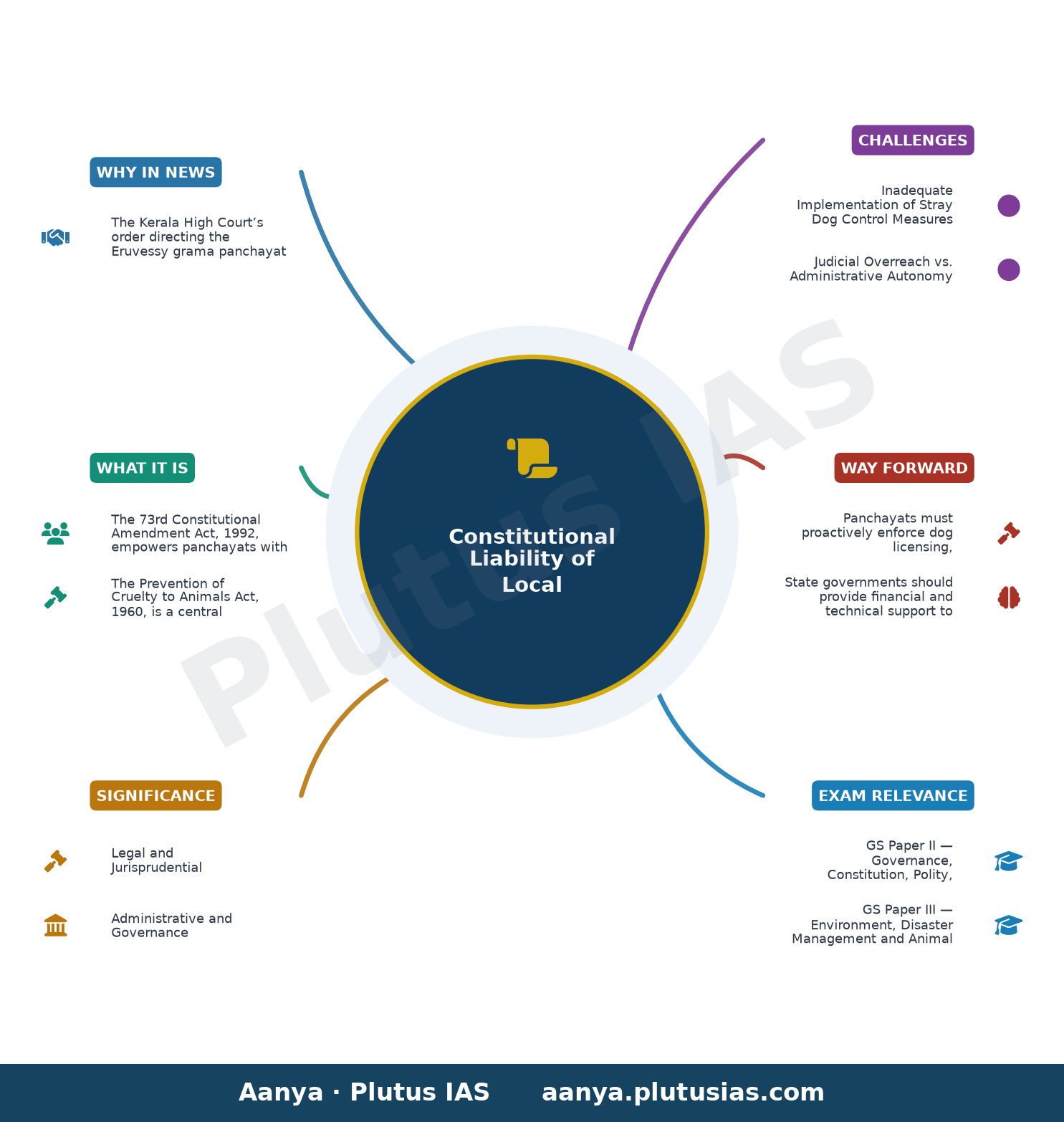
- GS Paper II — Governance, Constitution, Polity, Social Justice and International Relations (Local Governance and Fundamental Duties) | GS Paper III — Environment, Disaster Management and Animal Welfare
- Prelims: Panchayati Raj System, 73rd Constitutional Amendment Act, Fundamental Duties (Article 51A(g)), Prevention of Cruelty to Animals Act, 1960, Birth Control (Dogs) Rules, 2001, Municipal Functions under 12th Schedule, Compensatory Jurisprudence, Vicarious Liability, Judicial Activism
- Essay: The Role of Local Governments in Balancing Public Health and Animal Rights: A Case for Constitutional Accountability, Judicial Activism and the Expansion of State Liability in Public Welfare
Quick Revision: Local bodies are constitutionally and statutorily obligated to manage stray dog populations under the 73rd Amendment and the Prevention of Cruelty to Animals Act, 1960; failure to do so renders them liable for compensation in cases of negligence.
Why is this in the news?
The Kerala High Court’s order directing the Eruvessy grama panchayat to compensate ₹10,000 to a victim of a stray dog attack in 2007 underscores the constitutional and statutory obligations of local self-government institutions in ensuring public safety and animal welfare. The judgment reaffirms the principle that failure to discharge mandatory duties under the Prevention of Cruelty to Animals Act, 1960, and the Birth Control (Dogs) Rules, 2001, renders local bodies liable for compensation, thereby setting a significant precedent for municipal accountability in animal-related public health crises.
Background
- The incident occurred in 2007, with the victim sustaining injuries from a stray dog attack within the jurisdiction of the Eruvessy grama panchayat, Kerala.
- The panchayat’s failure to implement statutory obligations, including licensing of domestic dogs and control of stray dogs, was central to the dispute.
- The Kerala High Court’s judgment reaffirms the constitutional framework of local governance under the 73rd Constitutional Amendment Act, 1992, which assigns specific functions to panchayats, including public health and sanitation.
- The panchayat’s argument that it lacked financial assistance from the State to address stray dog menace was rejected by the court, emphasizing the duty to act within available resources.
- The judgment aligns with the Supreme Court’s jurisprudence on state liability for failure to discharge statutory duties, particularly in public health and welfare contexts.
Legal and Constitutional Framework Governing Local Bodies’ Responsibilities in Animal Welfare
- The 73rd Constitutional Amendment Act, 1992, empowers panchayats with the 11th Schedule, which includes functions related to public health, sanitation, and animal husbandry, thereby imposing a constitutional duty on local bodies to manage stray dog populations.
- The Prevention of Cruelty to Animals Act, 1960, is a central legislation that prohibits cruelty to animals and mandates the prevention of stray dog menace through sterilization, licensing, and control measures under Sections 3, 4, and 5.
- Local bodies are constitutionally obligated to act as agents of the State in discharging these duties, making them liable for compensation in cases of negligence, as established by the Kerala High Court’s judgment.
- The doctrine of vicarious liability in public law holds that failure to perform statutory duties by local bodies can result in legal consequences, including compensation, as seen in this case.
- The judgment reinforces the principle that local bodies cannot evade responsibility by citing financial constraints or lack of state assistance, as their duties are mandatory under law.
- The Kerala High Court’s order aligns with the Supreme Court’s stance in *Animal Welfare Board of India v. A. Nagaraja* (2014), which upheld the constitutional status of animal rights and the State’s duty to protect them.
- The case highlights the intersection of public health, animal welfare, and constitutional governance, emphasizing the need for proactive measures by local bodies to prevent stray dog attacks.
Key Features
| Feature | Significance |
|---|---|
| Statutory duty of panchayats under PCA Act, 1960 | Panchayats are legally obligated to control stray dog populations through licensing, sterilization, and capture, ensuring public safety and welfare. |
| Judicial interpretation of local body liability | The Kerala High Court held the panchayat vicariously liable for failing to discharge statutory duties, setting a precedent for municipal accountability in animal welfare cases. |
| Compensation for negligence | The court awarded ₹10,000 as compensation, reinforcing the principle that local authorities can be held financially accountable for dereliction of duty. |
| Foreseeability of harm | The court ruled that the dog attack was a reasonably foreseeable consequence of the panchayat’s inaction, establishing a causal link between negligence and injury. |
| Appeal process and judicial scrutiny | The case traversed multiple judicial levels (Munsiff Court, Sub-court, High Court), demonstrating the role of higher courts in reviewing local body decisions. |
Why it Matters
Legal and Jurisprudential
- Establishes precedent for holding local self-government institutions accountable for statutory failures in animal welfare management.
- Reinforces the doctrine of vicarious liability for public authorities in cases of negligence leading to harm.
- Clarifies the interplay between the Prevention of Cruelty to Animals Act, 1960, and local self-government functions under the 73rd Constitutional Amendment.
Administrative and Governance
- Highlights systemic gaps in the implementation of stray dog control measures by local bodies, despite statutory mandates.
- Underscores the need for capacity-building and financial support for panchayats to fulfill their animal welfare obligations.
- Demonstrates the judiciary’s role in ensuring administrative accountability in public health and safety matters.
Public Health and Safety
- Emphasizes the public health risks posed by unchecked stray dog populations, including zoonotic disease transmission and injuries.
- Reinforces the obligation of local authorities to adopt preventive measures to mitigate such risks.
- Serves as a cautionary tale for other local bodies to proactively address stray animal management.
Challenges
1. Inadequate Implementation of Stray Dog Control Measures
- Panchayats often lack the resources, technical expertise, or political will to enforce licensing, sterilization, and capture of stray dogs.
- Delays in action due to bureaucratic inertia or lack of coordination between local bodies and animal welfare agencies.
- Financial constraints cited by panchayats as a barrier to fulfilling statutory duties, despite legal obligations.
UPSC Link: GS2/73rd Amendment/PCA Act
2. Judicial Overreach vs. Administrative Autonomy
- Risk of courts substituting administrative discretion with judicial orders, potentially undermining local governance autonomy.
- Potential for excessive litigation if local bodies are held liable for isolated incidents, diverting resources from core functions.
- Need for a balanced approach that ensures accountability without stifling local decision-making.
UPSC Link: GS2/Role of Judiciary/Doctrine of Separation of Powers
3. Public Awareness and Community Participation
- Low public awareness about the role of panchayats in stray dog management, leading to complacency or misplaced expectations.
- Lack of community engagement in reporting stray dogs or supporting sterilization drives, exacerbating the problem.
- Need for sensitization campaigns to foster collective responsibility in animal welfare.
UPSC Link: GS2/Panchayati Raj/Community Participation
4. Intersection of Animal Welfare and Human Rights
- Balancing the rights of stray dogs (under PCA Act) with the right to life and health of citizens (Article 21 of the Constitution).
- Addressing ethical dilemmas in culling vs. sterilization-based population control.
- Ensuring humane treatment of animals while protecting public safety.
UPSC Link: GS2/Article 21/Animal Welfare Laws
Challenges — UPSC Perspective
| Issue | Concern |
|---|---|
| Resource Constraints | Panchayats lack funds, personnel, or infrastructure to implement stray dog control measures effectively. |
| Legal Ambiguity | Overlap between PCA Act and local self-government functions creates confusion in responsibility allocation. |
| Public Apathy | Low community involvement in reporting stray dogs or supporting sterilization drives. |
| Judicial Burden | Risk of floodgates litigation if local bodies are held liable for isolated incidents. |
| Ethical Dilemmas | Balancing animal rights with public health and safety concerns. |
Way Forward
- Panchayats must proactively enforce dog licensing, sterilization, and capture programs in accordance with PCA Act and Birth Control Rules.
- State governments should provide financial and technical support to local bodies for stray dog management, including capacity-building for officials.
- Judicial forums should adopt a balanced approach, ensuring accountability without overburdening local authorities with frivolous litigation.
- Public awareness campaigns must be launched to educate citizens on their role in reporting stray dogs and supporting humane control measures.
- Local bodies should collaborate with animal welfare NGOs and veterinary institutions to implement cost-effective and sustainable solutions.
- Regular audits of panchayat compliance with animal welfare laws should be conducted to identify and address systemic gaps.
- Policy reforms may be explored to clarify the division of responsibilities between panchayats, state agencies, and municipal corporations in stray dog management.
UPSC Value Addition
Keywords for Mains Answer-Writing
Local Self-Government · Panchayati Raj Institutions · Prevention of Cruelty to Animals Act 1960 · Birth Control Rules for Stray Dogs · Judicial Activism in Animal Welfare · Compensation for Animal Attack Victims · Statutory Duties of Local Bodies · Kerala High Court Judgment on Stray Dogs · Fundamental Duties vs. Statutory Obligations · Doctrine of Reasonable Foreseeability in Tort Law
Constitutional & Policy Linkages
- [‘Article 21’, ‘Right to life and personal liberty’]
- [’73rd Constitutional Amendment’, ‘Empowerment of Panchayati Raj Institutions’]
- [‘State List (7th Schedule)’, ‘Public health and local governance’]
Concept Flow
Failure of panchayat to enforce stray dog control measures under PCA Act, 1960 → → Statutory duty of local bodies to license, sterilize, and capture stray dogs remains unfulfilled → → Stray dog population grows unchecked, increasing public health risks → → Dog attack occurs, causing injury to a citizen → → Victim files claim for compensation, citing panchayat’s negligence → → Judicial scrutiny establishes causal link between panchayat’s inaction and harm → → High Court awards compensation, setting precedent for local body accountability.
Prelims Practice Questions
Q1. Consider the following statements regarding the Prevention of Cruelty to Animals Act, 1960:
1. The Act mandates the establishment of Animal Welfare Boards at the Central and State levels.
2. It empowers the government to regulate the training of animals for entertainment purposes.
3. The Act does not apply to the control and eradication of stray dogs.
4. The Act provides for the appointment of Animal Welfare Officers to ensure compliance.
How many of the above statements are correct?
- Only one
- Only two
- Only three
- All four
Answer: Only three — Statements 1, 2, and 4 are correct as per Sections 4, 22, and 35 of the Act. Statement 3 is incorrect because the Act, read with the Birth Control Rules, governs the control of stray dogs.
Q2. Assertion (A): The Kerala High Court held that the failure of the Eruvessy grama panchayat to capture and sterilize stray dogs constituted a breach of its statutory duty.
Reason (R): The Prevention of Cruelty to Animals Act, 1960, and the Birth Control Rules impose a mandatory obligation on local bodies to control stray dog populations.
In the context of the above two statements, which one of the following is correct?
- Both A and R are true and R is the correct explanation of A
- Both A and R are true but R is not the correct explanation of A
- A is true but R is false
- A is false but R is true
Answer: Both A and R are true and R is the correct explanation of A — Both the Assertion and Reason are correct. The Kerala High Court’s ruling is rooted in the statutory obligations under the Prevention of Cruelty to Animals Act, 1960, and the Birth Control Rules, which mandate local bodies to control stray dog populations.
Q3. Match the following provisions with their respective legal instruments:
Column I
1. Licensing of domestic dogs
2. Establishment of Animal Welfare Boards
3. Regulation of animal training for entertainment
4. Appointment of Animal Welfare Officers
Column II
A. Prevention of Cruelty to Animals Act, 1960
B. Birth Control Rules for Stray Dogs
C. Both A and B
D. Neither A nor B
- 1-C, 2-A, 3-A, 4-A
- 1-B, 2-A, 3-A, 4-A
- 1-C, 2-B, 3-A, 4-A
- 1-A, 2-A, 3-B, 4-A
Answer: 1-C, 2-A, 3-A, 4-A — 1. Licensing of domestic dogs is governed by the Birth Control Rules for Stray Dogs (Column II-B). 2. Establishment of Animal Welfare Boards is under the Prevention of Cruelty to Animals Act, 1960 (Column II-A). 3. Regulation of animal training for entertainment is under the Prevention of Cruelty to Animals Act, 1960 (Column II-A). 4. Appointment of Animal Welfare Officers is under the Prevention of Cruelty to Animals Act, 1960 (Column II-A).
Mains Practice Question
✍ The Kerala High Court’s judgment in *Tankappan v. Eruvessy grama panchayat* underscores the expanding ambit of judicial activism in enforcing statutory obligations of local self-government institutions towards animal welfare. Critically examine the legal and administrative implications of this judgment for Panchayati Raj Institutions (PRIs) in India. Also, elucidate the balance between local autonomy and statutory duties in the context of stray dog management. (15 Marks)
Approach: MODEL-ANSWER SKELETON:
1. **Judicial Activism and Statutory Obligations**
– Cite the Kerala High Court’s reasoning: failure of the panchayat to discharge duties under the Prevention of Cruelty to Animals Act, 1960, and Birth Control Rules.
– Highlight the doctrine of reasonable foreseeability and the principle of vicarious liability for statutory breaches.
– Reference: *State of Punjab v. Ram Lubhaya Bagga* (1998) on statutory duties of local bodies.
2. **Legal Implications for PRIs**
– Discuss the expansion of judicial scrutiny over PRIs’ performance of statutory functions.
– Analyze the potential for increased litigation against PRIs for non-performance of duties (e.g., stray dog control, sanitation).
– Reference: Article 243G of the Constitution (functions of PRIs) and the 11th and 12th Schedules.
3. **Administrative Challenges**
– Examine resource constraints: lack of financial assistance from the state (as argued by the panchayat).
– Discuss the role of State Animal Welfare Boards and local Animal Welfare Officers in aiding PRIs.
– Reference: *Animal Welfare Board of India v. A. Nagaraja* (2014) on the state’s role in animal welfare.
4. **Balance Between Local Autonomy and Statutory Duties**
– Contrast the panchayat’s argument of autonomy with the statutory mandate under the PCA Act and Birth Control Rules.
– Discuss the principle of subsidiarity: local bodies are best placed to address local issues like stray dogs, but must comply with national laws.
– Reference: *Gram Panchayat of Village Kodumudi v. State of Tamil Nadu* (2018) on the limits of local autonomy.
5. **Way Forward**
– Suggest measures: capacity-building for PRIs, state funding for stray dog management, and community participation.
– Highlight the need for a harmonized approach between local governance and statutory compliance.
6. **Critical Perspective**
– Acknowledge concerns about ‘floodgates of litigation’ but argue for judicial oversight to ensure accountability.
– Reference: *Jacob Puliyel v. Union of India* (2016) on judicial intervention in public health matters.
Source: The Hindu
Generated by AanyaAi for educational purpose.

- महाराष्ट्र में त्योहार जुलूसों पर बॉम्बे हाईकोर्ट का बड़ा फैसला: पटाखे, लेजर और संगीत पर रोक - September 24, 2026
- Bombay HC Bans Firecrackers, Music in Maharashtra Processions: Key UPSC Analysis - September 24, 2026
- तमिलनाडु में महिला कर्मचारियों के लिए सवैतनिक माहवारी अवकाश नीति पर HC का आदेश - September 24, 2026

No Comments