


09 Aug INL Challenges Kerala CM on PM SHRI Scheme Implementation: Centre’s Clarification Sparks Row
✎ The PM SHRI scheme is a centrally sponsored initiative to transform 14,500 schools into model institutions, but its implementation remains contentious due to Centre-State disputes over policy autonomy, funding mechanisms, and…
Subject Relevance — Where This Topic Fits
- GS Paper II — Centre-State Relations | GS Paper II — Government Policies and Interventions for Development in various sectors | GS Paper III — Issues Relating to Development and Management of Social Sector/Services relating to Education
- Prelims: PM SHRI Scheme, Samagra Shiksha Abhiyan, National Education Policy (NEP) 2020, MoU in Public Policy, Union-State Financial Disputes, LDF vs UDF Governments in Kerala, Kerala Education Reforms
- Essay: Federalism in India: Challenges and Opportunities, Role of Education in Nation-Building: Balancing Uniformity and Diversity
Quick Revision: The PM SHRI scheme is a centrally sponsored initiative to transform 14,500 schools into model institutions, but its implementation remains contentious due to Centre-State disputes over policy autonomy, funding mechanisms, and ideological alignment with the NEP 2020.
Why is this in the news?
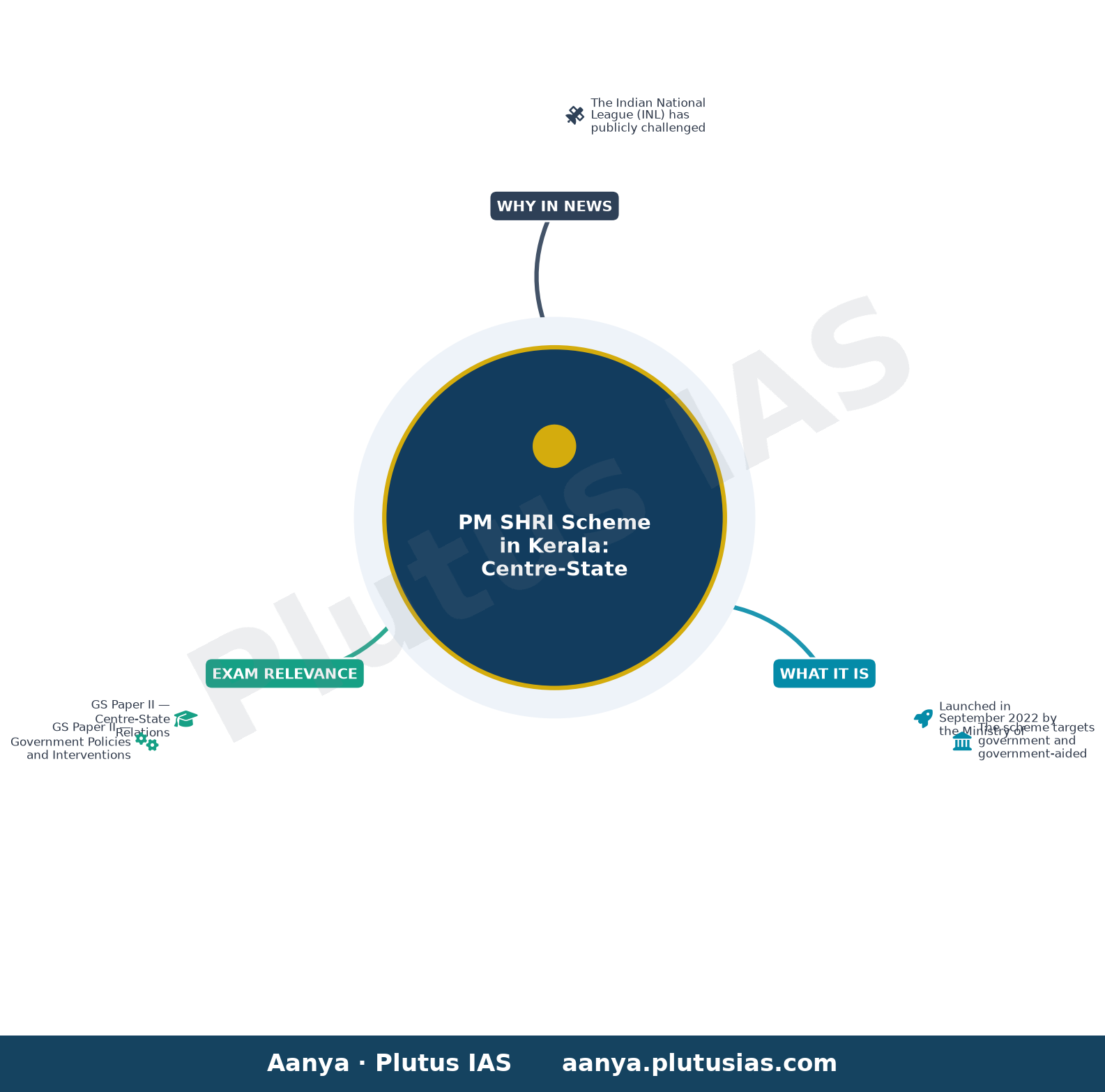
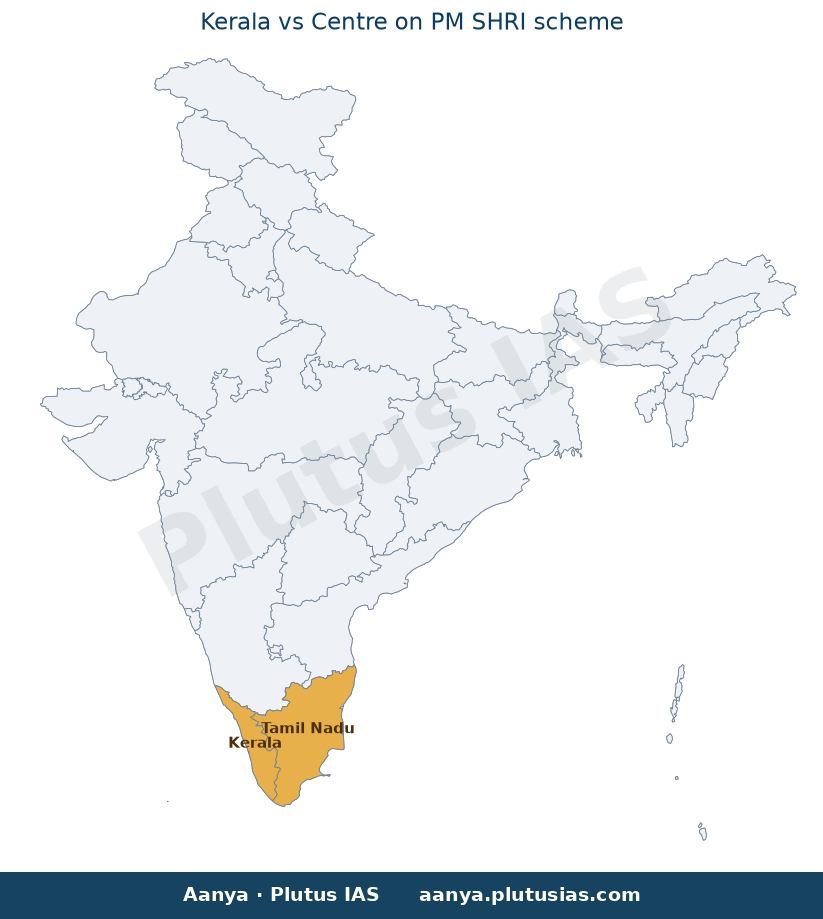
The Indian National League (INL) has publicly challenged Kerala Chief Minister V.D. Satheesan over his assertions regarding the implementation of the PM SHRI (Pradhan Mantri Schools for Rising India) scheme, following a clarification by the Union Ministry of Education that Kerala had not implemented the scheme despite signing an MoU. The dispute highlights the Centre-State tensions over educational policy, funding mechanisms, and the ideological underpinnings of the NEP 2020, particularly in the context of Kerala’s secular and progressive education policies.
Background
- The PM SHRI scheme, launched in September 2022, aims to develop 14,500 schools across India as model schools, including government and government-aided institutions, by providing enhanced infrastructure, resources, and pedagogical support.
- The Union Ministry of Education, in a parliamentary reply on July 30, 2026, clarified that Kerala had not implemented the PM SHRI scheme, contrary to claims by the state government that it was bound to do so due to the prior MoU.
- The Indian National League (INL) has accused the Kerala government of attempting to implement the NEP 2020, which it alleges reflects the ideological vision of the Rashtriya Swayamsevak Sangh (RSS), thereby politicising the education sector.
- Kerala has historically been a pioneer in education reforms, with a literacy rate of 96.2% (2011 Census) and a strong emphasis on secular, inclusive, and progressive educational policies.
What is the PM SHRI Scheme?
- Launched in September 2022 by the Ministry of Education, the PM SHRI (Pradhan Mantri Schools for Rising India) scheme is a centrally sponsored initiative aimed at transforming 14,500 schools across India into model schools of excellence.
- The scheme targets government and government-aided schools, including Kendriya Vidyalayas and Navodaya Vidyalayas, to provide them with upgraded infrastructure, digital resources, and enhanced pedagogical support.
- Funding under PM SHRI is provided by the Centre to states/UTs on a 60:40 ratio (90:10 for North-Eastern states), with the state governments required to contribute their share for the scheme’s implementation.
- The scheme mandates adherence to the National Education Policy (NEP) 2020, including its emphasis on experiential learning, multilingualism, and holistic development, which has sparked debates over its uniformity versus state-level autonomy.
- States are required to sign an MoU with the Centre to participate in the scheme, committing to specific reforms and resource allocations, though the implementation remains voluntary in practice.
- The scheme’s objectives include improving learning outcomes, reducing dropout rates, and ensuring equitable access to quality education, with a focus on digital integration and teacher training.
- Critics argue that the scheme’s conditionalities undermine state autonomy in education policy, particularly in states with divergent ideological or pedagogical approaches, such as Kerala.
- The PM SHRI scheme is distinct from the Samagra Shiksha Abhiyan (SSA), which is a broader umbrella programme for universalising elementary education, though both aim to improve school quality.
UPSC Value Addition
Keywords for Mains Answer-Writing
PM SHRI Scheme · Kerala Chief Minister · PMO clarification · MoU with Centre · Samagra Shiksha Kerala · National Education Policy 2020 · Rashtriya Swayamsevak Sangh · Left Democratic Front · Union Education Ministry · Secularism in Education
Prelims Practice Questions
Q1. Consider the following statements regarding the PM SHRI Scheme:
1. The scheme is implemented in all states that have signed an MoU with the Centre.
2. Kerala has received funds under the PM SHRI Scheme for government schools.
3. The Samagra Shiksha Kerala programme is distinct from the PM SHRI Scheme.
4. The PM SHRI Scheme is a centrally sponsored scheme under the National Education Policy 2020.
How many of the above statements are correct?
- Only one
- Only two
- Only three
- All four
Answer: Only three — Statements 3 and 4 are correct. Statement 1 is incorrect as the Centre clarified that Kerala has not implemented the PM SHRI Scheme despite signing an MoU. Statement 2 is incorrect as Kerala has received funds only under the Samagra Shiksha Kerala programme, not the PM SHRI Scheme.
Q2. Assertion (A): The PM SHRI Scheme is a centrally sponsored scheme aimed at transforming government schools.
Reason (R): The scheme aligns with the National Education Policy 2020 and seeks to provide quality education.
Options:
A. Both A and R are true, and R is the correct explanation of A.
B. Both A and R are true, but R is not the correct explanation of A.
C. A is true, but R is false.
D. A is false, but R is true.
- A
- B
- C
- D
Answer: A — Both the Assertion (A) and Reason (R) are true. The PM SHRI Scheme is indeed a centrally sponsored scheme aimed at transforming government schools and aligns with the National Education Policy 2020. The Reason (R) correctly explains the Assertion (A).
Q3. Match the following schemes with their respective objectives:
Column I
1. PM SHRI Scheme
2. Samagra Shiksha Abhiyan
3. National Education Policy 2020
4. Rashtriya Swayamsevak Sangh
Column II
A. Transforming government schools into model institutions
B. Holistic development of school education from pre-primary to senior secondary level
C. Framework for transforming the education system in India
D. Ideological organisation associated with Hindutva ideology
Options:
1. 1-A, 2-B, 3-C, 4-D
2. 1-B, 2-A, 3-C, 4-D
3. 1-C, 2-B, 3-A, 4-D
4. 1-D, 2-A, 3-B, 4-C
- 1
- 2
- 3
- 4
Answer: 1 — The correct match is: 1-A (PM SHRI Scheme aims to transform government schools into model institutions), 2-B (Samagra Shiksha Abhiyan focuses on holistic development of school education), 3-C (National Education Policy 2020 provides a framework for transforming the education system), and 4-D (Rashtriya Swayamsevak Sangh is an ideological organisation associated with Hindutva ideology).
Mains Practice Question
✍ Critically examine the constitutional and political dimensions of the Centre-State dispute over the implementation of the PM SHRI Scheme in Kerala. Also, analyse the implications of the Centre’s clarification on the autonomy of States in education policy. (15 Marks)
Approach: MODEL-ANSWER SKELETON:
1. **Constitutional Framework**:
– Article 29 and 30 of the Constitution guarantee cultural and educational rights to minorities and linguistic groups.
– Education is a Concurrent Subject (List III, Seventh Schedule), requiring cooperation between the Centre and States.
– The role of the Governor under Article 200 (assent to Bills) and Article 201 (reservation of Bills for Presidential consideration) in the context of education policies.
2. **Centre-State Relations in Education**:
– The PM SHRI Scheme as a centrally sponsored scheme under the National Education Policy 2020.
– Legal and political debates on whether States are bound to implement centrally sponsored schemes after signing an MoU.
– The principle of cooperative federalism (Article 263) and the role of the NITI Aayog in policy coordination.
3. **Kerala’s Position**:
– The State’s argument: The previous LDF government signed the MoU to ensure the release of Samagra Shiksha Kerala funds, not to implement the PM SHRI Scheme.
– The secular stance of Kerala in education policy, contrasting with the ideological underpinnings of the PM SHRI Scheme (as alleged by the INL).
– The role of the UDF government in resisting the implementation of the National Education Policy 2020.
4. **Centre’s Clarification**:
– The Union Education Ministry’s statement that the PM SHRI Scheme has not been implemented in Kerala and that the State has only signed an MoU.
– The implications of this clarification on the autonomy of States in education policy and the Centre’s coercive federalism.
5. **Political and Ideological Dimensions**:
– The allegation by the INL that the UDF government’s resistance to the PM SHRI Scheme is linked to its opposition to the ideological vision of the RSS.
– The broader debate on the imposition of national policies on States with differing ideological orientations.
6. **Conclusion**:
– The need for a balanced approach that respects State autonomy while ensuring national educational goals.
– The role of judicial review in resolving Centre-State disputes over policy implementation.
Source: The Hindu
Generated by AanyaAi for educational purpose.

- यूपीएससी/पीसीएस: 25 सितंबर 2026 को सरकारी प्रतिभूतियों की बोली प्रक्रिया, ₹34,000 करोड़ का पुनर्प्रस्ताव - September 24, 2026
- RBI to Auction ₹34,000 Crore Govt Securities on Sept 25, 2026: Key Details for UPSC & PCS - September 24, 2026
- भारत सेमीकंडक्टर उद्योग में ‘सकारात्मक चक्र’ की ओर: अशोक चंदक - September 24, 2026

No Comments