


09 Aug Andhra Pradesh-Australia MoUs Boost Clean Energy & Skill Development for UPSC 2026
✎ The Andhra Pradesh-Australia MoUs represent a strategic convergence of clean energy innovation, inclusive education, and skill development, positioning Andhra Pradesh as a key player in India’s energy transition and global…
Subject Relevance — Where This Topic Fits
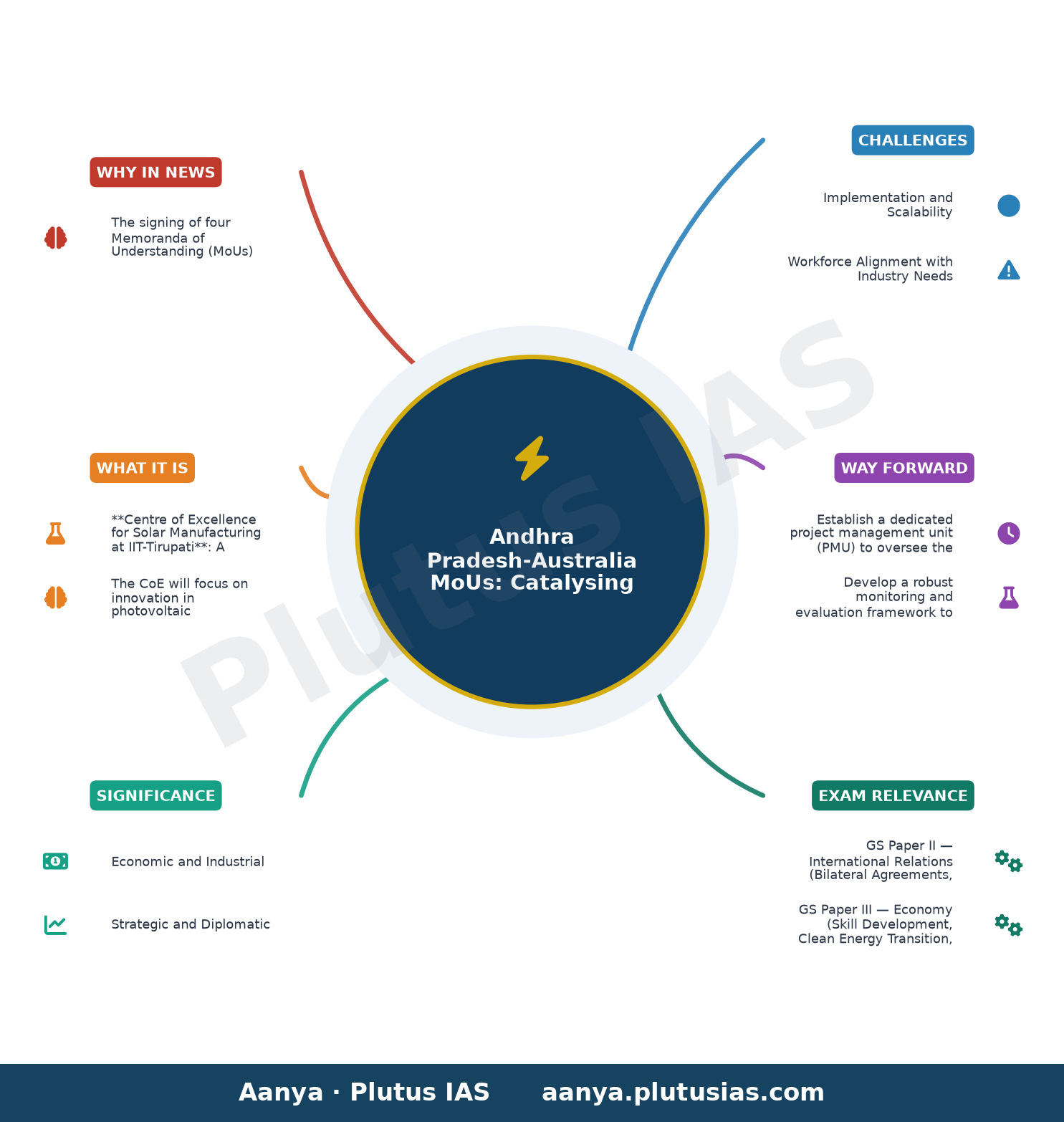
- GS Paper II — International Relations (Bilateral Agreements, Regional Cooperation) | GS Paper III — Economy (Skill Development, Clean Energy Transition, Advanced Manufacturing) | GS Paper III — Environment (Renewable Energy, Energy Transition)
- Prelims: Memorandum of Understanding (MoU), Centre of Excellence (CoE), Solar Manufacturing, Neurodiversity, Inclusive Education, Energy Transition, Skill Development, Advanced Manufacturing, IIT-Tirupati, UNSW Sydney
- Essay: India’s Role in Global Energy Transition: Opportunities and Challenges, Skill Development as a Catalyst for India’s Economic Growth
Quick Revision: The Andhra Pradesh-Australia MoUs represent a strategic convergence of clean energy innovation, inclusive education, and skill development, positioning Andhra Pradesh as a key player in India’s energy transition and global competitiveness.
Why is this in the news?
The signing of four Memoranda of Understanding (MoUs) between Andhra Pradesh and Australia on 8 August 2026 marks a significant milestone in bilateral cooperation, particularly in clean energy, advanced manufacturing, inclusive education, and skill development. These agreements underscore Andhra Pradesh’s strategic vision to position itself as a global hub for renewable energy innovation and a skilled workforce, while also addressing neurodiversity in education. The partnerships, formalised during a high-level delegation led by Australia’s Assistant Minister for International Education, highlight the growing emphasis on international collaborations to accelerate India’s energy transition and human capital development.
Background
- The state’s focus on advanced manufacturing and skill development aligns with the ‘National Skill Development Mission’ and the ‘Make in India’ initiative, aiming to create a globally competitive workforce.
- Australia, a global leader in renewable energy research and education, has been actively seeking international partnerships to advance its clean energy agenda, particularly in solar and hydrogen technologies.
- The bilateral relationship between India and Australia has strengthened in recent years, with a focus on education, technology, and trade, as evidenced by the ‘India-Australia Comprehensive Strategic Partnership’ (2020).
- The establishment of the ‘Centre of Excellence for Energy Transition (CoEET)’ in Andhra Pradesh reflects the state’s commitment to fostering innovation ecosystems in critical sectors.
- The MoUs build on prior engagements, including Minister Nara Lokesh’s visit to Australia in October 2025, where initial discussions on collaboration in clean energy and education were held.
Key Features of the Andhra Pradesh-Australia MoUs
- **Centre of Excellence for Solar Manufacturing at IIT-Tirupati**: A tripartite MoU between the Andhra Pradesh Centre of Excellence for Energy Transition (CoEET), IIT-Tirupati, and the University of New South Wales (UNSW) Sydney to establish a dedicated centre for cutting-edge research, technology development, and workforce training in solar manufacturing. This aligns with India’s goal to achieve 500 GW of renewable energy capacity by 2030 and positions Andhra Pradesh as a leader in the clean energy transition.
- The CoE will focus on innovation in photovoltaic technologies, supply chain resilience, and the development of a skilled talent pipeline to support India’s solar manufacturing ecosystem.
- The partnership leverages UNSW Sydney’s expertise in renewable energy research, particularly in solar cell efficiency and grid integration, to enhance India’s technological capabilities.
- The MoU includes provisions for joint research projects, faculty and student exchange programmes, and industry-academia collaborations to foster a globally competitive ecosystem.
- **Strengthening Inclusive Education for Neurodiverse Learners**: An MoU to improve inclusive education practices. The agreement focuses on training teachers to support children with autism and other neurodiverse learning needs, aligning with the ‘Rashtriya Madhyamik Shiksha Abhiyan (RMSA)’ and the ‘National Education Policy (NEP) 2020’.
- The initiative aims to create an inclusive classroom environment by adopting evidence-based teaching strategies, assistive technologies, and curriculum adaptations for neurodiverse students.
- The partnership will facilitate knowledge exchange between Australian institutions, known for their inclusive education frameworks, and Indian educators, thereby enhancing the state’s capacity to address diverse learning needs.
- **Skill Development and Advanced Manufacturing**: While specific details of the remaining two MoUs are not fully disclosed, they are expected to focus on skill development.
- The agreements are likely to include provisions for joint certification programmes, industry-led training modules, and the establishment of vocational training centres to bridge the skills gap in Andhra Pradesh’s growing manufacturing sector.
- **Student Mental Health and Well-being**: One of the MoUs is expected to address student mental health, a critical yet often overlooked aspect of inclusive education.
- The partnership may involve the development of mental health awareness programmes, counselling services, and stress management workshops in schools and higher education institutions across Andhra Pradesh.
- This initiative is particularly relevant given the rising incidence of mental health challenges among Indian you
Key Features
| Feature | Significance |
|---|---|
| Centre of Excellence (CoE) for Solar Manufacturing at IIT-Tirupati | Establishes a globally competitive research and innovation hub in clean energy, aligning with Andhra Pradesh’s renewable energy ambitions and India’s energy transition goals. |
| Inclusive Education MoU (UNSW, SPMVV, Samagra Shiksha) | Aims to enhance teacher training and support systems for neurodiverse learners, promoting equitable access to quality education in Andhra Pradesh. |
| Skill Development and Workforce Development Initiatives | Focuses on creating a skilled talent pipeline for advanced manufacturing and clean energy sectors, addressing industry demands and reducing unemployment. |
| Student Mental Health Collaboration | Introduces frameworks for mental health support in educational institutions, addressing rising concerns about student well-being in competitive academic environments. |
| Bilateral Diplomatic Engagement | Strengthens India-Australia ties in education, clean energy, and skill development, fostering long-term strategic partnerships between the two nations. |
Why it Matters
Economic and Industrial
- Accelerates Andhra Pradesh’s transition to a knowledge-driven economy by integrating advanced manufacturing, clean energy, and skill development.
Strategic and Diplomatic
- Enhances India-Australia bilateral cooperation, leveraging Australia’s expertise in renewable energy and higher education to support India’s developmental goals.
Educational and Human Capital
- Promotes inclusive education and mental health initiatives, ensuring equitable access to opportunities and fostering a resilient workforce.
Environmental and Sustainability
- Supports India’s clean energy transition through collaborative research and technology transfer, reducing carbon emissions and enhancing energy security.
Challenges
1. Implementation and Scalability
- Ensuring timely execution of MoU commitments, particularly in establishing the CoE for Solar Manufacturing and scaling inclusive education programs.
UPSC Link: Governance/Implementation challenges
2. Workforce Alignment with Industry Needs
- Bridging the gap between skill development initiatives and actual industry requirements to prevent skill mismatches and underemployment.
UPSC Link: Human Resource Development
3. Financial Sustainability
- Securing long-term funding for research, infrastructure, and skill development programs to avoid dependency on short-term grants.
UPSC Link: Public Finance
4. Equitable Access to Education
- Addressing disparities in access to quality education and mental health support across rural and urban regions in Andhra Pradesh.
UPSC Link: Inclusive Growth
5. Regulatory and Bureaucratic Hurdles
- Navigating cross-border regulatory frameworks and bureaucratic processes to facilitate smooth collaboration between Indian and Australian institutions.
UPSC Link: Governance and Administration
Challenges — UPSC Perspective
| Issue | Concern |
|---|---|
| Resource Allocation | Limited availability of funds, infrastructure, and skilled personnel to execute the MoUs effectively. |
| Monitoring and Evaluation | Lack of robust mechanisms to assess the impact of collaborative programs on education, skill development, and clean energy outcomes. |
| Stakeholder Coordination | Ensuring seamless collaboration among government agencies, educational institutions, and industry partners. |
| Policy Consistency | Maintaining long-term policy support despite changes in political leadership or administrative priorities. |
| Technology Transfer | Facilitating smooth transfer and adaptation of advanced technologies from Australia to Indian institutions. |
| Public Awareness | Creating awareness among stakeholders about the benefits and opportunities arising from these collaborations. |
Way Forward
- Establish a dedicated project management unit (PMU) to oversee the implementation of MoUs, ensuring accountability and timely delivery of outcomes.
- Develop a robust monitoring and evaluation framework to track progress in research, education, and skill development initiatives.
- Facilitate industry-academia partnerships to align skill development programs with market demands in clean energy and advanced manufacturing.
- Strengthen cross-border regulatory frameworks to simplify collaboration between Indian and Australian institutions.
- Invest in infrastructure development for the CoE for Solar Manufacturing, including state-of-the-art labs and research facilities.
- Promote inclusive education programs through targeted teacher training and resource allocation for neurodiverse learners.
- Launch public awareness campaigns to highlight the benefits of these collaborations and encourage stakeholder participation.
- Encourage private sector participation in funding and co-developing skill development and clean energy projects.
UPSC Value Addition
Keywords for Mains Answer-Writing
Andhra Pradesh-Australia MoUs · Centre of Excellence for Solar Manufacturing · IIT-Tirupati · clean energy transition · skill development partnerships · inclusive education initiatives · India-Australia bilateral cooperation · renewable energy ecosystem · neurodiverse learning support · advanced manufacturing innovation
Concept Flow
Bilateral Diplomacy → MoU Signing → Institutional Collaboration → Knowledge Transfer → Skill Development → Workforce Creation → Economic Growth → Sustainable Development
Prelims Practice Questions
Q1. Consider the following statements regarding the Centre of Excellence for Solar Manufacturing established at IIT-Tirupati under the Andhra Pradesh-Australia MoU:
1. It is a joint initiative between the Centre of Excellence for Energy Transition (CoEET), IIT-Tirupati, and the University of New South Wales (UNSW), Sydney.
2. The Centre aims to drive cutting-edge research, technology development, and workforce development in solar manufacturing.
3. The initiative is part of Andhra Pradesh’s broader vision to build a complete ecosystem for clean energy innovation.
4. The MoU was signed during the visit of the Australian Minister for Education to India in 2024.
How many of the above statements are correct?
- Only one
- Only two
- Only three
- All
Answer: All — Statements 1, 2, and 3 are correct. Statement 4 is incorrect as the MoU was signed in October 2025, not 2024.
Q2. Assertion (A): The Andhra Pradesh-Australia MoUs focus exclusively on renewable energy and skill development.
Reason (R): The agreements signed include provisions for inclusive education and student mental health support.
Options:
A. Both A and R are true, and R is the correct explanation of A.
B. Both A and R are true, but R is not the correct explanation of A.
C. A is true, but R is false.
D. A is false, but R is true.
- A
- B
- C
- D
Answer: ? — Assertion (A) is false because the MoUs cover inclusive education and student mental health, not exclusively renewable energy and skill development. Reason (R) is true as it correctly states the inclusion of inclusive education and student mental health.
Q3. Match the following areas of cooperation under the Andhra Pradesh-Australia MoUs with their respective implementing partners:
Column I (Area of Cooperation)
1. Centre of Excellence for Solar Manufacturing
2. Inclusive Education for Neurodiverse Learners
3. Skill Development
4. Student Mental Health
Column II (Implementing Partners)
A. University of New South Wales (UNSW), Sri Padmavati Mahila Visvavidyalayam, Samagra Shiksha
B. Centre of Excellence for Energy Transition (CoEET), IIT-Tirupati, UNSW
C. State government of Andhra Pradesh, Australian institutions
D. IIT-Tirupati, Australian institutions
- 1-B, 2-A, 3-C, 4-D
- 1-D, 2-B, 3-A, 4-C
- 1-B, 2-A, 3-D, 4-C
- 1-A, 2-B, 3-C, 4-D
Answer: 1-B, 2-A, 3-C, 4-D — 1-B (Centre of Excellence for Solar Manufacturing involves CoEET, IIT-Tirupati, and UNSW), 2-A (Inclusive Education involves UNSW, Sri Padmavati Mahila Visvavidyalayam, and Samagra Shiksha), 3-C (Skill Development is a broader area involving state and Australian institutions), 4-D (Student Mental Health is linked to IIT-Tirupati and Australian institutions).
Mains Practice Question
✍ Critically examine the significance of the Andhra Pradesh-Australia MoUs in the context of India’s clean energy transition and skill development. Substantiate your answer with reference to the specific initiatives under the agreements and their potential impact on India’s renewable energy ecosystem. (15 Marks)
Approach: MODEL-ANSWER SKELETON:
1. **Introduction (2 marks)**: Define the clean energy transition in India, citing the National Renewable Energy Action Plan (NREAP) and India’s commitments under the Paris Agreement. Highlight Andhra Pradesh’s role as a renewable energy hub.
2. **Centre of Excellence for Solar Manufacturing (4 marks)**:
– Detail the establishment of the CoE at IIT-Tirupati under the MoU with UNSW.
– Explain its objectives: cutting-edge research, technology development, and workforce skilling in solar manufacturing.
– Link to India’s PLI scheme for solar manufacturing and the Atal Innovation Mission.
– Discuss potential outcomes: reduced import dependence, job creation, and global competitiveness.
3. **Skill Development and Advanced Manufacturing (4 marks)**:
– Examine the broader skill development initiatives under the MoUs, including partnerships between Indian and Australian institutions.
– Discuss the role of skill development in supporting India’s transition to a green economy.
– Reference the Skill India Mission and the National Skill Development Corporation (NSDC).
4. **Inclusive Education and Neurodiverse Support (3 marks)**:
– Highlight the MoU between UNSW, Sri Padmavati Mahila Visvavidyalayam, and Samagra Shiksha for inclusive education.
– Discuss the importance of neurodiverse learning support in India’s education system.
– Reference the Rights of Persons with Disabilities Act, 2016, and the need for inclusive policies.
5. **Challenges and Way Forward (2 marks)**:
– Identify potential challenges: funding, institutional capacity, and alignment with state policies.
– Suggest measures: leveraging Australia’s expertise in renewable energy, strengthening public-private partnerships, and ensuring equitable access to skill development.
6. **Conclusion (1 mark)**: Summarise the transformative potential of these MoUs for India’s clean energy and skill development landscape.
Source: The Hindu
Generated by AanyaAi for educational purpose.

- हैती: UN में PM ने कहा- अंतरराष्ट्रीय बल की पूरी मदद ज़रूरी, सुरक्षा बलों को मज़बूत करना होगा - September 26, 2026
- Haiti’s PM Urges UN for Full Backing Against Gangs at UNGA 2026 - September 26, 2026
- सुपर एल नीनो: 4.51 लाख अतिरिक्त मौतों के अनुमान की गणना कैसे हुई? - September 26, 2026

No Comments