


09 Aug UPSC Alert: Ambedkar Foundation Schemes Merged with Central Plan in 2023
✎ The merger of Dr. Ambedkar Foundation schemes with the Centrally Sponsored Scheme for the Protection of Civil Rights Act, 1955, and the Scheduled Castes and Scheduled Tribes (Prevention of Atrocities) Act, 1989, aims to eliminate…
Subject Relevance — Where This Topic Fits
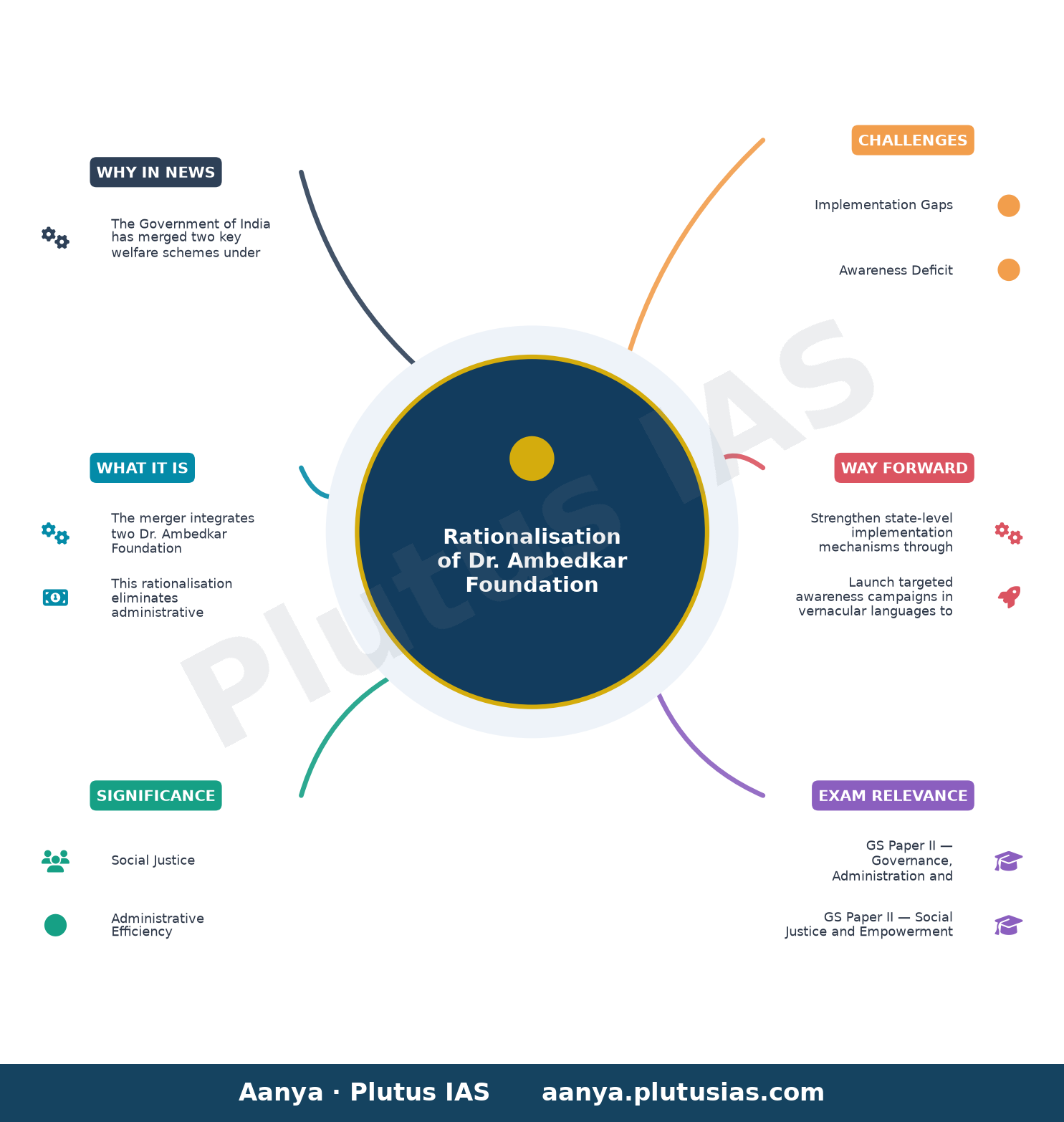
- GS Paper II — Governance, Administration and Policies | GS Paper II — Social Justice and Empowerment
- Prelims: Scheduled Castes and Scheduled Tribes (Prevention of Atrocities) Act, 1989, Protection of Civil Rights Act, 1955, Central Sector Scheme, Dr. Ambedkar Foundation, Inter-caste Marriage
- Essay: Social justice and inclusive governance in India, Challenges in implementing welfare schemes for marginalised communities
Quick Revision: The merger of Dr. Ambedkar Foundation schemes with the Centrally Sponsored Scheme for the Protection of Civil Rights Act, 1955, and the Scheduled Castes and Scheduled Tribes (Prevention of Atrocities) Act, 1989, aims to eliminate duplication and enhance welfare delivery for marginalised communities.
Why is this in the news?
The Government of India has merged two key welfare schemes under the Dr. Ambedkar Foundation—namely, the ‘Dr. Ambedkar Scheme for Social Integration through Inter-Caste Marriages’ and the ‘Dr. Ambedkar National Relief to the Scheduled Castes/Scheduled Tribes Victims of Atrocities Scheme’—with the existing Centrally Sponsored Scheme for the implementation of the Protection of Civil Rights Act, 1955, and the Scheduled Castes and Scheduled Tribes (Prevention of Atrocities) Act, 1989, effective from 31 March 2023. This merger, announced in response to an Unstarred Question (No. 2052) in the Rajya Sabha, aims to eliminate duplication in scheme implementation and streamline relief mechanisms for beneficiaries.
Background
- The Protection of Civil Rights Act, 1955, and the Scheduled Castes and Scheduled Tribes (Prevention of Atrocities) Act, 1989, are pivotal legislations addressing discrimination and atrocities against marginalised communities.
- The Dr. Ambedkar Foundation was established to promote the socio-economic welfare of Scheduled Castes and Scheduled Tribes, with schemes tailored for inter-caste marriages and relief for atrocity victims.
- Prior to the merger, these schemes operated independently, leading to administrative overlaps and potential inefficiencies in fund utilisation and beneficiary outreach.
- The merger aligns with the government’s broader objective of consolidating welfare initiatives to enhance transparency, reduce redundancy, and improve service delivery.
- The Centrally Sponsored Scheme under the Department of Social Justice and Empowerment provides financial assistance to state governments and Union Territory administrations for effective implementation of these acts.
- Special initiatives were undertaken to clear pending cases, including the disbursement of approximately ₹9 crore as incentives for 385 inter-caste marriage cases under the integrated framework.
What is the Dr. Ambedkar Foundation Scheme Merger?
- The merger integrates two Dr. Ambedkar Foundation schemes—’Social Integration through Inter-Caste Marriages’ and ‘Relief to Atrocity Victims’—into the existing Centrally Sponsored Scheme for the implementation of the Protection of Civil Rights Act, 1955, and the Scheduled Castes and Scheduled Tribes (Prevention of Atrocities) Act, 1989.
- This rationalisation eliminates administrative duplication, ensuring unified governance and streamlined fund flow to state governments and Union Territory administrations.
- The Centrally Sponsored Scheme provides financial assistance to states for infrastructure, awareness campaigns, and victim support mechanisms under the two acts.
- The merger enhances the scope of the Centrally Sponsored Scheme to include inter-caste marriage incentives and atrocity relief, thereby broadening its coverage and impact.
- State governments and Union Territory administrations remain responsible for implementation, with the central government providing oversight and financial support.
- The initiative reflects a commitment to social justice by ensuring timely disbursement of relief, as evidenced by the release of ₹9 crore for 385 inter-caste marriage cases.
- The merger also addresses long-standing issues of pending applications and delayed relief, as the integrated framework ensures a single-window approach for beneficiaries.
- This reform underscores the government’s focus on eliminating caste-based discrimination and atrocities through systemic policy integration.
Key Features
| Feature | Significance |
|---|---|
| Merger of Schemes | Eliminates duplication in implementation of welfare measures for SC/ST communities, ensuring administrative efficiency and optimal resource utilisation. |
| Centrally Sponsored Scheme (CSS) Integration | Brought under the ambit of the CSS for the Protection of Civil Rights Act, 1955 and the Scheduled Castes and Scheduled Tribes (Prevention of Atrocities) Act, 1989, enhancing uniformity and accountability. |
| Relief for Inter-Caste Marriages | Promotes social integration by providing financial incentives to couples entering inter-caste marriages, thereby challenging caste-based social hierarchies. |
| Relief for Atrocity Victims | Ensures timely financial assistance to victims of caste-based atrocities under the Scheduled Castes and Scheduled Tribes (Prevention of Atrocities) Act, 1989. |
| Special Initiative for Pending Cases | 385 inter-caste marriage cases resolved with ₹9 crore disbursed, demonstrating proactive redressal of grievances. |
Why it Matters
Social Justice
- Advances the constitutional mandate of social justice and equality as enshrined in Articles 15, 16, and 17 of the Indian Constitution.
- Strengthens the implementation of protective legislations for marginalised communities, reducing social exclusion and discrimination.
- Promotes inter-caste harmony, a critical component of India’s socio-cultural fabric and national integration.
Administrative Efficiency
- Streamlines welfare delivery mechanisms by integrating overlapping schemes, reducing bureaucratic delays and administrative costs.
- Centralises monitoring and evaluation, ensuring better tracking of fund utilisation and outcomes.
Legal Framework
- Aligns with the Protection of Civil Rights Act, 1955, which prohibits untouchability and caste-based discrimination.
- Supports the Scheduled Castes and Scheduled Tribes (Prevention of Atrocities) Act, 1989, by providing timely relief to victims of caste-based violence.
Economic Impact
- Financial incentives for inter-caste marriages and atrocity victims act as economic safety nets, reducing vulnerability of marginalised groups.
- Disbursement of ₹9 crore to 385 beneficiaries demonstrates tangible economic support, albeit limited in scale.
Challenges
1. Implementation Gaps
- Dependence on state governments for execution may lead to uneven implementation across regions.
- Lack of robust grievance redressal mechanisms at the grassroots level may delay relief distribution.
UPSC Link: GS-II: Welfare Schemes
2. Awareness Deficit
- Limited awareness among target beneficiaries about eligibility criteria and application processes for schemes.
- Misinformation or lack of outreach may exclude eligible beneficiaries, particularly in remote areas.
UPSC Link: GS-II: Social Sector
3. Resource Constraints
- Inadequate budgetary allocation may limit the scope and reach of welfare measures.
- Delays in fund disbursement due to bureaucratic hurdles or procedural inefficiencies.
UPSC Link: GS-III: Resource Mobilisation
4. Caste-Based Violence Persistence
- Despite legal protections, caste-based atrocities continue, indicating systemic societal challenges.
- Relief schemes alone cannot address deep-rooted social prejudices; requires multi-dimensional interventions.
UPSC Link: GS-I: Social Issues
5. Monitoring and Evaluation
- Absence of real-time tracking systems may hinder assessment of scheme effectiveness.
- Lack of independent audits may lead to misreporting of outcomes or fund misuse.
UPSC Link: GS-II: Governance
Challenges — UPSC Perspective
| Issue | Concern |
|---|---|
| State-Level Implementation | Variations in administrative capacity and political will may lead to inconsistent execution across states. |
| Beneficiary Identification | Risk of exclusion errors due to inadequate data or flawed eligibility criteria. |
| Fund Disbursement Delays | Bureaucratic bottlenecks may cause delays in releasing financial assistance to beneficiaries. |
| Social Stigma | Persistent caste-based discrimination may deter victims from reporting atrocities or seeking relief. |
| Awareness Campaigns | Insufficient outreach efforts may leave marginalised communities unaware of their rights and entitlements. |
| Data Transparency | Lack of public access to scheme data may reduce accountability and citizen oversight. |
Government Initiatives — Must-Memorise for Prelims
- Dr. Ambedkar Scheme for Social Integration through Inter-Caste Marriages
- Dr. Ambedkar National Relief to the Scheduled Castes/Scheduled Tribes Victims of Atrocities Scheme
- Centrally Sponsored Scheme for the Protection of Civil Rights Act, 1955 and the Scheduled Castes and Scheduled Tribes (Prevention of Atrocities) Act, 1989
Way Forward
- Strengthen state-level implementation mechanisms through capacity-building and periodic reviews.
- Launch targeted awareness campaigns in vernacular languages to ensure maximum beneficiary reach.
- Establish a real-time monitoring system for fund disbursement and grievance redressal.
- Increase budgetary allocations to expand the scope of welfare measures and cover more beneficiaries.
- Conduct independent audits to ensure transparency and accountability in scheme execution.
- Integrate digital platforms for seamless application and tracking of relief claims.
- Promote inter-departmental coordination between social justice, police, and legal authorities to expedite atrocity case resolutions.
- Encourage civil society participation to enhance community trust and facilitate last-mile delivery.
UPSC Value Addition
Keywords for Mains Answer-Writing
Dr. Ambedkar Foundation Schemes · Inter-caste Marriage Promotion · Scheduled Castes and Scheduled Tribes (Prevention of Atrocities) Act, 1989 · Protection of Civil Rights Act, 1955 · Centrally Sponsored Schemes · Social Justice and Empowerment · Amalgamation of Welfare Schemes · Scheduled Caste/Scheduled Tribe Victims Relief · Inter-caste Marriage Incentives · State Government Implementation of Central Schemes
Constitutional & Policy Linkages
- Article 15: Prohibition of discrimination on grounds of religion, race, caste, sex, or place of birth.
- Article 16: Equality of opportunity in matters of public employment.
- Article 17: Abolition of Untouchability.
- Article 46: Promotion of educational and economic interests of weaker sections.
Concept Flow
Caste-based discrimination and atrocities → Legislative protections (Protection of Civil Rights Act, 1955; SC/ST (Prevention of Atrocities) Act, 1989) → Welfare schemes (Dr. Ambedkar Foundation schemes) → Implementation challenges (duplication, delays) → Merger into CSS for efficiency → Proactive redressal (₹9 crore disbursement) → Long-term social integration and justice.
Prelims Practice Questions
Q1. Consider the following statements regarding the Scheduled Castes and Scheduled Tribes (Prevention of Atrocities) Act, 1989:
1. The Act aims to prevent the commission of offences of atrocities against members of Scheduled Castes and Scheduled Tribes.
2. The Act provides for the establishment of Special Courts for the trial of such offences.
3. The Act does not cover offences committed by public servants.
4. The Act mandates the State Governments to provide relief to victims of atrocities.
How many of the above statements are correct?
- Only one
- Only two
- Only three
- All
Answer: All — Statements 1, 2, and 4 are correct as per the provisions of the Act. Statement 3 is incorrect because the Act does cover offences committed by public servants.
Q2. Assertion (A): The Protection of Civil Rights Act, 1955, and the Scheduled Castes and Scheduled Tribes (Prevention of Atrocities) Act, 1989, are implemented through a centrally sponsored scheme.
Reason (R): The centrally sponsored scheme provides financial assistance to State Governments and Union Territories for the effective implementation of these Acts.
Options:
A. Both A and R are true, and R is the correct explanation of A.
B. Both A and R are true, but R is not the correct explanation of A.
C. A is true, but R is false.
D. A is false, but R is true.
Answer: ? — Both Assertion (A) and Reason (R) are true, and Reason (R) correctly explains Assertion (A). The Acts are indeed implemented through a centrally sponsored scheme that provides financial assistance to State Governments and Union Territories.
Q3. Which of the following schemes was/were amalgamated into the centrally sponsored scheme for the implementation of the Protection of Civil Rights Act, 1955, and the Scheduled Castes and Scheduled Tribes (Prevention of Atrocities) Act, 1989, as per the recent notification?
1. Dr. Ambedkar Scheme for Social Integration through Inter-Caste Marriages
2. Dr. Ambedkar National Relief to the Scheduled Castes/Scheduled Tribes Victims of Atrocities Scheme
3. Pradhan Mantri Adarsh Gram Yojana
Options:
A. 1 and 2 only
B. 2 and 3 only
C. 1 and 3 only
D. 1, 2, and 3
- A
- B
- C
- D
Answer: A — Schemes 1 and 2 were amalgamated into the centrally sponsored scheme, as stated in the press release. Scheme 3 is unrelated to the context.
Mains Practice Question
✍ The Government of India has recently amalgamated the ‘Dr. Ambedkar Scheme for Social Integration through Inter-Caste Marriages’ and the ‘Dr. Ambedkar National Relief to the Scheduled Castes/Scheduled Tribes Victims of Atrocities Scheme’ into a centrally sponsored scheme for the implementation of the Protection of Civil Rights Act, 1955, and the Scheduled Castes and Scheduled Tribes (Prevention of Atrocities) Act, 1989. Critically examine the rationale behind this amalgamation and its implications for social justice and empowerment in India. (15 Marks)
Approach: MODEL-ANSWER SKELETON:
1. **Introduction (2 Marks)**
– Briefly define the two schemes amalgamated and the Acts they relate to.
– State the date of amalgamation (31 March 2023) and the rationale provided (avoidance of duplication).
2. **Rationale for Amalgamation (4 Marks)**
– **Avoidance of Duplication**: Explain how the two schemes overlapped in their objectives and beneficiary categories, leading to administrative inefficiency.
– **Streamlining Implementation**: Highlight the benefits of a single centrally sponsored scheme for better coordination, monitoring, and resource allocation.
– **Alignment with Legal Framework**: Link the amalgamation to the enforcement of the Protection of Civil Rights Act, 1955, and the Scheduled Castes and Scheduled Tribes (Prevention of Atrocities) Act, 1989.
– **Financial Efficiency**: Mention the release of ₹9 crore for 385 inter-caste marriage cases as evidence of improved disbursement.
3. **Implications for Social Justice and Empowerment (5 Marks)**
– **Enhanced Coverage**: Discuss how the amalgamation ensures that both inter-caste marriage incentives and atrocity victim relief are addressed under a unified framework.
– **State Government Role**: Explain the responsibilities of State Governments and Union Territories in implementing the scheme, as mandated by the centrally sponsored scheme.
– **Impact on Marginalised Groups**: Analyse how the scheme addresses the needs of Scheduled Castes, Scheduled Tribes, and inter-caste couples, promoting social integration.
– **Challenges**: Acknowledge potential challenges such as bureaucratic delays, lack of awareness, and regional disparities in implementation.
4. **Conclusion (4 Marks)**
– Summarise the significance of the amalgamation in promoting social justice.
– Provide a balanced view: While the amalgamation is a step forward, its success depends on effective implementation by State Governments.
– Suggest measures for further improvement, such as greater transparency, faster disbursement, and awareness campaigns.
Source: PIB (Press Information Bureau)
Generated by AanyaAi for educational purpose.

- Nilekani Panel Reforms Exams: Radhakrishnan’s Role Unveiled - September 29, 2026
- सुप्रीम कोर्ट में चुनाव आयोग के फैसलों पर सुनवाई: जानें क्या है पूरा मामला - September 29, 2026
- MP’s 4 New UNESCO Tentative Sites: UPSC & State PCS Focus - September 29, 2026

No Comments