


09 Aug Vikram-1 Launch: How India’s Space Reforms Boosted Private Sector Role
✎ India’s space sector reforms, enacted in 2020, have institutionalised public-private partnerships to achieve self-reliance, with the Vikram-1 launch by Skyroot Aerospace serving as a tangible demonstration of this transformative…
Subject Relevance — Where This Topic Fits
- GS Paper III — Science and Technology — Developments and their Applications and Effects in Everyday Life | GS Paper III — Economy — Liberalisation, Privatisation and Globalisation | GS Paper III — Economy — Infrastructure: Energy, Ports, Roads, Airports, Railways etc.
- Prelims: Vikram-1 launch, Skyroot Aerospace, ISRO, IN-SPACe, FDI in space sector, New Space India Limited (NSIL), Indian National Space Promotion and Authorisation Centre (IN-SPACe), Space Sector Reforms 2020, Atmanirbhar Bharat in space technology, Chandrayaan-3, Lunar south pole landing, Water ice on Moon
- Essay: The role of public-private partnerships in achieving national self-reliance: A case study of India’s space sector, Innovation and entrepreneurship as drivers of India’s technological ascendancy
Quick Revision: India’s space sector reforms, enacted in 2020, have institutionalised public-private partnerships to achieve self-reliance, with the Vikram-1 launch by Skyroot Aerospace serving as a tangible demonstration of this transformative policy framework.
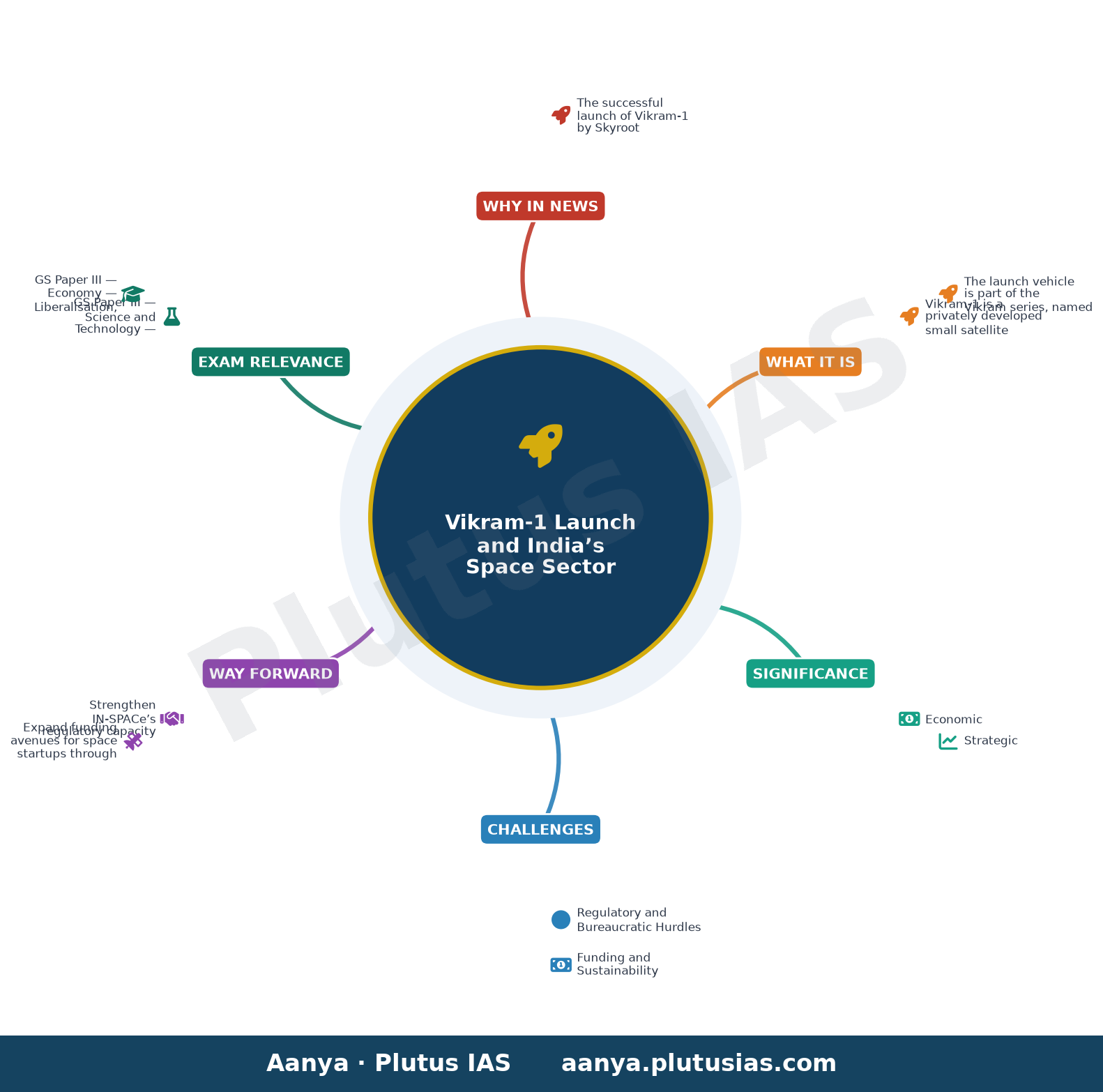
Why is this in the news?
The successful launch of Vikram-1 by Skyroot Aerospace, a private Indian aerospace company, marks a significant milestone in India’s space sector reforms. The event underscores the synergy between ISRO’s institutional expertise and private sector agility, reinforcing India’s trajectory towards self-reliance in space technology while positioning the nation as a global leader in cost-effective, reliable space missions.
Background
- The Indian space programme, historically driven by ISRO, has evolved from a state-centric model to one that actively fosters private sector participation through structural reforms initiated in 2020.
- The Space Sector Reforms of 2020 introduced a liberalised framework, allowing 100% FDI in the space sector, enabling private entities to engage in end-to-end space activities including satellite manufacturing, launch services, and space-based applications.
- The establishment of IN-SPACe (Indian National Space Promotion and Authorisation Centre) in 2020 as a single-window nodal agency to promote, authorise, and oversee private sector activities in the space domain.
- New Space India Limited (NSIL), ISRO’s commercial arm, has been tasked with transferring technologies and facilitating partnerships between ISRO and private entities to accelerate indigenisation.
- Skyroot Aerospace, founded in 2018, became the first Indian private company to successfully launch a rocket (Vikram-S) in November 2022, followed by the Vikram-1 launch in 2026, demonstrating the viability of private sector-led innovation in launch vehicle technology.
- India’s space sector reforms align with the broader vision of ‘Atmanirbhar Bharat’ and the global trend of commercialising space activities, exemplified by the rise of NewSpace companies worldwide.
What is Vikram-1 and the Space Sector Reforms in India?
- Vikram-1 is a privately developed small satellite launch vehicle (SSLV) designed by Skyroot Aerospace, capable of placing payloads up to 300 kg into Low Earth Orbit (LEO).
- The launch vehicle is part of the Vikram series, named after Dr. Vikram Sarabhai, the father of India’s space programme, symbolising continuity with ISRO’s legacy while embracing private innovation.
- The Vikram-1 launch demonstrates the operationalisation of India’s space sector reforms, which have dismantled historical barriers to private participation by allowing entities to develop, launch, and operate space assets independently.
- The reforms enable private companies to access ISRO’s infrastructure, technical expertise, and launch facilities, thereby reducing the cost and time required for developing indigenous launch capabilities.
- IN-SPACe plays a pivotal role in facilitating these partnerships by providing regulatory oversight, technical guidance, and streamlined approval processes for private space missions.
- The reforms also permit private entities to utilise foreign launch services for domestic payloads, fostering competition and reducing dependency on foreign launch providers.
- The commercialisation of space activities is expected to generate significant economic value, with projections indicating a potential $100 billion global market for space-based services by 2040, of which India aims to capture a substantial share.
- The Vikram-1 launch is a precursor to India’s ambition to become a global hub for cost-effective satellite launches, competing with established players like SpaceX and Arianespace.
Key Features
| Feature | Significance |
|---|---|
| Vikram-1 launch by Skyroot Aerospace | Demonstrates operational capability of India’s private sector in orbital launch services, validating the ‘Atmanirbhar Bharat’ push in space technology. |
| ISRO’s mentorship and technical support to private entities | Accelerates technology transfer, reduces entry barriers for startups, and ensures adherence to safety and reliability standards. |
| Space Sector Reforms (2020-2021) | Unlocked private participation via liberalised FDI norms, IN-SPACe framework, and simplified licensing, transforming India’s space economy. |
| IIST convocation address by ISRO Chairperson | Highlights the synergy between academia, industry, and government in fostering a skilled workforce for India’s space ambitions. |
| Governor’s emphasis on Viksit Bharat vision | Links space sector growth to national development, reinforcing the role of science and technology in socio-economic transformation. |
Why it Matters
Economic
- Stimulates growth in India’s space economy, projected to reach $40 billion by 2040, with private sector contributing ~30% (Morgan Stanley estimates).
- Enhances export potential of space-based services (e.g., satellite data, launch services) and reduces reliance on foreign platforms.
- Attracts global investments in India’s space startups, positioning the country as a cost-competitive alternative to established players like SpaceX.
Strategic
- Bolsters India’s strategic autonomy in critical space technologies, including satellite navigation, remote sensing, and launch capabilities.
- Supports national security objectives by enabling rapid deployment of indigenous communication and reconnaissance satellites.
- Strengthens India’s position in multilateral forums (e.g., UNOOSA, COPUOS) as a responsible spacefaring nation with robust private sector engagement.
Technological
- Accelerates innovation in reusable launch systems, miniaturised satellites, and propulsion technologies through public-private collaboration.
- Facilitates technology spillovers to adjacent sectors (e.g., AI, robotics, materials science) via space applications.
- Demonstrates India’s capability in end-to-end space missions, from design to launch, reducing dependence on foreign collaborators.
Institutional
- Validates the effectiveness of IN-SPACe (Indian National Space Promotion and Authorisation Centre) as a single-window regulator for private space activities.
- Strengthens the role of IIST and other institutions in producing a skilled workforce aligned with industry needs.
- Encourages academia-industry partnerships, as seen in joint R&D projects and internship programs.
Challenges
1. Regulatory and Bureaucratic Hurdles
- Complex licensing processes and delayed clearances can stifle innovation and deter private investment in high-risk segments.
- Need for harmonised policies across central and state governments to avoid jurisdictional conflicts in land use and spectrum allocation.
UPSC Link: GS3: Science & Technology
2. Funding and Sustainability
- Private space startups often face capital constraints, requiring patient capital and venture funding tailored to long gestation periods.
- Over-reliance on government contracts may limit market-driven innovation; diversification into commercial applications is essential.
UPSC Link: GS3: Investment Models
3. Talent Retention and Skilling
- Shortage of domain experts in niche areas (e.g., orbital mechanics, thermal protection systems) poses a bottleneck for scaling operations.
- Need for continuous upskilling programs to keep pace with rapid technological advancements in the global space industry.
UPSC Link: GS2: Education & Skill Development
4. International Competition and Geopolitics
- Intense rivalry with established players (e.g., SpaceX, Arianespace) and emerging nations (e.g., China) demands sustained R&D investment.
- Export controls and technology transfer restrictions by advanced economies may constrain India’s access to critical components.
UPSC Link: GS2: International Relations
5. Infrastructure and Supply Chain Gaps
- Limited domestic manufacturing capacity for high-precision components (e.g., cryogenic engines, avionics) increases costs and lead times.
- Dependence on foreign suppliers for critical materials (e.g., carbon fibre, rare earth metals) poses supply chain vulnerabilities.
UPSC Link: GS3: Industrial Policy
Challenges — UPSC Perspective
| Issue | Concern |
|---|---|
| High cost of capital for startups | Limits R&D and operational scaling, especially for capital-intensive projects like orbital launches. |
| Fragmented regulatory landscape | Delays in approvals and compliance create uncertainty for private players. |
| Brain drain to foreign firms | Loss of skilled professionals to global space companies weakens India’s talent pool. |
| Limited private sector participation in high-tech segments | Government dominance in strategic areas (e.g., heavy-lift rockets) restricts market competition. |
| Cybersecurity risks in space systems | Vulnerabilities in satellite networks and ground stations could compromise national security. |
| Environmental concerns over rocket launches | Need for sustainable propulsion systems and debris mitigation strategies to align with global norms. |
Way Forward
- Strengthen IN-SPACe’s regulatory capacity to streamline approvals and reduce bureaucratic delays for private entities.
- Expand funding avenues for space startups through dedicated venture funds (e.g., ISRO’s Technology Transfer Office) and sovereign wealth funds.
- Establish industry-academia consortia to address skill gaps and co-develop technologies for next-gen launch systems.
- Promote public-private partnerships in critical infrastructure (e.g., launch pads, testing facilities) to de-risk investments.
- Enhance export promotion policies for space services, leveraging India’s cost advantages and reliability in satellite launches.
- Invest in R&D for reusable launch technologies and indigenous propulsion systems to reduce dependency on foreign components.
- Develop a national space debris mitigation policy to ensure long-term sustainability of space operations.
- Encourage IIST and other institutions to offer specialised courses in space law, policy, and entrepreneurship.
UPSC Value Addition
Keywords for Mains Answer-Writing
Space sector reforms · Public-Private Partnership (PPP) in space · Vikram-1 launch · Skyroot Aerospace · ISRO’s role in commercial space · Indian Space Policy 2023 · Atmanirbhar Bharat in space technology · IIST convocation address · Chandrayaan mission achievements · Viksit Bharat vision · Space sector liberalisation · Private sector participation in space · ISRO’s mentorship model · Space sector startups in India · Global perception of India’s space capabilities
Concept Flow
Space Sector Reforms (2020-2021) → Liberalisation of FDI norms and IN-SPACe framework → Entry of private players (e.g., Skyroot Aerospace) → Development of indigenous launch vehicles (Vikram-1) → Operational validation and market expansion → Economic growth and strategic autonomy.
Prelims Practice Questions
Q1. Consider the following statements regarding the Vikram-1 launch and India’s space sector reforms:
1. Vikram-1 is India’s first privately developed orbital rocket.
2. The launch reflects the strength of public-private partnerships in India’s space sector.
3. ISRO provided direct financial support to Skyroot Aerospace for the Vikram-1 launch.
4. The Indian Space Policy 2023 aims to increase private sector participation in space activities.
How many of the above statements are correct?
- Only one
- Only two
- Only three
- All four
Answer: Only three — Statements 1, 2, and 4 are correct. Statement 3 is incorrect as ISRO provided technical and mentorship support, not direct financial support, to Skyroot Aerospace.
Q2. Assertion (A): The Vikram-1 launch by Skyroot Aerospace marks a transformational milestone in India’s space sector.
Reason (R): The Indian Space Policy 2023 liberalised the space sector, enabling unprecedented private participation.
Options:
A. Both A and R are true, and R is the correct explanation of A.
B. Both A and R are true, but R is not the correct explanation of A.
C. A is true, but R is false.
D. A is false, but R is true.
Answer: ? — Both Assertion (A) and Reason (R) are true. The Vikram-1 launch is indeed a transformational milestone, and the Indian Space Policy 2023 liberalised the space sector, enabling such private participation. However, R is not the sole explanation for A, as other factors like ISRO’s mentorship also contributed.
Q3. Match the following space missions/initiatives with their respective organisations:
Column I
1. Vikram-1 launch
2. Chandrayaan mission
3. Indian Space Policy 2023
4. IIST convocation address
Column II
A. ISRO
B. Skyroot Aerospace
C. Government of India
D. Indian Institute of Space Science and Technology
Options:
A. 1-B, 2-A, 3-C, 4-D
B. 1-A, 2-B, 3-C, 4-D
C. 1-C, 2-A, 3-B, 4-D
D. 1-D, 2-B, 3-C, 4-A
Answer: ? — 1-B (Vikram-1 launch by Skyroot Aerospace), 2-A (Chandrayaan mission by ISRO), 3-C (Indian Space Policy 2023 by Government of India), 4-D (IIST convocation address by IIST).
Mains Practice Question
✍ The recent launch of Vikram-1 by Skyroot Aerospace exemplifies the success of India’s public-private partnership model in the space sector. Critically analyse the role of ISRO in fostering this ecosystem, with reference to the Indian Space Policy 2023 and the broader vision of Atmanirbhar Bharat. (15 Marks)
Approach: MODEL-ANSWER SKELETON:
1. **Introduction (2 marks)**
– Briefly define the Vikram-1 launch and its significance as India’s first privately developed orbital rocket.
– State the context: India’s space sector reforms and the Indian Space Policy 2023.
2. **ISRO’s Role in Fostering PPP (5 marks)**
– **Mentorship and Technical Support**: ISRO’s role in providing technical guidance, infrastructure, and regulatory support to private entities like Skyroot Aerospace (e.g., sharing of launch facilities, expertise in propulsion systems).
– **Policy Framework**: The Indian Space Policy 2023’s provisions for liberalising the space sector, including the creation of the Indian National Space Promotion and Authorisation Centre (IN-SPACe) to facilitate private participation.
– **Capacity Building**: ISRO’s collaboration with academic institutions (e.g., IIST) to nurture talent and innovation in the space sector.
– **Infrastructure Sharing**: Use of ISRO’s launch pads and testing facilities by private players under regulated conditions.
3. **Indian Space Policy 2023: Key Provisions (4 marks)**
– **Liberalisation**: Shift from a state-centric model to a more inclusive approach, allowing private entities to engage in end-to-end space activities (satellite manufacturing, launches, and data utilisation).
– **IN-SPACe**: Its role as a single-window nodal agency for promoting and regulating private space activities.
– **Atmanirbhar Bharat Alignment**: How the policy aligns with the vision of self-reliance in critical technologies and reducing dependence on foreign launch services.
– **Global Perception**: India’s emergence as a cost-effective and reliable hub for space launches, attracting international clients.
4. **Challenges and Criticisms (3 marks)**
– **Regulatory Bottlenecks**: Potential delays in approvals and regulatory clarity despite policy liberalisation.
– **Resource Constraints**: Limited availability of launch infrastructure and skilled manpower for private players.
– **Competition vs. Collaboration**: Balancing competition between ISRO and private entities while ensuring equitable growth.
5. **Conclusion (1 mark)**
– Summarise ISRO’s pivotal role in enabling PPP while acknowledging the need for continued reforms to address challenges. Highlight the long-term benefits for India’s space economy and global standing.
Source: The Hindu
Generated by AanyaAi for educational purpose.

- KWML’s Feasibility Reports for Water Metro in 18 Cities: UPSC & PCS Insights - October 3, 2026
- ओडिशा में वन्यजीव अनुसंधान अनुदान कार्यक्रम शुरू, सिमिलिपाल में 300 कैमरे और बढ़ेंगे - October 3, 2026
- India Summons Pakistan High Commission Official Over Violation - October 3, 2026

No Comments