


09 Aug Tamil Nadu Budget 2026: 6.6% Rise in Healthcare Spending for UPSC
✎ Tamil Nadu’s Budget 2026 prioritises geriatric, maternal, and cancer care through mobile units, hub-and-spoke models, and telemedicine, but overlooks critical healthcare manpower expansion, risking suboptimal utilisation of…
Subject Relevance — Where This Topic Fits
- GS Paper II — Governance, Welfare Schemes for Vulnerable Sections | GS Paper III — Issues Relating to Development and Management of Social Sector/Services relating to Health, Education, Human Resources
- Prelims: Healthcare financing, Public Health Infrastructure, Hub-and-Spoke Model, Geriatric Healthcare, Tamil Nadu Budget 2026, Thai Maaman Thanga Mothiram Thittam, Mobile Geriatric Treatment Centres, Cancer Care Hubs
- Essay: Healthcare as a Public Good: Balancing Fiscal Prudence and Social Welfare in India, Demographic Dividend and Ageing Population: Policy Imperatives for Inclusive Growth
Quick Revision: Tamil Nadu’s Budget 2026 prioritises geriatric, maternal, and cancer care through mobile units, hub-and-spoke models, and telemedicine, but overlooks critical healthcare manpower expansion, risking suboptimal utilisation of infrastructure.
Why is this in the news?
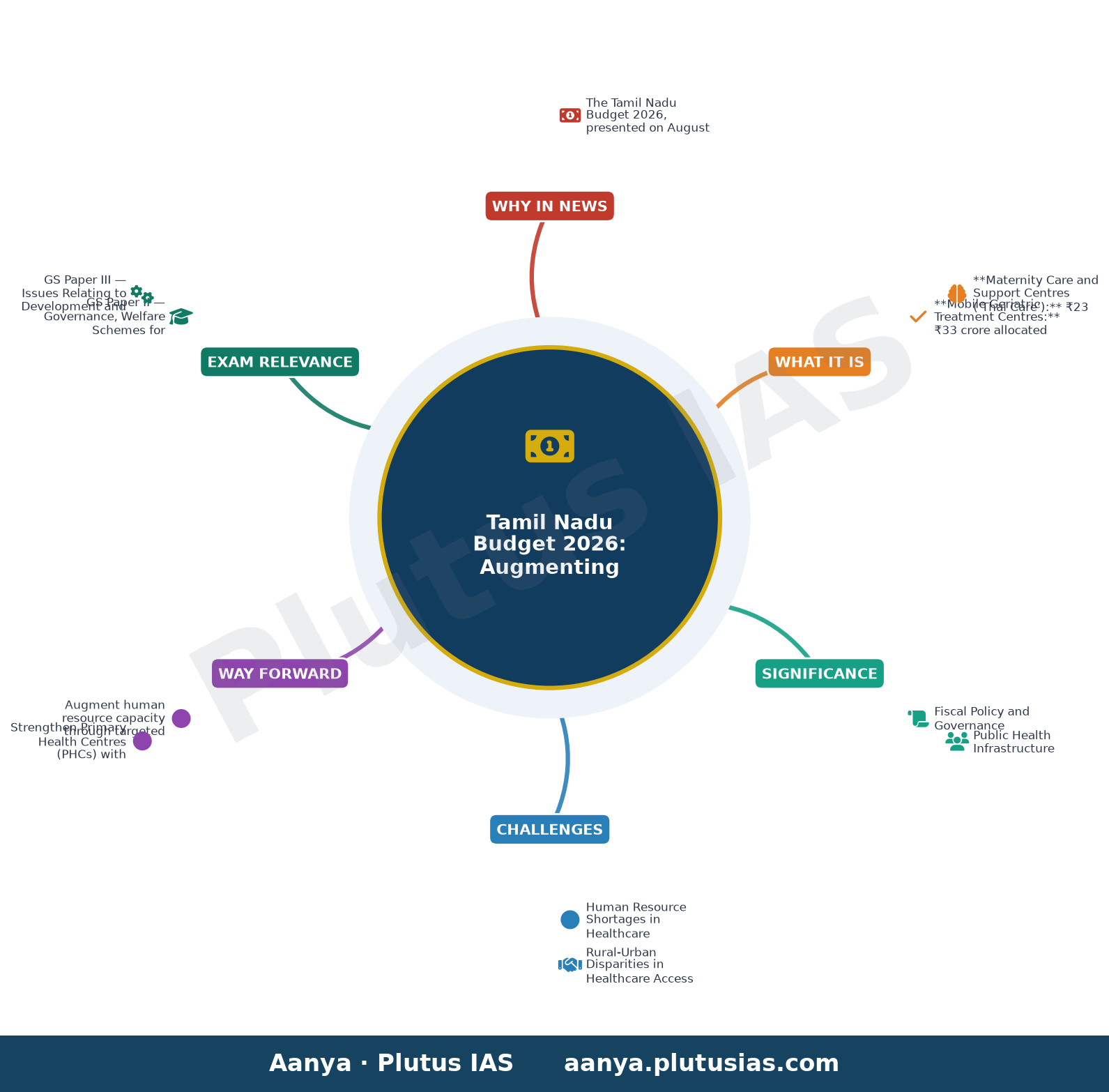
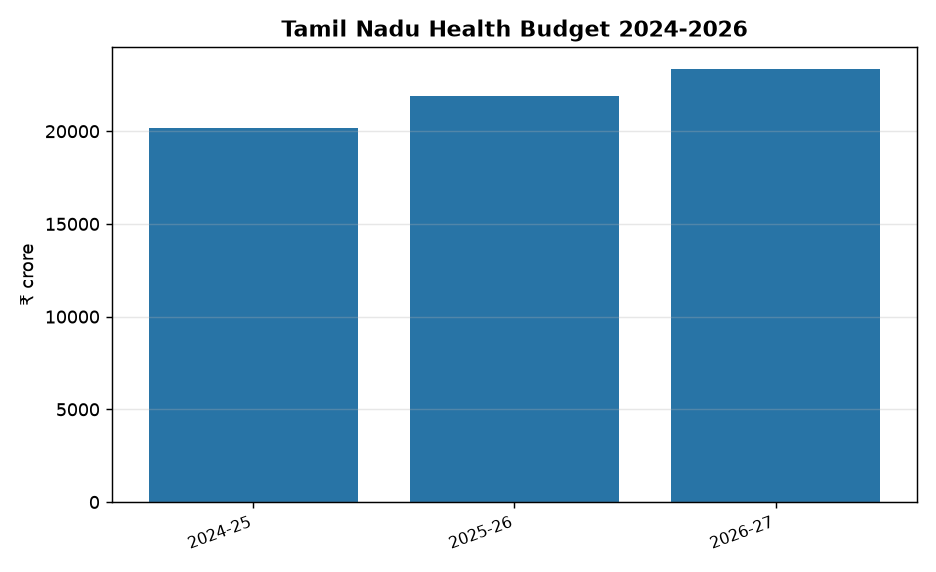
The Tamil Nadu Budget 2026, presented on August 5, 2026, has drawn attention for its continued emphasis on healthcare expenditure, with a 6.62% increase in allocation to ₹23,357 crore. The budget introduces targeted schemes such as mobile geriatric centres, maternity care support, and a hub-and-spoke model for cancer care, reflecting the state’s proactive approach to addressing demographic and epidemiological transitions. However, the absence of provisions to expand healthcare manpower underscores a critical gap in sustainable healthcare delivery.
Background
- Tamil Nadu has consistently prioritised healthcare in its annual budgets, with allocations rising from ₹20,197 crore in 2024-25 to ₹21,905 crore in 2025-26, marking an 8.45% increase in the preceding year.
- The state’s healthcare expenditure is aligned with its demographic profile, characterised by a growing elderly population and high maternal and child health indicators, necessitating specialised care infrastructure.
- Public health infrastructure in Tamil Nadu is a mix of government hospitals, primary health centres (PHCs), and sub-centres, with varying levels of accessibility and service quality across rural and urban areas.
- The hub-and-spoke model has been increasingly adopted in India to bridge the gap between tertiary care centres and peripheral health units, particularly in specialised domains like oncology and geriatrics.
- The ‘Thai Maaman Thanga Mothiram Thittam’ scheme, allocating ₹560 crore, reflects the state’s cultural and social welfare priorities, though its economic rationale remains debated.
- Healthcare manpower shortages, particularly of doctors and nurses, persist as a structural challenge in India, exacerbated by urban-rural maldistribution and inadequate training capacities.
Key Components of Tamil Nadu’s Healthcare Budget 2026
- **Mobile Geriatric Treatment Centres:** ₹33 crore allocated to establish 1,000 centres across villages, each staffed with a doctor, nurse, and physiotherapist to provide free health check-ups, medicines for chronic conditions, and preventive care for the elderly.
- **Maternity Care and Support Centres (‘Thai Care’):** ₹23 crore earmarked for centres where pregnant women can avail free meals, medical monitoring, and continuous care as their delivery date approaches, aiming to reduce maternal and neonatal mortality.
- **Telemedicine Expansion:** ₹18.5 crore allocated to strengthen a hub-and-spoke telemedicine network, enhancing access to specialist care in remote and rural areas through digital health platforms.
- **Newborn Welfare Scheme (‘Thai Maaman Thanga Mothiram Thittam’):** ₹560 crore allocated to provide a one-gram gold ring to every newborn delivered in government hospitals, combining social welfare with symbolic cultural recognition.
- **Fiscal Prudence vs. Welfare Trade-offs:** While allocations reflect commitment to healthcare, the absence of manpower augmentation schemes risks diluting the impact of infrastructure investments, highlighting the need for integrated human resource policies.
Key Features
| Feature | Significance |
|---|---|
| Increase in healthcare allocation to ₹23,357 crore | Demonstrates sustained political commitment to public health infrastructure and service delivery, reflecting Tamil Nadu’s progressive social sector expenditure. |
| Mobile Geriatric Treatment Centres (₹33 crore) | Addresses the demographic challenge of an aging population by providing decentralised, primary healthcare services to senior citizens in rural areas. |
| Thai Care Maternity Centres (₹23 crore) | Enhances maternal and neonatal health outcomes through institutionalised care, reducing home deliveries and associated risks. |
| Hub-and-Spoke Telemedicine Model (₹18.5 crore) | Bridges the urban-rural divide in healthcare access by leveraging digital infrastructure to connect remote Primary Health Centres with tertiary care specialists. |
| Zonal Cancer Care Hospitals (5 hubs) | Strengthens tertiary healthcare capacity in oncology, integrating treatment, research, and preventive measures within a structured referral system. |
| Uninterrupted Medicine Supply (₹100 crore increase) | Ensures continuity of essential drug availability, critical for chronic disease management and public health resilience. |
Why it Matters
Fiscal Policy and Governance
- Demonstrates Tamil Nadu’s fiscal federalism by prioritising social sector spending despite economic constraints, aligning with the 15th Finance Commission’s emphasis on state-level welfare augmentation.
- Shows a balanced approach to welfare and fiscal prudence, avoiding populism while maintaining growth in developmental expenditure.
- Highlights the role of state budgets in addressing demographic transitions, particularly the rise in elderly population and maternal health needs.
Public Health Infrastructure
- Reinforces the shift from curative to preventive healthcare through decentralised services like geriatric and maternity care centres.
- Leverages technology (telemedicine) to overcome geographical barriers, a model replicable for other states with similar rural-urban disparities.
- Integrates research and development in cancer care, positioning Tamil Nadu as a leader in tertiary healthcare innovation.
Social Equity and Inclusion
- Directly targets vulnerable groups: senior citizens, pregnant women, and rural populations, ensuring equitable healthcare access.
- The ‘Thai Maaman Thanga Mothiram Thittam’ (gold ring for newborns) symbolises cultural sensitivity in welfare delivery while promoting institutional deliveries.
Economic Impact
- Healthcare spending acts as a multiplier for local economies through job creation in allied sectors (nursing, paramedics, logistics).
- Reduces out-of-pocket expenditure for citizens, particularly in maternal and geriatric care, thereby improving household financial security.
Challenges
1. Human Resource Shortages in Healthcare
- Despite increased allocations, the Budget does not address the critical shortage of doctors, nurses, and paramedical staff, particularly in rural areas.
- The Tamil Nadu Nurses Empowerment Association’s criticism underscores the gap between infrastructure expansion and manpower availability.
- A 2022 NITI Aayog report highlights Tamil Nadu’s nurse-to-population ratio (1:500) as below the WHO-recommended 1:300.
UPSC Link: GS2: Health, GS3: Human Resource Development
2. Rural-Urban Disparities in Healthcare Access
- While telemedicine and mobile centres aim to bridge gaps, persistent infrastructure deficits in rural areas (power, internet) may limit their effectiveness.
- Primary Health Centres (PHCs) often lack basic diagnostic equipment, undermining the Hub-and-Spoke model’s potential.
UPSC Link: GS2: Governance, GS3: Rural Development
3. Sustainability of Welfare Schemes
- Schemes like the gold ring for newborns raise questions about long-term fiscal sustainability, especially if scaled up without measurable health outcomes.
- The absence of a clear exit strategy for such schemes risks creating dependency without addressing systemic healthcare gaps.
UPSC Link: GS2: Public Finance, GS3: Inclusive Growth
4. Integration of Preventive and Curative Care
- While infrastructure for cancer care and geriatrics is expanding, there is limited focus on primary prevention (e.g., vaccination, lifestyle interventions).
- Non-communicable diseases (NCDs) account for 60% of deaths in Tamil Nadu, yet the Budget lacks targeted preventive health programmes.
UPSC Link: GS2: Health Policy, GS3: NCDs
5. Data Systems and Monitoring
- The Budget does not outline mechanisms for real-time monitoring of scheme outcomes (e.g., maternal mortality reduction, geriatric health improvements).
- Weak data systems hinder evidence-based policymaking and inter-departmental coordination.
UPSC Link: GS2: Governance, GS3: E-Governance
Challenges — UPSC Perspective
| Issue | Concern |
|---|---|
| Nurse-to-population ratio | 1:500 vs WHO norm of 1:300; exacerbates rural healthcare gaps |
| Rural telemedicine adoption | Limited internet penetration and power supply in villages may render Hub-and-Spoke model ineffective |
| Welfare scheme sustainability | Gold ring scheme lacks health outcome metrics; potential fiscal burden without measurable impact |
| Primary Health Centre (PHC) deficits | Lack of diagnostic equipment undermines referral systems in the Hub-and-Spoke model |
| Preventive healthcare focus | NCDs dominate mortality; Budget lacks programmes for lifestyle interventions or early screening |
| Data-driven governance | No real-time monitoring systems for scheme performance; hinders accountability |
Government Initiatives — Must-Memorise for Prelims
- Thai Maaman Thanga Mothiram Thittam (Gold Ring Scheme for Newborns)
- Mobile Geriatric Treatment Centres
- Thai Care Maternity Centres
- Hub-and-Spoke Telemedicine Model
Way Forward
- Augment human resource capacity through targeted recruitment drives for doctors, nurses, and paramedical staff, with a focus on rural postings.
- Strengthen Primary Health Centres (PHCs) with essential diagnostics and telemedicine equipment to enhance the Hub-and-Spoke model’s efficacy.
- Integrate preventive healthcare programmes (e.g., NCD screening, vaccination drives) into the existing infrastructure to address Tamil Nadu’s rising NCD burden.
- Establish a state-level health data repository with real-time monitoring dashboards for scheme performance and outcome tracking.
- Develop a phased exit strategy for welfare schemes like the gold ring programme, linking benefits to measurable health outcomes (e.g., institutional delivery rates).
- Expand public-private partnerships (PPPs) for telemedicine and geriatric care to leverage private sector expertise and resources.
- Conduct a demographic health needs assessment to align future allocations with Tamil Nadu’s evolving healthcare priorities (e.g., mental health, paediatric care).
- Incorporate community health workers (ASHAs, ANMs) into the telemedicine and geriatric care networks to improve last-mile service delivery.
UPSC Value Addition
Keywords for Mains Answer-Writing
Tamil Nadu State Budget 2026 · Healthcare financing in India · Public health infrastructure · Geriatric healthcare · Maternity care schemes · Hub-and-Spoke model in healthcare · Cancer care policy · Telemedicine in rural India · State health allocations · Fiscal federalism in healthcare · Primary Health Centres (PHCs) · Universal Health Coverage (UHC) · Demographic dividend and healthcare · State-level policy implementation
Concept Flow
Demographic transition (aging population) → Increased demand for geriatric care → Budget allocation for Mobile Geriatric Centres → Decentralised service delivery → Improved rural health outcomes → High maternal mortality rates → Need for institutionalised care → Budget allocation for Thai Care Maternity Centres → Reduced home deliveries → Lower maternal and neonatal mortality → Urban-rural healthcare divide → Telemedicine adoption → Hub-and-Spoke model → Specialist care access in remote areas → Reduced out-of-pocket expenditure → Rising cancer burden → Need for tertiary care infrastructure → Zonal Cancer Care Hospitals → Integrated treatment and research → Improved survival rates → Fiscal federalism → State budget priorities → Increased healthcare allocation → Social sector expenditure growth → Alignment with 15th Finance Commission recommendations
Prelims Practice Questions
Q1. Consider the following statements about the Tamil Nadu Budget 2026-27:
1. The healthcare allocation increased by 8.45% from 2024-25 to 2025-26.
2. The Budget allocated ₹560 crore for the “Thai Maaman Thanga Mothiram Thittam” scheme.
3. The “Hub-and-Spoke” model for cancer care will link 5 hubs to 200 spokes initially.
How many of the above statements are correct?
- Only one
- Only two
- Only three
- None
Answer: Only three — Statements 1 and 3 are correct. Statement 2 is incorrect as ₹560 crore was allocated for the “Thai Maaman Thanga Mothiram Thittam” scheme, but this scheme pertains to newborns receiving gold rings, not healthcare allocation increases.
Q2. Assertion (A): The Tamil Nadu Budget 2026-27 increased healthcare spending by 6.62% compared to the previous year.
Reason (R): The Budget allocated ₹23,357 crore for healthcare, continuing a steady rise in public health allocations over the past few years.
- Both A and R are true, and R is the correct explanation of A
- Both A and R are true, but R is NOT the correct explanation of A
- A is true, but R is false
- A is false, but R is true
Answer: Both A and R are true, but R is NOT the correct explanation of A — Both the Assertion (A) and Reason (R) are true. The increase in healthcare spending by 6.62% is directly reflected in the allocation of ₹23,357 crore for the current year, which is higher than the previous year’s allocation of ₹21,905 crore.
Q3. Match the following healthcare initiatives announced in the Tamil Nadu Budget 2026-27 with their respective allocations:
Initiative | Allocation (₹ crore)
— | —
1. Mobile Geriatric Treatment Centres | A. ₹23 crore
2. Thai Care Maternity Centres | B. ₹33 crore
3. Hub-and-Spoke Telemedicine System | C. ₹18.5 crore
4. Cancer Care Hub-and-Spoke Model | D. ₹23,357 crore (total healthcare allocation)
- 1-B, 2-A, 3-C, 4-D; 1-B, 2-A, 3-D, 4-C; 1-A, 2-B, 3-C, 4-D; 1-B, 2-C, 3-A, 4-D
- answer_index_list_for_json_output_here
- explain_match_pairs_in_explain_field
- format
Answer: 1-B, 2-A, 3-C, 4-D; 1-B, 2-A, 3-D, 4-C; 1-A, 2-B, 3-C, 4-D; 1-B, 2-C, 3-A, 4-D —
Mains Practice Question
✍ The Tamil Nadu State Budget 2026-27 reflects a continued emphasis on strengthening public healthcare infrastructure through targeted schemes and fiscal allocations. Critically examine the significance of these initiatives in the context of India’s broader goals of Universal Health Coverage (UHC) and demographic dividend. Also, analyse the limitations of these measures in addressing systemic gaps such as healthcare manpower shortages. (15 Marks)
Approach: MODEL-ANSWER SKELETON:
1. **Introduction (2 marks)**
– Define Universal Health Coverage (UHC) as per WHO: ensuring all individuals receive quality health services without financial hardship.
– Highlight Tamil Nadu’s demographic dividend: 68% of population below 35 years (Census 2011), necessitating robust healthcare systems.
– State the Budget’s healthcare allocation: ₹23,357 crore (6.62% increase from previous year) and key schemes (Mobile Geriatric Centres, Thai Care Maternity Centres, Hub-and-Spoke models for telemedicine and cancer care).
2. **Significance of Initiatives (5 marks)**
– **Geriatric Healthcare (Mobile Geriatric Treatment Centres):**
– Addresses the needs of an aging population (projected 19% elderly by 2030 in Tamil Nadu).
– Ensures preventive and curative care through mobile teams (doctor, nurse, physiotherapist) in rural panchayats.
– Aligns with National Programme for Health Care of the Elderly (NPHCE).
– **Maternity Care (Thai Care Centres):**
– Reduces maternal mortality by providing free meals, medical support, and continuous monitoring.
– Complements Ayushman Bharat’s Pradhan Mantri Matru Vandana Yojana (PMMVY).
– **Hub-and-Spoke Models:**
– Telemedicine: Links 5 hubs to 200 spokes (PHCs) initially, scaling to 1,000 over 5 years. Reduces urban-rural healthcare disparities.
– Cancer Care: 5 zonal cancer hospitals as primary nodes for treatment and R&D. Aligns with National Cancer Grid (NCG) objectives.
– **Fiscal Federalism:**
– Demonstrates state-level innovation in healthcare financing, complementing central schemes like Ayushman Bharat.
3. **Limitations and Gaps (5 marks)**
– **Manpower Shortages:**
– Tamil Nadu Nurses Empowerment Association raised concerns over lack of provisions to increase healthcare workforce.
– India faces a shortage of 600,000 doctors and 2 million nurses (Lancet, 2023).
– Schemes like mobile geriatric centres require trained staff, which may not be scalable without systemic reforms.
– **Sustainability:**
– Gold ring scheme (₹560 crore) is symbolic but does not address core healthcare delivery gaps.
– Allocation increases (6.62%) may not match inflation or rising healthcare costs.
– **Implementation Challenges:**
– Hub-and-Spoke models require robust digital infrastructure and training, which may be uneven across rural areas.
4. **Conclusion (3 marks)**
– Tamil Nadu’s Budget initiatives are progressive but require complementarity with central schemes and systemic reforms.
– Emphasise the need for integrated policies addressing manpower, infrastructure, and financing to achieve UHC.
– Cite examples of successful state-level healthcare models (e.g., Kerala’s decentralized health planning) for comparative insights.
Source: The Hindu
Generated by AanyaAi for educational purpose.

- KWML’s Feasibility Reports for Water Metro in 18 Cities: UPSC & PCS Insights - October 3, 2026
- ओडिशा में वन्यजीव अनुसंधान अनुदान कार्यक्रम शुरू, सिमिलिपाल में 300 कैमरे और बढ़ेंगे - October 3, 2026
- India Summons Pakistan High Commission Official Over Violation - October 3, 2026

No Comments