


24 Nov Transgender Rights & Healthcare: UPSC & State PCS Analysis
✎ The Transgender Persons (Protection of Rights) Amendment Act, 2026, shifts the legal recognition of gender identity from self-identification to a process requiring medical board recommendation and District Magistrate…
Subject Relevance — Where This Topic Fits
- GS Paper II — Social Justice: Welfare schemes for vulnerable sections of the population by the Centre and States and the performance of these schemes; mechanisms, laws, institutions and Bodies constituted for the protection and betterment of these vulnerable sections. | GS Paper II — Governance: Government policies and interventions for development in various sectors and issues arising out of their design and implementation.
- Prelims: Transgender Persons (Protection of Rights) Act, 2019, Transgender Persons (Protection of Rights) Amendment Act, 2026, Self-identification principle, Medical board assessment, District Magistrate certification, World Health Organization (WHO) ICD-11, World Professional Association for Transgender Health (WPATH) Standards of Care, National Legal Services Authority (NALSA) v. Union of India judgement
- Essay: The evolving landscape of human rights in India: Balancing individual autonomy with state regulation., Healthcare access and equity for marginalized communities: Challenges and way forward.
Quick Revision: The Transgender Persons (Protection of Rights) Amendment Act, 2026, shifts the legal recognition of gender identity from self-identification to a process requiring medical board recommendation and District Magistrate certification, raising concerns about autonomy and healthcare access for transgender individuals.
Why is this in the news?
The Transgender Persons (Protection of Rights) Amendment Act, 2026, recently enacted, has drawn attention due to its significant alterations to the legal framework governing transgender rights in India. Specifically, the amendment’s shift from a principle of self-identification to a system requiring medical board recommendations and District Magistrate certification for legal recognition of gender identity has prompted discussions regarding its implications for transgender individuals’ autonomy and access to appropriate healthcare.
Background
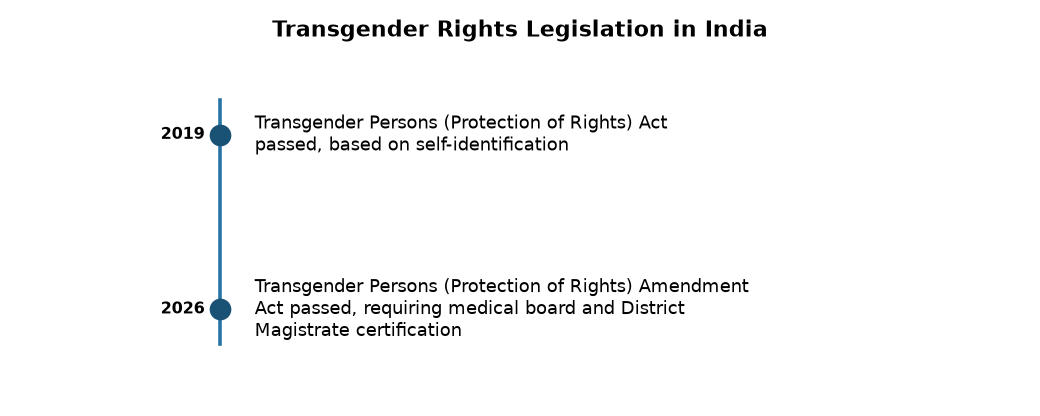
- The Transgender Persons (Protection of Rights) Act, 2019, was initially enacted to provide for the protection of rights of transgender persons and their welfare.
- A key feature of the 2019 Act was the recognition of gender identity based on self-identification, aligning with international best practices and the Supreme Court’s NALSA judgement.
- The National Legal Services Authority (NALSA) v. Union of India judgement (2014) affirmed the right to self-identification of gender as integral to dignity and personal liberty under Article 21 of the Constitution.
- International guidelines, such as the World Health Organization’s ICD-11 and the World Professional Association for Transgender Health Standards of Care, emphasize self-determination in gender recognition.
- Prior to the 2019 Act, transgender persons faced significant legal and social challenges in obtaining formal recognition of their gender identity, leading to discrimination in various spheres.
- The recent 2026 amendment introduces new provisions that alter the process of legal gender recognition, moving towards a more medically and administratively mediated approach.
Key Provisions and Implications of the Transgender Persons (Protection of Rights) Amendment Act, 2026
- The Amendment Act, 2026, fundamentally alters the process of legal recognition for transgender persons from self-identification to a system requiring external validation.
- Under the new provisions, legal recognition of gender identity necessitates a recommendation from a medical board.
- Following the medical board’s recommendation, individuals must select from prescribed categories for gender identity.
- Final certification of gender identity is contingent upon approval by a District Magistrate.
- This revised framework represents a departure from the philosophical foundation of transgender rights, which previously emphasized individual autonomy and self-determination.
- Critics argue that the definition of ‘transgender’ introduced in the Amendment Act may contradict established international evidence and guidelines from bodies like the WHO and WPATH.
- Concerns have been raised regarding the potential impact on access to healthcare, as a rudimentary clinical understanding of transgender care needs persists in India, necessitating extensive training for medical and administrative staff.
- The shift from self-identification to medical and administrative mediation raises questions about the alignment of national legislation with international human rights standards and the NALSA judgement.
Key Features
| Feature | Significance |
|---|---|
| Shift from Self-Identification | The Transgender Persons (Protection of Rights) Amendment Act, 2026, mandates a medical board’s recommendation, prescribed categories, and District Magistrate certification for legal recognition, departing from the 2019 Act’s principle of self-identification. |
| Medical and Administrative Mediation | The philosophical foundation of transgender rights recognition has transitioned from individual autonomy to a process mediated by medical and administrative authorities. |
| Increased Protection | Despite the change in recognition methodology, the 2026 Amendment Act is acknowledged to enhance the overall protective framework for transgender individuals. |
| Definition of ‘Transgender’ | The definition introduced by the Amendment Act is noted to be inconsistent with established international evidence and guidelines, including those from the World Health Organization (ICD-11) and the World Professional Association for Transgender Health (WPATH Standards of Care Version 8). |
| Healthcare Training Imperative | There is a critical need for comprehensive training of medical and administrative staff in healthcare settings regarding basic transgender health and care needs, as current understanding is rudimentary. |
Why it Matters
Social Significance
- The legislative amendments reflect evolving societal approaches to gender identity and rights, impacting the lived experiences and legal standing of transgender individuals.
- The debate surrounding self-identification versus medical certification highlights ongoing discussions about autonomy, dignity, and the role of state in personal identity.
Healthcare Significance
- The rudimentary understanding of transgender healthcare needs necessitates systemic improvements in medical education and service delivery to ensure equitable access and quality of care.
- Alignment with international health guidelines is crucial for ensuring that healthcare practices for transgender persons are evidence-based and uphold global best practices.
Legal and Governance Significance
- The amendment signifies a shift in the legal framework governing transgender rights, impacting the implementation of protective measures and access to legal recognition.
- The role of district magistrates and medical boards in identity certification introduces new administrative layers and potential procedural complexities for transgender individuals seeking legal recognition.
Challenges
1. Compromise on Autonomy
- The shift from self-identification to a medically and administratively mediated process for legal recognition may infringe upon the fundamental right to self-determination and personal autonomy of transgender individuals.
- Requiring external validation for identity can be a dehumanizing experience, potentially leading to psychological distress and marginalization.
UPSC Link: Social Justice; Fundamental Rights
2. Healthcare Access and Quality
- The lack of clinical understanding and trained personnel in transgender health can lead to inadequate healthcare services, discrimination, and barriers to accessing essential medical care.
- The absence of standardized, sensitive, and affirmative healthcare protocols can exacerbate health disparities and compromise the well-being of transgender persons.
UPSC Link: Social Justice; Health Policy
3. Inconsistency with International Standards
- The definition of ‘transgender’ in the Amendment Act diverging from international guidelines (e.g., WHO ICD-11, WPATH Standards of Care) could lead to a lack of alignment in policy and practice, potentially isolating India from global best practices in transgender rights and healthcare.
- This divergence may also affect international recognition of Indian legal identities for transgender persons.
UPSC Link: International Relations; Social Justice
4. Administrative Hurdles and Bureaucracy
- The requirement for medical board recommendations and District Magistrate certification introduces multiple administrative layers, which can be cumbersome, time-consuming, and potentially discriminatory.
- This bureaucratic process may create significant barriers for transgender individuals seeking legal identity documents, affecting their access to education, employment, and other social benefits.
UPSC Link: Governance; Social Justice
Challenges — UPSC Perspective
| Issue | Concern |
|---|---|
| Legal Recognition Process | Shift from self-identification to medical and administrative mediation for identity certification. |
| Definition of ‘Transgender’ | Inconsistency with established international evidence and guidelines (e.g., WHO ICD-11, WPATH). |
| Healthcare Infrastructure | Rudimentary clinical understanding and lack of trained personnel in transgender health. |
| Access to Services | Potential for discrimination and barriers in accessing healthcare, education, and employment due to complex recognition processes. |
| Autonomy and Dignity | Compromise on the right to self-determination and personal autonomy for transgender individuals. |
Way Forward
- Review and align the definition of ‘transgender’ in national legislation with international best practices and guidelines, such as those from WHO and WPATH, to ensure comprehensive and rights-affirming recognition.
- Prioritize the development and implementation of comprehensive training modules for healthcare professionals, including doctors, nurses, and administrative staff, on transgender health, gender-affirming care, and sensitive patient interaction.
- Simplify and streamline the legal recognition process for transgender persons, ensuring that it upholds the principle of self-identification while providing necessary safeguards, reducing bureaucratic hurdles.
- Establish specialized healthcare facilities and clinics dedicated to transgender health, offering a range of services from mental health support to gender-affirming medical interventions.
- Launch public awareness campaigns to foster greater understanding and acceptance of transgender individuals, combating stigma and discrimination within society and healthcare settings.
- Ensure robust grievance redressal mechanisms are in place for transgender persons facing discrimination or denial of rights and services, with clear accountability frameworks.
- Facilitate research and data collection on the health and social needs of transgender communities to inform evidence-based policy making and resource allocation.
UPSC Value Addition
Keywords for Mains Answer-Writing
Transgender Persons (Protection of Rights) Act 2019 · Transgender Persons (Protection of Rights) Amendment Act 2026 · Self-identification principle · Medical board assessment · District Magistrate certification · Gender identity · Healthcare access for transgender persons · World Health Organization (WHO) ICD-11 · World Professional Association for Transgender Health (WPATH) Standards of Care · Constitutional rights of transgender persons · Nalsa v. Union of India 2014 · Social justice and inclusion
Constitutional & Policy Linkages
- {‘article’: ‘Article 14’, ‘note’: ‘Equality before law’}
- {‘article’: ‘Article 15’, ‘note’: ‘Prohibition of discrimination’}
- {‘article’: ‘Article 21’, ‘note’: ‘Protection of life and personal liberty’}
Concept Flow
Transgender Persons (Protection of Rights) Amendment Act, 2026 enacted. → Shift from self-identification to medical/administrative mediation for recognition. → Concerns raised regarding autonomy and international guideline divergence. → Healthcare system identified as having rudimentary understanding of transgender needs. → Call for comprehensive training and policy alignment for rights and healthcare.
Prelims Practice Questions
Q1. Consider the following statements regarding the legal framework for transgender persons in India:
1. The Transgender Persons (Protection of Rights) Act, 2019, primarily recognized gender identity based on self-identification.
2. The Transgender Persons (Protection of Rights) Amendment Act, 2026, mandates a medical board’s recommendation and District Magistrate certification for legal recognition of gender identity.
3. International guidelines, such as WHO ICD-11, align with the self-identification principle for gender recognition.
- Only one
- Only two
- Only three
- None
Answer: Only three — Statement 1 is correct: The 2019 Act was based substantially on the principle of self-identification. Statement 2 is correct: The 2026 Amendment Act shifted towards a system requiring medical assessment and administrative certification. Statement 3 is correct: International guidelines, including WHO ICD-11 and WPATH Standards of Care, generally support self-identification.
Q2. Which of the following is a key feature introduced by the Transgender Persons (Protection of Rights) Amendment Act, 2026, concerning the legal recognition of transgender persons?
- Exclusive reliance on self-declaration for gender identity.
- Mandatory medical board recommendation and District Magistrate certification.
- Automatic legal recognition upon submission of an affidavit.
- Prohibition of discrimination in employment only.
Answer: Mandatory medical board recommendation and District Magistrate certification. — The Transgender Persons (Protection of Rights) Amendment Act, 2026, fundamentally changed the process of legal recognition from self-identification to one mediated by medical and administrative authorities, requiring a medical board’s recommendation and District Magistrate certification.
Mains Practice Question
✍ Critically examine the shift in the philosophical foundation of transgender rights in India, from self-identification to medical and administrative mediation, as introduced by the Transgender Persons (Protection of Rights) Amendment Act, 2026. Discuss its potential implications for the healthcare access and overall well-being of transgender persons. (15 Marks)
Approach: MODEL-ANSWER SKELETON:
1. Introduction: Briefly introduce the Transgender Persons (Protection of Rights) Act, 2019, and the subsequent Amendment Act, 2026, highlighting the core change in the principle of gender recognition.
2. Philosophical Shift: Detail the shift from the self-identification principle (as per the 2019 Act and Nalsa v. Union of India, 2014 judgment) to the medical board recommendation and District Magistrate certification model introduced by the 2026 Amendment.
3. Rationale for Self-Identification: Explain the importance of self-identification in affirming gender identity, aligning with international best practices (e.g., WHO ICD-11, WPATH Standards of Care) and principles of bodily autonomy and dignity.
4. Potential Implications for Healthcare Access: Discuss how the new requirement for medical assessment and administrative certification might create barriers to accessing healthcare services, including gender-affirming care. Address issues like lack of trained medical professionals, stigma, privacy concerns, and potential delays.
5. Implications for Overall Well-being: Analyze broader impacts on the social inclusion, mental health, and legal recognition of transgender persons, potentially leading to increased discrimination and marginalization.
6. Balancing Protection and Autonomy: Discuss the need for a balanced approach that ensures protection against discrimination while upholding the fundamental right to self-determination and bodily integrity.
7. Conclusion: Summarize the critical concerns regarding the 2026 Amendment’s approach and suggest the importance of a rights-based, inclusive framework for transgender persons.
Source: The Hindu
Generated by AanyaAi for educational purpose.
Related guides on our sites
- Best sociology optional coaching for upsc
- Which is best sociology optional coaching for upsc
- Best teacher of sociology optional for upsc
- How to prepare for GS paper 1 for UPSC CSE mains exam

- Transgender Rights & Healthcare: UPSC & State PCS Analysis - November 24, 2026
- वायु प्रदूषण: कोविड-19 से सीखे सबक और राष्ट्रीय प्रतिक्रिया की आवश्यकता - November 24, 2026
- India’s COP31 Stance: Development vs. Climate Action - November 24, 2026

No Comments