


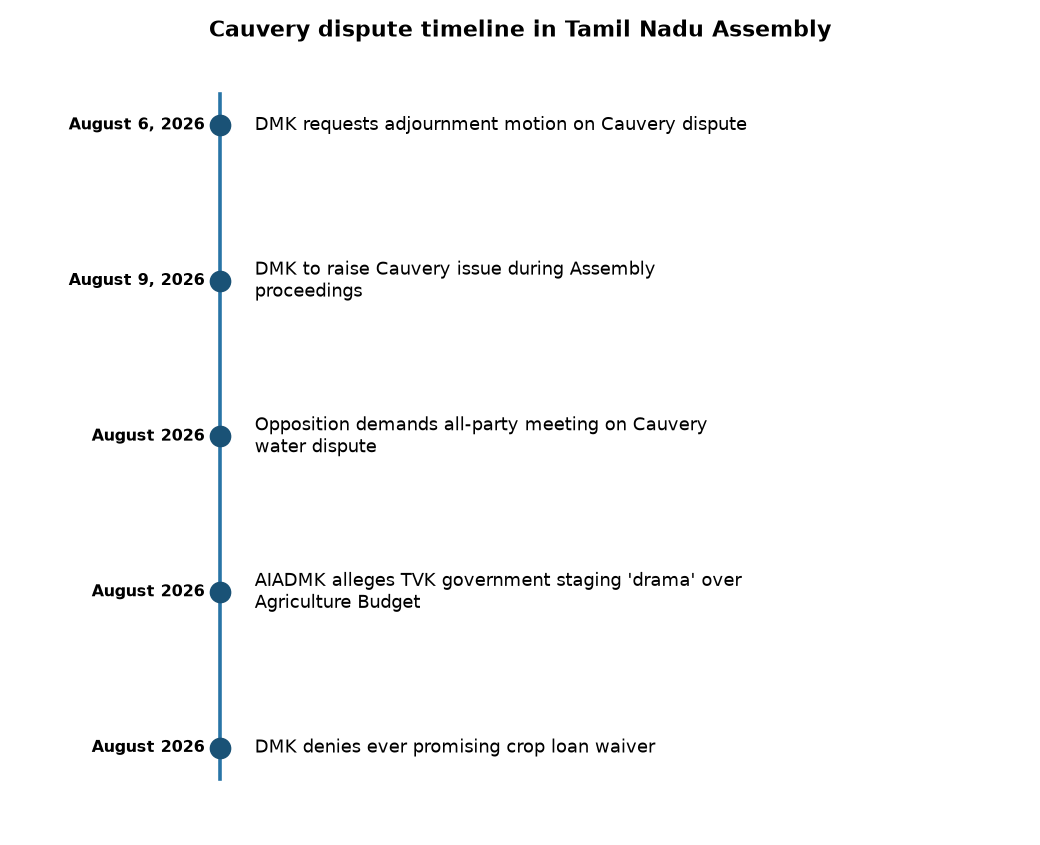
09 Aug DMK demands Cauvery discussion in TN Assembly amid Agriculture Budget debate
✎ The Cauvery dispute is governed by the Inter-State Water Disputes Act, 1956, with the Supreme Court’s 2018 judgment modifying the CWDT award, reducing Tamil Nadu’s share by 14.75 tmc ft, a decision Tamil Nadu continues to contest.
Subject Relevance — Where This Topic Fits
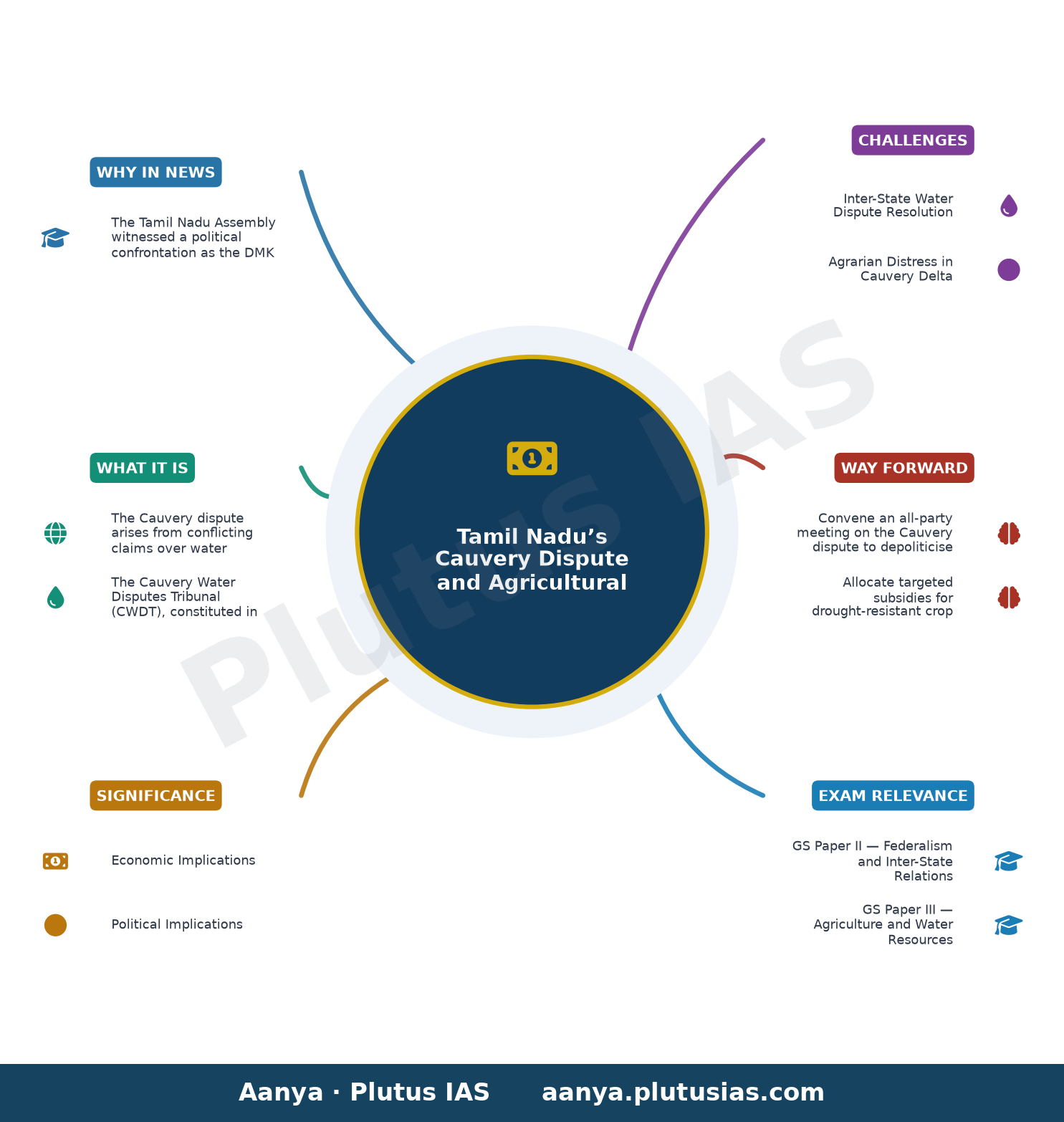
- GS Paper II — Federalism and Inter-State Relations | GS Paper III — Agriculture and Water Resources | GS Paper III — Government Budgeting and Economic Policy
- Prelims: Cauvery Water Disputes Tribunal (CWDT), Inter-State Water Disputes Act, 1956, Tamil Nadu Agriculture Budget 2026-27, Super El Niño impacts on agriculture, Organic farming promotion schemes, Inter-State River Water Disputes (Amendment) Act, 2019
- Essay: Federalism in India: Challenges and Solutions, Agrarian Crisis in India: Causes and Remedies
Quick Revision: The Cauvery dispute is governed by the Inter-State Water Disputes Act, 1956, with the Supreme Court’s 2018 judgment modifying the CWDT award, reducing Tamil Nadu’s share by 14.75 tmc ft, a decision Tamil Nadu continues to contest.
Why is this in the news?
The Tamil Nadu Assembly witnessed a political confrontation as the DMK sought an adjournment motion to discuss the Cauvery water dispute, criticising the TVK government’s Agriculture Budget for failing to address farmer distress in the Cauvery Delta. The Opposition alleged that the budget lacked substantive relief measures, while the ruling party defended its policy initiatives. This episode underscores the intersection of federal water-sharing disputes, agricultural policy, and electoral politics in Tamil Nadu, making it a critical case study for UPSC aspirants on federalism, inter-state relations, and rural governance.
Background
- The Cauvery water dispute is a long-standing inter-state conflict between Karnataka and Tamil Nadu over the equitable sharing of Cauvery river waters, governed by the Cauvery Water Disputes Tribunal (CWDT) award of 2007, which was subsequently modified by the Supreme Court in 2018.
- The Inter-State Water Disputes Act, 1956, provides the legal framework for resolving disputes between states over river water sharing, while the Inter-State River Water Disputes (Amendment) Act, 2019, introduced a permanent tribunal and a dispute resolution mechanism to expedite settlements.
- Tamil Nadu, a predominantly agrarian state, relies heavily on Cauvery waters for irrigation in the delta districts, making the dispute a critical issue for farmers and political parties alike.
- The DMK, as the Opposition, has historically championed the Cauvery cause, while the ruling TVK has been accused of downplaying the issue despite its constitutional obligations to address farmer distress.
What is the Cauvery Water Dispute and its Implications for Tamil Nadu?
- The Cauvery dispute arises from conflicting claims over water sharing between Karnataka and Tamil Nadu, with Karnataka arguing for greater utilisation rights due to upstream geography and Tamil Nadu asserting historical usage rights for delta irrigation.
- The Cauvery Water Disputes Tribunal (CWDT), constituted in 1990, delivered its final award in 2007, allocating 419 tmc ft of water annually to Tamil Nadu, 270 tmc ft to Karnataka, 30 tmc ft to Kerala, and 7 tmc ft to Puducherry, with 10 tmc ft reserved for environmental purposes.
- The Supreme Court, in its 2018 judgment, upheld the CWDT award but reduced Tamil Nadu’s share by 14.75 tmc ft, citing the need for equitable distribution and environmental considerations, a decision that Tamil Nadu opposed.
- The dispute is governed by the Inter-State Water Disputes Act, 1956, which empowers the Union Government to constitute tribunals and enforce awards, though compliance remains a challenge due to political and administrative complexities.
- Tamil Nadu’s agricultural economy, particularly in the Cauvery Delta districts (Thanjavur, Tiruchi, Nagapattinam, etc.), is heavily dependent on Cauvery waters, with paddy being the dominant crop, making water scarcity a direct threat to livelihoods.
- The dispute has political ramifications, with parties like the DMK and AIADMK often using it as a tool to mobilise support, while the Union Government’s role in enforcing tribunal awards or mediating disputes remains a point of contention.
- The Inter-State River Water Disputes (Amendment) Act, 2019, introduced a permanent tribunal and a two-tier dispute resolution mechanism, but its effectiveness in resolving long-standing disputes like Cauvery remains untested.
- Recent climate variability, including Super El Niño events, has exacerbated water scarcity, further straining inter-state relations and highlighting the need for integrated water resource management.
Key Features
| Feature | Significance |
|---|---|
| Adjournment Motion on Cauvery Dispute | A parliamentary procedure to suspend normal business to discuss urgent matters of public importance, here used by DMK to highlight the Cauvery water-sharing issue in the Tamil Nadu Assembly. |
| Agriculture Budget Critique by Opposition | Opposition parties, particularly DMK, have condemned the TVK government’s Agriculture Budget for failing to address drought and water scarcity challenges in the Cauvery Delta region. |
| Farmers’ Distress in Cauvery Delta | The budget’s perceived inadequacy exacerbates agrarian distress, particularly in districts dependent on Cauvery waters, where drought and erratic rainfall compound livelihood risks. |
| Political Posturing on Water Governance | The DMK’s adjournment motion reflects inter-party rivalry over water governance, with accusations of political theatrics by the ruling TVK government. |
| Super El Niño Contingency Plans | The TVK government claims contingency measures are in place for districts, indicating proactive disaster preparedness amid climate variability. |
Why it Matters
Economic Implications
- Agricultural output in Tamil Nadu’s Cauvery Delta is critical to the state’s GDP, with rice production alone contributing significantly to food security and rural employment.
- Failure to address water scarcity risks long-term economic losses, including reduced farm incomes, migration, and food inflation.
- The budget’s perceived inadequacies may erode public trust in fiscal policy, particularly in regions facing acute water stress.
- Inter-state water disputes, if unresolved, can escalate into trade and investment disruptions, affecting industrial and agricultural sectors.
Political Implications
- The adjournment motion underscores the DMK’s strategy to corner the ruling TVK on a politically sensitive issue, leveraging farmer distress for electoral gains.
- The ruling party’s response (or lack thereof) to Opposition demands may shape public perception of governance efficacy in crisis management.
- Water disputes often transcend state boundaries, making them a tool for opposition parties to mobilise regional identities and grievances.
- The debate reflects broader tensions between state autonomy in water governance and centralised dispute resolution mechanisms.
Environmental and Agricultural Sustainability
- The Cauvery Delta’s ecological balance is threatened by over-extraction, salinity intrusion, and erratic monsoons, necessitating sustainable water management practices.
- Organic farming initiatives, such as the proposed diploma college named after Nammalvar, highlight the need for agro-ecological solutions to mitigate climate impacts.
- Wild boar damage, addressed in the budget, is symptomatic of ecological imbalances requiring integrated pest and habitat management strategies.
- Climate projections, including Super El Niño impacts, demand adaptive agricultural policies to safeguard food production systems.
Challenges
1. Inter-State Water Dispute Resolution
- The Cauvery dispute remains unresolved despite multiple tribunals and Supreme Court directives, highlighting systemic delays in dispute resolution.
- Political posturing often overshadows technical solutions, delaying consensus on equitable water-sharing formulas.
- Climate change exacerbates water scarcity, complicating negotiations between riparian states.
- Lack of a permanent inter-state water governance mechanism perpetuates ad-hoc crisis management.
UPSC Link: GS II: Water disputes between states
2. Agrarian Distress in Cauvery Delta
- Droughts and erratic rainfall reduce agricultural productivity, threatening livelihoods of small and marginal farmers.
- Groundwater depletion and salinity intrusion degrade soil health, reducing crop yields and increasing input costs.
- Farmers face debt traps due to failed monsoons and inadequate support systems, exacerbating rural distress.
- Market fluctuations and input price volatility compound the challenges of water-stressed agriculture.
UPSC Link: GS III: Agricultural distress and farmer suicides
3. Fiscal Policy Gaps in Agriculture
- The Agriculture Budget’s perceived inadequacies reflect a disconnect between policy intent and ground realities in water-scarce regions.
- Lack of targeted subsidies for drought-resistant crops and water-efficient technologies limits adaptive capacity.
- Insufficient investment in irrigation infrastructure and watershed management undermines long-term agricultural resilience.
- Political rhetoric often substitutes for evidence-based policy, delaying structural reforms.
UPSC Link: GS III: Agricultural subsidies and MSP
4. Ecological Degradation and Climate Vulnerability
- Over-extraction of groundwater and deforestation in catchment areas reduce water retention capacity, worsening droughts.
- Super El Niño events intensify weather extremes, increasing the frequency of floods and droughts in the Cauvery basin.
- Biodiversity loss, including wild boar proliferation, disrupts agro-ecosystems, requiring integrated management strategies.
- Climate-smart agriculture (CSA) adoption remains limited due to high costs and lack of awareness among farmers.
UPSC Link: GS III: Climate change and agriculture
5. Political Polarisation on Water Governance
- Opposition parties use water disputes to mobilise regional sentiments, complicating consensus-building on sustainable solutions.
- Ruling parties often prioritise short-term political gains over long-term water security, delaying critical reforms.
- Media narratives amplify political divisions, shaping public opinion without fostering constructive dialogue.
- Lack of bipartisan cooperation undermines the effectiveness of state-level water management institutions.
UPSC Link: GS II: Centre-State relations
Challenges — UPSC Perspective
| Issue | Concern |
|---|---|
| Cauvery Water Dispute | Persistent inter-state conflict over water-sharing, exacerbated by climate change and political posturing. |
| Drought and Water Scarcity | Agricultural productivity in the Cauvery Delta is critically dependent on water availability, which is declining due to over-extraction and erratic rainfall. |
| Agriculture Budget Inadequacies | Perceived lack of targeted interventions for drought-prone regions, including insufficient subsidies for water-efficient technologies. |
| Ecological Degradation | Salinity intrusion, groundwater depletion, and biodiversity loss threaten the long-term sustainability of the Cauvery Delta’s agro-ecosystems. |
| Climate Variability | Super El Niño events and other climate anomalies intensify weather extremes, increasing the vulnerability of agricultural systems. |
| Political Polarisation | Opposition parties leverage water disputes for electoral gains, complicating consensus-building on sustainable water governance. |
Way Forward
- Convene an all-party meeting on the Cauvery dispute to depoliticise the issue and explore technical solutions for equitable water-sharing.
- Allocate targeted subsidies for drought-resistant crop varieties and water-efficient irrigation techniques in the Cauvery Delta.
- Invest in watershed management, afforestation, and groundwater recharge projects to enhance water retention and reduce salinity intrusion.
- Strengthen the State Water Resources Department with technical expertise to monitor and manage water resources sustainably.
- Promote climate-smart agriculture (CSA) through farmer training programs, including organic farming initiatives like the proposed Nammalvar diploma college.
- Enhance inter-state coordination mechanisms, such as the Cauvery Management Board, to ensure adherence to Supreme Court directives and climate-resilient water governance.
- Establish a dedicated fund for contingency planning to address Super El Niño impacts and other climate anomalies in vulnerable districts.
- Encourage public-private partnerships (PPPs) for agro-ecological initiatives, including pest management (e.g., wild boar control) and sustainable input supply chains.
UPSC Value Addition
Keywords for Mains Answer-Writing
Cauvery water dispute · Inter-State River Water Disputes Act, 1956 · Tamil Nadu Assembly · adjournment motion · Agriculture Budget · Tamilaga Vettri Kazhagam (TVK) · Dravida Munnetra Kazhagam (DMK) · Chief Minister of Tamil Nadu · farmers’ distress · organic farming · water-sharing agreements · inter-state federalism · Parliamentary procedures · State Legislative Assembly · Constitutional provisions on water · drought mitigation · wildlife-human conflict · El Niño impact on agriculture
Concept Flow
Political posturing and media narratives → Opposition’s adjournment motion on Cauvery dispute → Critique of Agriculture Budget for inadequacies → Farmer distress in Cauvery Delta → Inter-state water dispute escalates → Climate variability (Super El Niño) intensifies challenges → Need for sustainable water governance and agro-ecological solutions → Policy reforms and inter-state cooperation required → Long-term agricultural resilience and food security at stake.
Prelims Practice Questions
Q1. Consider the following statements regarding the Cauvery water dispute:
1. The Cauvery dispute is governed by the Inter-State River Water Disputes Act, 1956.
2. The Cauvery Water Disputes Tribunal was constituted under the provisions of the Act.
3. The Tribunal’s award has been upheld by the Supreme Court of India.
4. The dispute is solely between Tamil Nadu and Karnataka, with no role for Kerala or Puducherry.
How many of the above statements are correct?
- Only one
- Only two
- Only three
- All four
Answer: All four — Statements 1, 2, and 3 are correct. The Inter-State River Water Disputes Act, 1956 governs the Cauvery dispute, and the Cauvery Water Disputes Tribunal was constituted under this Act. The Supreme Court upheld the Tribunal’s award in 2018. Statement 4 is incorrect as Kerala and Puducherry are also parties to the dispute.
Q2. Assertion (A): The Inter-State River Water Disputes Act, 1956 empowers the Union Government to constitute a tribunal for resolving inter-state river water disputes.
Reason (R): The Act mandates that the tribunal’s decision is binding on all parties involved.
In the context of the above statements, which of the following is correct?
- Both A and R are true, and R is the correct explanation of A
- Both A and R are true, but R is not the correct explanation of A
- A is true, but R is false
- A is false, but R is true
Answer: A is true, but R is false — Assertion (A) is true as the Act empowers the Union Government to constitute a tribunal. Reason (R) is also true, but the tribunal’s award is not binding until it is notified by the Union Government under Section 6 of the Act, making R not the correct explanation of A.
Q3. Match the following pairs related to inter-state water disputes in India:
Column I (Dispute) Column II (States Involved)
A. Cauvery Water Dispute 1. Tamil Nadu, Karnataka, Kerala, Puducherry
B. Krishna Water Dispute 2. Maharashtra, Karnataka, Andhra Pradesh, Telangana
C. Godavari Water Dispute 3. Maharashtra, Karnataka, Telangana
D. Ravi-Beas Water Dispute 4. Punjab, Haryana, Rajasthan, Himachal Pradesh
Choose the correct match:
- A-1, B-2, C-3, D-4
- A-1, B-3, C-2, D-4
- A-4, B-2, C-3, D-1
- A-2, B-1, C-4, D-3
Answer: A-1, B-2, C-3, D-4 — The correct matches are: A-1 (Cauvery: Tamil Nadu, Karnataka, Kerala, Puducherry), B-2 (Krishna: Maharashtra, Karnataka, Andhra Pradesh, Telangana), C-3 (Godavari: Maharashtra, Karnataka, Telangana), and D-4 (Ravi-Beas: Punjab, Haryana, Rajasthan, Himachal Pradesh).
Mains Practice Question
✍ The Cauvery water dispute exemplifies the structural challenges in India’s federal framework, particularly in the management of inter-state river water sharing. Critically examine the efficacy of the Inter-State River Water Disputes Act, 1956 and the role of the Supreme Court in resolving such disputes. Also, analyse the political economy of water-sharing agreements in the context of the recent adjournment motion moved by the DMK in the Tamil Nadu Assembly. (15 Marks)
Approach: MODEL-ANSWER SKELETON:
1. **Introduction (2 Marks)**
– Define the Cauvery water dispute and its historical context (pre-1990s, Tribunal constitution in 1990).
– Mention the Inter-State River Water Disputes Act, 1956: Objectives, provisions for tribunal formation (Section 4), and binding nature of awards (Section 6).
2. **Efficacy of the Inter-State River Water Disputes Act, 1956 (4 Marks)**
– Strengths: Legal framework for dispute resolution, quasi-judicial nature of tribunals, and provision for Presidential reference (Article 143).
– Weaknesses: Delays in tribunal formation (e.g., delay in constituting the Cauvery Tribunal until 1990), prolonged litigation (e.g., Supreme Court’s final verdict in 2018), and lack of enforcement mechanisms for compliance.
– Critique: The Act does not address basin-wide planning or ecological sustainability, focusing solely on apportionment.
3. **Role of the Supreme Court (4 Marks)**
– Judicial intervention: Supreme Court’s 2018 verdict upholding the Tribunal’s award, setting a precedent for judicial resolution of inter-state disputes.
– Limitations: The Court’s role is reactive, not proactive; it cannot enforce compliance or monitor implementation post-judgment.
– Comparative perspective: Contrast with the Australian Murray-Darling Basin Authority or the US Colorado River Compact for institutionalised basin management.
4. **Political Economy of Water-Sharing Agreements (3 Marks)**
– Federal tensions: Centre-State dynamics in water governance (e.g., Union Government’s role in notifying Tribunal awards).
– Political narratives: Regional parties (DMK, AIADMK) using water disputes for electoral mobilisation (e.g., DMK’s adjournment motion in Tamil Nadu Assembly).
– Farmers’ distress: Link to agricultural budgets (e.g., Tamil Nadu’s 2026 Agriculture Budget) and the failure to address drought mitigation or organic farming incentives.
5. **Conclusion (2 Marks)**
– Synthesis: The Act and judicial intervention provide a legal framework but lack institutional mechanisms for sustainable and equitable water management.
– Way forward: Suggest basin-level institutions (e.g., Cauvery Management Board) or constitutional amendments for cooperative federalism in water governance.
Source: The Hindu
Generated by AanyaAi for educational purpose.

- मद्रास उच्च न्यायालय ने एआईएडीएमके के व्हिप के मामले को खारिज किया, मेकेदातू संशोधन पर तमिलनाडु विधानसभा का फैसला बरकरार - September 23, 2026
- Madras HC Rejects AIADMK Plea Against Mekedatu Resolution Amendment - September 23, 2026
- कर्नाटक में उद्योग-आधारित पाठ्यक्रम तैयार करेगा विशेष समिति: मुख्यमंत्री - September 23, 2026

No Comments