


09 Aug US Senate Russia Sanctions Bill: Threat to India’s Energy Security Explained for UPSC 2026
✎ The US Senate’s Russia sanctions bill could impose up to 100% tariffs on major importers of Russian crude, threatening India’s energy security by raising import costs and risking supply disruptions in a tight global oil market.
Subject Relevance — Where This Topic Fits
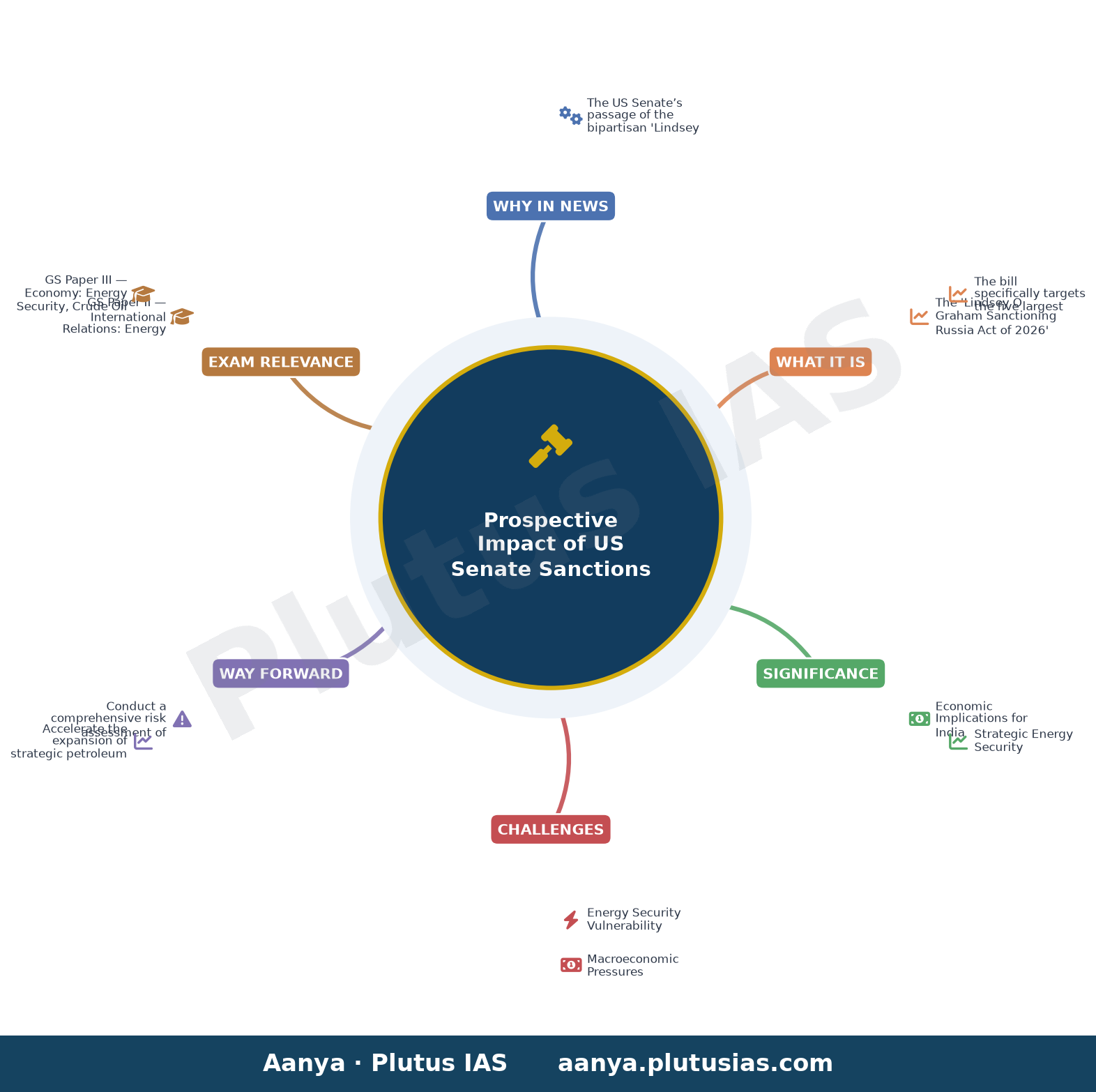
- GS Paper II — International Relations: Energy Geopolitics, Sanctions and their Global Implications | GS Paper III — Economy: Energy Security, Crude Oil Imports, and Fiscal Policy
- Prelims: US Senate sanctions bill, Russian crude oil, energy security, crude import dependence, tariffs on energy imports, geopolitical oil supply risks
- Essay: Energy Security and Geopolitical Dependencies: Balancing National Interest and Global Alliances, The Role of Economic Sanctions in International Relations: Efficacy and Unintended Consequences
Quick Revision: The US Senate’s Russia sanctions bill could impose up to 100% tariffs on major importers of Russian crude, threatening India’s energy security by raising import costs and risking supply disruptions in a tight global oil market.
Why is this in the news?
The US Senate’s passage of the bipartisan ‘Lindsey O Graham Sanctioning Russia Act of 2026’ introduces a legislative framework that could impose tariffs of up to 100% on countries identified as major purchasers of Russian oil and gas. This development is significant for India as it risks disrupting stable crude supply chains, increasing import costs, and exacerbating energy security vulnerabilities amid already tight global oil markets.
Background
- The Russian invasion of Ukraine in February 2022 triggered a cascade of Western sanctions, including restrictions on Russian oil exports, which led to a reorientation of global crude trade flows toward Asian markets.
- The proposed US sanctions bill targets the top five purchasers of Russian energy, aiming to curtail Moscow’s revenue from hydrocarbon exports, thereby exerting pressure on Russia’s war economy.
- Global oil markets remain structurally tight due to geopolitical uncertainties, particularly in the Middle East, which amplifies the strategic importance of alternative supply sources like Russian crude for energy-deficient nations.
- The bill’s passage by the US Senate is a procedural milestone, but its final implementation depends on subsequent legislative approvals and administrative discretion, including the potential for waivers or exemptions.
Understanding the US-Russia Sanctions Bill and Its Implications for Global Oil Markets
- The ‘Lindsey O Graham Sanctioning Russia Act of 2026’ is a bipartisan US legislative initiative designed to impose punitive tariffs on countries identified as major purchasers of Russian oil and gas, with rates escalating up to 100% of the import value.
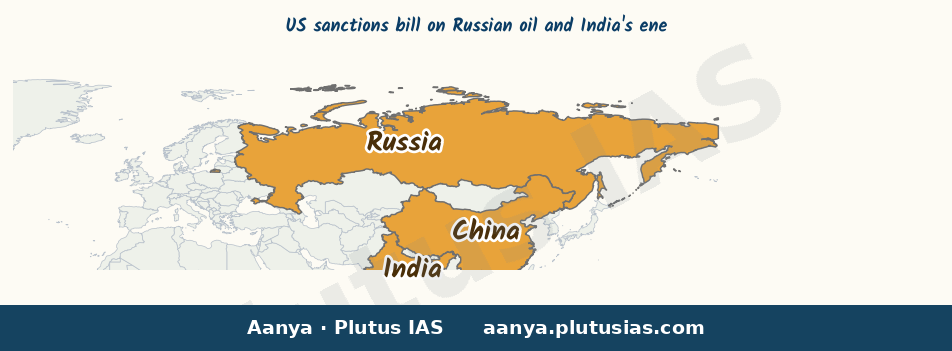
- The bill specifically targets the five largest importers of Russian energy, which, based on recent trends, would likely include India, China, Turkey, and possibly other Asian or Eurasian states.
- The legislation seeks to reduce Russia’s revenue from hydrocarbon exports, thereby weakening its capacity to sustain military operations in Ukraine and other geopolitical ventures.
- The bill’s impact on global oil markets hinges on the US administration’s enforcement posture, including the discretion to grant exemptions or waivers, which could mitigate immediate supply disruptions.
- Analysts such as Kpler note that the bill’s timing coincides with a period of tight global crude supplies, where any restriction on Russian oil exports could exacerbate market tightness rather than merely redirect trade flows.
- For India, the bill introduces a dual risk: first, potential tariffs on Russian crude imports, increasing fiscal burden; second, the possibility of supply disruptions if Russian exports are constrained, thereby threatening energy security.
- The bill reflects a broader US strategy to isolate Russia economically, aligning with NATO objectives but potentially creating collateral damage for energy-dependent nations like India.
- The legislative process is not yet complete; the bill must pass the US House of Representatives and undergo administrative scrutiny before it can take effect, providing a window for diplomatic negotiations.
Key Features
| Feature | Significance |
|---|---|
| US Senate Sanctions Bill (2026) | Proposes up to 100% tariffs on major buyers of Russian oil and gas, targeting top five purchasers, including India. |
| Lindsey O Graham Sanctioning Russia Act of 2026 | Legislative mechanism to reduce Moscow’s oil and gas revenues by penalising primary importers. |
| Global Oil Market Tightness | Pre-existing supply constraints exacerbated by Middle Eastern geopolitical risks, amplifying the impact of supply disruptions. |
| India’s Dependence on Russian Crude | Russian oil imports rose from 2.5% (2021) to 39% (2023) of India’s total crude imports, with July 2024 recording 2.8 million bpd. |
| Tariff Implementation Flexibility | US administration retains discretion to grant exemptions or waivers, influencing the bill’s actual impact on trade flows. |
| Kpler Analyst Assessment (Sumit Ritolia) | Emphasises that supply security concerns may deter overly aggressive enforcement, preserving crude availability. |
Why it Matters
Economic Implications for India
- Escalation of crude import costs due to potential 100% tariffs on Russian oil, directly impacting India’s fiscal deficit and inflation dynamics.
- Increased volatility in global oil prices, disrupting India’s energy budgeting and macroeconomic stability.
- Risk of supply chain disruptions if Russian oil flows are curtailed, forcing India to seek alternative sources at higher costs.
- Potential erosion of India’s bargaining power in global oil markets if Russian crude is marginalised, reducing leverage in price negotiations.
Strategic Energy Security
- India’s diversification of oil imports post-Ukraine war (2022) is now at risk, reversing gains in reducing dependence on West Asian suppliers.
- Over-reliance on Russian crude exposes India to geopolitical leverage by adversarial powers, undermining energy autonomy.
- Long-term contracts with Russia may become untenable if tariffs are imposed, necessitating costly renegotiations or substitutions.
- Energy security challenges compounded by global supply chain fragilities, particularly in refining and logistics infrastructure.
Geopolitical Ramifications
- US-Russia energy sanctions escalate into a proxy conflict affecting third-party nations, testing India’s strategic autonomy in foreign policy.
- Potential strain on India-US relations if tariffs are imposed, despite shared democratic values and strategic partnerships.
- Russia’s pivot to Asian markets (India, China) intensifies, altering global energy trade routes and power dynamics.
- India’s balancing act between Western sanctions regimes and pragmatic energy needs becomes more precarious.
Global Oil Market Dynamics
- Tightening of global oil markets due to reduced Russian exports, exacerbating price spikes and supply bottlenecks.
- Redirection of Russian crude flows to non-sanctioning nations (e.g., China, India) may not offset supply losses, creating structural deficits.
- Middle Eastern supply uncertainties (e.g., geopolitical tensions) amplify the impact of Russian supply disruptions.
Challenges
1. Energy Security Vulnerability
- Sudden curtailment of Russian crude imports could disrupt refinery operations, given India’s limited spare refining capacity.
- High dependence on a single supplier (Russia) for nearly 40% of crude imports creates systemic risk in energy supply chains.
- Limited alternative suppliers (e.g., West Asia, Africa) with comparable volume and discount structures to replace Russian crude.
- Insufficient strategic petroleum reserves (SPR) to buffer short-term supply shocks, leaving India exposed to price volatility.
UPSC Link: GS III: Infrastructure – Energy
2. Macroeconomic Pressures
- Potential inflationary spiral from higher crude import costs, impacting domestic fuel prices and consumer welfare.
- Fiscal strain from increased subsidy burdens on petroleum products if global prices surge.
- Risk of current account deficit (CAD) widening due to higher import bills, affecting India’s sovereign credit ratings.
UPSC Link: GS III: Indian Economy and issues relating to planning, mobilization of resources
3. Geopolitical Dilemma
- Balancing strategic autonomy with compliance to US-led sanctions regimes, risking alienation from either bloc.
- Potential retaliation from Russia (e.g., export restrictions, price hikes) if India aligns too closely with US sanctions.
- Erosion of India’s diplomatic leverage in multilateral forums if perceived as yielding to external pressures on energy trade.
UPSC Link: GS II: India and its Neighbourhood- Relations
4. Refinery and Logistics Bottlenecks
- Existing refining infrastructure optimised for Russian crude grades (e.g., Urals), requiring costly reconfiguration for alternatives.
- Limited port and pipeline capacities to handle sudden shifts in crude sourcing, risking logistical bottlenecks.
- Dependence on Russian technical expertise and infrastructure for certain refinery processes, complicating substitutions.
UPSC Link: GS III: Infrastructure – Energy
5. Policy and Regulatory Uncertainty
- Lack of clarity on US administration’s enforcement stance (exemptions, waivers) creates uncertainty for Indian refiners.
- Potential retroactive application of tariffs, disrupting long-term contracts and financial planning for energy firms.
- Inconsistent global regulatory frameworks on Russian oil trade, complicating compliance and risk management.
UPSC Link: GS II: Effect of Policies and Politics of Countries on India’s interests
Challenges — UPSC Perspective
| Issue | Concern |
|---|---|
| Crude Import Costs | Risk of 100% tariffs on Russian oil increasing India’s energy import bill, exacerbating fiscal and current account deficits. |
| Supply Disruption | Potential curtailment of Russian crude flows disrupting refinery operations and domestic fuel availability. |
| Refinery Adaptability | Limited flexibility of Indian refineries to process alternative crude grades without significant capital expenditure. |
| Geopolitical Alignment | Strain on India-US relations if tariffs are imposed, despite shared strategic interests. |
| Global Price Volatility | Tightening oil markets amplifying price spikes, impacting inflation and economic growth. |
| Strategic Reserve Gaps | Inadequate strategic petroleum reserves to buffer short-term supply shocks from geopolitical disruptions. |
Way Forward
- Conduct a comprehensive risk assessment of India’s crude import portfolio to identify vulnerabilities and diversification opportunities.
- Accelerate the expansion of strategic petroleum reserves (SPR) to at least 90 days of net imports, enhancing supply buffer capacity.
- Diversify crude sourcing by negotiating long-term contracts with West Asian, African, and Latin American suppliers to reduce dependence on Russia.
- Engage in diplomatic dialogue with the US administration to secure exemptions or waivers for Indian refiners, highlighting energy security imperatives.
- Invest in refinery upgradation to process a wider range of crude grades, reducing reliance on specific suppliers like Russia.
- Enhance bilateral energy cooperation with resource-rich nations (e.g., UAE, Saudi Arabia) to secure stable and discounted crude supplies.
- Strengthen domestic exploration and production (E&P) efforts under the Hydrocarbon Exploration and Licensing Policy (HELP) to reduce import dependence.
- Develop contingency plans for sudden supply disruptions, including emergency procurement mechanisms and fuel rationing strategies.
UPSC Value Addition
Keywords for Mains Answer-Writing
Russia-Ukraine war · US sanctions on Russia · Energy security of India · Crude oil imports from Russia · Global oil market dynamics · Lindsey-Graham Sanctioning Russia Act 2026 · Strategic petroleum reserves · Geopolitics of energy · India-Russia energy relations · OPEC+ and non-OPEC supply dynamics
Concept Flow
Russia-Ukraine War (2022) → Western sanctions on Russian oil → Discounts offered to Asian buyers (India, China) → India increases Russian crude imports (2.5% in 2021 to 39% in 2023) → US Senate sanctions bill (2026) targets top buyers of Russian energy → Potential 100% tariffs on Indian imports → Global oil markets tighten due to reduced Russian exports → India faces higher crude import costs and supply risks → Energy security vulnerabilities emerge → Macroeconomic pressures (inflation, CAD) intensify → Geopolitical dilemma for India’s strategic autonomy → Need for diversification and policy adaptation.
Prelims Practice Questions
Q1. Consider the following statements regarding India’s crude oil imports from Russia:
1. India’s dependence on Russian crude has increased significantly since 2022.
2. Russia became India’s largest crude supplier in 2023.
3. The US Senate’s sanctions bill of 2026 targets the top five purchasers of Russian energy.
How many of the above statements are correct?
- Only one
- Only two
- All three
- None
Answer: All three — Statements 1 and 3 are correct. Statement 2 is correct as Russia supplied 39% of India’s crude imports in 2023, making it the largest supplier. Statement 1 is correct as imports surged post-2022.
Q2. Assertion (A): The Lindsey-Graham Sanctioning Russia Act of 2026 aims to cut Moscow’s revenues from oil and gas sales.
Reason (R): The bill imposes tariffs of up to 100% on imports from countries that are major buyers of Russian energy.
Options:
A. Both A and R are true, and R is the correct explanation of A.
B. Both A and R are true, but R is not the correct explanation of A.
C. A is true but R is false.
D. A is false but R is true.
- A
- B
- C
- D
Answer: A — Both A and R are true. The bill targets major buyers of Russian energy to reduce Moscow’s revenues, and the tariffs are a mechanism to achieve this goal.
Q3. Match the following columns regarding India’s energy security and global oil markets:
Column I
1. Strategic Petroleum Reserves
2. OPEC+
3. Lindsey-Graham Sanctioning Russia Act 2026
4. Kpler
Column II
A. Analytical firm tracking global oil flows
B. Legislation targeting major buyers of Russian energy
C. Collective of oil-producing nations
D. Emergency crude oil stockpiles maintained by India
Options:
1-D, 2-C, 3-B, 4-A
1-A, 2-B, 3-C, 4-D
1-C, 2-D, 3-A, 4-B
1-B, 2-A, 3-D, 4-C
- 1-D, 2-C, 3-B, 4-A
- 1-A, 2-B, 3-C, 4-D
- 1-C, 2-D, 3-A, 4-B
- 1-B, 2-A, 3-D, 4-C
Answer: 1-D, 2-C, 3-B, 4-A — 1-D (Strategic Petroleum Reserves are emergency stockpiles), 2-C (OPEC+ is a collective of oil-producing nations), 3-B (The Lindsey-Graham Act targets major buyers of Russian energy), 4-A (Kpler is an analytical firm tracking global oil flows).
Mains Practice Question
✍ Critically examine the geopolitical and economic implications of the Lindsey-Graham Sanctioning Russia Act 2026 on India’s energy security. How far can India mitigate these risks through diversification and strategic partnerships? (15 Marks)
Approach: MODEL-ANSWER SKELETON:
1. **Context and Provisions of the Act**:
– Brief outline of the Lindsey-Graham Sanctioning Russia Act 2026: bipartisan bill targeting top 5 purchasers of Russian energy, authority to impose tariffs up to 100%.
– Objective: reduce Moscow’s revenues from oil and gas sales.
– Legislative status: passed by US Senate, pending House approval and administrative implementation.
2. **India’s Energy Security Dependence on Russia**:
– Data: Russian crude imports rose from <100,000 bpd in 2021 to ~2.8 million bpd in July 2024, making Russia India’s largest supplier (39% in 2023).
– Reasons: post-2022 Ukraine war, Western sanctions, discounted Russian crude.
– Strategic rationale: energy diversification, price advantages, and geopolitical alignment with Russia.
3. **Geopolitical Implications**:
– **US-India Relations**: Potential strain if India faces tariffs or sanctions; implications for Quad and Indo-Pacific strategy.
– **Russia-India Relations**: Impact on long-standing strategic partnership, defense cooperation, and energy trade.
– **Global Oil Markets**: Tightening of global crude supply if Russian exports are disrupted; upward pressure on prices.
4. **Economic Implications**:
– **Crude Import Costs**: Potential rise in import bills if Russian crude becomes expensive or unavailable.
– **Refinery Operations**: Indian refiners (e.g., Reliance, HPCL, BPCL) dependent on Russian crude may face operational disruptions.
– **Inflation and Growth**: Higher energy costs could feed into inflation and impact economic growth.
5. **Mitigation Strategies for India**:
– **Diversification of Suppliers**: Expand imports from Middle East (Saudi Arabia, UAE), USA, and Latin America.
– **Strategic Petroleum Reserves (SPRs)**: Utilize SPRs to buffer supply shocks.
– **Long-term Contracts**: Secure long-term supply agreements with alternative suppliers.
– **Renewable Energy Transition**: Accelerate adoption of renewables to reduce oil dependence.
– **Diplomatic Engagement**: Engage with US to seek exemptions or waivers; leverage India’s role in global energy governance.
6. **Challenges in Mitigation**:
– Geopolitical constraints: US pressure vs. Russia’s strategic importance.
– Infrastructure limitations: Limited port capacity for alternative crude imports.
– Market dynamics: Global oil market tightness may limit immediate diversification.
7. **Conclusion**:
– The Act poses significant risks to India’s energy security but is not an immediate existential threat.
– India must adopt a multi-pronged approach: diversification, strategic reserves, diplomatic engagement, and energy transition.
– The balance between geopolitical alignment and economic pragmatism will define India’s response.
Source: Hindustan Times
Generated by AanyaAi for educational purpose.


No Comments