


09 Aug AI in Indian Healthcare: Bridging Doctor Shortages with Tech in 2026
✎ AI in healthcare serves as a force multiplier for specialist capacity, addressing India's doctor shortages and rising NCD burden by augmenting diagnostics and clinical decision-making, but requires AI-ready data, robust…
Subject Relevance — Where This Topic Fits
- GS Paper II — Health, Education, Human Resources | GS Paper III — Science and Technology, Development and Employment
- Prelims: Ayushman Bharat Digital Mission, National Medical Devices Policy 2023, Non-communicable diseases (NCDs), AI-enabled diagnostics, Healthcare workforce shortages
- Essay: The Role of Technology in Addressing Socio-Economic Inequalities, Ethics and Governance in the Age of AI
Quick Revision: AI in healthcare serves as a force multiplier for specialist capacity, addressing India’s doctor shortages and rising NCD burden by augmenting diagnostics and clinical decision-making, but requires AI-ready data, robust regulation, and equitable reimbursement to transition from pilots to routine use.
Why is this in the news?
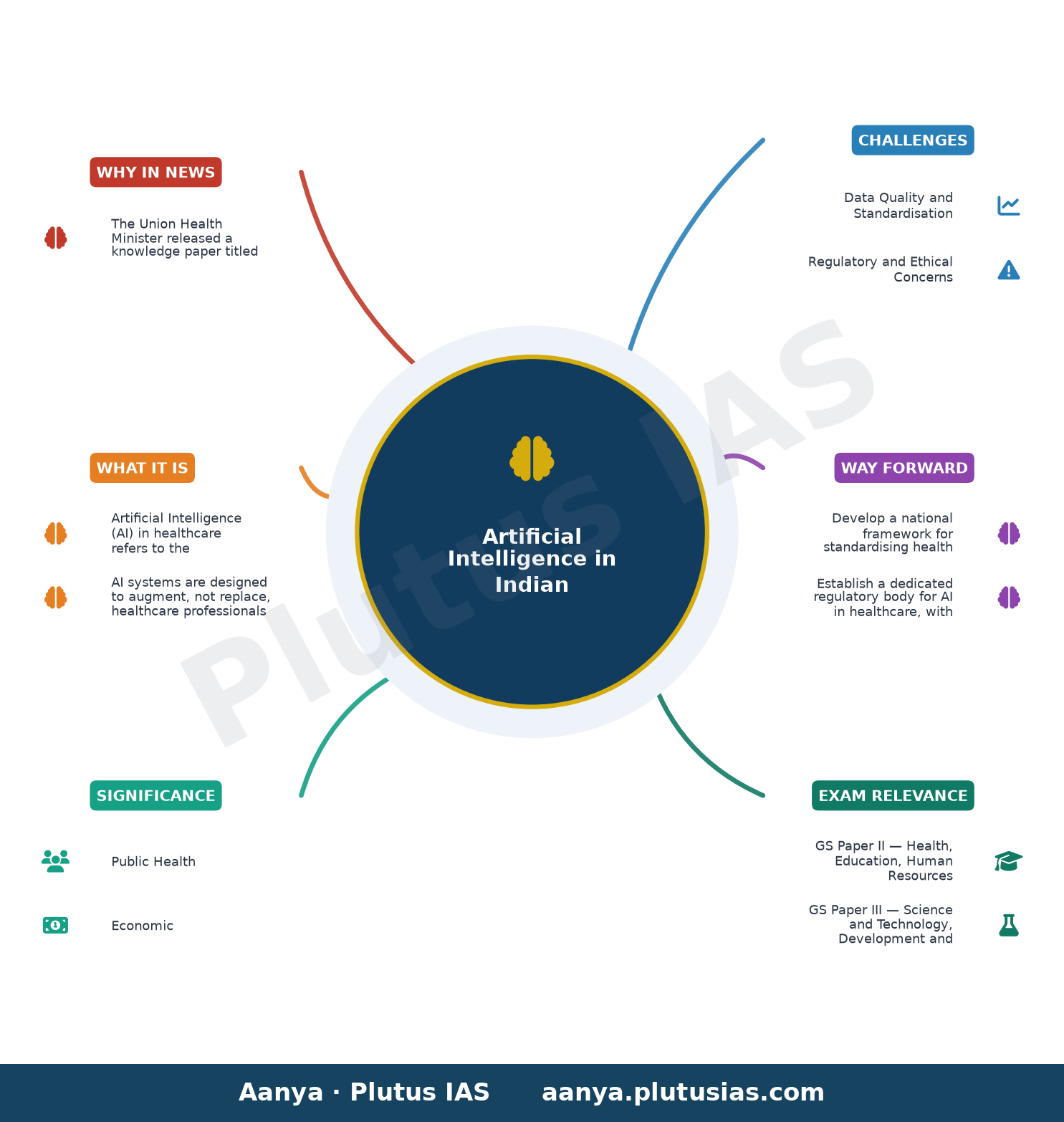
The Union Health Minister released a knowledge paper titled ‘AI in MedTech: Revolutionizing Healthcare Through Artificial Intelligence’ at the 9th edition of India Medical Device 2026, highlighting AI’s potential to address India’s critical healthcare challenges, including doctor shortages, rising non-communicable diseases, and regional disparities in healthcare access. The report underscores the need for AI integration to augment specialist capacity without replacing human expertise, while also addressing systemic gaps in data infrastructure, regulation, and reimbursement mechanisms.
Background
- India’s healthcare system faces severe shortages, with only 9.6 doctors per 10,000 population against a global average of 18.3, and 15.9 hospital beds per 10,000 compared to the global average of 33.
- Non-communicable diseases (NCDs) account for over 65% of deaths in India, with projections indicating that the population aged 60 and above will exceed 230 million by 2036, further straining healthcare demand.
- The Ayushman Bharat Digital Mission (ABDM) and IndiaAI Mission provide foundational frameworks for integrating AI into healthcare, while the National Medical Devices Policy 2023 aims to foster innovation in medical technology.
- AI is positioned as a tool to extend specialist expertise to primary and secondary healthcare settings, particularly in underserved and rural areas, without replacing human medical professionals.
- The report emphasizes the need for AI-ready health data, a predictable regulatory framework, and reimbursement mechanisms to transition AI from pilot projects to routine clinical use.
What is Artificial Intelligence in Healthcare?
- Artificial Intelligence (AI) in healthcare refers to the application of machine learning, natural language processing, and computer vision to assist in clinical decision-making, diagnostics, and patient management.
- AI systems are designed to augment, not replace, healthcare professionals by enhancing diagnostic accuracy, reducing human error, and improving workflow efficiency in high-volume settings.
- Key applications include AI-enabled diagnostics (e.g., radiology, pathology), predictive analytics for disease progression, and personalized treatment recommendations based on patient data.
- AI can address critical shortages in specialist care by enabling remote consultations, triaging patients, and providing decision support tools for primary care physicians.
- The technology relies on high-quality, standardized health data for training models, necessitating robust digital health infrastructure and interoperable systems.
- Ethical considerations include data privacy, algorithmic bias, transparency in AI decision-making, and ensuring equitable access to AI-driven healthcare solutions.
- Regulatory frameworks must balance innovation with patient safety, requiring clear guidelines for validation, certification, and post-market surveillance of AI tools.
- Reimbursement mechanisms are essential to incentivize adoption, ensuring that AI-enabled technologies are financially viable for healthcare providers and patients.
Key Features
| Feature | Significance |
|---|---|
| AI-enabled diagnostics | Extends specialist expertise to primary and secondary healthcare, improving early detection and reducing diagnostic errors. |
| Clinical decision support systems | Assists healthcare providers in evidence-based decision-making, particularly in resource-constrained settings. |
| Ayushman Bharat Digital Mission integration | Provides a unified health data infrastructure, enabling seamless AI deployment across healthcare facilities. |
| National Medical Devices Policy, 2023 | Establishes regulatory pathways for AI-driven medical technologies, ensuring safety and efficacy. |
| IndiaAI Mission | Facilitates research and development in AI applications for healthcare, fostering indigenous innovation. |
Why it Matters
Public Health
- Addresses critical shortage of specialists (e.g., radiologists, pathologists) by augmenting diagnostic capabilities in underserved regions.
- Reduces healthcare inequalities by enabling early intervention in non-communicable diseases (NCDs), which account for over 65% of deaths.
- Improves long-term care capacity by supporting geriatric healthcare for India’s ageing population (projected 230 million aged 60+ by 2036).
Economic
- Lowers per-capita healthcare costs by reducing unnecessary referrals and hospitalisations through accurate AI-driven diagnostics.
- Enhances productivity in healthcare delivery, particularly in primary and secondary care facilities with limited staffing.
- Stimulates growth in the MedTech sector, positioning India as a global hub for AI-driven healthcare solutions.
Technological
- Leverages India’s digital public infrastructure (e.g., ABDM) to create interoperable, scalable AI solutions across the healthcare ecosystem.
- Accelerates adoption of emerging technologies (e.g., computer vision, NLP) in clinical workflows, improving efficiency and accuracy.
- Fosters public-private partnerships to develop indigenous AI models tailored to India’s epidemiological and demographic profile.
Policy and Governance
- Aligns with the National Health Policy 2017’s goal of achieving universal health coverage through technology-enabled care.
- Supports the Sustainable Development Goal 3 (Good Health and Well-being) by improving access to quality healthcare.
- Encourages standardisation of AI applications in healthcare, ensuring ethical deployment and patient safety.
Challenges
1. Data Quality and Standardisation
- Health data in India is fragmented, with inconsistencies in formats, coding systems, and metadata across states and facilities.
- Lack of standardised electronic health records (EHRs) hinders the training and deployment of robust AI models.
- Data privacy concerns (e.g., under the Digital Personal Data Protection Act, 2023) may limit data sharing for AI development.
UPSC Link: GS Paper 3: Science & Tech
2. Regulatory and Ethical Concerns
- Absence of a dedicated regulatory framework for AI in healthcare, leading to ambiguity in approval processes for AI tools.
- Risk of algorithmic bias, particularly if AI models are trained on data skewed towards urban or affluent populations.
- Accountability gaps in cases of AI-driven misdiagnosis or adverse outcomes require clear legal and ethical guidelines.
UPSC Link: GS Paper 4: Ethics
3. Infrastructure and Accessibility Gaps
- Limited digital infrastructure in rural and remote areas, including unreliable internet connectivity and low penetration of smartphones.
- Shortage of skilled workforce to implement, maintain, and interpret AI systems in clinical settings.
- High upfront costs for AI deployment may exacerbate disparities between well-funded and under-resourced healthcare facilities.
UPSC Link: GS Paper 2: Governance
4. Reimbursement and Adoption Barriers
- Lack of clear reimbursement policies for AI-enabled diagnostics and treatments, discouraging private sector investment.
- Resistance from healthcare professionals due to perceived threats to job security or distrust of AI decision-making.
- Cultural and linguistic barriers may hinder acceptance of AI tools among patients and providers in diverse regions.
UPSC Link: GS Paper 3: Economy
5. Ethical and Social Implications
- Potential for over-reliance on AI, leading to deskilling of healthcare professionals and erosion of clinical judgment.
- Risk of exacerbating healthcare disparities if AI tools are only accessible to urban, affluent populations.
- Need for transparency in AI algorithms to ensure patient trust and informed consent in AI-driven care pathways.
UPSC Link: GS Paper 4: Ethics
Challenges — UPSC Perspective
| Issue | Concern |
|---|---|
| Data fragmentation | Inconsistent formats and metadata impede AI model training and deployment. |
| Regulatory ambiguity | Lack of clear guidelines for AI approval delays clinical adoption. |
| Digital divide | Poor infrastructure in rural areas limits AI accessibility and effectiveness. |
| Workforce readiness | Shortage of skilled professionals to implement and maintain AI systems. |
| Cost barriers | High initial investment may widen disparities in healthcare quality. |
| Ethical dilemmas | Accountability and bias issues require robust governance frameworks. |
Government Initiatives — Must-Memorise for Prelims
- Ayushman Bharat Digital Mission (ABDM)
- IndiaAI Mission
- National Medical Devices Policy, 2023
Way Forward
- Develop a national framework for standardising health data across states, ensuring interoperability for AI applications.
- Establish a dedicated regulatory body for AI in healthcare, with clear guidelines for approval, deployment, and monitoring.
- Invest in digital infrastructure in rural and remote areas, including high-speed internet and mobile health (mHealth) platforms.
- Launch targeted training programs for healthcare professionals to build AI literacy and operational skills.
- Create reimbursement policies for AI-enabled diagnostics and treatments to incentivise private sector participation.
- Promote public-private partnerships to develop indigenous AI models tailored to India’s epidemiological profile.
- Implement pilot projects in tier-2 and tier-3 cities to demonstrate the efficacy of AI in reducing healthcare disparities.
- Strengthen ethical guidelines for AI deployment, including transparency, accountability, and patient consent mechanisms.
UPSC Value Addition
Keywords for Mains Answer-Writing
Artificial Intelligence in healthcare · Ayushman Bharat Digital Mission · Non-communicable diseases burden in India · Healthcare workforce shortages in India · AI-enabled diagnostics · Medical device policy 2023 · Healthcare accessibility in underserved areas · AI regulatory framework for healthcare · Health data governance · Chronic disease management in India
Concept Flow
Rising burden of non-communicable diseases (NCDs) and ageing population increases demand for healthcare services. → Shortages of doctors, nurses, and infrastructure (e.g., MRI scanners) create gaps in access and quality of care. → Ayushman Bharat Digital Mission and IndiaAI Mission provide foundational digital and AI infrastructure. → AI-enabled diagnostics and clinical decision support systems extend specialist expertise to underserved areas. → Regulatory frameworks (e.g., National Medical Devices Policy) ensure safe and ethical deployment of AI tools. → Scalable adoption of AI improves early detection, reduces costs, and enhances long-term care capacity. → Sustainable integration of AI into healthcare systems requires addressing challenges in data, regulation, and infrastructure.
Prelims Practice Questions
Q1. Consider the following statements regarding India’s healthcare infrastructure as highlighted in the report ‘AI in MedTech: Revolutionizing Healthcare Through Artificial Intelligence’:
1. India has 9.6 doctors per 10,000 population compared to the global average of 18.3.
2. The report projects India’s population aged 60 years and above to cross 230 million by 2036.
3. India has 15.9 hospital beds per 10,000 population against the global average of 33.
4. The number of MRI scanners in India is 19 per million people, matching the global average.
How many of the above statements are correct?
- Only one
- Only two
- Only three
- All
Answer: Only three — Statements 1, 2, and 3 are correct. Statement 4 is incorrect as India has only 4 MRI scanners per million people against the global average of 19.
Q2. Assertion (A): The Ayushman Bharat Digital Mission is cited in the report as a foundational initiative for integrating AI in healthcare.
Reason (R): AI-enabled diagnostics are expected to be the first large-scale application to extend specialist expertise to primary and secondary healthcare.
In the context of the above statements, which of the following is correct?
- Both A and R are true, and R is the correct explanation of A
- Both A and R are true, but R is not the correct explanation of A
- A is true, but R is false
- A is false, but R is true
Answer: Both A and R are true, but R is not the correct explanation of A — Both the assertion and reason are true. The Ayushman Bharat Digital Mission is indeed a foundational initiative for AI integration in healthcare (A). AI-enabled diagnostics are expected to be the first large-scale application to extend specialist expertise (R), and this directly explains why the mission is foundational.
Q3. Which of the following initiatives is NOT mentioned in the report as a foundation for AI in healthcare in India?
- Ayushman Bharat Digital Mission
- IndiaAI Mission
- National Health Protection Scheme
- National Medical Devices Policy, 2023
Answer: National Health Protection Scheme — The National Health Protection Scheme (Ayushman Bharat Pradhan Mantri Jan Arogya Yojana) is not mentioned in the report as a foundation for AI in healthcare. The other three initiatives are explicitly cited.
Mains Practice Question
✍ Artificial intelligence is increasingly being positioned as a transformative tool to address India’s critical healthcare challenges. Critically examine the potential of AI in bridging the healthcare gap in India, with reference to the report ‘AI in MedTech: Revolutionizing Healthcare Through Artificial Intelligence’. Also, analyse the challenges in scaling AI applications from pilot projects to routine clinical use. (15 Marks)
Approach: Introduction (2 marks): Briefly define AI in healthcare and its relevance to India’s healthcare challenges. Mention the report’s key findings on healthcare workforce shortages and non-communicable disease burden. Potential of AI in bridging healthcare gap (6 marks): 1. Extending specialist expertise: AI-enabled diagnostics and clinical decision support systems (CDSS) can assist primary and secondary healthcare providers in underserved areas. Cite examples like AI-driven radiology for detecting tuberculosis or diabetic retinopathy. 2. Improving diagnosis and screening: AI models trained on large datasets can improve early detection of diseases like cancer, cardiovascular diseases, and diabetes. Reference the report’s emphasis on AI as a multiplier of specialist capacity. 3. Expanding access to quality healthcare: AI can facilitate telemedicine, remote monitoring, and predictive analytics for chronic disease management, particularly in rural and tribal areas. 4. Productivity and efficiency: AI can automate administrative tasks, reduce diagnostic errors, and optimize resource allocation in hospitals. Challenges in scaling AI applications (5 marks): 1. Data quality and interoperability: AI models require high-quality, standardized health data. Discuss the current gaps in health data governance, including data silos and lack of standardization. 2. Regulatory and ethical concerns: Highlight the need for a predictable regulatory framework for AI in healthcare, including approval processes for AI-enabled medical devices and ethical considerations like bias and transparency. 3. Reimbursement mechanisms: Lack of clear reimbursement policies for AI-enabled technologies may hinder their adoption in routine clinical practice. 4. Infrastructure and capacity building: Discuss the need for robust digital infrastructure, training of healthcare professionals, and public-private partnerships to scale AI applications. 5. Trust and acceptance: Address the skepticism among healthcare professionals and patients regarding AI’s reliability, accountability, and potential to replace human judgment. Conclusion (2 marks): Summarize the transformative potential of AI in addressing India’s healthcare challenges while emphasizing the need for a multi-stakeholder approach to overcome the identified challenges. Highlight the role of government initiatives like the Ayushman Bharat Digital Mission and the National Medical Devices Policy, 2023, in creating an enabling environment for AI adoption.
Source: Times of India
Generated by AanyaAi for educational purpose.

- UPSC Civil Services (Main) Examination 2026 — Mechanical Engineering Optional Paper I: Question Paper | Plutus IAS - September 24, 2026
- सुप्रीम कोर्ट ने टीएमसी नाम और चुनाव चिह्न विवाद पर चुनाव आयोग से समयसीमा मांगी, 28 सितंबर को सुनवाई - September 24, 2026
- UPSC Civil Services (Main) Examination 2026 — Chemistry Optional Paper I: Questions with Model Answers | Plutus IAS - September 24, 2026

No Comments