


09 Aug Women Reservation Bill: SAD Demands Immediate Implementation from Centre
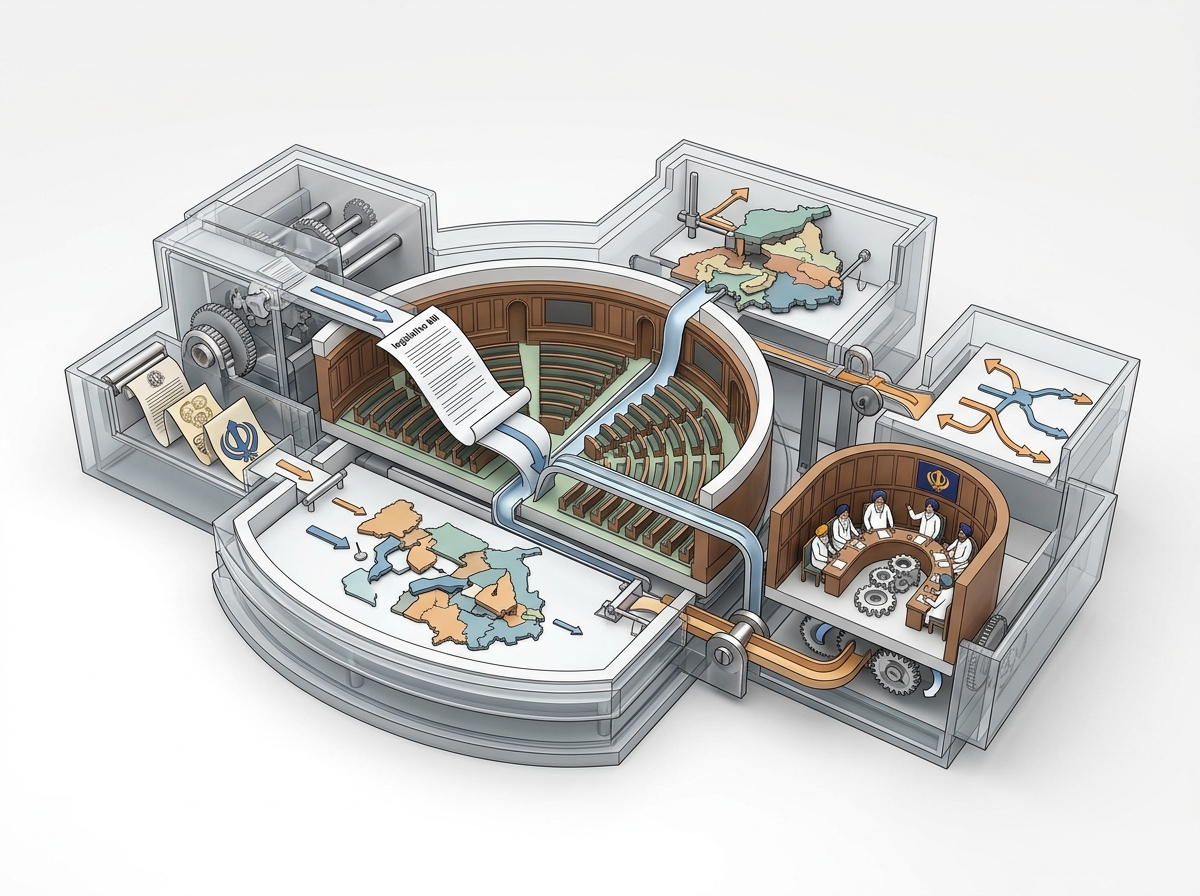
Women’s Reservation BillDelimitation processLok Sabha seatsState Legislative seats✎ The Women’s Reservation Bill, 2023, seeks to reserve 33% of seats for women in Parliament and State Legislatures, but its implementation requires delimitation, a constitutional amendment, and political consensus, with the SAD’s…
Subject Relevance — Where This Topic Fits
- GS Paper II — Polity and Governance (Constitutional Provisions, Reservation Policies, Delimitation) | GS Paper II — Social Justice (Gender Justice, Representation of Women) | GS Paper III — Economic and Social Development (Inclusive Growth, Gender Parity)
- Prelims: 103rd Constitutional Amendment Act, 2019, Women’s Reservation Bill, 2023, Delimitation Commission, Article 82 and 170, SAD (Shiromani Akali Dal), SGPC (Shiromani Gurdwara Parbandhak Committee), 50% increase in parliamentary seats proposal, Panchsheel principles of Sikhism
- Essay: Gender equality as a cornerstone of inclusive democracy, The interplay of constitutional reform and political consensus
Quick Revision: The Women’s Reservation Bill, 2023, seeks to reserve 33% of seats for women in Parliament and State Legislatures, but its implementation requires delimitation, a constitutional amendment, and political consensus, with the SAD’s recent endorsement adding a significant regional dimension to the debate.
Why is this in the news?
The Shiromani Akali Dal (SAD) has publicly endorsed the Women’s Reservation Bill and the delimitation process, demanding their immediate implementation by the Centre. This stance, articulated by senior SAD leader Gulzar Singh Ranike and SAD president Sukhbir Singh Badal, follows a high-level meeting and aligns with the party’s historical advocacy for women’s rights, rooted in Sikh principles. The development is significant as it reflects a potential shift in regional political alliances and highlights the constitutional and social dimensions of gender representation in Indian democracy.
Background
- The Women’s Reservation Bill, 2023, seeks to reserve one-third of seats in the Lok Sabha and State Legislative Assemblies for women, including seats reserved for SCs/STs.
- Delimitation refers to the process of redrawing the boundaries of parliamentary and assembly constituencies to reflect population changes, as mandated by Articles 82 and 170 of the Constitution.
- The Centre has proposed a 50% increase in the number of parliamentary seats across states, which requires constitutional amendment and delimitation before the Bill can be implemented.
- The SAD’s endorsement comes amid renewed political negotiations, particularly with the BJP, with which the party has a history of coalition governance in Punjab.
- The SAD’s support is also influenced by Sikh religious principles, as articulated by SAD leaders, which emphasize gender equality and women’s dignity, exemplified by the SGPC’s internal reservation policies for women.
What is the Women’s Reservation Bill and the Delimitation Process?
- The Women’s Reservation Bill, 2023, is a constitutional amendment bill introduced to reserve 33% of seats in the Lok Sabha and State Legislative Assemblies for women, including seats reserved for Scheduled Castes and Scheduled Tribes.
- The Bill aims to address the underrepresentation of women in legislative bodies, which currently stands at approximately 15% in the Lok Sabha and varies across state assemblies.
- Implementation of the Bill is contingent upon the delimitation of constituencies, as the current reservation cannot be applied without redrawing electoral boundaries to ensure fair representation.
- Delimitation is conducted by the Delimitation Commission, a statutory body established under the Delimitation Act, 2002, with the objective of ensuring equitable distribution of seats based on population data from the latest census.
- The Women’s Reservation Bill, 2023 (Nari Shakti Vandan Adhiniyam), introduced Article 334A, which mandates that the reservation for women shall cease to have effect after a period of 15 years from the date of commencement of the Act (i.e., by 2034).
- The SAD’s endorsement of the Bill and delimitation process is rooted in its commitment to gender justice, as reflected in Sikh teachings and the SGPC’s internal policies, which reserve 33% of seats in the Shiromani Gurdwara Parbandhak Committee for women.
- The Bill and delimitation process are intertwined with broader debates on federalism, as states must agree on the redistribution of seats, and the Centre must ensure transparency and fairness in the process.
- The SAD’s position also reflects its political strategy, as it seeks to align with the Centre on key legislative reforms while maintaining its regional autonomy and electoral viability in Punjab.
Key Features
| Feature | Significance |
|---|---|
| Women Reservation Bill (128th Constitutional Amendment Act, 2023) | Seeks to reserve one-third of seats in the Lok Sabha and State Legislative Assemblies for women, aiming to enhance female political representation and address gender disparity in governance. |
| Delimitation Process | Involves redrawing of electoral boundaries to reflect population changes, ensuring equitable representation; critical for fair allocation of reserved seats under the Women Reservation Bill. |
| Shiromani Akali Dal (SAD) Support | Demonstrates inter-party consensus on gender-inclusive policies, aligning with SAD’s historical advocacy for women’s empowerment within Sikh principles. |
| Punjab’s Political Stance | Reflects regional priorities in electoral reforms, with SAD emphasizing transparent and fair delimitation to prevent injustice against any state. |
| Centre-State Coordination | Highlights the necessity of federal cooperation in implementing constitutional amendments, particularly those affecting electoral processes and representation. |
Why it Matters
Political
- Demonstrates cross-party consensus on gender-inclusive electoral reforms, reinforcing democratic ideals of representation and equality.
- SAD’s alignment with the Women Reservation Bill underscores the Bill’s potential to reshape India’s political landscape by increasing female participation in decision-making.
- The delimitation process, tied to the Bill, ensures that electoral boundaries are updated to reflect demographic changes, preventing underrepresentation of growing populations.
Social
- The Bill addresses systemic gender imbalances in political representation, aligning with constitutional goals of social justice and equality (Articles 14, 15, and 16).
- SAD’s invocation of Sikh Gurus’ teachings on women’s dignity and equality reinforces the cultural and ethical foundation for gender-inclusive policies.
- Increased female representation in legislatures can lead to policies more responsive to women’s needs, including education, health, and economic empowerment.
Constitutional
- The Bill is a legislative measure to operationalise the constitutional principle of equality (Part III), specifically through reservation mechanisms.
- Delimitation, governed by Articles 81 and 82, is a constitutional process that must adhere to fairness and transparency to avoid disputes.
Challenges
1. Implementation Delay
- The Bill, passed in 2023, awaits notification of the delimitation process, which is constitutionally mandated before reservation can be enforced.
- Delays risk eroding public trust in electoral reforms and may lead to political disillusionment regarding gender-inclusive governance.
- Legal and administrative hurdles in delimitation, such as data accuracy and boundary disputes, could further postpone implementation.
UPSC Link: GS2-constitutional-remedies
2. Federal Coordination
- The delimitation process requires Centre-State collaboration, which may face resistance if states perceive unfairness in boundary adjustments.
- Political parties may prioritise partisan interests over consensus, delaying or derailing the reform process.
- Lack of a unified national policy on delimitation could lead to inconsistencies across states, undermining the Bill’s objectives.
UPSC Link: GS2-federalism
3. Gender Stereotypes
- Deep-rooted societal biases may persist despite reservation, limiting the effectiveness of female legislators in influencing policy.
- Cultural and traditional barriers could discourage women from contesting elections or participating in political processes.
- Inadequate support systems (e.g., childcare, safety) for female politicians may hinder their sustained participation.
UPSC Link: GS1-social-issues
4. Legal and Logistical Hurdles
- The delimitation process is time-consuming and requires precise data on population, which may be contested or delayed.
- Legal challenges to delimitation or reservation could arise, necessitating judicial intervention and further prolonging the process.
- Administrative capacity constraints in conducting delimitation and managing reserved seats may pose operational challenges.
UPSC Link: GS2-constitutional-bodies
Challenges — UPSC Perspective
| Issue | Concern |
|---|---|
| Delayed Notification of Delimitation | Constitutional mandate for delimitation must precede reservation; delays risk undermining the Bill’s implementation. |
| Federal Disputes on Boundary Adjustments | States may resist delimitation if perceived as unfair, leading to Centre-State tensions. |
| Societal Resistance to Gender Quotas | Deep-seated biases may persist, limiting the transformative impact of female reservation. |
| Administrative and Legal Delays | Data inaccuracies, legal challenges, and logistical constraints could stall the delimitation process. |
| Political Partisanship | Parties may prioritise electoral gains over consensus, delaying or derailing the reform process. |
Way Forward
- Ensure timely notification of the delimitation process by the Election Commission of India, in consultation with states, to operationalise the Women Reservation Bill.
- Strengthen Centre-State coordination through inter-governmental committees to address disputes and ensure transparent boundary adjustments.
- Launch nationwide awareness campaigns to sensitise society on the importance of gender-inclusive governance and challenge stereotypes.
- Establish support systems for female legislators, including safety measures, childcare facilities, and mentorship programs, to enhance their effectiveness.
- Conduct periodic reviews of the delimitation process to address logistical and legal challenges proactively.
- Encourage all political parties to adopt internal quotas for female candidates to complement the constitutional reservation.
- Leverage technology (e.g., GIS mapping) to ensure data accuracy and transparency in the delimitation process.
- Monitor the implementation of the Bill through independent audits to assess its impact on female representation and governance.
UPSC Value Addition
Keywords for Mains Answer-Writing
Women Reservation Bill 2023 · Constitution (108th Amendment) Bill · Perliamentary representation · Delimitation Commission · Political empowerment of women · Shiromani Akali Dal (SAD) · BJP-SAD alliance · Sikh Gurus’ teachings on gender equality · 50% increase in parliamentary seats · Punjab Legislative Assembly · Gender parity in governance · Constitutional provisions for women · Political reservation · Public interest litigation · Representation of marginalised groups
Constitutional & Policy Linkages
- Article 14 – Equality before law and equal protection of laws
- Article 15(3) – Special provisions for women and children
- Article 16 – Equality of opportunity in public employment
- Article 81 – Composition of the Lok Sabha
- Article 82 – Delimitation of constituencies
- Seventh Schedule – Distribution of legislative powers
Concept Flow
Constitutional Amendment (128th Bill) → Legislative Enactment → Delimitation Process → Reservation Implementation → Enhanced Female Representation → Policy Impact → Gender Disparity in Governance → Women Reservation Bill → Societal Awareness → Political Consensus → Implementation Challenges → Reform Outcomes → Centre-State Relations → Delimitation Mandate → Boundary Adjustments → Equitable Representation → Federal Cooperation → Constitutional Compliance → SAD’s Support → Political Alignment → Cross-Party Consensus → Electoral Reform Momentum → Public Trust in Governance → Democratic Strengthening → Sikh Principles on Women’s Equality → Cultural Advocacy → Policy Justification → Legislative Support → Implementation Urgency → Social Transformation
Prelims Practice Questions
Q1. Consider the following statements regarding the Women Reservation Bill 2023: 1. It seeks to reserve one-third of the seats in the Lok Sabha and State Legislative Assemblies for women. 2. The bill was introduced in the Lok Sabha in September 2023. 3. The reservation will be implemented immediately after the bill is passed. 4. The bill includes a provision for reservation of seats for women belonging to Scheduled Castes and Scheduled Tribes. How many of the above statements are correct?
- Only one
- Only two
- Only three
- All
Answer: Only three — Statements 1 and 4 are correct. Statement 2 is incorrect as the bill was introduced in March 2010, not September 2023. Statement 3 is incorrect as the reservation will come into effect only after the next delimitation exercise.
Q2. Assertion (A): The Shiromani Akali Dal (SAD) has demanded immediate implementation of the Women Reservation Bill. Reason (R): SAD argues that the bill aligns with the teachings of Sikh Gurus, which emphasize gender equality and women’s dignity.
- Both A and R are true, and R is the correct explanation of A.
- Both A and R are true, but R is not the correct explanation of A.
- A is true but R is false.
- A is false but R is true.
Answer: Both A and R are true, but R is not the correct explanation of A. — Both the assertion and reason are correct. SAD has explicitly linked its support for the Women Reservation Bill to the teachings of Sikh Gurus, which advocate for gender equality and women’s dignity.
Q3. Match the following provisions with their respective constitutional or legislative contexts: Column A: 1. Women Reservation Bill 2023, 2. Delimitation Commission, 3. 106th Constitutional Amendment Act, 4. Article 330A. Column B: A. Reservation of seats for women in Panchayati Raj Institutions, B. Reservation of seats for women in Lok Sabha and State Legislative Assemblies, C. Constitution of a body to readjust the division of territorial constituencies, D. Reservation of seats for women in Lok Sabha.
- 1-D, 2-C, 3-B, 4-A
- 1-B, 2-C, 3-A, 4-D
- 1-C, 2-B, 3-D, 4-A
- 1-A, 2-D, 3-C, 3-B
Answer: 1-B, 2-C, 3-A, 4-D — The correct match is: Women Reservation Bill 2023 (D), Delimitation Commission (C), 106th Constitutional Amendment Act (B), and Article 330A (A).
Mains Practice Question
✍ Critically examine the constitutional, political, and social dimensions of the demand for immediate implementation of the Women Reservation Bill 2023 in India. How does the stance of the Shiromani Akali Dal (SAD) reflect the evolving discourse on gender representation in Indian politics? (15 Marks)
Approach: MODEL-ANSWER SKELETON:
1. **Constitutional Framework**:
– Reference to the 106th Constitutional Amendment Act (2023) inserting Articles 330A and 332A to reserve one-third of seats for women in Lok Sabha and State Legislative Assemblies.
– Mention of the pending implementation pending the next delimitation exercise (Article 82).
2. **Political Dimensions**:
– Analysis of the SAD’s demand for immediate implementation, linking it to Punjab’s political context and the BJP-SAD alliance dynamics.
– Examine the role of regional parties in advocating for gender representation.
3. **Social Dimensions**:
– Highlight the historical underrepresentation of women in Indian politics and the global context of gender parity in governance.
– Reference to the teachings of Sikh Gurus on gender equality as cited by SAD.
4. **Critique and Challenges**:
– Discuss the arguments against immediate implementation: potential disruption in electoral demographics, lack of consensus on delimitation, and federal concerns.
– Evaluate the counter-arguments: urgency of gender parity, progressive social policy, and alignment with constitutional goals.
5. **Conclusion**:
– Weigh the balance between constitutional mandates and political feasibility.
– Suggest a middle path: phased implementation or conditional immediate reservation for certain seats.
Source: amarujala.com
Generated by AanyaAi for educational purpose.


No Comments