


09 Aug Madras HC orders TN govt on transgender rehabilitation scheme at taluk level
✎ The Madras High Court’s directive mandates the Tamil Nadu government to formulate a **taluk-level rehabilitation scheme for transgender persons**, ensuring self-employment, sustainable livelihoods, and judicial oversight of…
Subject Relevance — Where This Topic Fits
- GS Paper II — Social Justice and Welfare Schemes | GS Paper II — Fundamental Rights and Judicial Activism | GS Paper III — Inclusive Growth and Employment
- Prelims: Transgender Persons (Protection of Rights) Act, 2019, National Portal for Transgender Persons, Article 15(2) of the Constitution, NITI Aayog’s 2021 Report on Transgender Persons, Tamil Nadu’s Transgender Welfare Board, Judicial review of executive inaction, Taluk-level implementation of welfare schemes, Right to Livelihood under Article 21
- Essay: Judicial Activism as a Catalyst for Social Transformation: Case Study of Transgender Rights in India, Inclusive Governance: Bridging the Gap Between Policy and Practice in Welfare Delivery
Quick Revision: The Madras High Court’s directive mandates the Tamil Nadu government to formulate a **taluk-level rehabilitation scheme for transgender persons**, ensuring self-employment, sustainable livelihoods, and judicial oversight of executive compliance with constitutional and statutory rights.
Why is this in the news?
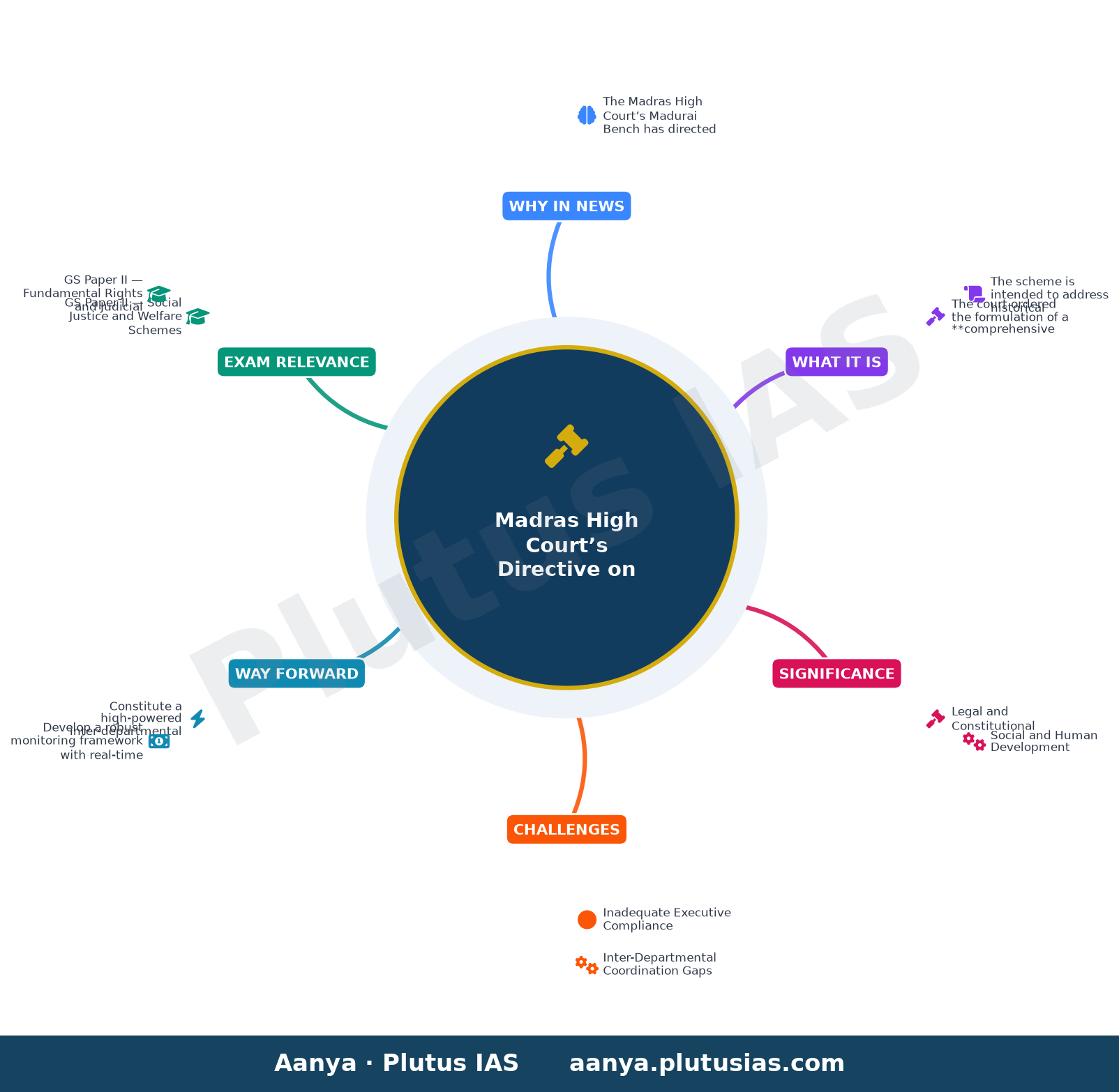
The Madras High Court’s Madurai Bench has directed the Tamil Nadu Chief Secretary to file a compliance report by August 21, 2026, on the implementation of a taluk-level rehabilitation scheme for transgender persons. This directive follows the court’s April 24, 2026, order, which underscored the State’s failure to ensure meaningful inclusion, self-employment opportunities, and sustainable livelihoods for transgender individuals, despite constitutional guarantees and statutory frameworks. The case exemplifies judicial intervention in addressing systemic gaps in welfare delivery and highlights the judiciary’s role in upholding socio-economic rights.
Background
- The Transgender Persons (Protection of Rights) Act, 2019, was enacted to safeguard the rights of transgender persons and promote their welfare, including provisions for self-employment, education, and healthcare.
- Tamil Nadu established the Transgender Welfare Board in 2019 to implement welfare schemes, though implementation has been uneven across districts and taluks.
- The Madras High Court has previously issued landmark judgments on transgender rights, including the recognition of the right to self-identified gender and protection from discrimination (e.g., *Arunkumar & Anr. v. The Inspector General of Registration and Ors., 2019*).
- National-level reports, such as NITI Aayog’s 2021 study, highlight persistent challenges in access to livelihoods, healthcare, and social security for transgender persons.
- Judicial activism has increasingly been invoked to address executive inaction in welfare schemes, particularly for marginalised communities.
- The court’s directive reflects a broader trend of judicial oversight in ensuring the realisation of socio-economic rights guaranteed under Part III of the Constitution.
What is the Madras High Court’s Directive on Transgender Rehabilitation?
- The court ordered the formulation of a **comprehensive rehabilitation scheme at the taluk level** to ensure **self-employment, sustainable livelihoods, and meaningful inclusion** for transgender persons.
- The scheme is intended to address historical injustices and provide **access to education, healthcare, and essential resources**, aligning with the principles of **dignity, equality, and non-discrimination** under Articles 14, 15, and 21 of the Constitution.
- The Chief Secretary has been directed to coordinate with **all departments**—including Social Welfare, Labour, Education, and Health—to ensure **time-bound implementation** and file a compliance report by August 21, 2026.
- The court’s order underscores the **judicial role in enforcing executive accountability** for welfare schemes, particularly where executive inaction has perpetuated socio-economic marginalisation.
- The court’s emphasis on **taluk-level implementation** reflects a recognition of the need for **localised, accessible, and tailored welfare measures** to address the unique challenges faced by transgender persons in rural and urban areas.
- The order also highlights the **judiciary’s concern over the lack of meaningful inclusion** of transgender persons in mainstream society, despite constitutional and statutory guarantees.
Key Features
| Feature | Significance |
|---|---|
| Comprehensive rehabilitation scheme at taluk level | Ensures decentralised, grassroots-level implementation of welfare measures tailored to the socio-economic needs of transgender persons, addressing historical marginalisation and promoting inclusive development. |
| Self-employment and sustainable livelihood avenues | Provides economic empowerment through skill development, entrepreneurship support, and access to credit, reducing dependency and fostering financial independence. |
| Coordination among departments | Ensures inter-departmental synergy (e.g., Social Welfare, Health, Education) for holistic implementation, avoiding siloed approaches and duplication of efforts. |
| Time-bound compliance reporting | Imposes judicial accountability on the executive, ensuring periodic review and corrective action to prevent delays in justice delivery. |
| Judicial oversight of socio-economic conditions | Highlights the judiciary’s role in addressing systemic failures and directing the state to rectify historical injustices through affirmative action. |
Why it Matters
Legal and Constitutional
- Reinforces the principle of judicial activism in safeguarding the rights of marginalised communities under Articles 14, 15, 19, and 21 of the Constitution.
- Sets a precedent for the judiciary to direct executive action in cases of systemic neglect of vulnerable groups.
- Emphasises the state’s obligation to ensure substantive equality, not merely formal equality, for transgender persons.
Social and Human Development
- Addresses the intersectional vulnerabilities of transgender persons, including poverty, exclusion, and lack of access to education and healthcare.
- Promotes social inclusion by creating economic opportunities and reducing stigma through targeted welfare measures.
- Aligns with the Sustainable Development Goals (SDG 1, 4, 8, 10) on poverty eradication, quality education, decent work, and reduced inequalities.
Policy and Governance
- Demonstrates the role of the judiciary in shaping policy when executive action is inadequate or delayed.
- Highlights the need for a rights-based approach in governance, particularly for historically oppressed communities.
- Underscores the importance of decentralised implementation of welfare schemes to ensure reach and effectiveness.
Judicial Precedent and Accountability
- Expands the scope of judicial review to include socio-economic rights, reinforcing the doctrine of judicial accountability.
- Serves as a model for similar interventions in other states facing challenges in transgender welfare.
- Encourages proactive judicial engagement in monitoring compliance with constitutional and statutory obligations.
Challenges
1. Inadequate Executive Compliance
- The status report filed by the Chief Secretary was found non-compliant, indicating systemic delays and lack of ownership in implementation.
- Historical neglect of transgender welfare has led to institutional inertia, requiring sustained judicial oversight to ensure accountability.
- Lack of awareness among transgender persons about their rights and entitlements may hinder effective utilisation of the scheme.
UPSC Link: GS-II: Mechanisms, Laws, Institutions and Bodies constituted for the Protection and Betterment of these Sections.
2. Inter-Departmental Coordination Gaps
- Fragmented implementation across departments (e.g., Social Welfare, Health, Labour) may lead to overlapping or missed targets.
- Absence of a unified monitoring mechanism to track progress at the taluk level, risking decentralised inefficiencies.
- Bureaucratic delays in approvals, fund disbursement, and grievance redressal may undermine the scheme’s objectives.
UPSC Link: GS-II: Government Policies and Interventions for Development in various sectors and issues arising out of their Design and Implementation.
3. Socio-Economic Barriers
- Prevalence of discrimination in education and employment limits access to skill-building opportunities for transgender persons.
- Lack of affordable healthcare, including mental health support, exacerbates vulnerabilities and reduces productivity.
- Social stigma and familial rejection often force transgender persons into informal or exploitative livelihoods, perpetuating cycles of poverty.
UPSC Link: GS-I: Social Empowerment, Communalism, Regionalism & Secularism.
4. Resource Allocation and Sustainability
- Insufficient budgetary allocations for transgender welfare schemes may lead to ad-hoc or short-term interventions.
- Dependence on external funding (e.g., CSR, NGOs) risks discontinuity and lack of scalability in the long term.
- Absence of a dedicated cadre of trained personnel to implement and monitor the scheme at the grassroots level.
UPSC Link: GS-III: Issues relating to Direct and Indirect Farm Subsidies and Minimum Support Prices.
5. Legal and Policy Ambiguities
- Overlap or gaps between the Transgender Persons (Protection of Rights) Act, 2019, and state-level schemes may create confusion in implementation.
- Lack of clarity on the definition of ‘rehabilitation’ and ‘self-employment’ in the context of transgender persons may lead to misaligned priorities.
- Inadequate grievance redressal mechanisms to address discrimination or denial of benefits under the scheme.
UPSC Link: GS-II: Welfare Schemes for Vulnerable Sections of the population by the Centre and States and the Performance of these Schemes.
Challenges — UPSC Perspective
| Issue | Concern |
|---|---|
| Executive non-compliance with judicial directives | Delays in implementation and lack of accountability in fulfilling court-mandated obligations. |
| Fragmented inter-departmental coordination | Risk of overlapping efforts, missed targets, and inefficient resource utilisation. |
| Socio-economic exclusion of transgender persons | Persistent barriers in education, employment, and healthcare limit access to opportunities. |
| Insufficient budgetary allocations | May result in ad-hoc schemes with limited reach and sustainability. |
| Ambiguities in legal and policy frameworks | Overlap with central laws or lack of clear definitions may hinder effective implementation. |
| Lack of awareness among beneficiaries | Transgender persons may remain unaware of their rights or how to access the scheme. |
Government Initiatives — Must-Memorise for Prelims
- Tamil Nadu State Welfare Board for Transgender Persons (if operationalised)
Way Forward
- Constitute a high-powered inter-departmental committee under the Chief Secretary to oversee the scheme’s implementation at taluk, district, and state levels.
- Develop a robust monitoring framework with real-time dashboards to track progress, fund utilisation, and beneficiary feedback.
- Launch targeted awareness campaigns in collaboration with transgender communities, NGOs, and local bodies to ensure last-mile delivery.
- Integrate skill development programmes with existing schemes (e.g., PMKVY) to enhance employability and entrepreneurship among transgender persons.
- Establish a dedicated grievance redressal mechanism with fast-track resolution timelines to address discrimination or denial of benefits.
- Allocate dedicated budgetary provisions in the state’s annual financial statements, with transparent utilisation certificates for audit.
- Conduct periodic socio-economic surveys to assess the scheme’s impact and identify gaps for mid-course corrections.
- Collaborate with the National Council for Transgender Persons (NCTP) to align state-level initiatives with national priorities.
UPSC Value Addition
Keywords for Mains Answer-Writing
Transgender Persons (Protection of Rights) Act, 2019 · Madras High Court directives · Comprehensive rehabilitation scheme for transpersons · Self-employment and sustainable livelihood · Judicial activism in socio-economic rights · Taluk-level implementation of welfare schemes · Article 21 (Right to Life and Personal Liberty) · Socio-economic inclusion of marginalised communities · Judicial review and executive accountability · Constitutional morality and dignity
Constitutional & Policy Linkages
- {‘Article 14’: ‘Equality before law and equal protection of laws.’}
- {‘Article 15’: ‘Prohibition of discrimination on grounds of religion, race, caste, sex, or place of birth.’}
- {‘Article 19(1)(g)’: ‘Right to practise any profession or to carry on any occupation, trade or business.’}
- {‘Article 21’: ‘Right to life and personal liberty, including dignity and livelihood.’}
Concept Flow
Historical marginalisation of transgender persons → Systemic socio-economic exclusion → Judicial recognition of neglect → Madras HC directs state to formulate rehabilitation scheme → State fails to comply adequately → Court imposes time-bound compliance reporting → Need for decentralised (taluk-level) implementation → Focus on self-employment and sustainable livelihood → Inter-departmental coordination → Judicial oversight for accountability.
Prelims Practice Questions
Q1. Consider the following statements regarding the Transgender Persons (Protection of Rights) Act, 2019:
1. The Act provides for the formulation of welfare schemes for transgender persons at the district level.
2. The Act mandates the establishment of a National Council for Transgender Persons.
3. The Act recognises the right to self-identified gender identity.
How many of the above statements are correct?
- Only one
- Only two
- All three
- None
Answer: All three — Statements 2 and 3 are correct. Statement 1 is incorrect as the Act does not explicitly mandate district-level schemes; however, the Madras HC has directed taluk-level implementation, which is a judicial interpretation beyond the Act’s text.
Q2. Assertion (A): The Madras High Court has directed the Tamil Nadu government to formulate a comprehensive rehabilitation scheme for transgender persons at the taluk level.
Reason (R): The court observed that justice has not been adequately done for transgender persons and took judicial notice of their socio-economic conditions.
In the context of the above two statements, which one of the following is correct?
- Both A and R are true, and R is the correct explanation of A.
- Both A and R are true, but R is not the correct explanation of A.
- A is true, but R is false.
- A is false, but R is true.
Answer: Both A and R are true, but R is not the correct explanation of A. — Both the assertion and reason are true. The court’s directive (A) is directly linked to its observation of inadequate justice for transgender persons (R), as stated in the order dated April 24, 2026.
Q3. Match the following provisions with their respective legal frameworks:
Column I (Provisions)
A. Right to self-identified gender identity
B. Formulation of welfare schemes for transgender persons
C. Establishment of a National Council for Transgender Persons
D. Protection from discrimination in employment
Column II (Legal Frameworks)
1. Transgender Persons (Protection of Rights) Act, 2019
2. NALSA v. Union of India (2014)
3. Rights of Persons with Disabilities Act, 2016
4. Constitution of India (Article 15(2))
Choose the correct match from the options below:
- A-2, B-1, C-1, D-4
- A-1, B-2, C-3, D-4
- A-2, B-1, C-3, D-4
- A-1, B-2, C-4, D-3
Answer: A-2, B-1, C-1, D-4 — A-2: Right to self-identified gender identity was recognised in NALSA v. Union of India (2014). B-1: Formulation of welfare schemes is mandated under the Transgender Persons (Protection of Rights) Act, 2019. C-1: The National Council for Transgender Persons is established under the Act. D-4: Protection from discrimination in employment is guaranteed under Article 15(2) of the Constitution.
Mains Practice Question
✍ Critically examine the role of judicial activism in securing socio-economic rights for transgender persons in India. Refer specifically to the Madras High Court’s recent directive to the Tamil Nadu government to formulate a comprehensive rehabilitation scheme at the taluk level. Also, analyse the challenges in translating judicial directives into ground-level implementation. (15 Marks)
Approach: MODEL-ANSWER SKELETON:
1. **Introduction (2 marks)**
– Define judicial activism and socio-economic rights.
– Context: Transgender Persons (Protection of Rights) Act, 2019 and NALSA v. Union of India (2014) as foundational legal frameworks.
– Recent Madras HC order (April 24, 2026) directing taluk-level rehabilitation schemes.
2. **Judicial Activism in Securing Rights (5 marks)**
– **Constitutional Basis**: Article 21 (Right to Life and Personal Liberty) and Article 14 (Equality) as grounds for judicial intervention.
– **Judicial Precedents**: NALSA (2014) recognising self-identified gender identity; subsequent judicial directions for welfare measures.
– **Madras HC Order**: Specific directives for self-employment, sustainable livelihood, and inclusion; judicial sorrow over historical injustices.
– **Judicial Review vs. Executive Accountability**: Courts stepping in where executive action is deficient.
3. **Challenges in Implementation (5 marks)**
– **Structural Issues**: Lack of coordination among departments; bureaucratic inertia; inadequate funding.
– **Ground-Level Realities**: Stigma, lack of awareness, and socio-economic barriers faced by transgender persons.
– **Legal vs. Administrative Gaps**: Taluk-level implementation requires decentralised planning, which is often absent.
– **Monitoring and Compliance**: Past instances of non-compliance with judicial directives (e.g., status report filed by Chief Secretary found inadequate).
4. **Way Forward (3 marks)**
– **Strengthening Institutional Mechanisms**: Role of National Council for Transgender Persons and State-level bodies.
– **Participatory Approach**: Involvement of transgender communities in scheme formulation and monitoring.
– **Judicial Follow-Up**: Regular compliance hearings and penalties for non-compliance.
– **Synergy with Welfare Schemes**: Integration with existing programmes like PM-KISAN, Ayushman Bharat, and skill development initiatives.
Balance of Views:
– **Support for Judicial Activism**: Courts as guardians of constitutional morality and socio-economic justice.
– **Criticism**: Overreach by judiciary; encroachment on executive domain; need for legislative action rather than judicial directives.
Conclude with a balanced assessment of judicial activism’s efficacy in securing rights for marginalised communities.
Source: The Hindu
Generated by AanyaAi for educational purpose.

- महाराष्ट्र में त्योहार जुलूसों पर बॉम्बे हाईकोर्ट का बड़ा फैसला: पटाखे, लेजर और संगीत पर रोक - September 24, 2026
- Bombay HC Bans Firecrackers, Music in Maharashtra Processions: Key UPSC Analysis - September 24, 2026
- तमिलनाडु में महिला कर्मचारियों के लिए सवैतनिक माहवारी अवकाश नीति पर HC का आदेश - September 24, 2026

No Comments