


09 Aug Madras HC Slams TN Govt Over Delay in Transperson Rehabilitation Scheme
✎ The Madras High Court’s directive on transgender rehabilitation at the taluk level is a judicial corrective to systemic failures in implementing constitutional and statutory rights, demanding time-bound, departmental coordination…
Subject Relevance — Where This Topic Fits
- GS Paper II — Social Justice and Empowerment | GS Paper II — Fundamental Rights and Constitutional Provisions | GS Paper IV — Ethics, Integrity and Aptitude — Human Dignity and Inclusivity
- Prelims: Transgender Persons (Protection of Rights) Act, 2019, Nalsa vs Union of India (2014), National Council for Transgender Persons, Article 15(2) and 21 of the Constitution, Tamil Nadu Transgender Welfare Board, Scheduled Castes and Scheduled Tribes (Prevention of Atrocities) Act, 1989 (for intersectional vulnerabilities), Self-employment schemes under DAY-NRLM
- Essay: Inclusivity as a cornerstone of constitutional democracy, The judiciary’s role in correcting historical injustices
Quick Revision: The Madras High Court’s directive on transgender rehabilitation at the taluk level is a judicial corrective to systemic failures in implementing constitutional and statutory rights, demanding time-bound, departmental coordination for self-employment, livelihood, and dignified inclusion.
Why is this in the news?
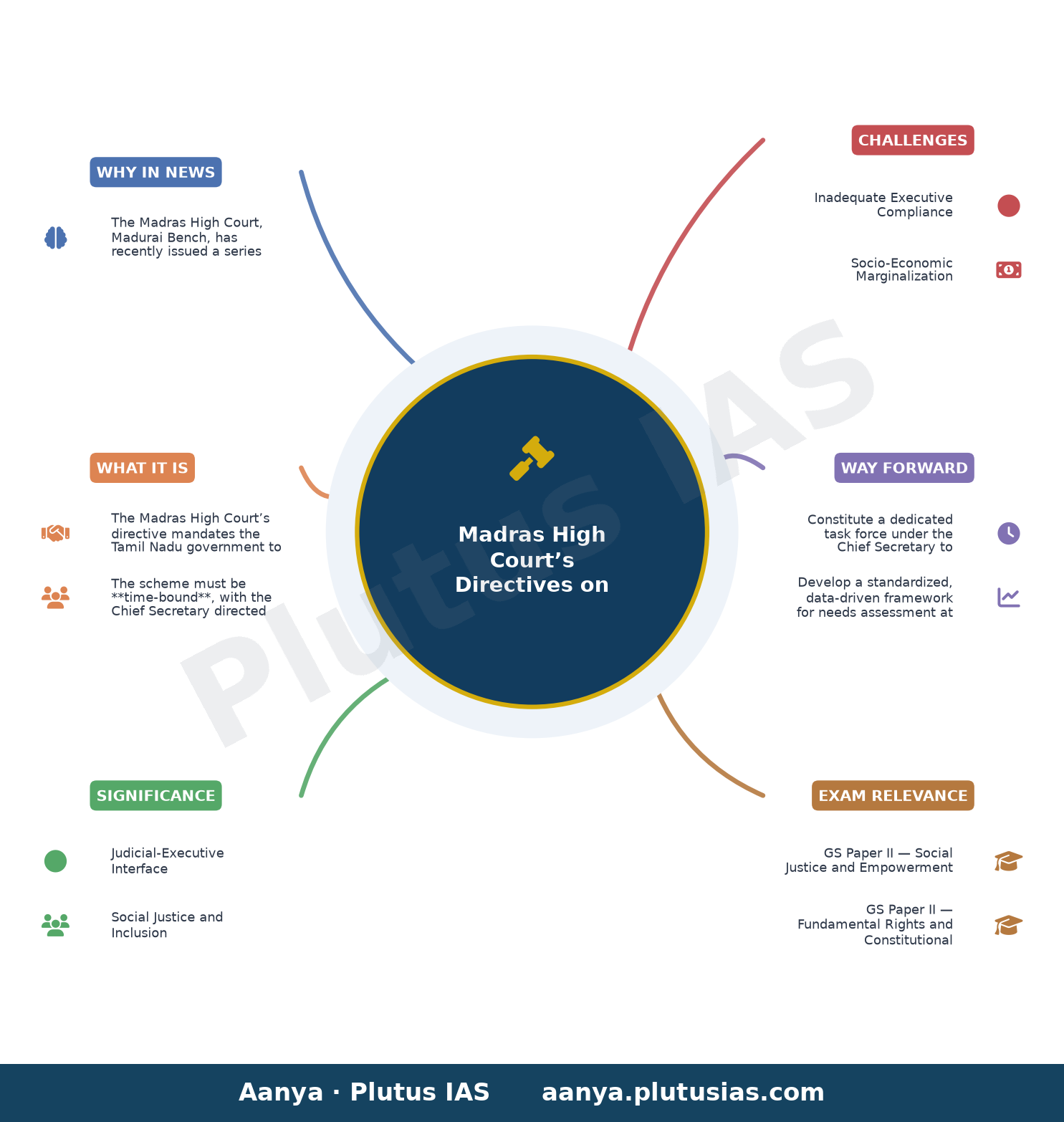
The Madras High Court, Madurai Bench, has recently issued a series of directives to the Tamil Nadu government, compelling the formulation and implementation of a comprehensive rehabilitation scheme for transgender persons at the taluk level. This judicial intervention underscores the persistent gap between constitutional guarantees and ground-level implementation, particularly in ensuring livelihood, dignity, and socio-economic inclusion for transgender communities. The court’s suo motu cognisance of systemic failures and its insistence on time-bound compliance reflect a critical juncture in the realisation of transgender rights in India.
Background
- The Supreme Court’s landmark judgment in *National Legal Services Authority (NALSA) vs Union of India* (2014) affirmed transgender persons as a ‘third gender’ and directed the Centre and State governments to grant them legal recognition and welfare measures, including reservation in education and employment.
- The Transgender Persons (Protection of Rights) Act, 2019, was enacted to provide a legal framework for the protection of rights and welfare of transgender persons, including provisions for self-identification, anti-discrimination, and welfare schemes.
- Tamil Nadu has historically been a pioneer in transgender welfare, establishing the Tamil Nadu Transgender Welfare Board in 2008, followed by the Tamil Nadu Transgender Persons (Protection of Rights) Rules, 2022, which mandate reservations in government jobs and educational institutions.
- Despite legislative and policy frameworks, ground-level implementation remains deficient, with transgender persons facing systemic barriers in accessing education, healthcare, employment, and social security.
- The court’s order aligns with the constitutional mandate under Articles 15(2) and 21, which prohibit discrimination and guarantee the right to life and dignity, respectively.
What is the Madras High Court’s Directive on Transgender Rehabilitation?
- The Madras High Court’s directive mandates the Tamil Nadu government to formulate a **comprehensive rehabilitation scheme for transgender persons at the taluk level**, ensuring self-employment opportunities, sustainable livelihoods, and dignified living conditions.
- The scheme must be **time-bound**, with the Chief Secretary directed to coordinate across all departments (e.g., Social Welfare, Labour, Education, Health) for effective implementation and to file a compliance report by August 21, 2026.
- The court emphasised the need for **meaningful inclusion** of transgender persons in society, addressing historical injustices and socio-economic marginalisation through targeted welfare measures.
- The directive recognises the **intersectional vulnerabilities** of transgender persons, particularly those from marginalised castes or economically weaker sections, and calls for tailored welfare schemes.
- The directive underscores the **judiciary’s proactive role** in ensuring constitutional rights are not merely paper promises but are translated into ground-level realities through judicial oversight.
- The court’s intervention reflects a broader trend of **judicial activism in social justice**, where the judiciary steps in to correct systemic failures when executive and legislative actions are inadequate.
Key Features
| Feature | Significance |
|---|---|
| Comprehensive rehabilitation scheme at taluk level | Ensures localized, grassroots-level implementation of welfare measures, addressing the unique socio-economic challenges faced by transgender persons in rural and semi-urban areas. |
| Self-employment and sustainable livelihood avenues | Promotes economic independence and dignity by creating job opportunities tailored to the skills and needs of transgender individuals. |
| Coordination among departments | Facilitates inter-departmental synergy to streamline service delivery, avoiding fragmentation and ensuring holistic support. |
| Time-bound compliance reporting | Imposes accountability on the executive branch, ensuring timely execution of judicial directives. |
| Judicial monitoring of socio-economic conditions | Highlights systemic failures and compels the state to address historical injustices through legal intervention. |
Why it Matters
Judicial-Executive Interface
- Demonstrates the judiciary’s proactive role in safeguarding the rights of marginalized communities, particularly when executive action is inadequate.
- Sets a precedent for judicial oversight in socio-economic welfare schemes, ensuring constitutional principles of equality and dignity are upheld.
- Highlights the tension between judicial activism and executive accountability, underscoring the need for collaborative governance.
Social Justice and Inclusion
- Reaffirms the state’s obligation to address systemic discrimination against transgender persons, aligning with constitutional guarantees under Articles 14, 15, and 16.
- Emphasizes the importance of inclusive policies that go beyond tokenism to ensure meaningful participation in society.
- Serves as a model for other states to replicate or adapt, fostering national-level standardization of transgender welfare measures.
Policy Implementation Challenges
- Exposes gaps in grassroots-level policy execution, particularly in rural and semi-urban areas where administrative reach is limited.
- Underscores the need for capacity-building within local governance structures to handle sensitive and specialized welfare programs.
- Highlights the role of civil society and community-based organizations in bridging the implementation deficit.
Economic Empowerment
- Links social justice to economic independence, recognizing that sustainable livelihoods are critical to breaking cycles of poverty and exclusion.
- Encourages the state to invest in skill development and entrepreneurship programs tailored to transgender persons.
- Illustrates how economic empowerment can reduce vulnerability to exploitation and discrimination.
Challenges
1. Inadequate Executive Compliance
- The Chief Secretary’s initial status report failed to demonstrate compliance with the court’s directives, indicating systemic inertia or lack of prioritization.
- Delays in filing compliance reports reflect bureaucratic inefficiencies and a disconnect between judicial directives and ground-level execution.
- Highlights the need for stronger mechanisms to monitor and enforce judicial orders.
UPSC Link: Judicial Activism vs Executive Accountability
2. Socio-Economic Marginalization
- Transgender persons face entrenched discrimination in education, employment, and healthcare, exacerbating poverty and social exclusion.
- Rural and taluk-level implementation is particularly challenging due to limited awareness, resources, and institutional support.
- Historical injustices, including systemic exclusion, require targeted interventions to reverse generational marginalization.
UPSC Link: Social Exclusion and Inclusive Policies
3. Inter-Departmental Coordination
- Effective implementation demands seamless coordination between departments such as Social Welfare, Health, Education, and Labour.
- Fragmented governance structures often lead to overlapping mandates, duplication of efforts, or critical gaps in service delivery.
- Requires institutional mechanisms like inter-departmental committees or dedicated nodal agencies to streamline action.
UPSC Link: Governance and Policy Coordination
4. Awareness and Sensitization
- Lack of awareness among officials and the public about transgender rights and needs hampers policy implementation.
- Sensitization programs for government staff, law enforcement, and healthcare providers are essential but often neglected.
- Community-led awareness campaigns can bridge this gap but require sustained support and funding.
UPSC Link: Social Awareness and Inclusive Governance
5. Data and Monitoring Gaps
- Absence of disaggregated data on transgender persons impedes evidence-based policymaking and targeted interventions.
- Lack of real-time monitoring mechanisms makes it difficult to assess the impact of rehabilitation schemes.
- Need for robust data collection systems and periodic evaluations to ensure accountability and course correction.
UPSC Link: Data-Driven Governance and Monitoring
Challenges — UPSC Perspective
| Issue | Concern |
|---|---|
| Bureaucratic inertia | Delays in compliance reporting and implementation reflect systemic resistance or lack of prioritization. |
| Limited administrative reach | Taluk-level implementation is constrained by inadequate resources, staff, and institutional capacity. |
| Socio-economic barriers | Poverty, lack of education, and discrimination create compounded challenges for transgender persons. |
| Fragmented governance | Overlapping or siloed departmental mandates lead to inefficiencies and gaps in service delivery. |
| Public awareness deficit | Lack of sensitization among officials and communities undermines policy effectiveness. |
| Data scarcity | Absence of disaggregated data hinders targeted interventions and monitoring of welfare schemes. |
Way Forward
- Constitute a dedicated task force under the Chief Secretary to oversee the formulation and implementation of the taluk-level rehabilitation scheme, with clear timelines and accountability metrics.
- Develop a standardized, data-driven framework for needs assessment at the taluk level, incorporating inputs from transgender communities and civil society organizations.
- Launch multi-stakeholder sensitization programs for government officials, healthcare providers, and law enforcement to ensure inclusive and non-discriminatory service delivery.
- Establish a real-time monitoring mechanism, including periodic compliance audits and public disclosure of progress reports to enhance transparency.
- Allocate dedicated budgetary provisions for skill development, entrepreneurship grants, and healthcare access tailored to the needs of transgender persons.
- Strengthen coordination between the Social Welfare Department, Labour Department, and local self-government institutions to ensure holistic support.
- Institute a grievance redressal system at the taluk level, with dedicated helplines and community liaisons to address implementation challenges promptly.
- Collaborate with educational institutions and vocational training centers to create inclusive pathways for transgender persons to access education and employment.
UPSC Value Addition
Keywords for Mains Answer-Writing
Transgender Persons (Protection of Rights) Act, 2019 · Madras High Court directives on transgender welfare · Taluk-level rehabilitation schemes for marginalised groups · Judicial activism in socio-economic rights · Sustainable livelihoods for transgender persons · Right to life and dignity under Article 21 · Institutional mechanisms for social inclusion · Judicial review of executive inaction · Socio-economic marginalisation of transgender communities · Constitutional guarantees for vulnerable sections
Constitutional & Policy Linkages
- Article 14 (Right to Equality) – Ensures non-discrimination and equal protection under law for transgender persons.
- Article 15 (Prohibition of Discrimination) – Prohibits discrimination on grounds of gender identity and mandates affirmative action.
- Article 16 (Equality of Opportunity) – Guarantees equal opportunity in public employment and services.
- Article 21 (Right to Life and Personal Liberty) – Includes the right to dignity and means of livelihood.
Concept Flow
Historical exclusion and systemic discrimination → Judicial recognition of rights (Articles 14, 15, 16, 21) → Madras HC’s directive for taluk-level rehabilitation → Executive inaction and non-compliance → Judicial monitoring and time-bound compliance → Need for inter-departmental coordination and localized implementation → Socio-economic empowerment through self-employment and welfare schemes → Long-term inclusion and dignity.
Prelims Practice Questions
Q1. Consider the following statements regarding the Transgender Persons (Protection of Rights) Act, 2019:
1. It mandates the formulation of welfare schemes for transgender persons at the district level.
2. It provides for the establishment of a National Council for Transgender Persons.
3. It criminalises begging by transgender persons as a means of livelihood.
How many of the above statements are correct?
- Only one
- Only two
- All three
- None
Answer: Only two — Statement 1 is correct as the Act requires state governments to formulate welfare schemes. Statement 2 is correct as the Act establishes a National Council. Statement 3 is incorrect as the Act does not criminalise begging.
Q2. Assertion (A): The Madras High Court directed the Tamil Nadu government to formulate a comprehensive rehabilitation scheme for transgender persons at the taluk level.
Reason (R): The court observed that justice had not been adequately delivered to transgender persons due to socio-economic marginalisation.
- Both A and R are true, and R is the correct explanation of A
- Both A and R are true, but R is not the correct explanation of A
- A is true but R is false
- A is false but R is true
Answer: Both A and R are true, and R is the correct explanation of A — Both the assertion and reason are true, and the reason correctly explains the assertion as the court’s directive was a response to the socio-economic marginalisation of transgender persons.
Q3. Match the following provisions of the Transgender Persons (Protection of Rights) Act, 2019 with their corresponding objectives:
Column I (Provision)
A. Section 15
B. Section 16
C. Section 18
Column II (Objective)
1. Prohibition of discrimination
2. Welfare schemes and measures
3. National Council for Transgender Persons
- A-1, B-2, C-3
- A-2, B-3, C-1
- A-3, B-1, C-2
- A-1, B-3, C-2
Answer: A-1, B-2, C-3 — Section 15 prohibits discrimination, Section 16 mandates welfare schemes, and Section 18 establishes the National Council.
Mains Practice Question
✍ The Madras High Court has recently directed the Tamil Nadu government to formulate a comprehensive rehabilitation scheme for transgender persons at the taluk level, emphasising self-employment, sustainable livelihoods, and meaningful social inclusion. Critically analyse the constitutional and statutory framework governing the rights of transgender persons in India, and evaluate the role of judicial directives in ensuring their socio-economic empowerment. (15 Marks)
Approach: Introduction: Briefly state the context of the Madras High Court’s directive and its significance in addressing historical injustices faced by transgender persons. Constitutional Framework: Discuss Article 21 (right to life and dignity), Article 14 (equality), and Article 15(2) (prohibition of discrimination) as the foundational rights for transgender persons. Statutory Framework: Analyse the Transgender Persons (Protection of Rights) Act, 2019, focusing on Sections 15 (non-discrimination), 16 (welfare schemes), and 18 (National Council for Transgender Persons). Highlight the Act’s strengths and limitations, such as the lack of mandatory timelines for scheme implementation. Judicial Role: Examine the Supreme Court’s landmark judgment in *National Legal Services Authority v. Union of India* (2014) and the Madras High Court’s recent directive as examples of judicial activism in safeguarding transgender rights. Discuss how judicial directives can bridge gaps in executive implementation. Socio-Economic Empowerment: Evaluate the role of taluk-level rehabilitation schemes in providing self-employment opportunities, access to education, healthcare, and essential resources. Cite examples of successful state-level initiatives, such as Kerala’s ‘Sahayatra’ project. Challenges and Way Forward: Discuss challenges like lack of awareness, bureaucratic delays, and social stigma. Suggest measures such as mandatory periodic reviews, capacity-building for officials, and community participation in scheme formulation. Conclusion: Summarise the need for a multi-stakeholder approach involving the judiciary, executive, and civil society to ensure meaningful inclusion and empowerment of transgender persons.
Source: The Hindu
Generated by AanyaAi for educational purpose.

- महाराष्ट्र में त्योहार जुलूसों पर बॉम्बे हाईकोर्ट का बड़ा फैसला: पटाखे, लेजर और संगीत पर रोक - September 24, 2026
- Bombay HC Bans Firecrackers, Music in Maharashtra Processions: Key UPSC Analysis - September 24, 2026
- तमिलनाडु में महिला कर्मचारियों के लिए सवैतनिक माहवारी अवकाश नीति पर HC का आदेश - September 24, 2026

No Comments