


09 Aug UPSC Alert: SAD Backs Women Reservation Bill, Demands Immediate Implementation
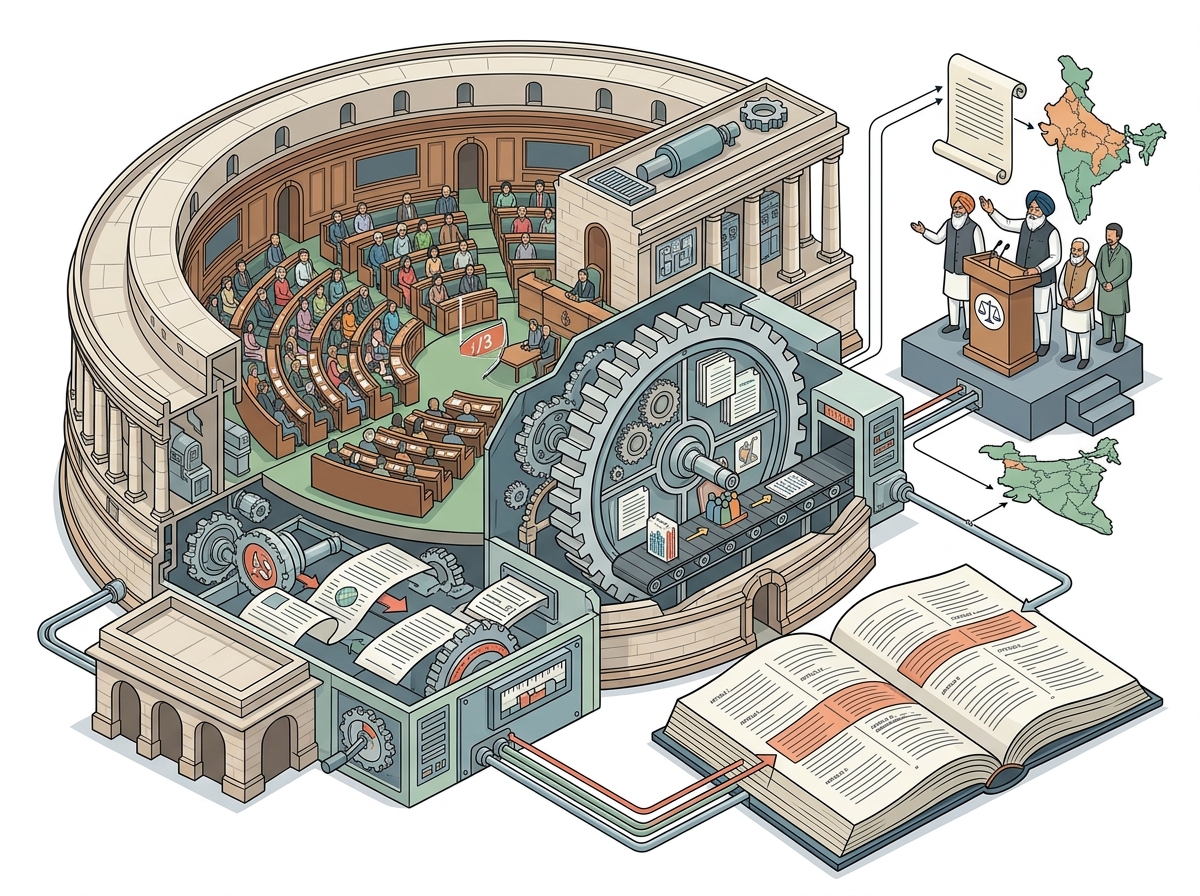
✎ The 128th Constitutional Amendment Act, 2023 (Women’s Reservation Bill) reserves one-third of seats in Parliament and State Legislatures for women, while delimitation—mandated by Article 82—ensures equitable constituency…
Subject Relevance — Where This Topic Fits
- GS Paper II — Constitutional and Non-Constitutional Bodies (Role of Parliament and State Legislatures) | GS Paper II — Government Policies and Interventions for Development in various sectors
- Prelims: 103rd Constitutional Amendment Act, 2019, Article 334A (Women’s Reservation), Delimitation Commission, Article 82 (Readjustment after each census), Concurrent List (Entry 50: Delimitation)
- Essay: Representation and Empowerment: The Case for Women in Indian Democracy, Balancing Representation with Governance: Lessons from Constitutional Amendments
Quick Revision: The 128th Constitutional Amendment Act, 2023 (Women’s Reservation Bill) reserves one-third of seats in Parliament and State Legislatures for women, while delimitation—mandated by Article 82—ensures equitable constituency boundaries based on population data.
Why is this in the news?
The Shiromani Akali Dal (SAD) has publicly endorsed the Women’s Reservation Bill and supported the delimitation process, urging the Union Government to implement the Bill without delay. This development assumes significance as it reflects a cross-party consensus on women’s political empowerment, while also highlighting the procedural challenges tied to delimitation, which is constitutionally mandated post-census. The SAD’s stance, articulated by senior leader Gulzar Singh Ranike and party president Sukhbir Singh Badal, underscores the intersection of political pragmatism, constitutional obligations, and social justice in India’s electoral framework.
Background
- The Women’s Reservation Bill, originally introduced in the Lok Sabha in 1996 as the 81st Amendment Bill, seeks to reserve one-third of seats in the Lok Sabha and State Legislative Assemblies for women.
- The Bill was passed by the Rajya Sabha in 2010 but lapsed due to lack of concurrence in the Lok Sabha. It was reintroduced in 2023 and passed by both Houses in September 2023, receiving Presidential assent as the 128th Constitutional Amendment Act on 28 September 2023.
- Delimitation refers to the process of redrawing the boundaries of electoral constituencies based on the latest census data. It is constitutionally mandated under Article 82 and is conducted by a Delimitation Commission appointed by the President.
- The last delimitation exercise was conducted in 2002–2008 based on the 2001 Census. The next delimitation is constitutionally due after the 2031 Census, but the government has proposed advancing it to ensure equitable representation in light of population changes.
- The SAD’s endorsement of both the Women’s Reservation Bill and delimitation reflects its alignment with Sikh principles of gender equality, as articulated in the teachings of Sikh Gurus, who emphasized the dignity and rights of women.
What is the Women’s Reservation Bill and its linkage with Delimitation?
- The Women’s Reservation Bill, formally known as the 128th Constitutional Amendment Act, 2023, reserves one-third of seats in the Lok Sabha, State Legislative Assemblies, and the Legislative Assemblies of NCT of Delhi and Puducherry for women. This reservation applies to seats filled by direct election and is rotated among constituencies in a manner determined by law.
- The reservation is for a period of 15 years from the date of commencement of the Act (28 September 2023), after which Parliament may extend it. The Bill does not reserve seats for women within the Scheduled Castes (SCs) and Scheduled Tribes (STs); however, it mandates that one-third of the seats reserved for SCs and STs shall be reserved for women.
- Delimitation is the process of redrawing the boundaries of electoral constituencies to reflect changes in population distribution. It is a constitutional requirement under Article 82, which mandates that the boundaries of constituencies shall be readjusted after each census.
- The Delimitation Commission, constituted under the Delimitation Act, 2002, is responsible for this exercise. The Commission determines the number of seats in each state and the boundaries of constituencies, ensuring that each constituency has approximately equal population.
- The linkage between the Women’s Reservation Bill and delimitation arises because the reservation of seats for women must be implemented within the framework of delimited constituencies. The Bill’s operationalisation requires the completion of the delimitation process to ensure fair and equitable representation.
- The SAD’s support for both the Bill and delimitation underscores the need for a transparent and inclusive process. The party has emphasised that delimitation must be fair, unbiased, and reflective of demographic changes to prevent any state from being disproportionately affected.
- The Bill and delimitation are intertwined with the broader discourse on electoral reforms, including the demand for simultaneous elections, the use of technology in voting, and the need for greater representation of marginalised groups in the political process.
- The SAD’s invocation of Sikh principles highlights the cultural and ethical dimensions of the debate, reinforcing the argument that women’s political empowerment is not merely a legal or constitutional imperative but also a moral one.
Key Features
| Feature | Significance |
|---|---|
| Women Reservation Bill (128th Constitutional Amendment Act, 2023) | Introduces 33% reservation for women in Lok Sabha, State Legislative Assemblies, and Delhi Legislative Assembly, aiming to enhance gender representation in governance. |
| Delimitation Process | Proposed 50% increase in parliamentary seats across states, ensuring equitable redistribution of constituencies while maintaining demographic balance. |
| Shiromani Akali Dal (SAD) Support | Demonstrates cross-party consensus on gender inclusivity, aligning with the Sikh principle of gender equality as espoused by Sikh Gurus. |
| Punjab’s Stake in Delimitation | Ensures fair representation of Punjab’s demographic diversity, preventing marginalization of any community in the state’s political landscape. |
| Centre-State Coordination | Highlights the necessity of federal cooperation for implementing constitutional amendments and administrative reforms. |
Why it Matters
Political
- Strengthens democratic inclusivity by addressing gender imbalance in legislative bodies, fostering equitable governance.
- Demonstrates SAD’s commitment to progressive policies, potentially influencing electoral strategies of other regional parties.
- Sets a precedent for inter-party collaboration on constitutional amendments, enhancing legislative efficiency.
Constitutional
- Reinforces the constitutional mandate of equality (Article 14) and non-discrimination (Article 15) through affirmative action.
- Aligns with the Directive Principles of State Policy (Article 38, 39) promoting social justice and gender parity.
- Ensures compliance with the 73rd and 74th Constitutional Amendments, which mandate women’s reservation in local bodies.
Social
- Promotes women’s empowerment by increasing their political participation, thereby influencing policy decisions that affect them.
- Challenges patriarchal norms in political structures, fostering a more inclusive societal framework.
- Encourages younger and diverse female leadership, diversifying political discourse and priorities.
Challenges
1. Implementation Delays
- Pending notification of delimitation orders post-Census 2021, which is constitutionally mandated for seat redistribution.
- Potential legal challenges from states or communities opposing seat redistribution or reservation quotas.
- Bureaucratic inertia and procedural bottlenecks in executing constitutional amendments.
UPSC Link: GS-II: Constitutional Amendments
2. Political Opposition
- Resistance from political factions perceiving reservation as a threat to their electoral dominance.
- Regional parties may prioritize local interests over national consensus, complicating implementation.
- Lack of consensus on delimitation criteria, such as population vs. geographical representation.
UPSC Link: GS-II: Centre-State Relations
3. Resource Allocation
- Increased financial burden on states for electoral infrastructure adjustments (e.g., polling booths, voter lists).
- Need for capacity-building among newly elected women representatives to ensure effective governance.
- Potential disparities in resource distribution across states during delimitation.
UPSC Link: GS-II: Federalism
4. Gender Stereotypes
- Deep-rooted societal biases may undermine the effectiveness of reservation, leading to tokenism rather than genuine empowerment.
- Lack of mentorship and support systems for women entering politics, hindering their long-term participation.
- Cultural resistance in certain regions, particularly those with conservative social norms.
UPSC Link: GS-I: Social Empowerment
Challenges — UPSC Perspective
| Issue | Concern |
|---|---|
| Legal Challenges | Potential petitions in courts against delimitation orders or reservation quotas on grounds of unconstitutionality. |
| State-Level Resistance | States may delay or dilute implementation due to political or administrative hurdles. |
| Data Accuracy | Reliance on Census 2021 data for delimitation, which may face delays or inaccuracies in enumeration. |
| Political Polarization | Partisan debates over reservation quotas could escalate into broader electoral conflicts. |
| Administrative Capacity | States may lack the institutional framework to execute delimitation and reservation smoothly. |
| Public Awareness | Insufficient sensitization of stakeholders (e.g., political parties, voters) on the objectives and benefits of reservation. |
Way Forward
- Constitute a high-powered committee under the Election Commission of India to expedite delimitation processes in consultation with states.
- Ensure timely publication of Census 2021 data to facilitate accurate seat redistribution and reservation implementation.
- Launch nationwide awareness campaigns to educate political parties and voters on the rationale and benefits of women’s reservation.
- Strengthen institutional support for women representatives through training programs in governance and leadership.
- Encourage cross-party dialogues to build consensus on delimitation criteria and address regional concerns.
- Monitor implementation progress through periodic reviews by the Ministry of Law and Justice and the Election Commission.
- Promote gender-sensitive electoral reforms, including gender audits of political manifestos and party structures.
- Foster collaboration between the Centre and states to address administrative and financial bottlenecks in implementation.
UPSC Value Addition
Keywords for Mains Answer-Writing
Women’s Reservation Bill 2023 · Constitution (108th Amendment) Bill · Delimitation Commission · Article 330A · 128th Constitutional Amendment Act · Political representation of women · Parliamentary form of government · Federalism and reservation · Sikh Gurus’ teachings on gender equality · Shiromani Akali Dal (SAD) · Political parties and women’s empowerment · Public interest litigation and reservation policies · Representation of States in Parliament
Constitutional & Policy Linkages
- {‘Article 14’: ‘Right to Equality’}
- {‘Article 15’: ‘Prohibition of Discrimination’}
- {‘Article 38’: ‘Directive Principle of State Policy (Social Justice)’}
- {‘Article 39’: ‘Directive Principle of State Policy (Gender Equality)’}
- {‘Article 243D’: ‘Women’s Reservation in Local Bodies (73rd Amendment)’}
- {‘Article 243T’: ‘Women’s Reservation in Municipalities (74th Amendment)’}
Concept Flow
Women’s Reservation Bill passed (2023) → Requires Census 2021 for delimitation → Delimitation increases seats by 50% → Ensures equitable representation → Implementation delays due to legal/political challenges → Need for Centre-State coordination → Strengthens democratic inclusivity and gender parity.
Prelims Practice Questions
Q1. Consider the following statements regarding the Women’s Reservation Bill:
1. The Bill seeks to reserve one-third of the seats for women in the Lok Sabha and State Legislative Assemblies.
2. The reservation will be implemented immediately after the Bill is passed by Parliament.
3. The Bill provides for a 50% increase in the number of parliamentary seats in all States.
4. The reservation will be rotated among different constituencies after every general election.
How many of the above statements are correct?
- Only one
- Only two
- Only three
- All four
Answer: Only two — Only statement 1 is correct. The Women’s Reservation Bill reserves one-third of seats for women in the Lok Sabha and State Legislative Assemblies (Art. 330A). Statement 2 is incorrect as the reservation will be implemented post-delimitation. Statement 3 is incorrect as the Bill does not propose a 50% increase in seats. Statement 4 is incorrect as the reservation is not rotational.
Q2. Assertion (A): The Women’s Reservation Bill is constitutionally valid as it falls within the ambit of Article 15(3) of the Constitution.
Reason (R): Article 15(3) empowers the State to make special provisions for women and children.
In the context of the above two statements, which one of the following is correct?
- Both A and R are true, and R is the correct explanation of A
- Both A and R are true, but R is not the correct explanation of A
- A is true, but R is false
- A is false, but R is true
Answer: Both A and R are true, and R is the correct explanation of A — Both the Assertion (A) and Reason (R) are true. The Women’s Reservation Bill is constitutionally valid under Article 15(3), which allows the State to make special provisions for women. The Reason (R) correctly explains the Assertion (A).
Q3. Match the following provisions with their respective constitutional articles:
Column I (Provision) | Column II (Article)
— | —
A. Reservation of seats for women in Lok Sabha and State Legislative Assemblies | 1. Article 330A
B. Reservation of seats for Scheduled Castes and Scheduled Tribes | 2. Article 332
C. Prohibition of discrimination on grounds of religion, race, caste, sex, or place of birth | 3. Article 15(1)
D. Empowerment of Parliament to make laws for the implementation of the Bill | 4. Article 334
Select the correct match:
- A-1, B-2, C-3, D-4
- A-2, B-1, C-4, D-3
- A-3, B-4, C-1, D-2
- A-4, B-3, C-2, D-1
Answer: A-1, B-2, C-3, D-4 — The correct match is: A-1 (Reservation of seats for women in Lok Sabha and State Legislative Assemblies under Article 330A), B-2 (Reservation of seats for Scheduled Castes and Scheduled Tribes under Article 332), C-3 (Prohibition of discrimination under Article 15(1)), and D-4 (Empowerment of Parliament under Article 334).
Mains Practice Question
✍ ‘The Women’s Reservation Bill, 2023, represents a significant step towards achieving substantive gender equality in Indian democracy.’ Critically examine this statement with reference to the constitutional provisions, political processes, and contemporary debates surrounding the Bill. Also, analyse the implications of delimitation and the role of political parties in ensuring its effective implementation. (15 Marks)
Approach: MODEL-ANSWER SKELETON:
1. **Introduction** (2 marks): Define the Women’s Reservation Bill, 2023 (128th Constitutional Amendment Act), and its primary objective of reserving one-third of seats for women in the Lok Sabha and State Legislative Assemblies. Mention its historical context, including the 108th Constitutional Amendment Bill introduced in 2010.
2. **Constitutional Provisions and Legal Framework** (3 marks):
– Cite Article 330A (inserted by the 108th Amendment) which provides for reservation of seats for women.
– Reference Article 15(3) which empowers the State to make special provisions for women.
– Discuss the role of the Delimitation Commission under Article 82 and the need for a constitutional amendment to implement delimitation.
3. **Political Processes and Contemporary Debates** (4 marks):
– Examine the political consensus required for the Bill’s passage, including the role of the Shiromani Akali Dal (SAD) and its demand for immediate implementation.
– Discuss the opposition’s concerns, such as the potential misuse of reservation and the need for a transparent delimitation process.
– Reference the Sikh Gurus’ teachings on gender equality as cited by SAD leader Sukhbir Singh Badal to highlight the cultural and ethical dimensions of the Bill.
4. **Implications of Delimitation** (3 marks):
– Explain the delimitation process, its objectives, and its necessity for fair representation.
– Discuss the challenges, including the potential for demographic shifts and the need for a fair and transparent process.
– Analyse the role of the Delimitation Commission in ensuring that the process is conducted impartially.
5. **Role of Political Parties** (2 marks):
– Evaluate the role of political parties in supporting or opposing the Bill, with a focus on the BJP-SAD alliance dynamics.
– Discuss the need for political will and consensus to ensure the Bill’s effective implementation.
6. **Conclusion** (1 mark): Summarise the significance of the Bill in achieving gender equality and the challenges that remain in its implementation. Emphasise the need for a balanced approach that addresses both the symbolic and substantive aspects of representation.
Source: amarujala.com
Generated by AanyaAi for educational purpose.

- मद्रास उच्च न्यायालय में 15 नए न्यायाधीशों ने ली शपथ, कार्यबल बढ़कर 66 हुआ - August 9, 2026
- 15 New Judges Sworn In: Madras HC Strength Rises to 66 - August 9, 2026
- एआई से भारत में स्वास्थ्य सेवाओं की कमी दूर करने की संभावना: रिपोर्ट - August 9, 2026

No Comments