


09 Aug Madras HC Orders Taluk-Level Rehabilitation Scheme for Transpersons: Key Facts for UPSC
✎ The Madras High Court’s directive to the Tamil Nadu government to formulate a taluk-level rehabilitation scheme for transgender persons is a judicial intervention to ensure constitutional guarantees of dignity, equality, and…
Subject Relevance — Where This Topic Fits
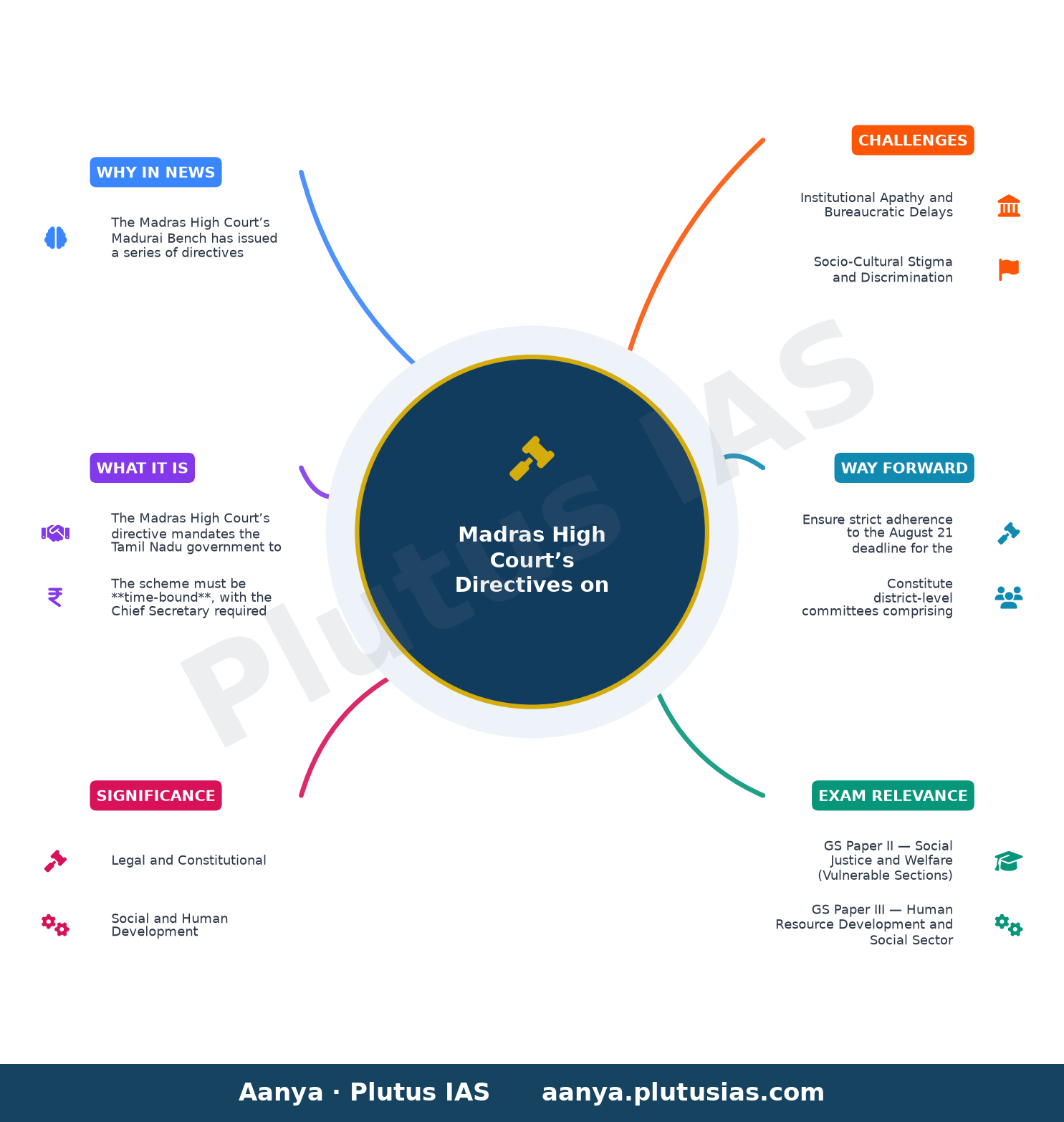
- GS Paper II — Social Justice and Welfare (Vulnerable Sections) | GS Paper III — Human Resource Development and Social Sector Initiatives
- Prelims: Transgender Persons (Protection of Rights) Act, 2019, National Portal for Transgender Persons, Article 15(2) and 21 of the Constitution, Directive Principles of State Policy (Articles 38, 39, 41, 46), Tamil Nadu Transgender Welfare Board, Taluk-level governance and decentralised implementation, Sustainable Livelihoods and Self-Employment Schemes, Judicial Activism in Social Justice
- Essay: The Role of Judiciary in Ensuring Social Justice: A Case Study of Transgender Rights, Decentralisation and Inclusive Governance: Bridging the Gap Between Policy and Implementation
Quick Revision: The Madras High Court’s directive to the Tamil Nadu government to formulate a taluk-level rehabilitation scheme for transgender persons is a judicial intervention to ensure constitutional guarantees of dignity, equality, and socio-economic inclusion under Articles 14, 15, 16, and 21.
Why is this in the news?
The Madras High Court’s Madurai Bench has issued a series of directives to the Tamil Nadu government, compelling the formulation and implementation of a comprehensive rehabilitation scheme for transgender persons at the taluk level. This judicial intervention underscores the persistent gaps in policy execution and the judiciary’s proactive role in safeguarding the constitutional rights of marginalised communities. The court’s emphasis on self-employment, sustainable livelihoods, and dignified inclusion highlights systemic deficiencies in existing welfare mechanisms and the urgent need for structural reforms.
Background
- The Transgender Persons (Protection of Rights) Act, 2019, was enacted to address discrimination and ensure socio-economic empowerment of transgender persons, but its implementation has been uneven across states.
- Despite legislative and administrative measures, studies indicate that over 80% of transgender persons in India lack stable employment, and access to education and healthcare remains severely constrained due to social stigma and systemic barriers.
- The National Human Rights Commission (NHRC) and the Supreme Court, in *National Legal Services Authority (NALSA) v. Union of India (2014)*, have repeatedly emphasised the state’s obligation to protect transgender rights under Articles 14, 15, 16, 19, and 21 of the Constitution.
- The Madras High Court’s order builds upon earlier directives in *S. Swapna v. State of Tamil Nadu (2021)*, where the court mandated the establishment of transgender welfare boards and the formulation of state-specific rehabilitation schemes.
- The court’s observation of ‘cosmic sadness’ among transgender persons reflects the psychological and socio-economic trauma inflicted by decades of systemic exclusion and discrimination.
What is the Madras High Court’s Directive on Transgender Rehabilitation?
- The Madras High Court’s directive mandates the Tamil Nadu government to formulate a **comprehensive rehabilitation scheme for transgender persons at the taluk level**, ensuring self-employment opportunities, sustainable livelihoods, and dignified inclusion in society.
- The scheme must be **time-bound**, with the Chief Secretary required to file compliance reports to monitor progress, reflecting the judiciary’s role in ensuring executive accountability in social justice matters.
- The directive aligns with the **Directive Principles of State Policy (DPSP)**, particularly Articles 38 (minimising inequalities), 39 (right to livelihood), 41 (public assistance in cases of unemployment), and 46 (promotion of educational and economic interests of weaker sections).
- The court’s emphasis on **taluk-level implementation** underscores the importance of decentralised governance, ensuring that rehabilitation schemes are accessible and responsive to local socio-economic conditions.
- The court’s invocation of ‘cosmic sadness’ reflects a judicial recognition of the **psychological and emotional toll** of systemic exclusion, reinforcing the need for holistic rehabilitation beyond mere economic measures.
- The order reinforces the **judicial activism** in social justice, where courts intervene to compel executive action when constitutional and statutory obligations are not fulfilled, particularly for marginalised communities.
Key Features
| Feature | Significance |
|---|---|
| Taluk-level rehabilitation scheme | Ensures localized, accessible, and inclusive welfare measures tailored to the socio-economic realities of transgender persons, addressing systemic neglect at grassroots level. |
| Self-employment and sustainable livelihood avenues | Directs focus toward economic empowerment, reducing dependence on charity and fostering long-term financial independence for transgender individuals. |
| Inter-departmental coordination | Mandates synchronized action across departments (e.g., Social Welfare, Labour, Education) to eliminate silos and ensure holistic implementation of welfare measures. |
| Judicial monitoring and compliance reporting | Institutionalizes accountability through periodic judicial oversight, ensuring adherence to directives and timely corrective action. |
| Dignity and meaningful inclusion | Reaffirms constitutional principles of equality (Article 14) and non-discrimination (Article 15(2)) by addressing historical marginalization and socio-economic disparities. |
Why it Matters
Legal and Constitutional
- Reinforces the judicial role in upholding fundamental rights of marginalized communities, particularly under Articles 14, 15, and 21 of the Constitution.
- Sets a precedent for judicial activism in socio-economic welfare, ensuring executive accountability for constitutional obligations.
- Aligns with the Supreme Court’s 2019 verdict in *National Legal Services Authority (NALSA) v. Union of India*, which recognized transgender persons as a third gender and guaranteed their rights to equality and dignity.
Social and Human Development
- Addresses systemic exclusion by providing structured pathways for education, healthcare, and economic participation, reducing vulnerability to exploitation.
- Promotes intersectional justice by recognizing the compounded challenges faced by transgender persons, especially those from socio-economically disadvantaged backgrounds.
- Encourages societal reintegration through livelihood opportunities, countering stigma and discrimination embedded in traditional social structures.
Administrative and Governance
- Demonstrates the judiciary’s proactive engagement in governance, particularly in ensuring the implementation of welfare schemes beyond mere policy announcements.
- Highlights the need for decentralized governance in implementing social justice measures, ensuring last-mile delivery of services.
- Underscores the importance of inter-departmental synergy to avoid fragmented implementation of welfare policies.
Economic
- Fosters economic self-sufficiency among transgender persons, reducing reliance on state doles and enhancing their contribution to the economy.
- Creates a model for inclusive employment policies, which can be replicated for other marginalized groups, thereby expanding the labor force participation rate.
Challenges
1. Institutional Apathy and Bureaucratic Delays
- Historical neglect of transgender welfare by state agencies, leading to systemic inertia in policy implementation.
- Risk of tokenistic compliance without genuine ground-level execution, as evidenced by the court’s dissatisfaction with the initial status report.
UPSC Link: GS-II: Governance, Transparency & Accountability
2. Socio-Cultural Stigma and Discrimination
- Deep-rooted societal prejudices hinder acceptance and participation of transgender persons in mainstream economic and social activities.
- Lack of sensitization among local authorities and community stakeholders may undermine the scheme’s effectiveness.
UPSC Link: GS-I: Social Empowerment, Inclusion
3. Fragmented Implementation at Grassroots Level
- Taluk-level schemes risk becoming paper exercises without adequate monitoring mechanisms or local ownership.
- Insufficient data on transgender populations at the district level may lead to misallocation of resources or exclusion of beneficiaries.
UPSC Link: GS-II: Decentralization, Local Governance
4. Economic Vulnerability and Skill Gaps
- Transgender persons often lack access to formal education and vocational training, limiting their employability under self-employment schemes.
- Limited financial literacy and market access may impede their ability to sustain livelihoods independently.
UPSC Link: GS-III: Employment, Skill Development
5. Legal and Policy Ambiguities
- Overlap or gaps between central and state welfare schemes may create confusion in availing benefits.
- Ambiguity in the definition of ‘transgender persons’ across policies could lead to exclusion of non-binary or intersex individuals.
UPSC Link: GS-II: Fundamental Rights, Policy Framework
Challenges — UPSC Perspective
| Issue | Concern |
|---|---|
| Lack of sensitization programs | Perpetuates societal stigma, reducing community participation and hindering scheme uptake. |
| Inadequate budgetary allocations | Leads to suboptimal implementation, with schemes remaining underfunded for meaningful impact. |
| Absence of grievance redressal mechanisms | Prevents beneficiaries from reporting violations or seeking corrective action, undermining accountability. |
| Poor inter-departmental coordination | Results in duplication of efforts or gaps in service delivery, particularly in welfare convergence. |
| Limited awareness among beneficiaries | Transgender persons may remain unaware of available schemes or their entitlements, leading to low enrollment. |
Government Initiatives — Must-Memorise for Prelims
- Tamil Nadu Transgender Welfare Board (TNTWB) schemes (as referenced in the court order)
- Ujjwala Scheme (for livelihood support, if applicable to transgender persons in Tamil Nadu)
- PM-DAKSH Yojana (if extended to transgender persons in the state)
Way Forward
- Ensure strict adherence to the August 21 deadline for the compliance report, with detailed timelines for each department’s action points.
- Constitute district-level committees comprising transgender community representatives, NGOs, and officials to oversee scheme implementation.
- Launch targeted awareness campaigns in local languages, using community radio, social media, and grassroots networks to reach beneficiaries.
- Integrate skill development programs with existing vocational training initiatives (e.g., ITIs, NSDC) to enhance employability under self-employment schemes.
- Allocate dedicated funds in the state budget for transgender welfare, with transparent disbursement mechanisms to prevent misuse.
- Develop a real-time monitoring dashboard to track enrollment, disbursements, and grievances, ensuring data-driven governance.
- Collaborate with corporate CSR initiatives to create job opportunities and mentorship programs for transgender persons.
- Conduct periodic judicial reviews to assess progress and issue further directives if compliance remains inadequate.
UPSC Value Addition
Keywords for Mains Answer-Writing
Transgender Persons (Protection of Rights) Act, 2019 · Madras High Court judgment on transgender rehabilitation · Article 21 (Right to Life and Dignity) · Social justice and welfare measures · Intersectionality and marginalised communities · Taluk-level implementation of welfare schemes · Judicial activism in socio-economic rights · Constitutional morality and dignity · Right to self-employment and sustainable livelihood · Socio-economic inclusion of transgender persons
Constitutional & Policy Linkages
- Article 14: Equality before law and equal protection of laws
- Article 15(2): Prohibition of discrimination on grounds of religion, race, caste, sex, or place of birth
- Article 16: Equality of opportunity in public employment
- Article 21: Protection of life and personal liberty (right to dignity)
- Article 46: Promotion of educational and economic interests of weaker sections
Concept Flow
Historical marginalization of transgender persons → Recognition of rights by NALSA judgment (2019) → State obligation to formulate welfare schemes → Judicial intervention for implementation (Madras HC order) → Formulation of taluk-level rehabilitation scheme → Inter-departmental coordination for execution → Monitoring and compliance reporting → Socio-economic empowerment and inclusion
Prelims Practice Questions
Q1. Consider the following statements regarding the Transgender Persons (Protection of Rights) Act, 2019:
1. The Act provides for the formulation of welfare schemes for transgender persons at the taluk level.
2. The Act mandates the establishment of a National Council for Transgender Persons.
3. The Act criminalises begging by transgender persons.
How many of the above statements are correct?
- Only one
- Only two
- All three
- None
Answer: Only two — Statement 1 is correct as the Act empowers the government to formulate welfare schemes, though the taluk-level directive is a judicial interpretation. Statement 2 is correct as the Act establishes a National Council. Statement 3 is incorrect as the Act does not criminalise begging.
Q2. Assertion (A): The Madras High Court has directed the Tamil Nadu government to formulate a comprehensive rehabilitation scheme for transgender persons at the taluk level.
Reason (R): The court observed that justice had not been adequately done for transgender persons and took judicial notice of their socio-economic conditions.
(a) Both A and R are true, and R is the correct explanation of A.
(b) Both A and R are true, but R is not the correct explanation of A.
(c) A is true, but R is false.
(d) A is false, but R is true.
- (a)
- (b)
- (c)
- (d)
Answer: (a) — Both the assertion and reason are true. The reason correctly explains the assertion as the court’s directive was based on its observation of inadequate justice for transgender persons.
Q3. Match the following welfare measures with their respective legal or policy frameworks:
Column I
1. Right to self-employment for transgender persons
2. National Council for Transgender Persons
3. Protection against discrimination
Column II
A. Transgender Persons (Protection of Rights) Act, 2019
B. NALSA v. Union of India (2014)
C. Directive Principles of State Policy (Article 38, 39)
D. Rights of Persons with Disabilities Act, 2016
- 1-A, 2-B, 3-C
- 1-C, 2-A, 3-B
- 1-B, 2-A, 3-D
- 1-D, 2-C, 3-A
Answer: 1-C, 2-A, 3-B — 1-C: Self-employment is a socio-economic right under Articles 38 and 39. 2-A: The National Council is established under the Transgender Persons Act. 3-B: The NALSA judgment recognised the right to non-discrimination.
Mains Practice Question
✍ The Madras High Court has recently directed the Tamil Nadu government to formulate a comprehensive rehabilitation scheme for transgender persons at the taluk level, emphasising self-employment and sustainable livelihood. Critically examine the constitutional and statutory framework governing the rights of transgender persons in India, and assess the effectiveness of judicial interventions in securing their socio-economic inclusion. (15 Marks)
Approach: MODEL-ANSWER SKELETON:
1. Constitutional Foundations:
– Article 14 (Equality), Article 15(1) (Prohibition of discrimination), Article 21 (Right to Life and Dignity), and Article 19(1)(g) (Right to practise any profession) as interpreted in NALSA v. Union of India (2014) and subsequent judgments.
– Judicial recognition of the right to self-identification and non-discrimination.
2. Statutory Framework:
– Transgender Persons (Protection of Rights) Act, 2019: Key provisions (identity recognition, welfare schemes, National Council, anti-discrimination clauses).
– Transgender Persons (Protection of Rights) Rules, 2020: Implementation mechanisms.
– Critique of the Act: Limited scope of reservation, lack of penal provisions for discrimination, and ambiguity in welfare scheme formulation.
3. Judicial Interventions:
– Madras High Court’s directive: Legal reasoning (Article 21, socio-economic justice), emphasis on taluk-level implementation, and coordination with departments.
– Role of the judiciary in enforcing socio-economic rights (e.g., Right to Food case, Vishaka Guidelines).
– Limitations: Judicial activism vs. separation of powers, enforcement challenges.
4. Challenges in Implementation:
– Socio-economic barriers: Stigma, lack of access to education, healthcare, and employment.
– Structural issues: Bureaucratic delays, lack of awareness, and inadequate funding for welfare schemes.
– Intersectionality: Marginalisation compounded by caste, class, and gender identity.
5. Way Forward:
– Strengthening the National Council for Transgender Persons with statutory powers.
– State-specific schemes aligned with local socio-economic conditions.
– Awareness campaigns and capacity-building for officials and communities.
– Monitoring and grievance redressal mechanisms at the taluk level.
Balance of Views:
– Optimistic: Judicial interventions and statutory frameworks provide a strong foundation for inclusion.
– Pessimistic: Implementation gaps and structural barriers limit the impact of legal provisions.
– Realist: Gradual progress with sustained judicial and executive action.
Source: The Hindu
Generated by AanyaAi for educational purpose.

- महाराष्ट्र में त्योहार जुलूसों पर बॉम्बे हाईकोर्ट का बड़ा फैसला: पटाखे, लेजर और संगीत पर रोक - September 24, 2026
- Bombay HC Bans Firecrackers, Music in Maharashtra Processions: Key UPSC Analysis - September 24, 2026
- तमिलनाडु में महिला कर्मचारियों के लिए सवैतनिक माहवारी अवकाश नीति पर HC का आदेश - September 24, 2026

No Comments