


09 Aug How AI Can Bridge India’s Healthcare Accessibility Gap in UPSC 2026
✎ AI in healthcare is a force multiplier for specialist capacity, not a replacement for clinicians, and its success hinges on AI-ready health data, predictable regulation, and equitable reimbursement mechanisms.
Subject Relevance — Where This Topic Fits
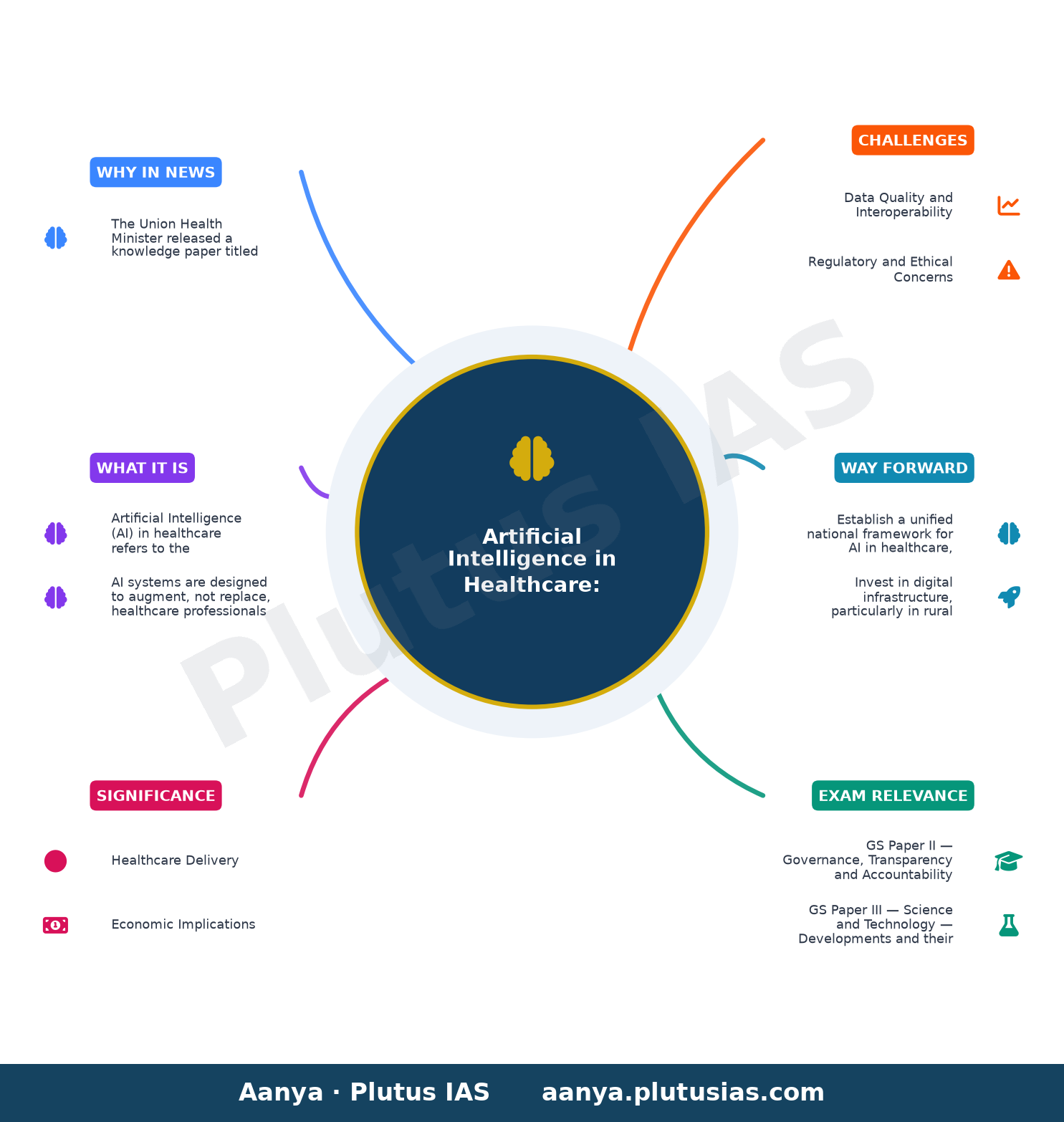
- GS Paper II — Governance, Transparency and Accountability | GS Paper III — Science and Technology — Developments and their Applications and Effects in Everyday Life
- Prelims: Ayushman Bharat Digital Mission (ABDM), IndiaAI Mission, National Medical Devices Policy 2023, SAHI initiative, BODH initiative, MRI scanner density, non-communicable diseases (NCDs) burden, Universal Health Coverage (UHC), health workforce density
- Essay: The role of technology in achieving inclusive and equitable healthcare systems, Can artificial intelligence bridge the gap between healthcare demand and supply in developing nations?
Quick Revision: AI in healthcare is a force multiplier for specialist capacity, not a replacement for clinicians, and its success hinges on AI-ready health data, predictable regulation, and equitable reimbursement mechanisms.
Why is this in the news?
The Union Health Minister released a knowledge paper titled ‘AI in MedTech: Revolutionizing Healthcare Through Artificial Intelligence’ at the 9th edition of India Medical Device 2026, highlighting AI’s potential to mitigate India’s healthcare challenges arising from demographic shifts, rising non-communicable diseases, and critical shortages in human resources and infrastructure. This underscores the government’s recognition of AI as a strategic enabler in achieving Universal Health Coverage (UHC) and improving healthcare delivery in underserved regions.
Background
- India’s healthcare system faces structural deficits, with a doctor-to-population ratio of 9.6 per 10,000, far below the global average of 18.3, and a nurse-to-population ratio of 27.2 per 10,000 against the global 40.5.
- The burden of non-communicable diseases (NCDs) such as cardiovascular diseases, diabetes, and cancer now accounts for over 65% of total deaths in India, reflecting a demographic and epidemiological transition.
- The elderly population (aged 60+) is projected to exceed 230 million by 2036, intensifying demand for long-term and specialized care.
- Despite progress in healthcare infrastructure, access remains inequitable, with rural areas and smaller hospitals lacking specialist services and advanced diagnostic tools like MRI scanners (4 per million vs. global average of 19).
- Initiatives such as the Ayushman Bharat Digital Mission (ABDM), IndiaAI Mission, SAHI, BODH, and the National Medical Devices Policy 2023 have laid the groundwork for integrating digital and AI-driven solutions in healthcare.
What is Artificial Intelligence in Healthcare?
- Artificial Intelligence (AI) in healthcare refers to the application of machine learning, natural language processing, and computer vision to analyze medical data, support clinical decision-making, and enhance diagnostic accuracy.
- AI systems are designed to augment, not replace, healthcare professionals by automating routine tasks, such as image analysis in radiology or pattern recognition in pathology, thereby increasing specialist throughput.
- AI-enabled diagnostics are identified as the first large-scale application, capable of extending specialist expertise to primary and secondary care settings, particularly in remote or underserved areas.
- The technology relies on high-quality, standardized health data for training and validation, necessitating robust digital health infrastructure and interoperable systems.
- Regulatory frameworks must ensure patient safety, data privacy, and ethical use, while reimbursement mechanisms are essential to incentivize adoption by healthcare providers and insurers.
- AI applications in healthcare include predictive analytics for disease outbreaks, personalized treatment recommendations, robotic-assisted surgeries, and chatbots for patient triage and mental health support.
- The integration of AI with telemedicine platforms can further democratize access to healthcare, enabling real-time consultations and remote diagnostics in rural and tribal regions.
- Ethical considerations such as algorithmic bias, transparency in decision-making, and accountability for AI-driven outcomes remain critical challenges in widespread adoption.
Key Features
| Feature | Significance |
|---|---|
| AI-enabled diagnostics | Extends specialist expertise to primary and secondary healthcare, improving early detection and reducing diagnostic errors. |
| Clinical decision support systems | Assists healthcare providers in evidence-based decision-making, particularly in resource-constrained settings. |
| AI-ready health data infrastructure | Facilitates interoperability and real-time analytics, enabling scalable AI applications across healthcare systems. |
| Predictable regulatory framework | Ensures safety, efficacy, and ethical use of AI tools in clinical practice, fostering trust among stakeholders. |
| Reimbursement mechanisms for AI technologies | Encourages adoption by healthcare providers through financial incentives and sustainable business models. |
Why it Matters
Healthcare Delivery
- Augments specialist capacity in diagnosis and screening, addressing the acute shortage of doctors and medical personnel in India.
- Enhances accessibility to quality healthcare in rural and underserved areas through telemedicine and AI-assisted primary care.
- Improves diagnostic accuracy and reduces human error, particularly in chronic disease management (e.g., diabetes, cardiovascular diseases).
- Supports long-term care for the ageing population by enabling predictive analytics for age-related conditions.
Economic Implications
- Reduces healthcare costs by optimizing resource allocation and minimizing unnecessary hospitalizations through early intervention.
- Creates high-skilled employment opportunities in AI, data science, and healthcare technology sectors.
- Attracts investment in MedTech and AI-driven healthcare solutions, positioning India as a global leader in health innovation.
Policy and Governance
- Aligns with the Ayushman Bharat Digital Mission (ABDM) by integrating AI into national digital health infrastructure.
- Supports the National Medical Devices Policy, 2023, by promoting indigenous development of AI-enabled medical technologies.
- Facilitates the IndiaAI Mission by leveraging AI for public health challenges, including non-communicable diseases (NCDs).
Social Equity
- Reduces urban-rural disparities in healthcare access by deploying AI tools in remote and under-resourced settings.
- Enhances affordability of specialist care through scalable AI solutions, benefiting economically weaker sections.
- Supports inclusive healthcare by enabling multilingual and culturally adaptable AI diagnostic tools.
Challenges
1. Data Quality and Interoperability
- Fragmented and incomplete health data across public and private sectors hinders the development of robust AI models.
- Lack of standardized data formats and protocols complicates integration with existing health information systems.
- Inadequate digital infrastructure in rural areas limits the collection and transmission of high-quality health data.
UPSC Link: GS-III: Health & Technology
2. Regulatory and Ethical Concerns
- Absence of a dedicated regulatory framework for AI in healthcare raises concerns about patient safety and liability.
- Ethical dilemmas arise from algorithmic bias, particularly in diagnostic tools trained on non-representative datasets.
- Need for clear guidelines on data privacy, informed consent, and the use of patient data in AI training.
UPSC Link: GS-II: Governance & Ethics
3. Human Resource and Capacity Gaps
- Shortage of skilled professionals trained in AI, data science, and healthcare technology to implement and maintain AI systems.
- Resistance from healthcare providers due to skepticism about AI replacing human expertise or adding operational complexity.
- Limited awareness among policymakers and administrators about the potential and limitations of AI in healthcare.
UPSC Link: GS-III: Human Resource Development
4. Financial and Infrastructure Constraints
- High initial costs of deploying AI technologies, including hardware, software, and training, pose barriers for public healthcare systems.
- Uneven distribution of AI-enabled medical devices and internet connectivity across states and districts.
- Limited reimbursement policies for AI-driven diagnostics and treatments discourage private sector participation.
UPSC Link: GS-III: Health Economics
5. Public Trust and Acceptance
- Skepticism among patients and healthcare providers about the reliability and transparency of AI-driven decisions.
- Cultural and linguistic barriers may reduce acceptance of AI tools, particularly in diverse and rural populations.
- Need for robust mechanisms to address misinformation and build confidence in AI-enabled healthcare solutions.
UPSC Link: GS-II: Social Justice
Challenges — UPSC Perspective
| Issue | Concern |
|---|---|
| Data privacy and security | Risk of breaches and misuse of sensitive health data in AI applications. |
| Algorithmic bias | Potential for diagnostic tools to perform poorly on underrepresented demographic groups. |
| High implementation costs | Financial barriers to scaling AI solutions in public healthcare systems. |
| Regulatory gaps | Lack of clear guidelines for approval, monitoring, and reimbursement of AI tools. |
| Digital divide | Unequal access to AI-enabled healthcare due to infrastructure disparities. |
| Workforce resistance | Lack of training and awareness among healthcare professionals about AI integration. |
Government Initiatives — Must-Memorise for Prelims
- Ayushman Bharat Digital Mission (ABDM)
- IndiaAI Mission
- National Medical Devices Policy, 2023
- SAHI (Scalable AI for Health Innovation)
- BODH (Bridging Operational Gaps through Digital Health)
Way Forward
- Establish a unified national framework for AI in healthcare, integrating data standards, regulatory protocols, and reimbursement policies.
- Invest in digital infrastructure, particularly in rural and tribal areas, to ensure reliable data collection and transmission for AI applications.
- Develop capacity-building programs to train healthcare professionals in AI literacy and the ethical use of AI tools.
- Promote public-private partnerships to accelerate the deployment of AI-enabled diagnostics and telemedicine in underserved regions.
- Formulate clear ethical guidelines to address algorithmic bias, data privacy, and informed consent in AI-driven healthcare.
- Encourage indigenous research and development in AI for healthcare through grants, incubators, and collaboration with academic institutions.
- Implement pilot projects in high-burden states to demonstrate the cost-effectiveness and scalability of AI solutions before nationwide rollout.
- Strengthen surveillance mechanisms to monitor the performance and impact of AI tools on health outcomes and equity.
UPSC Value Addition
Keywords for Mains Answer-Writing
Artificial Intelligence in healthcare · Ayushman Bharat Digital Mission · IndiaAI Mission · Non-communicable diseases in India · Healthcare workforce shortage in India · AI-enabled diagnostics · Medical device policy 2023 · Health data governance · Universal Health Coverage · Regulatory framework for AI in medicine · Chronic disease burden in India · Healthcare infrastructure gaps · AI in public health · National Medical Devices Policy 2023 · SAHI and BODH initiatives
Concept Flow
Rising burden of non-communicable diseases (NCDs) and ageing population → Increased demand for specialist healthcare → Shortage of doctors and medical personnel → Pressure on healthcare infrastructure. → Expansion of digital health initiatives (e.g., ABDM) → Availability of structured health data → Feasibility of AI integration in healthcare. → AI adoption in diagnostics and clinical decision support → Enhanced specialist capacity and early detection → Improved healthcare access in rural and underserved areas. → Regulatory and ethical frameworks → Standardized data protocols and reimbursement policies → Sustainable adoption of AI tools. → Public-private partnerships and capacity building → Scalable deployment of AI solutions → Reduction in urban-rural healthcare disparities.
Prelims Practice Questions
Q1. Consider the following statements regarding the healthcare workforce in India as per the report cited in the news article:
1. India has 9.6 doctors per 10,000 population, which is below the global average of 18.3.
2. The number of hospital beds in India is 33 per 10,000 population, which is higher than the global average.
3. India has only 4 MRI scanners per million people, significantly lower than the global average of 19.
4. The report highlights a shortage of nursing personnel at 27.2 per 10,000 population against the global average of 40.5.
How many of the above statements are correct?
- Only one
- Only two
- Only three
- All four
Answer: Only three — Statements 1, 3, and 4 are correct as per the report. Statement 2 is incorrect because India has 15.9 hospital beds per 10,000 population, which is lower than the global average of 33.
Q2. Assertion (A): The Ayushman Bharat Digital Mission (ABDM) is a foundational initiative for integrating AI into India’s healthcare system.
Reason (R): ABDM provides the necessary health data infrastructure and regulatory framework to enable routine clinical use of AI-enabled technologies.
Options:
A. Both A and R are true, and R is the correct explanation of A.
B. Both A and R are true, but R is not the correct explanation of A.
C. A is true, but R is false.
D. A is false, but R is true.
Answer: ? — Both A and R are true. ABDM is indeed a foundational initiative for AI integration in healthcare. However, while ABDM provides health data infrastructure, the regulatory framework for routine clinical use of AI is still evolving and not fully established by ABDM alone.
Q3. Match the following initiatives with their respective objectives in the context of AI in healthcare:
Column I (Initiative) | Column II (Objective)
1. Ayushman Bharat Digital Mission | A. National mission for AI development and adoption
2. IndiaAI Mission | B. Framework for digital health records and interoperability
3. National Medical Devices Policy 2023 | C. Policy framework for medical devices including AI-enabled technologies
4. SAHI | D. AI-enabled screening and diagnostic support in rural areas
Options:
A. 1-B, 2-A, 3-C, 4-D
B. 1-A, 2-B, 3-C, 4-D
C. 1-D, 2-A, 3-B, 4-C
D. 1-C, 2-B, 3-A, 4-D
Answer: ? — 1-B: Ayushman Bharat Digital Mission focuses on digital health records and interoperability. 2-A: IndiaAI Mission is a national mission for AI development and adoption. 3-C: National Medical Devices Policy 2023 provides a framework for medical devices, including AI-enabled technologies. 4-D: SAHI (Screening and Awareness for Health Improvement) is an AI-enabled screening and diagnostic support initiative in rural areas.
Mains Practice Question
✍ Artificial Intelligence (AI) is increasingly being viewed as a transformative tool to address India’s healthcare challenges. Critically examine the potential of AI in bridging the healthcare gap, with special reference to non-communicable diseases (NCDs) and the demographic dividend. Also, analyse the structural and regulatory challenges that must be overcome for AI to achieve its intended impact in India’s healthcare system. (15 Marks)
Approach: A full answer must cover the following dimensions:
1. **Context and Rationale**:
– Brief background on India’s healthcare challenges: demographic shifts (ageing population, rising NCDs), workforce shortages (doctors, nurses, hospital beds, MRI scanners), and disease burden (65% of deaths due to NCDs such as heart disease, diabetes, cancer).
– Reference to the report’s projections: population of 1.47 billion in 2026, 230 million aged 60+ by 2036.
2. **AI’s Potential in Healthcare**:
– **Diagnostics and Screening**: AI-enabled tools for early detection of NCDs (e.g., diabetic retinopathy, cardiovascular diseases) in primary and secondary care settings.
– **Clinical Decision Support**: AI models assisting doctors in evidence-based decision-making, reducing diagnostic errors.
– **Extending Specialist Capacity**: AI as a force multiplier to address specialist shortages, particularly in rural and underserved areas.
– **Productivity and Efficiency**: AI-driven automation of administrative tasks, predictive analytics for resource allocation, and telemedicine integration.
– **Data-Driven Public Health**: AI for population-level health monitoring, outbreak prediction, and policy formulation.
3. **Existing Foundations**:
– Reference to initiatives: Ayushman Bharat Digital Mission (ABDM), IndiaAI Mission, SAHI, BODH, and National Medical Devices Policy 2023.
– ABDM’s role in creating a unified health data ecosystem.
4. **Structural Challenges**:
– **Health Data Infrastructure**: Fragmented and siloed health data, lack of standardized formats, and interoperability issues.
– **Regulatory and Ethical Frameworks**: Absence of a predictable regulatory pathway for AI-enabled medical technologies, ethical concerns (bias, accountability, transparency), and data privacy (e.g., Digital Personal Data Protection Act, 2023).
– **Workforce Readiness**: Limited training of healthcare professionals in AI tools, resistance to adoption due to perceived job displacement.
– **Reimbursement Mechanisms**: Lack of clear reimbursement policies for AI-enabled diagnostics and treatments, limiting scalability.
– **Digital Divide**: Unequal access to AI tools between urban and rural areas, and among socio-economic groups.
5. **Way Forward**:
– Strengthening health data governance: standardized EHR systems, data sharing protocols, and AI-ready datasets.
– Developing a robust regulatory framework: certification for AI tools, post-market surveillance, and clear liability frameworks.
– Capacity building: upskilling healthcare professionals, fostering public-private partnerships for AI adoption.
– Ensuring equitable access: targeted deployment of AI tools in underserved regions, subsidized access for low-income groups.
– Policy integration: aligning AI initiatives with broader health goals such as Universal Health Coverage (UHC) and Ayushman Bharat.
6. **Conclusion**:
– Balanced assessment: AI holds immense potential but is not a panacea. Its success hinges on addressing structural, regulatory, and ethical challenges while ensuring equitable access.
Source: Times of India
Generated by AanyaAi for educational purpose.

- महाराष्ट्र में त्योहार जुलूसों पर बॉम्बे हाईकोर्ट का बड़ा फैसला: पटाखे, लेजर और संगीत पर रोक - September 24, 2026
- Bombay HC Bans Firecrackers, Music in Maharashtra Processions: Key UPSC Analysis - September 24, 2026
- तमिलनाडु में महिला कर्मचारियों के लिए सवैतनिक माहवारी अवकाश नीति पर HC का आदेश - September 24, 2026

No Comments