


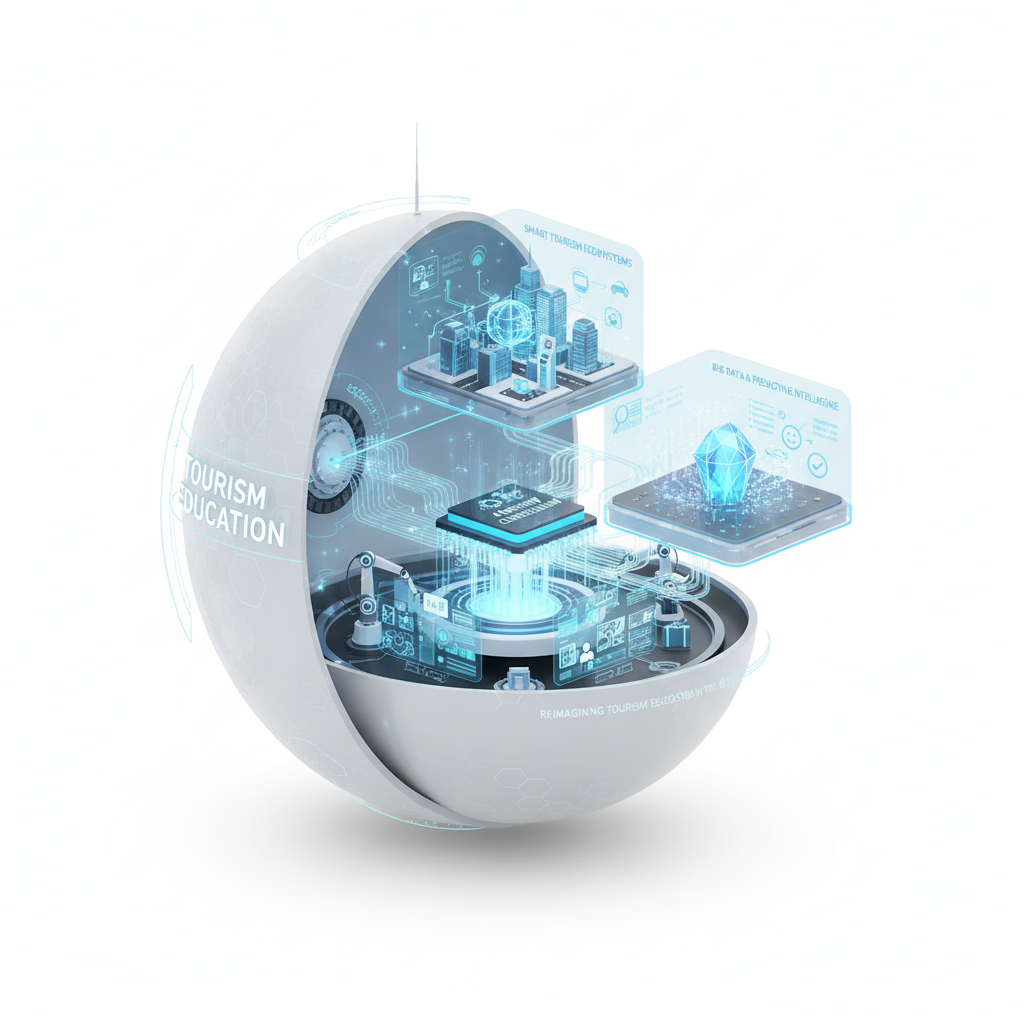
10 Aug AI in Tourism Education: Key UPSC Topic for 2026 Aspirants
✎ Tourism education must transition from traditional operational training to AI literacy, data analytics, and immersive learning to align with the demands of smart tourism ecosystems.
Subject Relevance — Where This Topic Fits
- GS Paper III — Technology, Economic Development, Biodiversity, Environment, Security and Disaster Management (Tourism as a service sector and its technological transformation) | GS Paper III — Science and Technology (AI, Big Data, IoT in tourism)
- Prelims: Smart tourism, AI in hospitality, Augmented Reality (AR), Virtual Reality (VR), Internet of Things (IoT), predictive analytics, hyper-personalisation, dynamic pricing, biometric-enabled travel
- Essay: The Role of Technology in Redefining Human-Centric Industries: A Case Study of Tourism
Quick Revision: Tourism education must transition from traditional operational training to AI literacy, data analytics, and immersive learning to align with the demands of smart tourism ecosystems.
Why is this in the news?
The article underscores the urgent need for a paradigm shift in tourism education to align with the rapid integration of artificial intelligence (AI), big data, and smart tourism ecosystems in the travel and hospitality sector. As AI-driven automation, predictive intelligence, and hyper-personalised travel experiences redefine industry standards, traditional curricula in hospitality and tourism education are rendered obsolete, necessitating a curricular and pedagogical overhaul to equip future professionals with data-driven and technology-integrated competencies.
Background
- The global tourism industry is undergoing a structural transformation driven by advancements in AI, machine learning, and data analytics, with a growing emphasis on automation and predictive intelligence.
- AI is increasingly embedded in tourism operations, including generative AI for customer-facing services such as booking assistance, real-time analytics, and decision-making, necessitating a workforce skilled in AI literacy and data interpretation.
- Smart tourism ecosystems, powered by the Internet of Things (IoT), big data, and AI, are enabling seamless, efficient, and hyper-personalised travel experiences, such as AI-driven chatbots, dynamic pricing, and biometric-enabled travel.
- Traditional tourism education, which primarily focuses on operational domains like front-office management and food-and-beverage operations, is insufficient to meet the demands of an AI-driven industry.
- The shift toward technology-integrated and data-driven learning frameworks is essential to bridge the gap between academic training and industry requirements.
What is Smart Tourism and AI-Driven Tourism Education?
- Smart tourism refers to the integration of advanced technologies such as AI, IoT, big data, and cloud computing to enhance the efficiency, sustainability, and personalisation of travel experiences.
- AI-driven tourism education involves curricula that incorporate AI literacy, data analytics, predictive modelling, and platform-based service design to prepare students for roles in a technology-integrated industry.
- Hyper-personalisation in tourism leverages customer data platforms, recommendation engines, and predictive algorithms to design tailored travel experiences, requiring professionals skilled in data interpretation and experience design.
- Immersive learning environments using AR and VR enable students to simulate real-world scenarios, such as managing virtual hotels, responding to guest situations, and navigating crises, thereby bridging the gap between theory and practice.
- Real-time industry data and predictive insights are critical components of modern tourism education, replacing static textbooks with dynamic learning frameworks that reflect current market signals and consumer behaviour.
- Curricula must include modules on digital strategy, predictive modelling, and platform-based service design to equip students with the skills to optimise systems, interpret real-time data, and design seamless, tech-enabled travel experiences.
- The adoption of AI-powered analytics tools and live dashboards in education enables students to make data-driven decisions, analyse tourist flows, and address sustainability challenges in a controlled, scalable environment.
Key Features
| Feature | Significance |
|---|---|
| AI and Generative AI Integration | Enables automation of customer-facing services, real-time analytics, and predictive decision-making in tourism operations. |
| Data-Driven Learning Frameworks | Replaces static textbooks with live industry datasets, AI-powered analytics, and real-time market signal interpretation. |
| Immersive Learning (AR/VR) | Facilitates experiential training through virtual hotels, crisis simulations, and real-world destination replicas for sustainability and infrastructure analysis. |
| Interdisciplinary Curriculum | Expands beyond traditional hospitality domains to include digital strategy, predictive modelling, and platform-based service design. |
| Hyper-Personalisation Modules | Equips students to design AI-driven, behaviour-based travel experiences using recommendation engines and customer data platforms. |
Why it Matters
Economic
- Enhances employability of graduates by aligning skills with AI-driven tourism industry demands.
- Drives innovation in service delivery, leading to higher productivity and competitiveness in the global tourism market.
- Supports the growth of smart tourism ecosystems, which are projected to expand the sector’s GDP contribution significantly.
Technological
- Accelerates adoption of AI, IoT, and big data analytics in tourism education and industry operations.
- Enables real-time decision-making through predictive modelling and dynamic pricing systems.
- Facilitates the development of biometric-enabled travel and seamless, interconnected service platforms.
Educational
- Transforms traditional hospitality education into a future-ready, technology-integrated discipline.
- Promotes experiential learning through AR/VR, bridging the gap between theory and practical application.
- Encourages interdisciplinary collaboration between tourism, data science, and digital design domains.
Strategic
- Aligns India’s tourism education with global best practices in AI and smart tourism.
- Positions Indian graduates as leaders in designing hyper-personalised, tech-enabled travel experiences.
- Supports the ‘Digital India’ and ‘Make in India’ initiatives by fostering a skilled workforce for technology-driven sectors.
Challenges
1. Curriculum Obsolescence
- Rapid technological advancements outpace the pace of curriculum updates in educational institutions.
- Static syllabi fail to incorporate real-time industry data and predictive insights, rendering graduates unprepared for dynamic market conditions.
- Lack of interdisciplinary integration limits the ability to address emerging roles in AI-driven tourism.
UPSC Link: GS Paper 2: Education
2. Infrastructure and Resource Gaps
- High costs associated with AR/VR technologies and AI tools limit accessibility for many institutions.
- Shortage of faculty trained in AI, data analytics, and smart tourism ecosystems.
- Digital divide exacerbates disparities between urban and rural educational institutions.
UPSC Link: GS Paper 2: Education
3. Industry-Academia Collaboration Gaps
- Insufficient partnerships between educational institutions and tourism industry stakeholders hinder curriculum relevance.
- Lack of structured internships and apprenticeships in AI-driven tourism operations.
- Slow adoption of feedback loops from industry to educational institutions for continuous curriculum improvement.
UPSC Link: GS Paper 3: Industry and Infrastructure
4. Data Privacy and Ethical Concerns
- Increased reliance on customer data for hyper-personalisation raises concerns about privacy and security.
- Ethical dilemmas in AI-driven decision-making, such as dynamic pricing and algorithmic bias in travel recommendations.
- Need for robust data governance frameworks to ensure compliance with global standards like GDPR.
UPSC Link: GS Paper 4: Ethics
5. Skill Mismatch and Employability
- Graduates lack hands-on experience with AI tools and data analytics platforms used in the industry.
- Traditional hospitality skills are undervalued in the face of AI-driven automation, leading to employability challenges.
- Need for continuous upskilling and reskilling to adapt to evolving job roles in the tourism sector.
UPSC Link: GS Paper 3: Employment
Challenges — UPSC Perspective
| Issue | Concern |
|---|---|
| Curriculum Obsolescence | Static syllabi fail to incorporate real-time industry data and predictive insights. |
| Infrastructure Gaps | High costs of AR/VR and AI tools limit accessibility for institutions. |
| Faculty Shortage | Lack of trainers with expertise in AI, data analytics, and smart tourism ecosystems. |
| Industry-Academia Gap | Insufficient collaboration hinders curriculum relevance and employability. |
| Data Privacy Risks | Hyper-personalisation raises concerns about customer data security and ethical use. |
| Skill Mismatch | Graduates lack hands-on experience with AI-driven tools used in the industry. |
Way Forward
- Establish industry-academia partnerships to co-design AI-integrated curricula with real-time data inputs.
- Invest in AR/VR labs and AI toolkits for tourism institutions to enable experiential learning.
- Develop faculty exchange programmes with global tourism and tech institutions to build expertise.
- Introduce mandatory modules on data analytics, AI literacy, and ethical AI use in tourism education.
- Create structured internships and apprenticeships in AI-driven tourism operations for students.
- Formulate national guidelines for data governance in tourism education to address privacy concerns.
- Promote research collaborations between institutions and smart tourism destinations to study AI applications.
- Encourage continuous upskilling through micro-credentials and certification programmes in emerging technologies.
UPSC Value Addition
Keywords for Mains Answer-Writing
Tourism education reform · AI in hospitality sector · Smart tourism ecosystems · Data-driven learning frameworks · Augmented Reality (AR) and Virtual Reality (VR) in tourism · Hyper-personalisation in travel experiences · Predictive analytics in tourism · Curriculum integration of AI and automation · Real-time industry data in education · Immersive learning environments for tourism professionals · Internet of Things (IoT) in smart destinations · Generative AI for customer-facing services · Sustainability challenges in tourism education · Platform-based service design in hospitality · Behavioural data and recommendation engines in travel
Concept Flow
AI and automation in tourism → Industry shift toward predictive intelligence and hyper-personalisation → Traditional hospitality education becomes obsolete → Need for technology-integrated curricula → Curriculum reboot with AI, data analytics, and immersive learning → Development of interdisciplinary modules → Graduates equipped with AI literacy and real-time decision-making skills → Enhanced employability in smart tourism → Industry adoption of AI-driven systems → Continuous feedback loop for curriculum refinement → Hyper-personalisation and smart ecosystems → Evolution of tourism education to meet future demands
Prelims Practice Questions
Q1. Consider the following statements regarding the impact of AI on the tourism and hospitality sector:
1. AI is primarily used for automating back-office operations in the tourism industry.
2. Generative AI is deployed for customer-facing services such as booking assistance and real-time itinerary optimisation.
3. Hyper-personalisation in travel experiences relies solely on manual customer feedback rather than algorithmic recommendations.
4. Smart tourism ecosystems utilise interconnected systems powered by AI, IoT, and big data to deliver seamless experiences.
How many of the above statements are correct?
- Only one
- Only two
- Only three
- All
Answer: Only three — Statements 2 and 4 are correct. AI is used for both back-office and customer-facing services (Statement 1 is incorrect). Hyper-personalisation relies on algorithmic recommendations and behavioural data, not manual feedback (Statement 3 is incorrect).
Q2. Assertion (A): The future of tourism education must integrate AI literacy and data analytics as core competencies.
Reason (R): AI is deeply embedded in global tourism operations, including generative AI for customer-facing services and internal analytics.
Options:
A. Both A and R are true, and R is the correct explanation of A.
B. Both A and R are true, but R is not the correct explanation of A.
C. A is true, but R is false.
D. A is false, but R is true.
Answer: ? — Both A and R are true, and R correctly explains why A is true. AI’s integration into tourism operations necessitates AI literacy and data analytics in education.
Q3. Match the following technologies with their applications in the tourism and hospitality sector:
Column I (Technology)
A. Augmented Reality (AR)
B. Virtual Reality (VR)
C. Internet of Things (IoT)
D. Generative AI
Column II (Application)
1. Real-time itinerary optimisation
2. Virtual hotel management and crisis simulation
3. Interactive tourist guides and destination overlays
4. Smart room automation and energy management
- A-3, B-2, C-4, D-1
- A-2, B-3, C-1, D-4
- A-1, B-4, C-3, D-2
- A-4, B-1, C-2, D-3
Answer: A-3, B-2, C-4, D-1 — A-3 (AR for interactive guides), B-2 (VR for virtual hotel management), C-4 (IoT for smart room automation), D-1 (Generative AI for itinerary optimisation).
Mains Practice Question
✍ The integration of AI, data analytics, and immersive technologies is transforming tourism education from traditional service models to technology-integrated, data-driven frameworks. Critically examine the necessity of this transformation, highlighting the gaps in conventional curricula and the competencies required for future tourism professionals. Also, discuss the challenges in implementing such a curriculum transformation in India. (15 Marks)
Approach: MODEL-ANSWER SKELETON:
1. **Necessity of Transformation (6 points)**
– Structural shift in tourism: automation, predictive intelligence, hyper-personalisation (cite industry trends).
– AI in operations: generative AI for customer-facing services, real-time data interpretation, and system optimisation.
– Limitations of traditional curricula: static textbooks vs. dynamic market signals; lack of interdisciplinary integration (digital strategy, predictive modelling).
– Need for experiential learning: AR/VR for virtual hotel management, crisis simulation, and sustainability analysis.
– Smart tourism ecosystems: IoT, big data, and interconnected systems requiring new skill sets.
– Hyper-personalisation: reliance on recommendation engines, behavioural data, and predictive algorithms.
2. **Gaps in Conventional Curricula (4 points)**
– Overemphasis on operational training (front-office management, F&B operations) at the expense of digital competencies.
– Static case studies vs. real-time industry data and predictive insights.
– Lack of modules on AI literacy, automation systems, and advanced data analytics.
– Insufficient focus on platform-based service design and customer data platforms.
3. **Competencies for Future Professionals (3 points)**
– Core competencies: AI literacy, data interpretation, system optimisation, and tech-enabled experience design.
– Soft skills: crisis management, sustainability planning, and ethical use of customer data.
– Interdisciplinary integration: collaboration with computer science, data science, and design fields.
4. **Challenges in Implementation (2 points)**
– Infrastructure gaps: limited access to AR/VR tools, high-speed internet, and industry datasets in Indian institutions.
– Faculty readiness: need for upskilling educators in AI, data analytics, and immersive technologies.
– Regulatory and accreditation hurdles: aligning with AICTE/NBA standards while integrating cutting-edge technologies.
– Industry-academia collaboration: bridging the gap between academic curricula and real-world industry needs.
5. **Conclusion (1 point)**
– Balanced approach: phased integration of technology-driven modules while preserving foundational service skills.
Source: The Hindu
Generated by AanyaAi for educational purpose.

- Exercise Tarang Shakti 2026: India’s Mega Multi-Nation Air Power Showcase - September 27, 2026
- रबी अभियान 2026: राष्ट्रीय सम्मेलन में केंद्र-राज्य तालमेल पर होगा जोर - September 27, 2026
- Himachal CM Sukhu: All Doctor Vacancies to be Filled by March - September 27, 2026

No Comments