


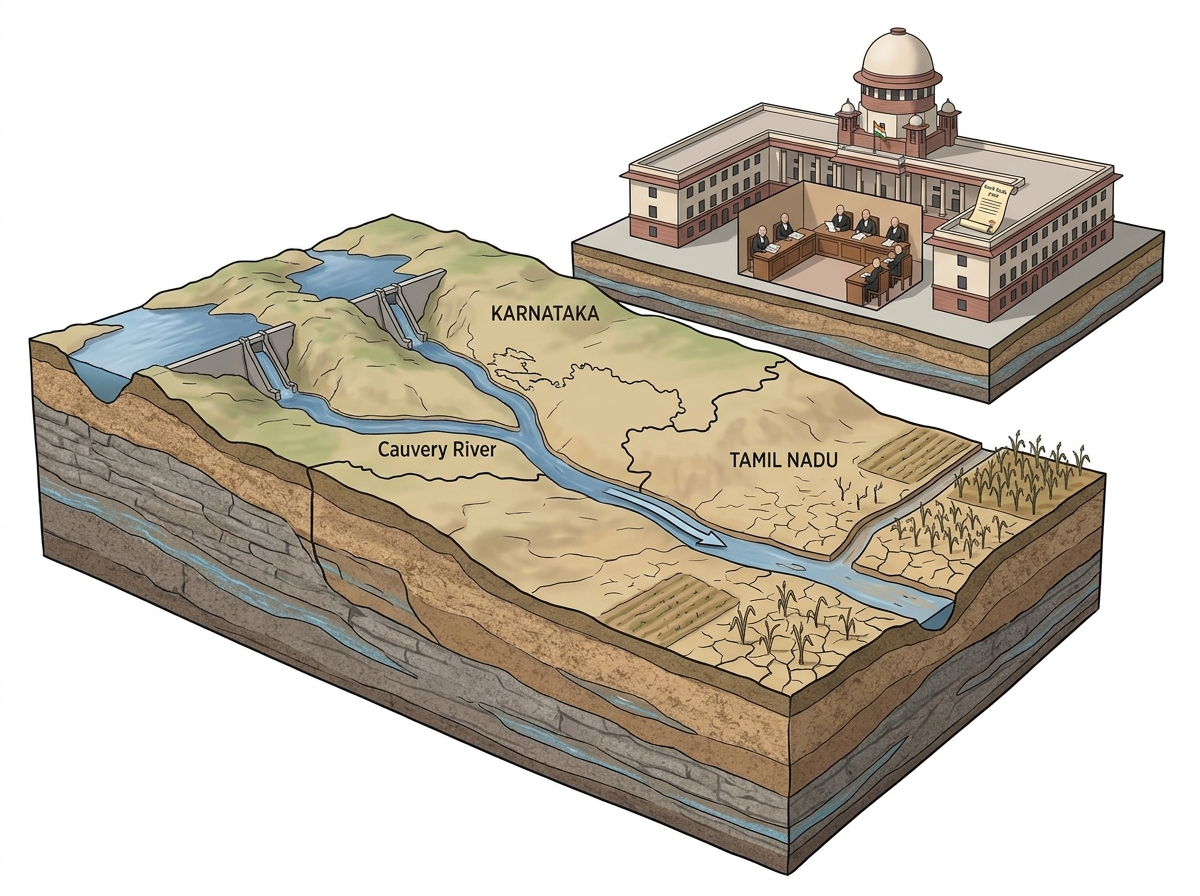
10 Aug Supreme Court to Hear Tamil Nadu’s Plea on Cauvery Water Dispute Early
✎ The Cauvery Water Dispute exemplifies the challenges of inter-State water governance in India, where tribunal awards, judicial directives, and institutional mechanisms often fail to ensure equitable and timely water sharing…
Subject Relevance — Where This Topic Fits
- GS Paper II — Functions and Responsibilities of the Union and the States | GS Paper III — Water Resources and their Management
- Prelims: Cauvery Water Disputes Tribunal (CWDT), Cauvery Water Management Authority (CWMA), Cauvery Water Regulations Committee (CWRC), Inter-State River Water Disputes Act, 1956, Billigundulu gauge station, cusecs, TMC (Thousand Million Cubic Feet), Kabini Reservoir, Krishna Raja Sagara (KRS) Reservoir
- Essay: Inter-State Water Disputes and Federalism in India: Balancing Equity and Sustainability, Judicial Activism in Environmental Governance: Lessons from the Cauvery Dispute
Quick Revision: The Cauvery Water Dispute exemplifies the challenges of inter-State water governance in India, where tribunal awards, judicial directives, and institutional mechanisms often fail to ensure equitable and timely water sharing, necessitating robust enforcement and adaptive governance frameworks.
Why is this in the news?
The Supreme Court of India has agreed to an early hearing of Tamil Nadu’s plea seeking urgent intervention in the Cauvery water dispute with Karnataka, citing the latter’s alleged non-compliance with tribunal orders and the critical agrarian distress in Tamil Nadu. This development underscores the recurring institutional failures in enforcing inter-State water-sharing agreements and the judiciary’s role in resolving such disputes amidst escalating water scarcity.
Background
- The Cauvery river dispute is a protracted inter-State conflict between Karnataka and Tamil Nadu, originating from the 1892 agreement between the Madras Presidency and the princely state of Mysore.
- The Cauvery Water Disputes Tribunal (CWDT), constituted under the Inter-State River Water Disputes Act, 1956, delivered its final award in 2007, allocating water shares among Karnataka, Tamil Nadu, Kerala, and Puducherry.
- The CWDT’s award was notified by the Union Government in 2013, but implementation has been contentious, with Karnataka frequently citing deficient monsoons and surplus demands to justify reduced releases.
- The Cauvery Water Management Authority (CWMA) and Cauvery Water Regulations Committee (CWRC) were established in 2018 to monitor and enforce the tribunal’s directives, yet compliance remains inconsistent.
- Tamil Nadu’s current plea highlights Karnataka’s failure to release stipulated water volumes, particularly during the monsoon season, exacerbating agricultural distress in delta districts.
- The dispute has seen recurrent judicial interventions, including the Supreme Court’s 2018 order directing Karnataka to release 177.25 TMC of water to Tamil Nadu over 12 months.
What is the Cauvery Water Dispute?
- The Cauvery Water Dispute is a long-standing inter-State conflict between Karnataka and Tamil Nadu over the equitable sharing of the Cauvery River’s waters, which originates in Karnataka and flows into Tamil Nadu.
- The dispute is governed by the Inter-State River Water Disputes Act, 1956, which provides for the adjudication of water-sharing disputes through a tribunal under the aegis of the Union Government.
- The Cauvery Water Disputes Tribunal (CWDT), constituted in 1990, delivered its final award in 2007, allocating 419 TMC to Tamil Nadu, 270 TMC to Karnataka, 30 TMC to Kerala, and 7 TMC to Puducherry, with 14 TMC reserved for environmental purposes.
- The CWDT’s award was challenged by Karnataka in the Supreme Court, leading to a 2018 judgment that modified the allocation to 177.25 TMC for Tamil Nadu and directed Karnataka to release water annually, subject to monsoon conditions.
- The Cauvery Water Management Authority (CWMA) and Cauvery Water Regulations Committee (CWRC) were established in 2018 to implement and monitor the tribunal’s directives, ensuring compliance with stipulated releases at key gauge stations like Billigundulu.
- The dispute is exacerbated by seasonal variations in rainfall, with Karnataka often citing deficit monsoons to justify reduced releases, while Tamil Nadu argues that Karnataka’s upstream control over reservoirs allows it to withhold water disproportionately.
- The dispute also involves hydrological complexities, including the interdependence of multiple reservoirs (e.g., Kabini, Krishna Raja Sagara) and the need for real-time monitoring to balance upstream and downstream demands.
- The recurring judicial interventions highlight the limitations of institutional mechanisms in resolving inter-State water disputes, necessitating stronger enforcement mechanisms and participatory governance.
Key Features
| Feature | Significance |
|---|---|
| Supreme Court’s early listing | Expedites judicial resolution of inter-State water disputes, reducing prolonged uncertainty for stakeholders. |
| Cauvery Water Management Authority (CWMA) | Statutory body mandated to implement Tribunal/Court orders, ensuring equitable water distribution between riparian states. |
| Kabini and Krishna Raja Sagara reservoirs | Critical storage infrastructure in Karnataka whose operational releases directly impact downstream Tamil Nadu’s agricultural calendar. |
| Billigundulu gauging station | Inter-State monitoring point where real-time flow measurements determine compliance with Tribunal allocations. |
| Pro-rata assessment of distress | Hydrological methodology accounting for rainfall deficits and reservoir inflows to adjust water allocations during scarcity periods. |
Why it Matters
Economic
- Agrarian distress in Tamil Nadu’s delta districts due to curtailed irrigation threatens food security and rural livelihoods, with rice cultivation (a major kharif crop) heavily dependent on Cauvery water.
- Karnataka’s hydropower generation from Cauvery basin projects (e.g., KRS, Kabini) may face operational constraints if forced releases exceed surplus inflows, impacting energy security.
- Inter-State trade and commerce in Cauvery basin states could be disrupted by prolonged disputes, affecting commodity flows and market confidence.
Legal-Judicial
- Reinforces the supremacy of judicial mechanisms (Supreme Court/CWMA) over unilateral state actions in inter-State water disputes, upholding constitutional federalism.
- Sets a precedent for expedited hearings in environmental and resource allocation cases, reducing delays in justice delivery.
- Clarifies the enforceability of Tribunal awards and CWMA directives, strengthening institutional compliance mechanisms.
Institutional
- Highlights the operational challenges of CWMA and CWRC in reconciling hydrological data with Tribunal-mandated allocations during extreme weather events (droughts/floods).
- Exposes gaps in real-time data sharing between basin states, necessitating robust hydrometeorological monitoring infrastructure.
Social
- Agricultural communities in Tamil Nadu’s Cauvery delta face existential threats from water scarcity, exacerbating farmer distress and migration pressures.
- Political tensions between states may escalate, diverting administrative focus from developmental priorities to crisis management.
Challenges
1. Defiance of Tribunal Orders
- Karnataka’s alleged non-compliance with Cauvery Tribunal/CWMA directives, despite judicial and statutory obligations, undermines federal trust.
- Selective compliance during surplus periods fails to address structural deficits, leaving downstream states vulnerable during droughts.
UPSC Link: GS-II: Federalism and Inter-State Relations
2. Hydrological Uncertainty
- Erratic monsoons and declining reservoir inflows (e.g., 50-year low in July 2026) complicate pro-rata assessments and allocation fairness.
- Discrepancies between predicted and actual inflows at Billigundulu (158–530 cusecs vs. stipulated 3,500 cusecs) challenge CWMA’s monitoring efficacy.
UPSC Link: GS-III: Water Resources and Drought Management
3. Institutional Coordination Gaps
- Lack of synchronized data-sharing protocols between Karnataka and Tamil Nadu hydrological agencies delays crisis response.
- CWMA’s limited enforcement powers hinder its ability to compel compliance, necessitating stronger statutory teeth.
UPSC Link: GS-II: Constitutional and Non-Constitutional Bodies
4. Political Economy of Water Allocation
- Competing demands from urban water supply, industrial use, and hydropower generation in Karnataka create zero-sum trade-offs with agricultural allocations to Tamil Nadu.
- Electoral cycles may incentivize state governments to prioritize short-term political gains over long-term basin-wide sustainability.
UPSC Link: GS-IV: Ethical Governance and Public Policy
5. Climate Change Amplification
- Increased frequency of extreme weather events (droughts/floods) strains the Tribunal’s static allocation framework, requiring adaptive governance.
- Glacial retreat in the Western Ghats (Cauvery’s catchment) threatens long-term water security, necessitating basin-wide climate resilience planning.
UPSC Link: GS-III: Climate Change and Environmental Governance
Challenges — UPSC Perspective
| Issue | Concern |
|---|---|
| Non-compliance with Tribunal orders | Erodes institutional credibility and exacerbates inter-State mistrust. |
| Declining reservoir inflows | Undermines CWMA’s ability to meet stipulated releases, triggering downstream crises. |
| Data-sharing gaps | Delays crisis response and hampers evidence-based decision-making. |
| Electoral politics vs. basin sustainability | Prioritises short-term gains over equitable long-term water management. |
| Climate variability | Renders static allocation frameworks obsolete, necessitating dynamic governance. |
Way Forward
- Constitute a high-powered inter-State committee to audit Karnataka’s reservoir operations and enforce CWMA directives with real-time transparency.
- Develop a dynamic allocation model incorporating real-time hydrological data, climate projections, and stakeholder consultations to replace static Tribunal orders.
- Strengthen CWMA’s enforcement powers by amending the Inter-State Water Disputes Act, 1956, to include penalties for non-compliance.
- Invest in basin-wide water conservation measures (e.g., micro-irrigation, rainwater harvesting) to reduce dependence on Cauvery flows during deficits.
- Establish a Cauvery Basin Authority with representation from all riparian states, Karnataka, Tamil Nadu, Kerala, and Puducherry, for integrated water management.
- Enhance public awareness campaigns to foster basin-wide solidarity and reduce politicisation of water disputes.
- Leverage satellite-based hydrological monitoring (e.g., ISRO’s resources) to improve data accuracy and dispute resolution efficiency.
UPSC Value Addition
Keywords for Mains Answer-Writing
Cauvery Water Disputes Tribunal · Cauvery Water Management Authority · Cauvery Water Regulations Committee · Inter-State River Water Disputes Act, 1956 · Billigundulu gauge and discharge station · Kabini and Krishna Raja Sagara reservoirs · Inter-State Water Disputes (Amendment) Bill, 2019 · Doctrine of Prior Appropriation · Equitable apportionment · Supreme Court’s constitutional jurisdiction under Article 136 · Inter-State Water Disputes (ISWD) Tribunals · River basin management
Constitutional & Policy Linkages
- Article 262: Adjudication of inter-State water disputes
- Article 263: Inter-State Council for coordination
- Seventh Schedule, List I (Union List): Entry 56 on water resources
- Seventh Schedule, List II (State List): Entry 17 on water supply
Concept Flow
Deficient South-West Monsoon → Reduced inflows into Karnataka reservoirs → Karnataka’s non-compliance with CWMA directives → Tamil Nadu’s agricultural distress → Supreme Court intervention → Early listing of Tamil Nadu’s plea → Judicial scrutiny of pro-rata allocations → Potential enforcement of Tribunal orders → Basin-wide institutional reforms.
Prelims Practice Questions
Q1. Consider the following statements regarding the Cauvery Water Disputes Tribunal (CWDT):
1. The CWDT was constituted under the Inter-State River Water Disputes Act, 1956.
2. The CWDT’s award was notified by the Government of India in 2007.
3. The CWDT’s award is binding on the parties and cannot be reviewed by the Supreme Court.
How many of the above statements are correct?
- Only one
- Only two
- All three
- None
Answer: Only two — Statement 1 is correct as the CWDT was constituted under the Inter-State River Water Disputes Act, 1956. Statement 2 is incorrect because the CWDT’s award was notified in 2013, not 2007. Statement 3 is incorrect as the Supreme Court has the jurisdiction to review the CWDT’s award under Article 136 of the Constitution.
Q2. Assertion (A): The Cauvery Water Management Authority (CWMA) was established to implement the final award of the Cauvery Water Disputes Tribunal.
Reason (R): The CWMA was constituted under the provisions of the Inter-State River Water Disputes (Amendment) Act, 2019.
Options:
A. Both A and R are true, and R is the correct explanation of A.
B. Both A and R are true, but R is not the correct explanation of A.
C. A is true, but R is false.
D. A is false, but R is true.
Answer: ? — Assertion (A) is correct as the CWMA was established to implement the final award of the CWDT. Reason (R) is also correct as the CWMA was constituted under the Inter-State River Water Disputes (Amendment) Act, 2019. However, R does not directly explain A, as the CWMA’s role is derived from the CWDT’s award, not solely from the Amendment Act.
Q3. Which of the following is the correct sequence of institutions involved in the Cauvery water dispute resolution, from the earliest to the most recent?
1. Cauvery Water Disputes Tribunal
2. Cauvery Water Management Authority
3. Cauvery Water Regulations Committee
4. Supreme Court of India
Options:
A. 1-2-3-4
B. 1-3-2-4
C. 3-1-2-4
D. 2-1-3-4
- A
- B
- C
- D
Answer: B — The correct sequence is: 1. Cauvery Water Disputes Tribunal (constituted in 1990), 2. Cauvery Water Regulations Committee (formed to monitor implementation), 3. Cauvery Water Management Authority (established in 2018 under the 2019 Amendment Act), and 4. Supreme Court of India (which has jurisdiction to hear appeals under Article 136).
Mains Practice Question
✍ The Cauvery water dispute exemplifies the complexities of inter-State water governance in India. Critically examine the legal and institutional framework governing inter-State river water disputes, with particular reference to the Cauvery case. Also, analyse the role of the Supreme Court in resolving such disputes. (15 Marks)
Approach: MODEL-ANSWER SKELETON:
1. **Introduction (2 marks)**: Define inter-State river water disputes and their constitutional significance (Article 262 and the Inter-State River Water Disputes Act, 1956). Mention the Cauvery dispute as a classic example.
2. **Legal Framework (4 marks)**:
– **Inter-State River Water Disputes Act, 1956**: Provisions for tribunal formation, award notification, and binding nature.
– **Cauvery Water Disputes Tribunal (CWDT)**: Constitution (1990), 16-year deliberation, final award (2013), and its binding nature.
– **Inter-State River Water Disputes (Amendment) Act, 2019**: Introduction of single permanent tribunal and establishment of CWMA (2018) to implement CWDT award.
– **Supreme Court’s role**: Jurisdiction under Article 136 (special leave petition), constitutional interpretation, and enforcement of tribunal awards.
3. **Institutional Mechanisms (4 marks)**:
– **CWMA**: Composition, functions (monitoring releases, resolving disputes), and challenges in implementation.
– **CWRC**: Role in real-time monitoring and enforcement of tribunal/CWMA directions.
– **Billigundulu gauge station**: Significance as the inter-State monitoring point and data discrepancies.
4. **Judicial Role and Challenges (3 marks)**:
– Supreme Court’s intervention in 2018 (directing Karnataka to release water) and 2026 (early hearing of Tamil Nadu’s plea).
– Critique of judicial activism vs. legislative/executive roles in water governance.
– Challenges: Defiance by States, hydrological uncertainties, and political pressures.
5. **Conclusion (2 marks)**: Balanced view on the effectiveness of the framework, suggesting reforms (e.g., data transparency, participatory governance) to address future disputes.
Source: The Hindu
Generated by AanyaAi for educational purpose.

- Hyderabad’s 4 Police Commissionerates: Why the Latest Rejig Matters for UPSC - October 5, 2026
- सुप्रीम कोर्ट में सीईसी के एकतरफा निर्णयों पर चुनौती, जानिए पूरा मामला - October 5, 2026
- UPSC Alert: India-Bangladesh Methanol Cargo Flagged Off from Dibrugarh - October 5, 2026

No Comments