


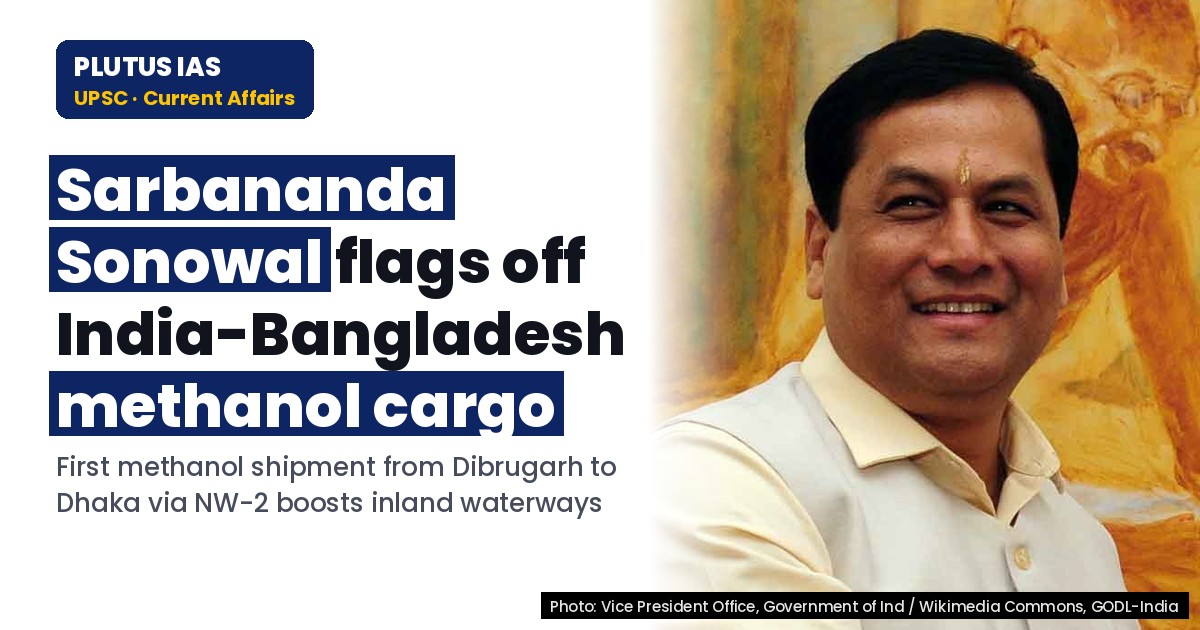
05 Oct UPSC Alert: India-Bangladesh Methanol Cargo Flagged Off from Dibrugarh
✎ National Waterway-2 (NW-2) on the Brahmaputra River and the India-Bangladesh Protocol Route (IBPR) enable cost-effective, environmentally sustainable, and efficient inland water transport for Northeast India’s trade with…
Subject Relevance — Where This Topic Fits
- GS Paper II — India and its Neighbourhood: International Relations and Bilateral Agreements | GS Paper III — Infrastructure: Ports, Inland Waterways and Logistics
- Prelims: National Waterways Act, 2016, Inland Waterways Authority of India (IWAI), India-Bangladesh Protocol Route (IBPR), Bogibeel Terminal, Assam Petro-Chemicals Limited (APCL), Methanol as a cargo commodity, Brahmaputra River System, Panchayati Raj and Rural Connectivity
- Essay: The role of infrastructure in fostering regional economic integration, Sustainable transportation: Balancing economic growth and environmental conservation
Quick Revision: National Waterway-2 (NW-2) on the Brahmaputra River and the India-Bangladesh Protocol Route (IBPR) enable cost-effective, environmentally sustainable, and efficient inland water transport for Northeast India’s trade with Bangladesh.
Why is this in the news?
The launch of the first international methanol cargo consignment from the Bogibeel Terminal in Dibrugarh, Assam, to Dhaka, Bangladesh, via National Waterway-2 (NW-2) and the India-Bangladesh Protocol Route (IBPR) marks a significant milestone in the revival of inland water transport in Northeast India. Scheduled for 5 October 2026, this event symbolises the resumption of a historic trade link that existed before independence, now reimagined as a modern, cost-effective, and environmentally sustainable logistics corridor. The initiative underscores the government’s commitment to leveraging waterways for regional connectivity, trade facilitation, and economic development in the northeastern states.
Background
- The Brahmaputra River system, particularly the stretch between Dibrugarh and Dhaka, historically served as a vital trade artery connecting upper Assam to global markets, with Dibrugarh being a prominent river port.
- Post-independence, the focus on rail and road transport led to a decline in the utilisation of inland waterways in Northeast India, despite their inherent advantages in terms of cost, capacity, and environmental sustainability.
- The National Waterways Act, 2016 identified 111 waterways in India, including National Waterway-2 (NW-2), which spans the Brahmaputra River from Dhubri to Sadiya, covering a distance of 891 km.
- The India-Bangladesh Protocol Route (IBPR), operationalised in 1972, facilitates bilateral trade through designated ports and rivers, including the Brahmaputra, and has been periodically updated to enhance connectivity.
- The Inland Waterways Authority of India (IWAI), established under the Inland Waterways Authority of India Act, 1985, is responsible for the development, maintenance, and regulation of national waterways in the country.
- Assam Petro-Chemicals Limited (APCL), a state-owned enterprise, operates a methanol production facility in Namrup, Assam, and this cargo marks its first international shipment via inland waterways.
What is National Waterway-2 (NW-2) and the India-Bangladesh Protocol Route (IBPR)?
- National Waterway-2 (NW-2) is a designated inland waterway under the National Waterways Act, 2016, covering the Brahmaputra River from Dhubri (Assam) to Sadiya (Assam), with a total length of 891 km. It is one of the longest and most strategically significant waterways in India.
- The India-Bangladesh Protocol Route (IBPR) is a bilateral agreement between India and Bangladesh, operationalised in 1972, which allows for the movement of goods between the two countries via designated ports and rivers, including the Brahmaputra, Ganga, and Barak. The route facilitates trade, transit, and people-to-people connectivity.
- NW-2 and IBPR together provide a seamless waterway corridor for transporting goods from India’s Northeast to Bangladesh and beyond, reducing transit time and logistics costs compared to road or rail transport.
- Methanol is a versatile chemical used in various industries, including plastics, textiles, and pharmaceuticals.
- The Bogibeel Terminal, inaugurated in 2018, is a modern multi-modal logistics hub located on the southern bank of the Brahmaputra River, designed to facilitate the movement of goods via road, rail, and waterways.
- The utilisation of inland waterways for international trade is governed by the Inland Waterways Authority of India (IWAI) and the respective authorities in Bangladesh, ensuring compliance with safety, environmental, and customs regulations.
- The revival of waterway-based trade in Northeast India aligns with the government’s broader initiatives such as the Sagarmala Programme, Bharatmala Pariyojana, and the Act East Policy, which aim to enhance regional connectivity and economic integration.
- The environmental benefits of inland water transport include lower carbon emissions per tonne-km compared to road or rail, reduced congestion on highways, and minimal impact on land use, making it a sustainable choice for freight movement.
Key Features
| Feature | Significance |
|---|---|
| National Waterway-2 (NW-2) | A designated inland waterway along the Brahmaputra River, facilitating cost-effective and environmentally sustainable cargo transport between India and Bangladesh. |
| India-Bangladesh Protocol Route (IBPR) | A bilateral navigational route enabling cross-border riverine trade under the 1972 Protocol on Inland Water Transit and Trade. |
| Methanol Cargo from Assam Petrochemicals Ltd (APCL) | Demonstrates the commercial viability of transporting petrochemicals via inland waterways, reducing logistics costs and carbon footprint. |
| Bogibeel Terminal, Dibrugarh | A strategically located inland port enabling multimodal connectivity for Northeast India’s trade with Bangladesh and beyond. |
| Panchagarh Port, Dhaka | Bangladesh’s inland port receiving the cargo, highlighting regional trade integration under the Protocol Route. |
Why it Matters
Economic Integration
- Revives historical riverine trade links between upper Assam and global markets via the Brahmaputra, post-independence for the first time.
- Reduces logistics costs by leveraging cheaper and fuel-efficient inland water transport compared to road/rail.
- Enhances competitiveness of Assam’s petrochemical industry by providing direct access to Bangladeshi markets.
- Promotes regional economic corridors under the Act East Policy and BBIN Motor Vehicles Agreement.
Strategic Connectivity
- Strengthens India-Bangladesh bilateral trade ties through institutionalised Protocol Route mechanisms.
- Diversifies trade routes, reducing dependency on land-based corridors vulnerable to geopolitical disruptions.
- Supports Northeast India’s integration with national and international supply chains via inland waterways.
Environmental Sustainability
- Inland water transport emits 75% less CO₂ per tonne-km compared to road transport, aligning with India’s climate commitments.
- Reduces congestion on road networks, particularly in the fragile Himalayan foothills of Northeast India.
- Leverages natural river systems, minimizing deforestation and land degradation associated with new infrastructure.
Policy and Institutional Framework
- Demonstrates the operationalisation of the Inland Waterways Authority of India (IWAI) and Ministry of Ports, Shipping and Waterways (MoPSW) initiatives.
- Validates the efficacy of the 1972 Protocol on Inland Water Transit and Trade, a cornerstone of India-Bangladesh riverine cooperation.
- Showcases public-private partnership (PPP) models in cargo logistics, with APCL as a key stakeholder.
Challenges
1. Infrastructure Gaps in Inland Waterways
- Seasonal fluctuations in Brahmaputra’s water levels necessitate dredging and navigational aids for year-round operations.
- Limited terminal infrastructure at key ports like Bogibeel, requiring investments in cargo handling and storage facilities.
- Need for modernisation of vessels to comply with international safety and environmental standards.
UPSC Link: GS Paper 3: Infrastructure – Inland Waterways
2. Cross-Border Regulatory Hurdles
- Complex customs and regulatory procedures under the India-Bangladesh Protocol Route may cause delays.
- Differences in port regulations, tariffs, and documentation between the two countries require harmonisation.
- Security clearances and biosecurity checks for petrochemical cargo add procedural layers.
UPSC Link: GS Paper 2: International Relations – India-Bangladesh
3. Market and Logistics Constraints
- Limited awareness among traders about the cost and time benefits of inland water transport.
- Dependence on intermediaries (e.g., freight forwarders) may erode cost advantages.
- Competition from road and rail transport, which may offer faster but costlier alternatives.
UPSC Link: GS Paper 3: Logistics Efficiency
4. Environmental and Social Concerns
- Potential ecological impacts of increased river traffic, including sediment disruption and noise pollution.
- Displacement risks for riverside communities due to port expansions or dredging activities.
- Need for sustainable dredging practices to preserve river ecosystems.
UPSC Link: GS Paper 3: Environmental Impact Assessment
Challenges — UPSC Perspective
| Issue | Concern |
|---|---|
| Seasonal navigability | Brahmaputra’s water levels fluctuate, requiring dredging and navigational aids for consistent operations. |
| Terminal infrastructure | Bogibeel and Panchagarh ports lack modern cargo handling and storage facilities. |
| Cross-border customs | Dual regulatory frameworks under the Protocol Route may cause delays in cargo clearance. |
| Vessel modernisation | Existing vessels may not meet international safety and environmental standards. |
| Market adoption | Traders lack awareness of inland water transport’s cost and time benefits. |
| Ecological impact | Increased river traffic may disrupt sediment flow and aquatic ecosystems. |
Government Initiatives — Must-Memorise for Prelims
- Inland Waterways Development Council (IWDC)
- Jal Marg Vikas Project (JMVP) for NW-2
- India-Bangladesh Protocol on Inland Water Transit and Trade (1972)
Way Forward
- Accelerate dredging and navigational aids along NW-2 to ensure year-round operations.
- Develop multimodal hubs at Bogibeel and Panchagarh with modern cargo handling facilities.
- Streamline cross-border customs and regulatory procedures under the Protocol Route.
- Promote PPP models to attract private investment in vessel modernisation and terminal infrastructure.
- Launch awareness campaigns for traders on the cost and time benefits of inland water transport.
- Conduct environmental impact assessments to mitigate ecological risks from increased river traffic.
- Expand the scope of the Protocol Route to include additional commodities and ports.
- Integrate inland waterways with rail and road networks to create seamless logistics corridors.
UPSC Value Addition
Keywords for Mains Answer-Writing
National Waterways Act 2016 · Inland Water Transport (IWT) policy · India-Bangladesh Protocol Route · Bogibeel Terminal · Assam Petro-Chemicals Limited (APCL) · Methanol cargo transport · Brahmaputra River · Multimodal connectivity · Logistics cost reduction · Sagarmala Programme · Inland Waterways Authority of India (IWAI) · Northeast Region connectivity · Sustainable transport · Trade facilitation · Regional economic integration
Concept Flow
Historical riverine trade (pre-independence) → Decline post-independence due to infrastructure gaps → Revival through NW-2 and IBPR → First methanol cargo dispatch from Dibrugarh → Integration with Bangladesh’s Panchagarh Port → Demonstration of cost-effective and sustainable logistics → Policy validation for inland waterways development.
Prelims Practice Questions
Q1. Consider the following statements about the National Waterways Act, 2016:
1. The Act declares 111 waterways as National Waterways (NWs) for the purpose of development and regulation.
2. National Waterway-2 (NW-2) is the Brahmaputra River between Dhubri and Sadiya.
3. The Act empowers the Central Government to develop, maintain, and regulate the NWs.
How many of the above statements are correct?
- Only one
- Only two
- All three
- None
Answer: All three — Statements 1 and 3 are correct. Statement 2 is incorrect as NW-2 is the Brahmaputra River between Dhubri and Sadiya, not the entire stretch. The Act indeed declares 111 waterways as NWs and empowers the Central Government to develop and regulate them.
Q2. Assertion (A): The India-Bangladesh Protocol Route (IBPR) facilitates cross-border movement of goods between India and Bangladesh via inland waterways.
Reason (R): The IBPR was established under the 1972 Indo-Bangladesh Trade Agreement to promote regional trade and connectivity.
In the context of the above two statements, which one of the following is correct?
- Both A and R are true and R is the correct explanation of A
- Both A and R are true but R is not the correct explanation of A
- A is true but R is false
- A is false but R is true
Answer: Both A and R are true but R is not the correct explanation of A — Both statements are correct. The IBPR is a bilateral arrangement between India and Bangladesh to facilitate trade through inland waterways, and it was formalized under the 1972 Indo-Bangladesh Trade Agreement.
Q3. Match the following National Waterways with their respective rivers:
Column I (National Waterway) | Column II (River)
NW-1 | a. Brahmani River
NW-2 | b. Ganga River
NW-3 | c. West Coast Canal
NW-4 | d. Brahmaputra River
Answer: ? — NW-1: Ganga River; NW-2: Brahmaputra River; NW-3: West Coast Canal; NW-4: Brahmani River.
Mains Practice Question
✍ The inauguration of the first international methanol cargo consignment from Bogibeel Terminal via National Waterway-2 to Dhaka marks a significant milestone in the revival of inland water transport in Northeast India. Critically examine the potential of inland waterways in transforming the logistics landscape of the region. Also, analyse the challenges that may impede the full realisation of this potential. (15 Marks)
Approach: MODEL-ANSWER SKELETON:
1. **Introduction (2 Marks)**
– Briefly define inland water transport (IWT) and its significance in the context of Northeast India.
– Mention the National Waterways Act 2016 and the Sagarmala Programme as policy frameworks.
2. **Potential of Inland Waterways (5 Marks)**
– **Cost Efficiency**: Lower logistics costs compared to road/rail transport; cite data on cost per tonne-km.
– **Environmental Sustainability**: Reduced carbon footprint and lower pollution levels.
– **Connectivity and Integration**: Enhanced multimodal connectivity (e.g., Bogibeel Terminal, Brahmaputra River, India-Bangladesh Protocol Route).
– **Economic Integration**: Facilitation of cross-border trade with Bangladesh and other regional partners.
– **Historical Context**: Revival of pre-independence trade routes (e.g., Brahmaputra River as a trade artery).
3. **Challenges (5 Marks)**
– **Infrastructure Gaps**: Limited terminal facilities, draft restrictions, and navigational bottlenecks.
– **Seasonal Variations**: Fluctuating water levels affecting year-round operations.
– **Regulatory and Bureaucratic Hurdles**: Delays in clearances, inter-state coordination issues.
– **Competition from Other Modes**: Dominance of road and rail transport in the region.
– **Security Concerns**: Cross-border smuggling and piracy risks along the Brahmaputra.
4. **Way Forward (3 Marks)**
– **Policy Interventions**: Strengthening the role of the Inland Waterways Authority of India (IWAI) and state governments.
– **Technological Upgrades**: Dredging, modern cargo handling equipment, and digital tracking systems.
– **Public-Private Partnerships (PPPs)**: Encouraging private sector participation in terminal development.
– **Capacity Building**: Training for navigators and port workers.
5. **Conclusion (2 Marks)**
– Summarise the transformative potential of IWT in Northeast India.
– Emphasise the need for sustained policy support and infrastructure investment.
Source: PIB (Press Information Bureau)
Assam PCS (APSC) — State PCS Practice
Prelims: Which of the following statements about the first international cargo flight flagged off by Union Minister Sarbananda Sonowal from Dibrugarh is correct?
- The flight was operated by Air India Express from Dibrugarh to Bangkok.
- The cargo flight marked the inauguration of direct air cargo connectivity between Assam and Southeast Asia.
- The flight was part of the ‘Ude Desh Ka Aam Nagrik’ (UDAN) scheme.
- The cargo included only tea and petroleum products from Assam.
Answer: The cargo flight marked the inauguration of direct air cargo connectivity between Assam and Southeast Asia. — The first international cargo flight from Dibrugarh inaugurated direct air cargo connectivity between Assam and Southeast Asia, enhancing trade and logistics.
Mains: Discuss the significance of the first international cargo flight from Dibrugarh in the context of Assam’s trade and economic development. Highlight the potential benefits for local industries and the challenges in sustaining such initiatives.
Generated by AanyaAi for educational purpose.
Related guides on our sites
- Best PSIR optional coaching for upsc
- Best PSIR optional teacher for upsc
- Best teacher of PSIR optional for upsc
- Best PSIR optional coaching in delhi for UPSC

- UPSC Alert: India-Bangladesh Methanol Cargo Flagged Off from Dibrugarh - October 5, 2026
- स्टॉक मार्केट में गिरावट, महंगाई ने बढ़ाया संकट: जानिए कारण और प्रभाव - October 5, 2026
- Rediscovered plant ‘Haplothismia exannulata’ inspires Wildlife Week in Kerala - October 5, 2026

No Comments