


10 Aug Lok Sabha Introduces Bill to Rename Kerala as Keralam: Key Facts for UPSC
✎ State name changes in India require a resolution from the state legislature, a parliamentary bill, and the President's assent, as per Article 3 of the Constitution.
Subject Relevance — Where This Topic Fits
- GS Paper II — Polity — Constitutional Provisions, Amendment Process, and Federalism | GS Paper II — Polity — Role of State Legislatures and Parliament in Governance
- Prelims: Article 3 of the Constitution, Procedural requirements for name changes of states, Article 212 — Courts’ jurisdiction over state legislative proceedings, Article 371 — Special provisions for certain states, Lok Sabha and Rajya Sabha procedures for state-related bills, President’s role in state name changes
- Essay: Federalism and cooperative governance in India: Balancing state autonomy and national unity, The interplay of language, identity, and constitutional governance in India
Quick Revision: State name changes in India require a resolution from the state legislature, a parliamentary bill, and the President’s assent, as per Article 3 of the Constitution.
Why is this in the news?
The Union Government introduced a bill in the Lok Sabha on 10 August 2026 to rename the state of Kerala as ‘Keralam’, following a unanimous resolution passed by the Kerala Legislative Assembly in 2024. This legislative initiative underscores the procedural and constitutional mechanisms governing state name changes in India, as well as the evolving discourse on linguistic identity and administrative nomenclature. The development is significant for UPSC aspirants as it intersects with constitutional law, federalism, and the procedural dynamics of parliamentary democracy.
Background
- The Constitution of India, under Article 3, empowers Parliament to admit new states, alter their boundaries, or change their names.
- State name changes require a bill introduced in Parliament, preceded by a resolution from the concerned state legislature expressing its views.
- Kerala’s Legislative Assembly passed a unanimous resolution in 2024 requesting the name change from ‘Kerala’ to ‘Keralam’, reflecting linguistic and cultural aspirations.
- The proposed name ‘Keralam’ aligns with the Malayalam language’s phonetic and orthographic conventions, reinforcing cultural identity.
- This is not the first instance of a state name change in India; an example includes the renaming of Madras State to Tamil Nadu in 1969.
What is the process for changing a state’s name in India?
- Initiation: The process begins with a resolution passed by the concerned state legislature, expressing its desire for a name change.
- Presidential Reference: The state’s resolution is forwarded to the President of India, who may refer the matter to the state legislature for its views if necessary.
- Parliamentary Bill: Upon receiving the state’s views, the Union Government may introduce a bill in Parliament to effect the name change.
- Parliamentary Approval: The bill must be passed by both Houses of Parliament with a simple majority, as it involves a change in the name of a state listed in the First Schedule of the Constitution.
- Presidential Assent: After parliamentary approval, the bill receives the President’s assent, following which the name change is officially notified.
- Administrative Implementation: The Union Government, in consultation with the state, implements the name change in all official records, documents, and communications.
- Judicial Scrutiny: Courts may intervene if the process violates constitutional provisions or procedural norms, though such instances are rare.
- Impact on Federalism: State name changes are emblematic of India’s federal structure, where linguistic and cultural identities are accommodated within the constitutional framework.
Key Features
| Feature | Significance |
|---|---|
| Bill introduced in Lok Sabha | Initiates the formal legislative process for renaming Kerala to ‘Keralam’ as per Article 3 of the Constitution. |
| State Legislative Assembly Resolution | Demonstrates democratic consensus within Kerala, fulfilling a prerequisite under Article 3 for name changes. |
| Presidential Reference to State Legislature | Constitutional mechanism ensuring state-level deliberation before Parliament acts on name alteration. |
| Unanimous State Assembly Support | Reflects political unity on the issue, reducing likelihood of legal or administrative friction in implementation. |
| Historical and Linguistic Context | The name ‘Keralam’ aligns with the Malayalam language’s script and cultural identity, reinforcing regional linguistic heritage. |
Why it Matters
Constitutional and Legal
- The proposal invokes Article 3 of the Constitution, which empowers Parliament to alter the name of a state upon the state legislature’s resolution.
- Ensures compliance with federal principles by mandating state-level consensus before central legislative action.
- Highlights the balance between regional identity and national unity in India’s federal structure.
Political and Governance
- Demonstrates the Centre’s responsiveness to state-level demands, fostering cooperative federalism.
- May set a precedent for other states considering name changes, particularly those with distinct linguistic identities.
- Strengthens the cultural assertion of Malayalam-speaking populations, potentially influencing electoral dynamics in Kerala.
Administrative and Procedural
- The process involves multiple stages: state resolution, Presidential reference, and Parliamentary approval, ensuring thorough scrutiny.
- Requires coordination between the state government, Parliament, and the President, testing inter-governmental efficiency.
- May necessitate updates to official records, geographical maps, and public infrastructure signage post-enactment.
Societal and Cultural
- Reinforces the linguistic and cultural identity of Malayalam-speaking communities, aligning with the Eighth Schedule of the Constitution.
- Could enhance regional pride and tourism branding, though tangible economic benefits remain speculative.
- Raises questions about the broader implications for linguistic federalism in India.
Challenges
1. Legal and Procedural Delays
- Parliamentary time constraints may delay passage, especially during Monsoon Session proceedings.
- Potential legal challenges if the process is perceived as violating federal norms or minority rights.
- Need for meticulous documentation to avoid administrative errors in name changes across official records.
UPSC Link: GS-II: Federalism (Article 3)
2. Political Opposition and Federal Tensions
- Risk of political backlash from parties opposing the name change on grounds of identity or cost.
- Possible friction between the Centre and states not supporting the move, undermining cooperative federalism.
- Electoral implications in Kerala and other states with similar linguistic assertions.
UPSC Link: GS-II: Cooperative Federalism
3. Administrative and Financial Burden
- Costs associated with updating official documents, signage, and public infrastructure nationwide.
- Logistical challenges in ensuring uniformity in name changes across government and private entities.
- Potential disruption to services during the transition period.
UPSC Link: GS-III: Public Administration
4. Linguistic and Cultural Debates
- Criticism from groups advocating for a pan-Indian identity over regional linguistic assertions.
- Concerns about marginalising non-Malayalam speakers within Kerala, despite the state’s linguistic homogeneity.
- Need to balance cultural pride with national integration objectives.
UPSC Link: GS-I: Social Empowerment
5. Implementation and Public Perception
- Risk of public skepticism if the name change is perceived as symbolic rather than substantive.
- Ensuring clarity in communication to avoid confusion among citizens and stakeholders.
- Monitoring public sentiment to address grievances post-implementation.
UPSC Link: GS-II: Governance
Challenges — UPSC Perspective
| Issue | Concern |
|---|---|
| Parliamentary Scrutiny | Delays in passage due to competing legislative priorities. |
| Federal Coordination | Potential resistance from states or political parties opposing the move. |
| Administrative Costs | Financial and logistical burden of updating official records and infrastructure. |
| Public Sentiment | Risk of backlash from groups perceiving the change as unnecessary or divisive. |
| Legal Challenges | Possibility of litigation challenging the constitutional validity of the process. |
| Linguistic Identity Debates | Criticism from groups advocating for a more inclusive national identity. |
Way Forward
- Parliament must prioritize the bill to ensure timely passage during the Monsoon Session or subsequent sittings.
- The Centre should conduct a comprehensive impact assessment on administrative, financial, and social implications.
- State and Central governments must collaborate on a phased implementation plan to minimize disruption.
- Public awareness campaigns should clarify the rationale and benefits of the name change to foster acceptance.
- Legal experts should review the process to preempt potential challenges under constitutional or administrative law.
- Monitoring committees should be established to oversee the transition and address grievances promptly.
- Post-implementation, a review mechanism should evaluate the socio-economic and cultural outcomes of the change.
UPSC Value Addition
Keywords for Mains Answer-Writing
Constitutional provisions for state name change · Article 3 of the Constitution · Federalism and Centre-State relations · Procedural safeguards for name change · Kerala Legislative Assembly resolution · President’s reference to state legislature · Keralam vs Kerala nomenclature · Federalism and linguistic identity · Constitutional amendment process · Statehood and identity politics
Constitutional & Policy Linkages
- Article 3: Alteration of names of States and their territorial divisions.
Concept Flow
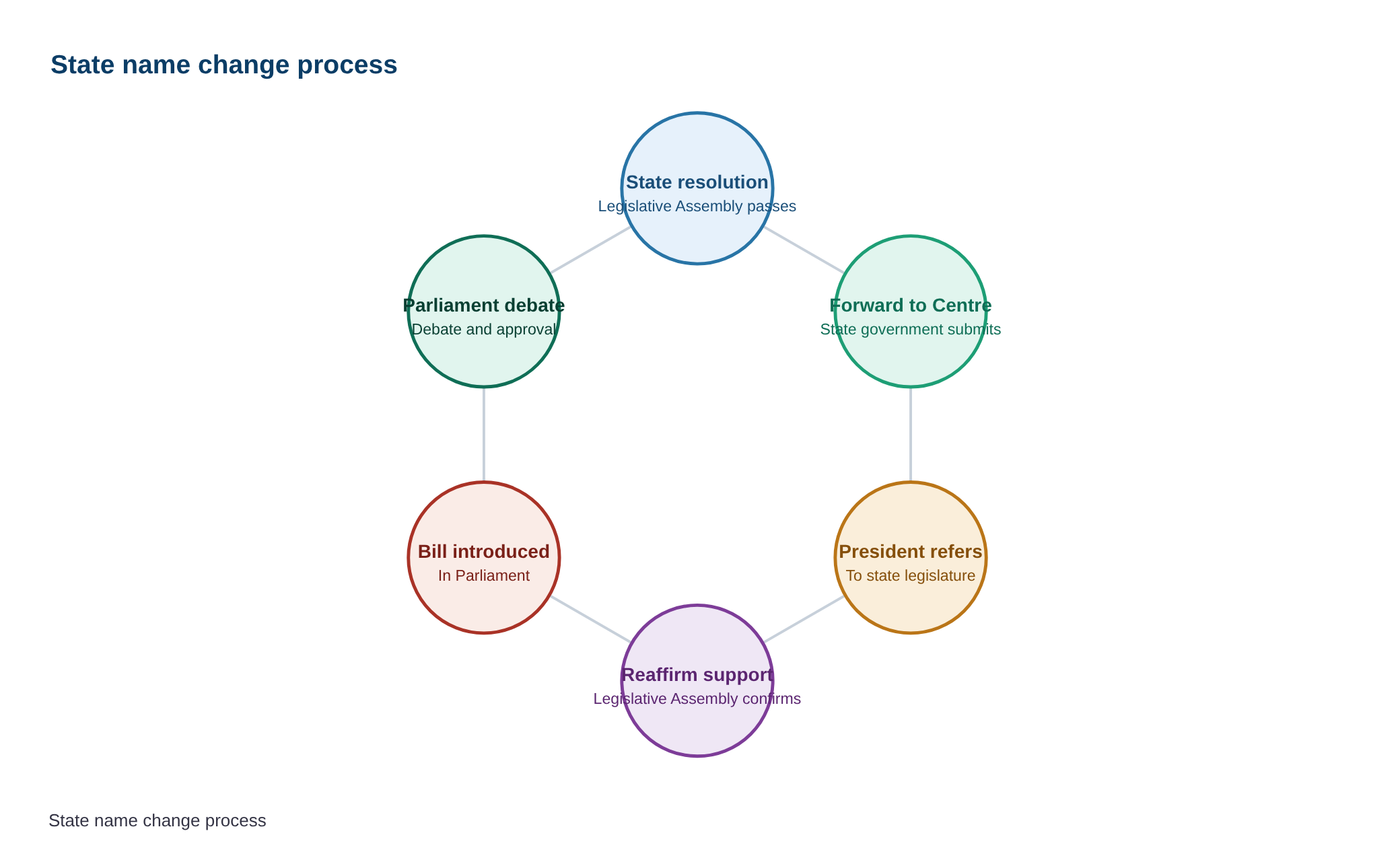
State Legislative Assembly adopts a resolution → State government forwards resolution to Centre → President refers the matter to the state legislature for views → State legislature reaffirms support → Bill introduced in Parliament → Parliamentary debate and approval → Presidential assent → Constitutional amendment (if required) → Implementation of name change across official records.
Prelims Practice Questions
Q1. Consider the following statements regarding the procedure for changing the name of a State in India:
1. A bill for the change of name of a State can be introduced only by the President.
2. The President may refer the bill to the legislature of the State for expressing its views.
3. The consent of the State legislature is mandatory before the Parliament can enact a law to change the name of a State.
4. The Constitution (One Hundred and First Amendment) Act, 2016 introduced the provision for changing the name of a State.
How many of the above statements are correct?
- Only one
- Only two
- Only three
- All
Answer: Only two — Statement 1 is incorrect: A bill for the change of name of a State can be introduced in Parliament by any member, not exclusively by the President. Statement 2 is correct: The President may refer the bill to the State legislature for its views. Statement 3 is incorrect: The consent of the State legislature is not mandatory; the President may or may not refer the bill to the State legislature. Statement 4 is incorrect: The Constitution does not require a specific amendment for name change; it is governed by Article 3 of the Constitution.
Q2. Assertion (A): The power to change the name of a State under Article 3 of the Constitution is vested exclusively with the Parliament.
Reason (R): The President of India must give prior assent before Parliament can enact a law to change the name of a State.
In the context of the above two statements, which one of the following is correct?
- Both A and R are true, and R is the correct explanation of A
- Both A and R are true, but R is not the correct explanation of A
- A is true, but R is false
- A is false, but R is true
Answer: A is true, but R is false — Assertion (A) is true: The power to change the name of a State is vested exclusively with Parliament under Article 3. Reason (R) is false: The President does not need to give prior assent; the President may refer the bill to the State legislature for its views, but this is not a mandatory step for the Parliament to enact the law.
Q3. Match the following constitutional provisions with their correct descriptions:
Column I (Provision) | Column II (Description)
1. Article 3 | A. Procedure for creation of new States and alteration of areas, boundaries or names of existing States
2. Article 2 | B. Power of Parliament to admit into the Union of India new States
3. Article 4 | C. Power of Parliament to form new States and alter boundaries or names of existing States
4. Article 1 | D. Name and territory of the Union of India
Select the correct match from the options below:
- 1-A, 2-B, 3-C, 4-D
- 1-B, 2-A, 3-D, 4-C
- 1-C, 2-D, 3-A, 4-B
- 1-D, 2-C, 3-B, 4-A
Answer: 1-A, 2-B, 3-C, 4-D — Article 3 empowers Parliament to form new States and alter the boundaries or names of existing States. Article 2 empowers Parliament to admit into the Union new States. Article 4 provides that laws made under Article 2 or Article 3 shall not be deemed to be amendments of the Constitution for the purposes of Article 368. Article 1 describes the name and territory of the Union of India.
Mains Practice Question
✍ Critically examine the constitutional and federal implications of the recent legislative initiative to change the name of Kerala to ‘Keralam’. In your answer, address the procedural safeguards under the Constitution, the role of the State legislature, and the Centre-State dynamics involved. (15 Marks)
Approach: MODEL-ANSWER SKELETON:
1. Constitutional Basis and Procedural Safeguards (4 points)
– Article 3 of the Constitution: Parliament’s power to alter the name of a State.
– Role of the President: Reference to State legislature for views (not mandatory consent).
– State legislature’s resolution: Kerala Legislative Assembly’s unanimous resolution as a precursor.
– Parliamentary process: Introduction of a bill in Lok Sabha and its subsequent legislative stages.
2. Federalism and Centre-State Relations (4 points)
– Cooperative federalism: Centre’s role in facilitating State identity while respecting federal autonomy.
– Linguistic identity: The name ‘Keralam’ reflects Malayalam linguistic heritage and cultural assertion.
– State consent: The State’s proactive role in initiating the process underscores federal principles.
– Potential challenges: Opposition from political groups or sections of society citing identity politics.
3. Comparative Perspective and Recent Trends (4 points)
– Precedents: Odisha (2011), Tamil Nadu (1969) — name changes for linguistic identity.
– Legal scrutiny: Courts’ role in ensuring constitutional validity of such legislative actions.
– Contemporary debates: Balancing State autonomy with national unity and identity.
– Broader implications: Impact on federal trust and Centre-State harmony.
4. Conclusion and Balanced View (3 points)
– The process adheres to constitutional mandates and reflects democratic federalism.
– The name change symbolizes linguistic and cultural pride while maintaining constitutional propriety.
– However, federal tensions may arise if the Centre overrides State sentiments without adequate consultation.
Source: The Indian Express
Generated by AanyaAi for educational purpose.

- मद्रास उच्च न्यायालय में ‘वेट्ट्री पयणम’ योजना को असंवैधानिक घोषित करने की मांग - October 4, 2026
- Gurugram’s groundwater extraction exceeds limit by 212%; HC seeks ban - October 4, 2026
- स्वतंत्रता सेनानी श्यामजी कृष्ण वर्मा की जन्म जयंती पर पीएम का श्रद्धांजलि - October 4, 2026

No Comments