


10 Aug NEP 2020: NCERT Curriculum Revamped with NCF-FS & NCF-SE
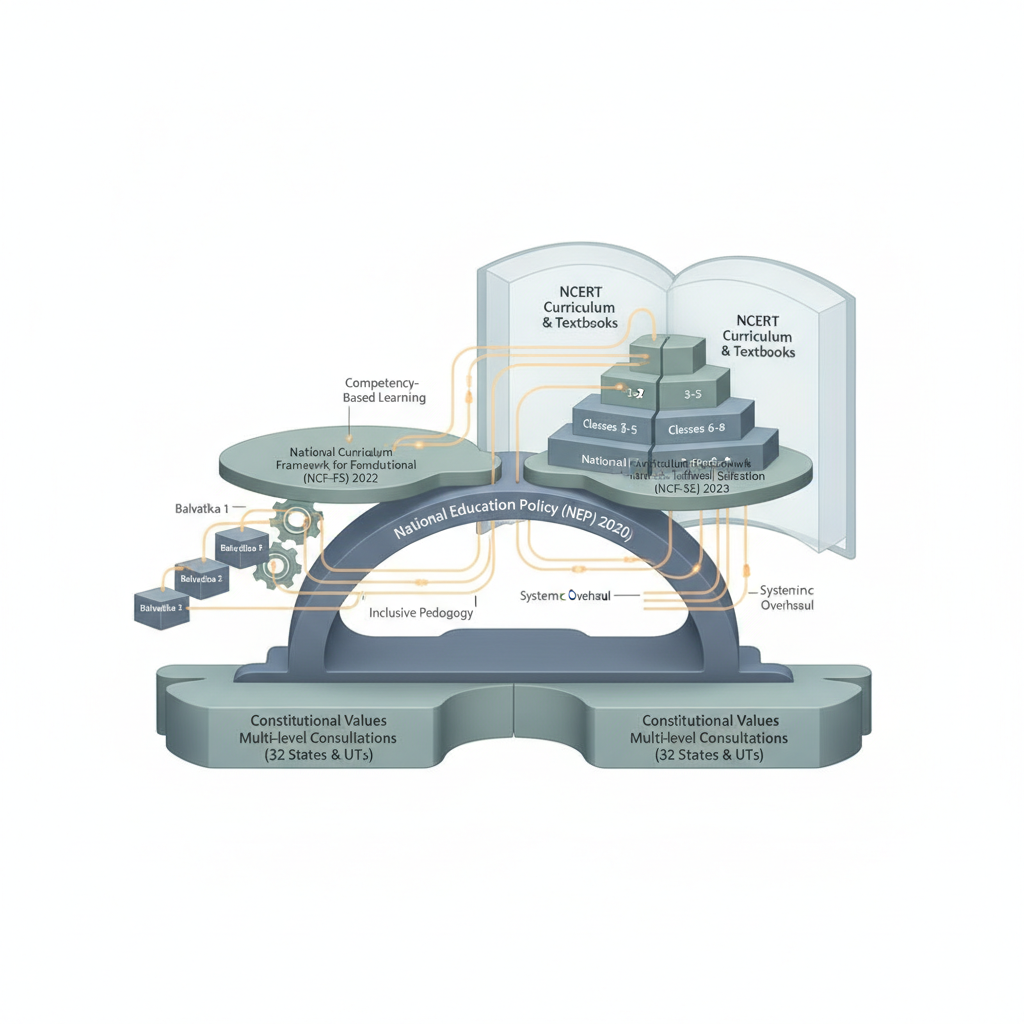
NCF-FS 2022NCF-SE 2023Competency-based learningInclusive pedagogyBalvatika stagesTextbook reforms✎ The National Curriculum Framework (NCF) 2023 operationalises NEP 2020 by defining competency-based learning outcomes, inclusive pedagogies, and constitutional values in school education through NCERT’s revised curriculum and…
Subject Relevance — Where This Topic Fits
- GS Paper II — Governance, Polity and Social Justice (Education Policy and Institutional Reforms) | GS Paper III — Human Resource Development and Social Sector Initiatives
- Prelims: National Education Policy (NEP) 2020, National Curriculum Framework (NCF), NCERT, Curriculum Reforms, Learning Outcomes, Competency-Based Education, Pedagogical Shifts, Inclusive Education, Gender Sensitivity in Curriculum, Constitutional Values in Education
- Essay: Reforms in School Education: Balancing Tradition and Modernity, The Role of Curriculum in Nation-Building: A Reflection on NEP 2020 and NCF 2023
Quick Revision: The National Curriculum Framework (NCF) 2023 operationalises NEP 2020 by defining competency-based learning outcomes, inclusive pedagogies, and constitutional values in school education through NCERT’s revised curriculum and textbooks for Classes 1–9 and pre-primary stages.
Why is this in the news?
The National Council of Educational Research and Training (NCERT) has recently aligned its school curriculum and textbooks with the National Education Policy (NEP) 2020 by implementing the National Curriculum Framework for Foundational Stage (NCF-FS) 2022 and the National Curriculum Framework for School Education (NCF-SE) 2023. This initiative represents a systemic overhaul of India’s school education framework, integrating competency-based learning, inclusive pedagogy, and constitutional values into textbooks and teaching-learning materials for Classes 1 to 9 and pre-primary stages (Balvatika 1, 2, and 3). The reforms are grounded in extensive multi-level consultations with stakeholders across 32 States and Union Territories, ensuring broad-based ownership and contextual relevance.
Background
- The National Education Policy (NEP) 2020, approved by the Union Cabinet on 29 July 2020, envisaged a transformative shift in India’s education system, emphasizing holistic development, critical thinking, and competency-based education.
- NEP 2020 mandated the development of a National Curriculum Framework (NCF) to guide curriculum design, pedagogy, and assessment at all school stages, replacing the previous NCF 2005.
- The NCF is developed through a bottom-up, participatory approach, involving teachers, parents, students, subject experts, and civil society across all States and Union Territories.
- The NCF-FS 2022 and NCF-SE 2023 were released on 20 October 2022 and 23 August 2023 respectively, following extensive consultations with over 13 lakh citizens and 1.5 lakh teachers via digital and in-person surveys.
- The NCF frameworks provide a structured blueprint for defining learning outcomes, competencies, curricular goals, and pedagogical strategies aligned with developmental stages of learners.
- NCERT, as the apex body for school curriculum development, has been tasked with implementing these frameworks through curriculum revision, textbook development, and teacher support materials.
What is the National Curriculum Framework (NCF)?
- The NCF is a policy document that defines the philosophical, pedagogical, and structural guidelines for school education in India, ensuring alignment with national priorities such as the NEP 2020.
- It is developed by NCERT under the aegis of the Ministry of Education and is periodically revised to reflect evolving educational needs and societal values.
- The NCF articulates learning outcomes and competencies across subjects and stages, moving from rote memorization to experiential and inquiry-based learning.
- It emphasizes inclusion, gender sensitivity, cultural relevance, and linguistic diversity, ensuring equitable access to quality education for all learners.
- The framework mandates integration of constitutional values such as justice, liberty, equality, and fraternity into all curricular and pedagogical practices.
- NCF promotes multi-disciplinary learning, critical thinking, and socio-emotional development, preparing students for real-world challenges.
- Implementation involves the development of textbooks, teacher guides, and digital resources, followed by rigorous academic and pedagogical reviews.
Key Features
| Feature | Significance |
|---|---|
| National Curriculum Framework for Foundational Stage (NCF-FS) 2022 | Establishes pedagogical and developmental benchmarks for learners aged 3-8, aligning early childhood education with NEP 2020’s emphasis on play-based and activity-based learning. |
| National Curriculum Framework for School Education (NCF-SE) 2023 | Provides a structured framework for grades 1-12, integrating competency-based education, experiential learning, and multidisciplinary approaches as mandated by NEP 2020. |
| Multi-tiered Consultation Process | Ensures inclusivity by engaging 13 lakh citizens, 1.5 lakh teachers, and 8,000 stakeholders across 32 states/UTs, incorporating grassroots inputs into curriculum design. |
| National Curriculum and Teaching-Learning Material Committee (NSTC) | Oversees the development of textbooks and teaching materials, ensuring alignment with NCF-FS and NCF-SE through 13 subject-area groups and textbook development teams. |
| Academic and Pedagogical Review Mechanism | Subjects curriculum drafts to multiple rounds of expert reviews for accuracy, age-appropriateness, inclusivity, and constitutional values, ensuring high-quality educational resources. |
Why it Matters
Pedagogical Transformation
- Shifts focus from rote memorisation to competency-based and experiential learning, fostering critical thinking and problem-solving skills in line with NEP 2020’s vision.
- Introduces play-based and activity-based learning for foundational stage, addressing developmental needs of young learners through structured yet flexible frameworks.
- Promotes multidisciplinary education by integrating subjects across domains, preparing students for real-world challenges and future skill demands.
Inclusivity and Equity
- Ensures representation of diverse stakeholders—teachers, parents, students, and marginalised groups—through extensive consultations, reducing biases in curriculum content.
- Mandates gender sensitivity, cultural relevance, and linguistic inclusivity in textbooks and teaching materials, addressing equity gaps in access to quality education.
- Incorporates inputs from special groups such as neo-literates, illiterate individuals, and Anganwadi workers, aligning education with social justice principles.
Institutional Capacity Building
- Strengthens the role of NCERT as a nodal agency for curriculum development, enhancing its capacity to design and disseminate high-quality educational resources.
- Establishes subject-specific committees and expert groups, fostering collaboration among educators, scholars, and practitioners for continuous curriculum improvement.
- Creates a feedback loop through annual textbook revisions, enabling iterative enhancements based on stakeholder inputs and evolving educational needs.
Alignment with Global Best Practices
- Adopts frameworks aligned with UNESCO’s Education 2030 and Sustainable Development Goal 4, ensuring India’s education system remains competitive globally.
- Integrates digital learning resources (e.g., ‘Jadui Pitara’ and ‘E-Jadui Pitara’) to bridge digital divides and prepare students for a technology-driven future.
- Emphasises formative assessment and continuous evaluation, reducing reliance on high-stakes examinations and promoting holistic development.
Challenges
1. Implementation at Scale
- Ensuring uniform adoption of NCF-aligned curricula across diverse states and Union Territories with varying administrative and infrastructural capacities.
- Training teachers in competency-based pedagogy and experiential learning methods, which may require significant capacity-building initiatives.
- Addressing resource disparities between urban and rural schools, including access to digital tools and trained educators.
UPSC Link: GS2: Issues relating to development and management of Social Sector/Services relating to Education
2. Curriculum-Textbook Disconnect
- Bridging the gap between curriculum frameworks (NCF-FS and NCF-SE) and actual classroom practices, particularly in resource-constrained settings.
- Preventing over-reliance on textbooks as the sole teaching resource, ensuring teachers utilise diverse pedagogical tools and activities.
- Maintaining consistency in curriculum delivery across different mediums of instruction (e.g., regional languages vs. English).
UPSC Link: GS1: Role of social influence and public opinion in policy implementation
3. Assessment and Evaluation
- Designing assessment tools that accurately measure competency-based learning outcomes without reverting to traditional examination formats.
- Ensuring formative assessments are practical and scalable, particularly in large classrooms with high student-teacher ratios.
- Balancing standardised testing with holistic evaluation to avoid unintended consequences such as increased stress or inequitable outcomes.
UPSC Link: GS2: Government policies and interventions for development in Education sector
4. Stakeholder Engagement
- Sustaining long-term engagement of teachers, parents, and students in curriculum feedback and improvement processes beyond initial consultations.
- Addressing resistance to change among educators accustomed to traditional teaching methods, particularly in government-run schools.
- Ensuring marginalised communities (e.g., tribal groups, persons with disabilities) have equitable representation in curriculum design and review.
UPSC Link: GS2: Issues relating to poverty and developmental inequalities
5. Digital Divide
- Ensuring equitable access to digital learning resources (e.g., ‘E-Jadui Pitara’) across socio-economic strata, particularly in remote areas.
- Preventing digital exclusion by providing offline access to materials and training educators in digital literacy.
- Mitigating the risk of over-reliance on digital tools in classrooms, which may exacerbate disparities in learning outcomes.
UPSC Link: GS3: Challenges to internal security through communication networks
Challenges — UPSC Perspective
| Issue | Concern |
|---|---|
| Teacher Training | Inadequate preparation of educators to implement competency-based and experiential learning methods effectively. |
| Resource Allocation | Disparities in infrastructure, teaching aids, and digital access between urban and rural schools hinder uniform implementation. |
| Curriculum Overload | Risk of adding excessive content to curricula under the guise of multidisciplinary education, defeating the purpose of competency-based learning. |
| Assessment Design | Difficulty in creating assessment tools that accurately evaluate skills like critical thinking and creativity without subjective biases. |
| Stakeholder Buy-in | Resistance from communities or educators accustomed to traditional examination-driven education systems. |
Way Forward
- Conduct state-wise capacity-building workshops for teachers to familiarise them with NCF-aligned pedagogies and assessment methods.
- Develop standardised training modules for digital literacy and the use of ‘Jadui Pitara’ and ‘E-Jadui Pitara’ in classrooms.
- Establish a national digital repository of teaching-learning materials to ensure equitable access across all regions and socio-economic groups.
- Institute periodic reviews of textbook content and classroom practices by NCERT in collaboration with state education departments to identify gaps and areas for improvement.
- Strengthen mechanisms for continuous stakeholder feedback, including digital platforms for real-time input from teachers, students, and parents.
- Allocate dedicated funds under the Samagra Shiksha Abhiyan for infrastructure development and teacher training in alignment with NCF requirements.
- Promote research on effective implementation strategies through partnerships with academic institutions and NGOs to generate evidence-based best practices.
UPSC Value Addition
Keywords for Mains Answer-Writing
National Education Policy 2020 · National Curriculum Framework for Foundational Stage (NCF-FS) 2022 · National Curriculum Framework for School Education (NCF-SE) 2023 · NCERT · National Council of Educational Research and Training · National Steering Committee for Curriculum and Pedagogy · Curriculum Goals · Learning Outcomes · Competency-Based Education · Pedagogical Reforms · Inclusive Education · Gender Sensitivity in Curriculum · Constitutional Values in Education · National Curriculum and Teaching-Learning Material Committee (NSTC) · Textbook Development Teams (TDT) · Multi-Stakeholder Consultation Process · Competency-Based Assessment · Foundational Literacy and Numeracy · Multilingual Education · Culturally Relevant Pedagogy
Constitutional & Policy Linkages
- Article 29(2): Cultural and linguistic minority rights in educational institutions.
- Article 30: Right of minorities to establish and administer educational institutions.
- Article 45: Directive Principles—free and compulsory education for children up to 14 years.
Concept Flow
National Education Policy (NEP) 2020 → Framing of National Curriculum Frameworks (NCF-FS 2022, NCF-SE 2023) → Multi-stakeholder consultations and expert reviews → Development of competency-based curricula and learning outcomes → Formation of NSTC and subject-area groups → Creation of textbooks and teaching-learning materials → Academic and pedagogical reviews → Iterative refinement of curricula and resources → Implementation in classrooms → Teacher training and resource allocation → Continuous feedback and annual revisions → Sustained alignment with NEP 2020 and evolving educational needs
Prelims Practice Questions
Q1. Consider the following statements regarding the National Curriculum Framework (NCF) as per the National Education Policy (NEP) 2020:
1. The NCF-FS 2022 is designed for the foundational stage of education.
2. The NCF-SE 2023 covers school education from pre-primary to higher secondary stages.
3. The NCF frameworks were developed through a top-down approach without stakeholder consultations.
4. The NCF frameworks emphasize competency-based education and learning outcomes.
How many of the above statements are correct?
- Only one
- Only two
- Only three
- All four
Answer: All four — Statements 1, 2, and 4 are correct as NCF-FS 2022 targets the foundational stage (3-8 years) and NCF-SE 2023 covers school education (3-18 years), with both frameworks emphasizing competency-based education. Statement 3 is incorrect because the NCF frameworks were developed through extensive stakeholder consultations, including 13 lakh+ citizens and 1.5 lakh+ teachers.
Q2. Assertion (A): The National Steering Committee for Curriculum and Pedagogy (NSTC) was constituted to oversee the development of textbooks and teaching-learning materials under NCF 2020.
Reason (R): The NSTC includes subject experts, teachers, and representatives from SCERTs to ensure academic rigor and alignment with NCF guidelines.
In the context of the above two statements, which of the following is correct?
- Both A and R are true, and R is the correct explanation of A.
- Both A and R are true, but R is not the correct explanation of A.
- A is true but R is false.
- A is false but R is true.
Answer: Both A and R are true, but R is not the correct explanation of A. — Assertion (A) is correct as the NSTC was indeed formed to develop textbooks and teaching-learning materials. Reason (R) is also correct and directly explains the role of NSTC, as it includes subject experts, teachers, and SCERT representatives to ensure alignment with NCF guidelines.
Q3. Match the following stages of school education with their corresponding National Curriculum Framework (NCF) documents as per NEP 2020:
Column I (Stage of Education) Column II (NCF Document)
A. Foundational Stage (3-8 years) 1. NCF-SE 2023
B. Preparatory Stage (8-11 years) 2. NCF-FS 2022
C. Middle Stage (11-14 years) 3. NCF-FS 2022
D. Secondary Stage (14-18 years) 4. NCF-SE 2023
Select the correct match:
- A-2, B-1, C-1, D-4; A-1, B-2, C-4, D-3; A-2, B-3, C-1, D-4; A-3, B-1, C-4, D-2
- answer_string_list_indexes_to_match_pairs: [[0,2],[1,1],[2,1],[3,4]]
- answer_index_in_options_array_to_match_pairs: 0,
- explain
- The correct matches are: A (Foundational Stage) with NCF-FS 2022 (2), B (Preparatory Stage) with NCF-SE 2023 (1), C (Middle Stage) with NCF-SE 2023 (1), and D (Secondary Stage) with NCF-SE 2023 (4). NCF-FS 2022 is specific to the foundational stage, while NCF-SE 2023 covers all school education stages from pre-primary to higher secondary.
- format
- match-the-following
Answer: A-2, B-1, C-1, D-4; A-1, B-2, C-4, D-3; A-2, B-3, C-1, D-4; A-3, B-1, C-4, D-2 —
Q4. Which of the following is NOT a key feature of the National Curriculum Frameworks (NCF-FS 2022 and NCF-SE 2023) developed by NCERT under NEP 2020?
- Competency-based education
- Multi-stakeholder consultation process
- Emphasis on rote learning
- Inclusion of constitutional values
Answer: Emphasis on rote learning — The NCF frameworks emphasize competency-based education, multi-stakeholder consultations, and inclusion of constitutional values. Rote learning is explicitly discouraged under NEP 2020 and the NCF frameworks.
Mains Practice Question
✍ The National Education Policy (NEP) 2020 envisages a transformative shift in India’s school education system through the National Curriculum Frameworks (NCF-FS 2022 and NCF-SE 2023). Critically examine the structural and pedagogical reforms proposed by these frameworks, with particular reference to their alignment with constitutional values, inclusivity, and competency-based learning. Also, assess the challenges in their implementation at the grassroots level. (15 Marks)
Approach: MODEL-ANSWER SKELETON:
1. **Introduction (2 marks)**
– Briefly state the objectives of NEP 2020 and the role of NCF-FS 2022 (Foundational Stage) and NCF-SE 2023 (School Education) in achieving these objectives.
– Mention the multi-stakeholder consultation process and the participatory nature of the NCF development.
2. **Structural Reforms (4 marks)**
– **Curriculum Goals and Learning Outcomes**: Explain the shift from content-heavy to competency-based education, focusing on foundational literacy and numeracy (FLN), critical thinking, and experiential learning.
– **Pedagogical Reforms**: Highlight the emphasis on play-based and activity-based learning for foundational stage, and inquiry-based and project-based learning for higher stages.
– **Assessment Reforms**: Discuss the move from summative to formative and competency-based assessments, including continuous and comprehensive evaluation (CCE).
– **Textbook and Teaching-Learning Material**: Explain the role of the National Steering Committee for Curriculum and Pedagogy (NSTC), Curriculum Area Groups (CAGs), and Textbook Development Teams (TDT) in developing inclusive, gender-sensitive, and culturally relevant materials.
3. **Alignment with Constitutional Values and Inclusivity (4 marks)**
– **Constitutional Values**: Discuss the integration of constitutional principles such as equality, justice, liberty, and fraternity into the curriculum, including lessons on fundamental duties and rights.
– **Inclusivity**: Explain measures for inclusive education, such as provisions for children with disabilities, multilingual education, and gender sensitivity in textbooks and pedagogy.
– **Cultural Relevance**: Highlight the emphasis on local and indigenous knowledge systems, and the promotion of multilingualism to preserve linguistic diversity.
4. **Challenges in Implementation (3 marks)**
– **Teacher Capacity Building**: Discuss the need for extensive teacher training to adopt new pedagogical methods and competency-based assessments.
– **Resource Constraints**: Highlight issues such as inadequate infrastructure, lack of teaching-learning materials, and digital divide, particularly in rural and tribal areas.
– **Stakeholder Engagement**: Emphasize the challenges in ensuring consistent engagement of parents, communities, and local bodies in the implementation process.
– **Assessment and Evaluation**: Discuss the difficulties in transitioning from traditional examination systems to competency-based assessments.
5. **Conclusion (2 marks)**
– Summarize the potential of NCF-FS 2022 and NCF-SE 2023 to transform India’s education system if implemented effectively.
– Stress the need for continuous monitoring, feedback mechanisms, and adaptive policy measures to address implementation challenges.
Source: PIB (Press Information Bureau)
Generated by AanyaAi for educational purpose.

- KWML’s Feasibility Reports for Water Metro in 18 Cities: UPSC & PCS Insights - October 3, 2026
- ओडिशा में वन्यजीव अनुसंधान अनुदान कार्यक्रम शुरू, सिमिलिपाल में 300 कैमरे और बढ़ेंगे - October 3, 2026
- India Summons Pakistan High Commission Official Over Violation - October 3, 2026

No Comments