


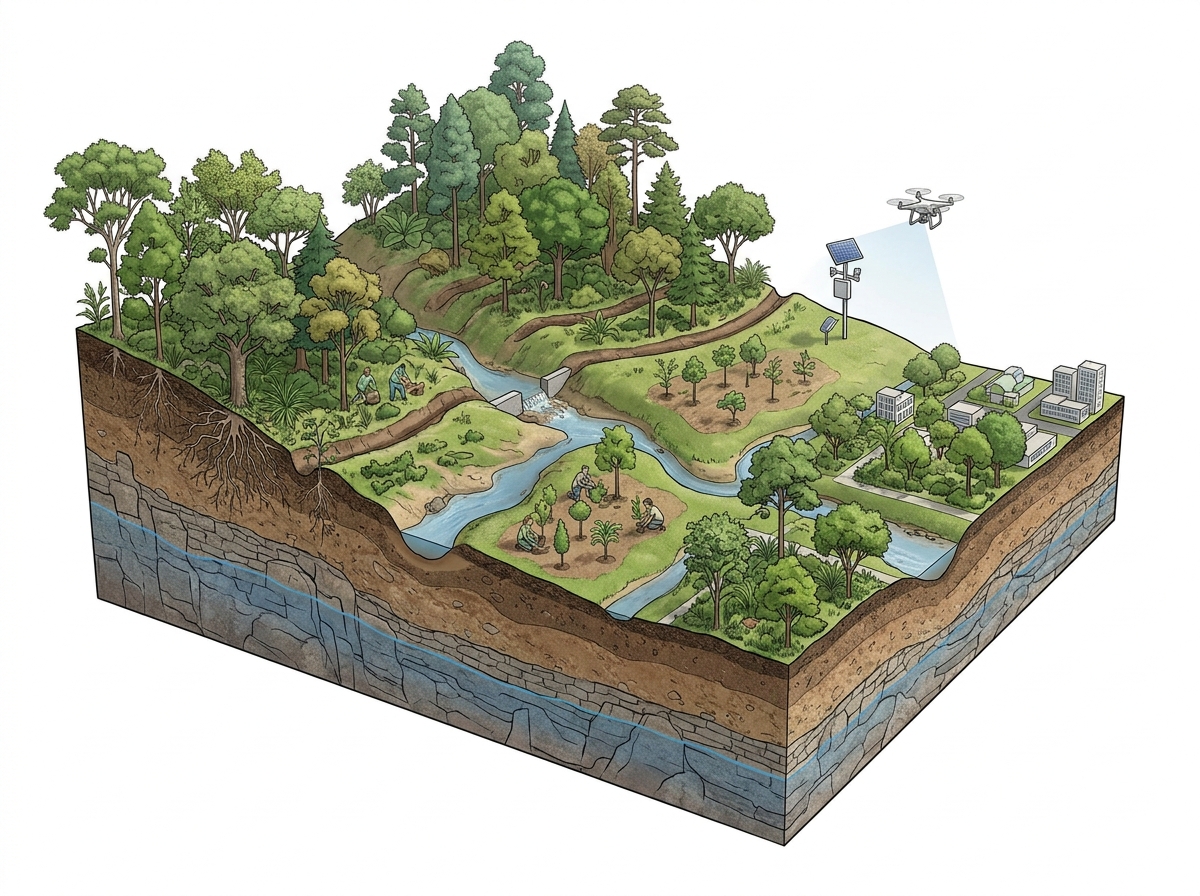
11 Aug GIM Progress: 1.84 lakh ha degraded land restored under Green India Mission
Green India MissionDegraded forest landUrban greening initiativesAfforestation outcomesMonitoring mechanisms✎ The Green India Mission (GIM) is a climate change mitigation initiative under the National Action Plan on Climate Change (NAPCC), operationalised from 2015-16, aimed at restoring 1,84,467 hectares of degraded forest lands across…
Subject Relevance — Where This Topic Fits
- GS Paper III — Environment, Forest and Climate Change | GS Paper III — Conservation, Environmental Pollution and Degradation
- Prelims: Green India Mission (GIM), National Action Plan on Climate Change (NAPCC), National Mission for a Green India, Integrated Landscape Approach, Compensatory Afforestation Fund Management and Planning Authority (CAMPA), Joint Forest Management Committees (JFMCs), Village Forest Committees (VFCs), India State of Forest Report (ISFR), Geo-tagging, GIS-based mapping, KML files
- Essay: Climate change mitigation through afforestation and ecosystem restoration, Role of community participation in environmental governance
Quick Revision: The Green India Mission (GIM) is a climate change mitigation initiative under the National Action Plan on Climate Change (NAPCC), operationalised from 2015-16, aimed at restoring 1,84,467 hectares of degraded forest lands across 17 states and one Union Territory using an integrated landscape approach, community participation, and technology-driven monitoring.
Why is this in the news?
The Ministry of Environment, Forest and Climate Change, in a written reply to a Parliament question on 10 August 2026, provided an update on the implementation progress of the Green India Mission (GIM), including the extent of degraded forest land restored, financial allocations, and monitoring mechanisms. The response highlighted the scale of ecological restoration across 17 states and one Union Territory, the integration of urban greening initiatives, and the use of advanced technologies for tracking afforestation outcomes.
Background
- GIM was operationalised from 2015-16 with the objective of restoring degraded forest lands and non-forest landscapes using an integrated landscape approach.
- Degraded forest lands refer to areas where forest cover has diminished due to anthropogenic pressures, natural calamities, or unsustainable land-use practices, leading to loss of biodiversity and ecosystem services.
- The Compensatory Afforestation Fund Act, 2016, and its Rules, 2018, established the Compensatory Afforestation Fund Management and Planning Authority (CAMPA) to manage funds for afforestation and related activities.
- Urban greening initiatives, such as the Nagar Van Yojana (NVY), were introduced in 2020-21 to enhance green cover in urban areas and improve micro-climatic conditions.
What is the Green India Mission (GIM)?
- GIM is a centrally sponsored scheme under the National Mission for a Green India, a sub-mission of the National Action Plan on Climate Change (NAPCC), aimed at enhancing forest cover and improving ecosystem services.
- The mission adopts an integrated landscape approach, which involves restoring degraded forests, afforestation in non-forest areas, and promoting sustainable land-use practices across diverse ecological zones.
- GIM focuses on both quantitative and qualitative restoration, including tree planting, soil conservation, water harvesting, and biodiversity enhancement in degraded landscapes.
- The mission is implemented through a collaborative framework involving central and state governments, local institutions, and community-based organisations.
- The mission prioritises the involvement of local communities, particularly through Joint Forest Management Committees (JFMCs) and Village Forest Committees (VFCs), to ensure participatory governance and sustainable outcomes.
- GIM integrates advanced technologies such as geo-tagging, GIS-based mapping, and remote sensing for real-time monitoring and assessment of restoration activities.
- The mission also supports livelihood enhancement activities, including nursery development, agroforestry, and non-timber forest produce (NTFP) collection, to provide socio-economic benefits to local communities.
Key Features
| Feature | Significance |
|---|---|
| Integrated Landscape Approach under GIM | Ensures holistic restoration of degraded forests and non-forest sites by addressing ecological, social, and economic dimensions simultaneously. |
| Community-Based Implementation | Leverages Joint Forest Management Committees (JFMCs), Village Forest Committees (VFCs), and self-help groups for local participation, ownership, and livelihood linkages. |
| Multi-Level Monitoring Framework | Combines central and state systems with technology-driven tools such as geotagging, GIS mapping, drone surveillance, and third-party audits for real-time assessment and corrective actions. |
| Urban Forestry Initiative (NVY) | Augments urban green cover through 600 ‘Nagar Vans’ and 400 ‘Nagar Vatikas’ to improve micro-climate, air quality, and urban biodiversity. |
| Annual Operational Planning under GIM | Ensures systematic allocation of funds, activities, and timelines for afforestation and post-plantation care, aligned with local ecological and socio-economic conditions. |
Why it Matters
Ecological Resilience
- Restores biodiversity by rehabilitating degraded ecosystems, thereby enhancing habitat connectivity and species survival.
- Improves soil health and water retention, mitigating desertification and land degradation in vulnerable regions.
- Contributes to carbon sequestration, aligning with India’s Nationally Determined Contributions (NDCs) under the Paris Agreement.
Climate Adaptation and Mitigation
- Strengthens climate resilience of forest-dependent communities by reducing vulnerability to extreme weather events.
- Supports India’s commitment to achieving 33% forest cover and restoring 26 million hectares of degraded land by 2030.
- Enhances local micro-climates, reducing urban heat island effects in cities through the ‘Nagar Van Yojana’.
Socio-Economic Benefits
- Generates rural and peri-urban employment through afforestation, nursery development, and allied livelihood activities.
- Empowers local communities via participatory governance models (JFMCs, VFCs), fostering social capital and institutional strengthening.
- Promotes agroforestry and non-timber forest produce (NTFP) cultivation, diversifying income sources for marginalized groups.
Institutional and Technological Advancements
- Demonstrates India’s institutional capacity in implementing large-scale landscape restoration with multi-stakeholder coordination.
- Leverages geospatial technologies (GIS, remote sensing) and drones for precise monitoring, reducing manual errors and enhancing transparency.
- Sets a precedent for integrating traditional ecological knowledge with modern scientific practices in forest management.
Challenges
1. Long-Term Survival and Maintenance of Planted Species
- High mortality rates of saplings due to inadequate post-plantation care, water scarcity, or biotic pressures (e.g., grazing, pests).
- Dependence on seasonal rainfall in many regions, necessitating supplementary irrigation and drought-resistant species selection.
UPSC Link: Environmental degradation and conservation measures
2. Land Tenure and Legal Ambiguities
- Conflicting land rights in forest fringe areas, particularly in Scheduled Tribes (ST) habitats, leading to encroachments or resistance to restoration efforts.
- Lack of clear demarcation between forest and revenue lands complicates the implementation of integrated landscape approaches.
UPSC Link: Forest rights and conservation policies
3. Resource Allocation and Financial Sustainability
- Inadequate and delayed fund disbursement from CAMPA or other sources, affecting the continuity of restoration activities.
- High operational costs for monitoring, maintenance, and community engagement, especially in remote or conflict-affected regions.
UPSC Link: Funding mechanisms for environmental schemes
4. Climate Change-Induced Stressors
- Increased frequency of extreme weather events (droughts, floods) disrupting restoration timelines and seedling survival rates.
- Shifts in temperature and precipitation patterns altering species suitability and ecosystem dynamics.
UPSC Link: Climate change impacts on ecosystems
5. Community Participation and Behavioral Barriers
- Low awareness or skepticism about the long-term benefits of restoration among local communities, leading to passive resistance.
- Competing land-use priorities (agriculture, infrastructure) diverting resources from afforestation efforts.
UPSC Link: People’s participation in environmental governance
6. Technological and Data Gaps
- Limited access to high-resolution remote sensing data in certain regions, affecting the accuracy of restoration monitoring.
- Inadequate training for local institutions in using geospatial tools, leading to underutilization of technological solutions.
UPSC Link: Use of technology in environmental management
Challenges — UPSC Perspective
| Issue | Concern |
|---|---|
| Post-plantation mortality | High sapling loss due to inadequate care and environmental stressors |
| Land tenure conflicts | Ambiguities in land rights hinder restoration efforts in forest-fringe areas |
| Funding delays | Disruptions in restoration activities due to irregular or insufficient financial flows |
| Climate variability | Extreme weather events undermine restoration outcomes and species survival |
| Community engagement | Low participation reduces the effectiveness of participatory restoration models |
| Data limitations | Gaps in geospatial data and technological capacity impede monitoring and evaluation |
Government Initiatives — Must-Memorise for Prelims
- National Mission for a Green India (GIM) under NAPCC
- Nagar Van Yojana (NVY) for urban afforestation
- Compensatory Afforestation Fund Management and Planning Authority (CAMPA) for funding
Way Forward
- Strengthen post-plantation care protocols with community-based monitoring and supplementary irrigation systems in drought-prone regions.
- Streamline land tenure resolutions through collaborative mapping and legal reforms to clarify forest-revenue land boundaries.
- Enhance financial sustainability by exploring public-private partnerships (PPPs) and carbon credit mechanisms for restoration projects.
- Expand climate-resilient afforestation by prioritizing native, drought-resistant, and multi-purpose species in restoration plans.
- Develop localized training programs for forest-dependent communities on nursery management, agroforestry, and geospatial tools.
- Integrate restoration efforts with existing rural employment schemes (e.g., MGNREGS) to ensure continuous funding and labor availability.
- Leverage drone technology for real-time monitoring of restoration sites, particularly in inaccessible or conflict-affected areas.
- Establish a national-level data repository combining remote sensing, ground-truthing, and third-party audits for transparent evaluation of GIM outcomes.
UPSC Value Addition
Keywords for Mains Answer-Writing
Green India Mission (GIM) · National Action Plan on Climate Change (NAPCC) · degraded forest land restoration · integrated landscape approach · Joint Forest Management Committees (JFMCs) · urban forest scheme · National Urban Forest Mission (NUF) · ecological restoration · community-based forest governance · geospatial monitoring of afforestation · India State of Forest Report (ISFR) · Forest Survey of India (FSI) · climate change mitigation · biodiversity conservation · carbon sequestration · micro-climate regulation · sustainable forest management · third-party monitoring in afforestation
Constitutional & Policy Linkages
- Article 48A (Directive Principles of State Policy) – Protection and improvement of environment and safeguarding of forests and wildlife
- Seventh Schedule (State List, Entry 17A) – Forest conservation and management
Concept Flow
Degraded land and forest ecosystems → Loss of biodiversity and ecosystem services → Implementation of GIM with integrated landscape approach → Community participation via JFMCs/VFCs → Technological monitoring (GIS, drones) → Restoration of ecological functions and carbon sequestration → Enhanced climate resilience and livelihood opportunities → Long-term sustainability through policy integration and financial mechanisms
Prelims Practice Questions
Q1. Consider the following statements regarding the Green India Mission (GIM):
1. It is one of the nine missions under the National Action Plan on Climate Change (NAPCC).
2. It focuses exclusively on afforestation in urban areas.
3. The Forest Survey of India (FSI) conducts biennial assessments of forest cover under GIM.
4. The mission employs geospatial technologies such as GIS mapping and geo-tagging for monitoring.
How many of the above statements are correct?
- Only one
- Only two
- Only three
- All four
Answer: All four — Statements 1, 3, and 4 are correct. Statement 2 is incorrect as GIM focuses on both degraded forest and non-forest lands, including rural and urban areas. The mission does not focus exclusively on urban areas.
Q2. Assertion (A): The Joint Forest Management Committees (JFMCs) are actively involved in the implementation of the Green India Mission.
Reason (R): JFMCs facilitate community participation in afforestation and forest management activities under GIM.
Options:
A. Both A and R are true, and R is the correct explanation of A.
B. Both A and R are true, but R is not the correct explanation of A.
C. A is true, but R is false.
D. A is false, but R is true.
Answer: ? — Both Assertion (A) and Reason (R) are true, and R correctly explains A. JFMCs are a key institutional mechanism under GIM for involving local communities in afforestation and forest restoration activities.
Q3. Match the following initiatives with their respective objectives:
Column I (Initiative) | Column II (Objective)
— | —
A. Green India Mission (GIM) | 1. Development of 600 urban forests and 400 urban gardens by 2026-27
B. National Urban Forest Mission (NUF) | 2. Restoration of degraded forest and non-forest lands through an integrated landscape approach
C. Joint Forest Management Committees (JFMCs) | 3. Facilitation of community-based forest governance and afforestation
D. Forest Survey of India (FSI) | 4. Biennial assessment of forest cover using remote sensing and ground verification
Options:
A-2, B-1, C-3, D-4
A-1, B-2, C-3, D-4
A-2, B-1, C-4, D-3
A-3, B-2, C-1, D-4
Answer: ? — The correct matches are: A-2 (GIM aims at restoration of degraded lands), B-1 (NUF aims to develop urban forests and gardens), C-3 (JFMCs facilitate community participation), and D-4 (FSI conducts biennial forest cover assessments).
Mains Practice Question
✍ The Green India Mission (GIM) represents a paradigm shift in India’s approach to ecological restoration by integrating landscape-level interventions with community participation and technological monitoring. Critically examine the design and implementation of GIM, highlighting its strengths, limitations, and the role of institutions such as Joint Forest Management Committees (JFMCs) and the Forest Survey of India (FSI). Also, assess how GIM contributes to India’s climate change mitigation and biodiversity conservation goals. (15 Marks)
Approach: MODEL-ANSWER SKELETON:
1. **Introduction (2 Marks)**
– Brief context: GIM as a mission under NAPCC (2008), operational since 2015-16.
– Objective: Restoration of degraded forest and non-forest lands through an integrated landscape approach.
– Scale: 1,84,467 hectares restored across 17 states and 1 UT (data from PIB release, 2026).
2. **Design and Implementation (5 Marks)**
– **Integrated Landscape Approach**: Combines afforestation, biodiversity conservation, and livelihood enhancement.
– **Institutional Mechanisms**:
– JFMCs and Village Forest Committees (VFCs) for community-based governance.
– Local institutions (e.g., SHGs) involved in nursery development, post-plantation care, and livelihood activities.
– **Technological Integration**:
– Geospatial tools (GIS, geo-tagging, KML files) for real-time monitoring.
– Third-party audits and drone-based surveillance for ground verification.
– **Funding and Execution**:
– Annual Operational Plans approved at state level.
– Funds released via CAMPA (Compensatory Afforestation Fund Management and Planning Authority).
3. **Strengths (3 Marks)**
– **Scalability**: Pan-India implementation across diverse ecological zones.
– **Community Participation**: Empowers local stakeholders, aligning with the National Forest Policy (1988) and Forest Rights Act (2006).
– **Monitoring and Accountability**: Multi-layered oversight (central, state, third-party) ensures transparency.
– **Climate and Biodiversity Co-benefits**: Enhances carbon sequestration, improves micro-climate, and supports habitat restoration.
4. **Limitations and Challenges (3 Marks)**
– **Ecological Suitability**: Risk of monoculture plantations vs. native species restoration.
– **Survival Rate of Saplings**: Post-plantation care and sapling survival remain critical challenges (FSI’s ISFR reports highlight gaps).
– **Institutional Capacity**: Variability in state-level execution due to administrative and financial constraints.
– **Land Tenure Issues**: Conflicts over land rights in community forests (e.g., Scheduled Tribes and Other Traditional Forest Dwellers (Recognition of Forest Rights) Act, 2006).
5. **Contribution to Climate and Biodiversity Goals (2 Marks)**
– **Climate Mitigation**: Contributes to India’s NDCs (Nationally Determined Contributions) under the Paris Agreement via carbon sequestration.
– **Biodiversity Conservation**: Supports the National Biodiversity Action Plan (2019) by restoring degraded ecosystems and corridors.
– **Urban Greening**: Complements the National Urban Forest Mission (NUF) in improving urban air quality and micro-climate.
6. **Conclusion (2 Marks)**
– GIM exemplifies a balanced approach combining ecological restoration with socio-economic benefits.
– However, sustained funding, ecological sensitivity, and robust community engagement are essential for long-term success.
– Recommendations: Strengthen FSI’s role in ecological impact assessment, integrate traditional ecological knowledge, and enhance inter-state coordination.
Source: PIB (Press Information Bureau)
Generated by AanyaAi for educational purpose.

- Exercise Tarang Shakti 2026: India’s Mega Multi-Nation Air Power Showcase - September 27, 2026
- रबी अभियान 2026: राष्ट्रीय सम्मेलन में केंद्र-राज्य तालमेल पर होगा जोर - September 27, 2026
- Himachal CM Sukhu: All Doctor Vacancies to be Filled by March - September 27, 2026

No Comments