


11 Aug UP’s TTZ Survey: 10 Key Parameters for New Industries in Taj Zone
✎ The Taj Trapezium Zone (TTZ) is a Supreme Court-monitored ecological zone where industrial activities are regulated through a combination of statutory laws, judicial directives, and multi-agency compliance verification to balance…
Subject Relevance — Where This Topic Fits
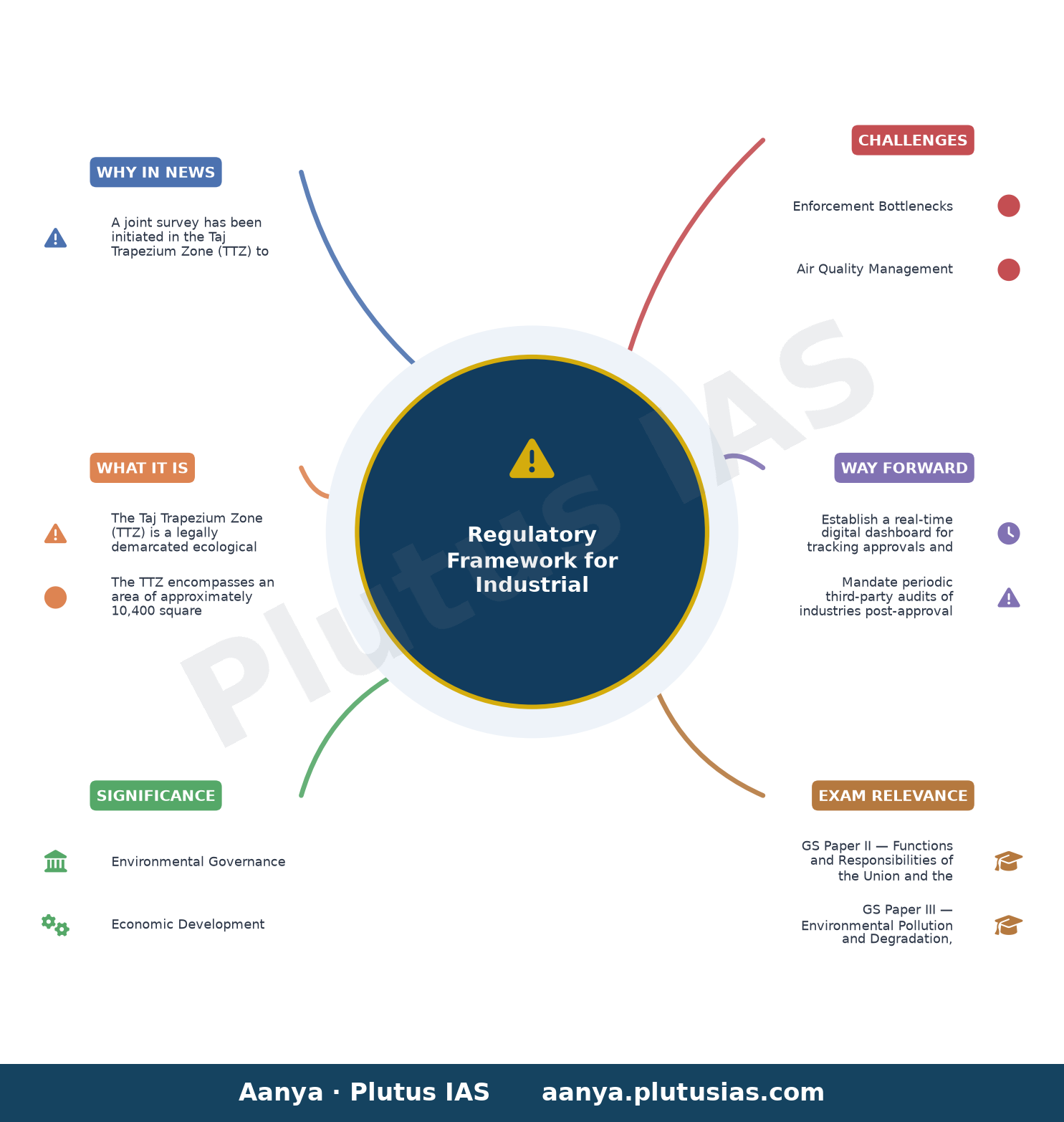
- GS Paper II — Functions and Responsibilities of the Union and the States, Issues and Challenges Pertaining to the Federal Structure | GS Paper III — Environmental Pollution and Degradation, Conservation, Environmental Impact Assessment
- Prelims: Taj Trapezium Zone (TTZ), Supreme Court directives on industrial regulation, Environmental Impact Assessment (EIA), Pollution Control Board, Micro, Small and Medium Enterprises (MSMEs), National Environmental Engineering Research Institute (NEERI), Central Empowered Committee (CEC)
- Essay: Balancing economic development and environmental conservation: The case of the Taj Trapezium Zone, Judicial activism in environmental governance: Strengths and limitations
Quick Revision: The Taj Trapezium Zone (TTZ) is a Supreme Court-monitored ecological zone where industrial activities are regulated through a combination of statutory laws, judicial directives, and multi-agency compliance verification to balance economic development with environmental conservation.
Why is this in the news?
A joint survey has been initiated in the Taj Trapezium Zone (TTZ) to assess the eligibility of existing and proposed industrial units for expansion or establishment, following the Supreme Court’s lifting of a two-year moratorium on new industrial activities. The survey, conducted by a multi-stakeholder team, evaluates units on ten critical parameters, including land-use compliance, project feasibility, and air pollution control, to ensure alignment with environmental safeguards mandated by the Court and statutory bodies such as the Pollution Control Board and NEERI.
Background
- The Taj Trapezium Zone (TTZ) is a defined area of 10,400 sq. km around the Taj Mahal, declared by the Supreme Court in 1996 to protect the monument from environmental degradation caused by industrial pollution.
- The zone includes parts of Uttar Pradesh, Rajasthan, Haryana, and Delhi, with Agra and Mathura as key urban centres within its jurisdiction.
- Historical industrialisation in the region led to severe air pollution, particularly from foundries and small-scale industries, prompting judicial intervention to regulate activities.
- The Supreme Court, in its landmark judgment in *M.C. Mehta v. Union of India* (1996), imposed strict environmental norms for the TTZ, including the closure of polluting industries and restrictions on new industrial units.
- A two-year moratorium on new industrial establishments and expansion of existing units in the TTZ was imposed by the Supreme Court, following concerns over rising pollution levels and non-compliance with environmental norms.
- The current survey follows the Supreme Court’s directive on 23 July 2026 to initiate the process for 410 MSME units, marking a phased resumption of regulated industrial activity.
What is the Taj Trapezium Zone (TTZ) and its regulatory framework?
- The Taj Trapezium Zone (TTZ) is a legally demarcated ecological zone established by the Supreme Court in 1996 to safeguard the Taj Mahal and its surrounding environment from industrial pollution, particularly air and water contamination.
- The TTZ encompasses an area of approximately 10,400 square kilometres, covering parts of Uttar Pradesh, Rajasthan, Haryana, and Delhi, with Agra and Mathura as critical urban nodes within its boundaries.
- The regulatory framework for the TTZ is anchored in the *Taj Trapezium Zone (TTZ) Notification* issued under the Environment (Protection) Act, 1986, which empowers the Central and State governments to enforce environmental standards.
- The Supreme Court, in its *M.C. Mehta v. Union of India* (1996) judgment, directed the closure of 292 industries in the TTZ and imposed stringent conditions on industrial activities to mitigate pollution and preserve the monument’s integrity.
- Industrial units operating within the TTZ are subject to a dual regulatory regime: statutory compliance under the Environment (Protection) Act, 1986, and specific directives from the Supreme Court, which often impose stricter norms than general environmental laws.
- The TTZ authority, chaired by the Divisional Commissioner of Agra, serves as the nodal body for coordinating environmental monitoring, industrial regulation, and compliance verification within the zone.
- Environmental Impact Assessment (EIA) is mandatory for all industrial projects in the TTZ, with clearance required from the State Pollution Control Board (SPCB) and, in some cases, the National Environmental Engineering Research Institute (NEERI) and the Central Empowered Committee (CEC).
- The current survey process involves a multi-agency team comprising officials from the District Industries Centre, Pollution Control Board, and local administration, who verify ten critical parameters, including land-use compliance, project feasibility, air pollution control measures, and effluent treatment infrastructure.
Key Features
| Feature | Significance |
|---|---|
| Survey of 208 MSME units in TTZ | Identifies eligible industries for expansion or new establishment while ensuring compliance with environmental norms. |
| Verification on 10 key parameters | Ensures alignment with statutory environmental safeguards, including air pollution control and effluent treatment. |
| Mandatory approvals from TTZ Authority, CEC, and NEERI | Institutionalises multi-layered scrutiny to balance industrial growth with heritage conservation. |
| Supreme Court’s conditional relaxation of ban | Legal framework permitting phased resumption of industrial activities subject to compliance with environmental standards. |
| Formation of district-level verification committee | Enhances ground-level enforcement through inter-departmental coordination (Pollution Control Board, District Industries Centre, SDM). |
Why it Matters
Environmental Governance
- Demonstrates the integration of judicial oversight with executive action in environmental regulation, particularly in ecologically sensitive zones.
- Highlights the role of scientific institutions (NEERI) in validating industrial compliance with pollution norms.
- Reinforces the principle of ‘polluter pays’ through mandatory treatment infrastructure verification.
Economic Development
- Facilitates MSME expansion, addressing supply chain disruptions caused by prolonged regulatory constraints.
- Potential to revive local industrial clusters in Agra, enhancing employment and revenue generation.
- Aligns with ‘Ease of Doing Business’ reforms by streamlining approvals for compliant units.
Institutional Coordination
- Showcases collaborative governance between judicial, executive, and technical bodies (Supreme Court, TTZ Authority, CEC, NEERI).
- Emphasises the role of district-level committees in balancing developmental aspirations with environmental protection.
Legal Precedent
- Sets a precedent for conditional relaxation of judicial bans, contingent on rigorous compliance verification.
- Reinforces the supremacy of environmental jurisprudence in industrial policy.
Challenges
1. Enforcement Bottlenecks
- Risk of delayed approvals due to multi-tiered verification processes.
- Potential for non-compliance by units post-approval, necessitating robust monitoring mechanisms.
UPSC Link: Environmental Impact Assessment (EIA) Notification 2006
2. Air Quality Management
- Persistent challenge of particulate matter (PM2.5/PM10) and VOC emissions in TTZ, requiring continuous monitoring.
- Need for retrofitting existing units with advanced pollution control technologies.
UPSC Link: National Clean Air Programme (NCAP)
3. Heritage Conservation vs. Industrial Growth
- Balancing the imperative of protecting the Taj Mahal’s integrity with economic imperatives of the region.
- Risk of greenwashing by industries claiming compliance without substantive improvements.
UPSC Link: Taj Trapezium Zone (TTZ) Notification 1998
4. Technical Capacity Gaps
- Limited institutional capacity of local bodies (e.g., Pollution Control Board) to conduct real-time environmental audits.
- Dependence on external agencies (NEERI, CEC) for validation may lead to delays.
UPSC Link: Environmental Governance in India
5. Public Participation Deficit
- Absence of structured mechanisms for public grievances or third-party audits in the verification process.
- Risk of elite capture in approvals, marginalising local stakeholders.
UPSC Link: Environmental Impact Assessment (EIA) 2006
Challenges — UPSC Perspective
| Issue | Concern |
|---|---|
| Multi-tiered approval delays | Risk of procedural inertia undermining industrial revival. |
| Non-compliance post-approval | Lack of post-facto monitoring mechanisms. |
| Air pollution in TTZ | Persistent exceedance of NAAQS despite existing regulations. |
| Institutional capacity constraints | Over-reliance on external agencies for validation. |
| Heritage-conservation trade-offs | Potential for irreversible damage to TTZ’s ecological balance. |
Way Forward
- Establish a real-time digital dashboard for tracking approvals and compliance status of MSME units in TTZ.
- Mandate periodic third-party audits of industries post-approval to ensure sustained compliance.
- Strengthen the Pollution Control Board’s technical and manpower capacity for continuous monitoring.
- Incorporate public participation mechanisms (e.g., grievance redressal portals) in the verification process.
- Develop a phased industrial expansion plan with clear timelines and accountability metrics.
- Promote adoption of clean technologies (e.g., biomass boilers, electrostatic precipitators) among MSMEs.
- Conduct awareness campaigns for industries on TTZ norms and pollution control best practices.
- Collaborate with academic institutions for independent research on TTZ’s environmental health.
UPSC Value Addition
Keywords for Mains Answer-Writing
Taj Trapezium Zone (TTZ) · Taj Mahal preservation · industrial regulation in ecologically sensitive zones · Supreme Court directives on environmental governance · pollution control mechanisms in Uttar Pradesh · MSME sector compliance · environmental impact assessment (EIA) · ecological balance vs. industrial development · Taj Trapezium Zone Authority · Central Empowered Committee (CEC) · National Environmental Engineering Research Institute (NEERI)
Constitutional & Policy Linkages
- Article 48A (Directive Principles of State Policy) – Protection and improvement of environment.
- Article 51A(g) (Fundamental Duties) – Duty to protect and improve the natural environment.
Concept Flow
Supreme Court’s ban on industrial expansion in TTZ → Judicial intervention based on environmental degradation concerns. → Formation of TTZ Authority and CEC → Institutional framework for governance and compliance. → Survey and verification of MSME units → Data-driven assessment of eligibility for expansion. → Multi-tiered approval process → Judicial (Supreme Court), executive (TTZ Authority), and technical (NEERI/CEC) scrutiny. → Conditional relaxation of ban → Balancing industrial revival with environmental safeguards. → Post-approval monitoring → Ensuring sustained compliance and mitigating enforcement gaps.
Prelims Practice Questions
Q1. Consider the following statements regarding the Taj Trapezium Zone (TTZ):
1. The TTZ is a defined area around the Taj Mahal aimed at preserving its ecological balance.
2. The Supreme Court has imposed a blanket ban on all industrial activities within the TTZ.
3. The TTZ Authority is empowered to permit industrial units based on environmental compliance.
4. The National Environmental Engineering Research Institute (NEERI) is involved in the environmental verification process within the TTZ.
How many of the above statements are correct?
- Only one
- Only two
- Only three
- All four
Answer: Only three — Statements 1, 3, and 4 are correct. Statement 2 is incorrect as the Supreme Court has not imposed a blanket ban but has imposed restrictions subject to environmental compliance.
Q2. Assertion (A): The Central Empowered Committee (CEC) plays a key role in environmental governance within the Taj Trapezium Zone.
Reason (R): The CEC is mandated to advise the Supreme Court on environmental matters and ensure compliance with environmental laws.
Options:
A. Both A and R are true, and R is the correct explanation of A.
B. Both A and R are true, but R is not the correct explanation of A.
C. A is true, but R is false.
D. A is false, but R is true.
- A
- B
- C
- D
Answer: B — Both the assertion and reason are true, and the reason correctly explains the assertion. The CEC advises the Supreme Court on environmental governance, including matters related to the TTZ.
Q3. Which of the following parameters is NOT among the ten key points being verified for industrial units in the Taj Trapezium Zone (TTZ)?
- Land-use classification
- Project report submission
- Air pollution control measures
- Water usage efficiency
Answer: Water usage efficiency — Air pollution control measures are not explicitly listed among the ten key parameters being verified. The focus includes land-use, project reports, and pollution control mechanisms, but water usage efficiency is not mentioned in the provided context.
Mains Practice Question
✍ The Supreme Court’s directive to the Taj Trapezium Zone (TTZ) Authority to permit industrial units subject to environmental compliance reflects a balancing act between ecological preservation and economic development. Critically examine this approach with reference to the regulatory framework governing the TTZ, the role of institutions like the CEC and NEERI, and the implications for the MSME sector. (15 Marks)
Approach: MODEL-ANSWER SKELETON:
1. **Introduction (2 Marks)**
– Define the Taj Trapezium Zone (TTZ) and its ecological significance.
– Mention the Supreme Court’s historical intervention (e.g., 1996 judgment, 2026 directive) to balance environmental protection and industrial activity.
2. **Regulatory Framework (4 Marks)**
– **Supreme Court Directives**: Cite key judgments (e.g., M.C. Mehta vs. Union of India) that led to the establishment of TTZ and subsequent restrictions.
– **TTZ Authority**: Discuss its composition, powers, and role in granting permissions (e.g., consent from TTZ Chairman, CEC, and NEERI).
– **Environmental Compliance Parameters**: List the ten key points being verified (e.g., land-use, project reports, air pollution control) and their legal basis (e.g., Air (Prevention and Control of Pollution) Act, 1981).
3. **Institutional Roles (4 Marks)**
– **Central Empowered Committee (CEC)**: Explain its advisory role to the Supreme Court and oversight of environmental compliance.
– **National Environmental Engineering Research Institute (NEERI)**: Discuss its technical role in assessing environmental impact and verifying pollution control measures.
– **State-Level Agencies**: Highlight the role of the Pollution Control Board, District Industries Centre, and District Magistrate in enforcement.
4. **Balancing Ecological Preservation and Industrial Development (3 Marks)**
– **Arguments for Restrictions**: Discuss the need to protect the Taj Mahal from pollution (e.g., particulate matter, sulfur dioxide) and its cultural heritage value.
– **Arguments for Permitting Units**: Highlight the economic significance of MSMEs in Uttar Pradesh and the potential for job creation and industrial growth.
– **Critique**: Evaluate whether the current approach strikes a fair balance or imposes undue restrictions on industrial expansion.
5. **Implications for MSME Sector (2 Marks)**
– Discuss the challenges faced by MSMEs (e.g., 410 units awaiting clearance, expansion restrictions) and the potential benefits of streamlined compliance.
– Highlight the role of the survey in identifying compliant units and facilitating their growth.
6. **Conclusion (1 Mark)**
– Summarize the need for a nuanced approach that prioritizes environmental sustainability while enabling responsible industrial development.
Source: amarujala.com
Generated by AanyaAi for educational purpose.

- केरल में अमित शाह ने शुरू की शी-मार्ट पहल, महिलाओं को मिलेगा बाज़ार तक सीधा पहुँच - September 26, 2026
- Amit Shah Launches SHE-Mart & NCCF Schemes in Kerala for Women Empowerment - September 26, 2026
- यूएस-चीन एआई हॉटलाइन: क्यों शी जिनपिंग-ट्रम्प शिखर वार्ता में टैरिफ से आगे बढ़ा ‘सुपर इंटेलिजेंस’ का मुद्दा - September 26, 2026

No Comments