


11 Aug Supreme Court directs Himachal Pradesh to fill vacant Information Commission posts in 2 weeks
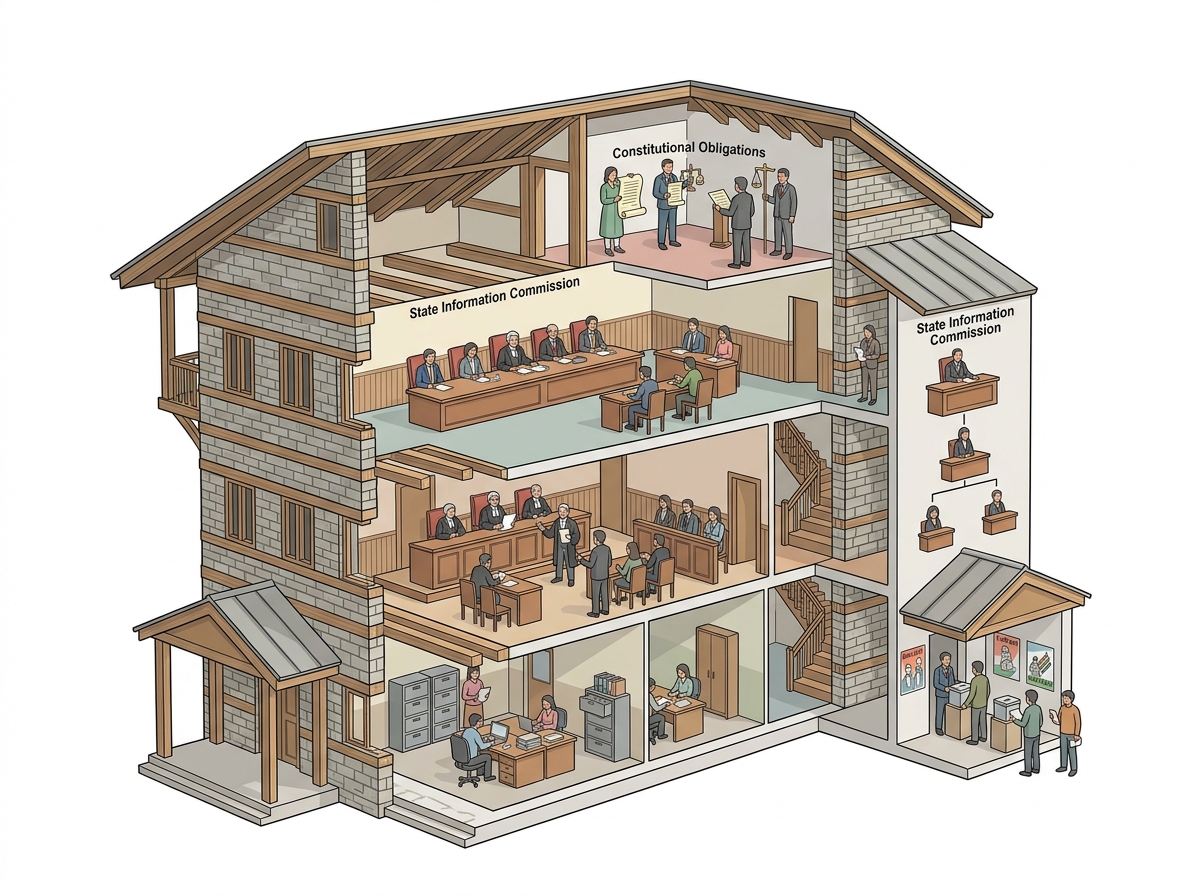
State Information CommissionChief Information CommissionerState Information Commissioner✎ The State Information Commission is a statutory body under the RTI Act, 2005, mandated to adjudicate RTI appeals and ensure transparency in governance; vacancies in SICs must be filled expeditiously to uphold constitutional and…
Subject Relevance — Where This Topic Fits
- GS Paper II — Constitutional and Statutory Bodies | GS Paper IV — Governance, Transparency and Accountability
- Prelims: Right to Information Act, 2005, State Information Commission, Constitutional provisions under Article 19(1)(a), Judicial review of executive inaction, Model Code of Conduct and statutory appointments
- Essay: Transparency as a cornerstone of democratic governance, Judicial activism in ensuring constitutional compliance
Quick Revision: The State Information Commission is a statutory body under the RTI Act, 2005, mandated to adjudicate RTI appeals and ensure transparency in governance; vacancies in SICs must be filled expeditiously to uphold constitutional and statutory obligations.
Why is this in the news?
The Supreme Court, in a landmark judgment delivered on 11 August 2026, directed the Himachal Pradesh government to fill the vacant posts of Chief Information Commissioner and State Information Commissioner within two weeks. The Court clarified that the Model Code of Conduct during elections does not impede statutory appointments when mandated by judicial directives, underscoring the primacy of constitutional obligations over electoral constraints.
Background
- The Right to Information (RTI) Act, 2005, mandates the establishment of State Information Commissions (SICs) as statutory bodies to adjudicate appeals and complaints related to the disclosure of information under the Act.
- SICs are headed by the Chief Information Commissioner (CIC) and include State Information Commissioners (ICs), whose appointments are governed by Section 15 of the RTI Act and the relevant State Rules.
- Vacancies in SICs have persisted across multiple states, leading to significant backlogs of pending appeals and complaints, thereby undermining the efficacy of the RTI regime.
- The Supreme Court, in the case of *Anjali Bhardwaj & Ors. v. Union of India*, has been monitoring the compliance of states with the RTI Act, including the timely filling of vacancies in SICs.
- The Model Code of Conduct (MCC) during elections has often been cited by state governments as a reason for delaying statutory appointments, a contention the Court has rejected when judicial timelines are involved.
What is the State Information Commission (SIC)?
- The State Information Commission (SIC) is a statutory body constituted under Section 15 of the Right to Information (RTI) Act, 2005, to oversee the implementation of the Act at the state level.
- Each SIC is headed by a Chief Information Commissioner (CIC) and includes State Information Commissioners (ICs), whose number is determined by the state government in consultation with the Central Government.
- The primary functions of the SIC include adjudicating appeals against decisions of Public Information Officers (PIOs), imposing penalties for non-compliance with RTI requests, and promoting transparency and accountability in governance.
- The SIC operates independently of the executive, with members appointed through a transparent process involving a selection committee comprising the Chief Minister, Leader of Opposition, and a Cabinet Minister nominated by the Chief Minister.
- The Commission’s decisions are binding on public authorities, and its orders can be challenged before the High Court under Article 226 of the Constitution.
- The RTI Act stipulates that the Chief Information Commissioner and State Information Commissioners shall hold office for a term of five years or until they attain the age of sixty-five years, whichever is earlier.
- The transparency and efficiency of the SIC are critical to the effective implementation of the RTI Act, as delays in appointments and backlogs of cases directly impact citizens’ access to information.
Key Features
| Feature | Significance |
|---|---|
| Supreme Court directive on vacant Information Commission posts | Ensures timely compliance with the Right to Information Act, 2005, by mandating the filling of vacancies within a strict timeframe to uphold transparency and accountability in governance. |
| Judicial intervention in executive appointments | Demonstrates the judiciary’s role in safeguarding constitutional mandates when executive delays threaten statutory obligations, particularly under the RTI framework. |
| Exclusion of Model Code of Conduct as a barrier | Clarifies that the Model Code of Conduct during elections does not override the statutory requirement to fill vacancies in constitutional bodies like the State Information Commission. |
| Transparency in appointment process | Mandates the publication of details of newly appointed Information Commissioners on official websites to enhance public scrutiny and credibility of the selection process. |
| Judicial monitoring of pendency in RTI appeals | Highlights the judiciary’s proactive stance in addressing the backlog of RTI appeals, ensuring timely redressal of citizen grievances. |
Why it Matters
Constitutional and Legal
- Reinforces the constitutional guarantee of transparency and accountability under Article 19(1)(a) and the Right to Information Act, 2005.
- Affirms the judiciary’s authority to direct executive action when statutory obligations are not met, ensuring adherence to the rule of law.
- Clarifies the legal standing of the Model Code of Conduct vis-à-vis statutory appointments, preventing misuse of procedural delays.
Governance and Administration
- Expedites the functioning of the State Information Commission, which is pivotal for the effective implementation of RTI in the state.
- Reduces pendency of RTI appeals, thereby enhancing the efficiency of the grievance redressal mechanism for citizens.
- Sets a precedent for other states to prioritize the filling of vacancies in constitutional bodies to ensure uninterrupted service delivery.
Citizen-Centric
- Strengthens the citizens’ right to information by ensuring the availability of a functional Information Commission to address their queries and grievances.
- Promotes public trust in the RTI mechanism by ensuring timely appointments and transparency in the selection process.
Challenges
1. Pendency of RTI Appeals
- Accumulation of a large number of pending RTI appeals due to vacancies in the State Information Commission, leading to delayed justice for citizens.
- Inadequate capacity in the Commission to dispose of appeals within the stipulated timeframe, resulting in erosion of public confidence in the RTI framework.
UPSC Link: GS-II: Judiciary and RTI
2. Executive Delays in Appointments
- Procrastination by the executive branch in filling vacancies in constitutional bodies, often citing procedural or political reasons.
- Lack of urgency in addressing statutory obligations, leading to prolonged vacancies and undermining the effectiveness of the Information Commission.
UPSC Link: GS-II: Constitutional Bodies
3. Model Code of Conduct as a Pretext
- Misuse of the Model Code of Conduct during elections to justify delays in statutory appointments, thereby circumventing legal obligations.
- Need for judicial clarification to prevent the Model Code from being used as a tool to obstruct governance and transparency.
UPSC Link: GS-II: Election Commission
4. Transparency in Selection Process
- Lack of public disclosure of the selection process for Information Commissioners, raising concerns about fairness and meritocracy.
- Need for a transparent and merit-based appointment process to ensure the credibility of the Information Commission.
UPSC Link: GS-II: Transparency and Accountability
Challenges — UPSC Perspective
| Issue | Concern |
|---|---|
| Vacancies in State Information Commission | Reduced capacity to dispose of RTI appeals, leading to pendency and delayed justice for citizens. |
| Executive procrastination in appointments | Delays in filling statutory vacancies undermine the effectiveness of constitutional bodies. |
| Misuse of Model Code of Conduct | Potential for procedural delays to obstruct statutory appointments during election periods. |
| Lack of transparency in selection | Concerns about fairness and meritocracy in the appointment of Information Commissioners. |
| Pendency of RTI appeals | Accumulation of unresolved appeals due to inadequate capacity in the Information Commission. |
Way Forward
- State governments must prioritize the filling of vacancies in constitutional bodies like the State Information Commission within the stipulated timeframe.
- The executive branch should establish a transparent and merit-based selection process for Information Commissioners, with public disclosure of selection criteria and outcomes.
- Judicial monitoring of the appointment process should continue to ensure compliance with court directives and statutory obligations.
- States with high pendency of RTI appeals should consider increasing the capacity of the Information Commission by creating additional posts.
- Public awareness campaigns should be conducted to educate citizens about their RTI rights and the process for filing appeals.
- Regular audits of the functioning of the State Information Commission should be conducted to identify bottlenecks and improve efficiency.
- The judiciary should continue to play an active role in addressing systemic issues in the RTI framework, including pendency and appointment delays.
UPSC Value Addition
Keywords for Mains Answer-Writing
Right to Information Act, 2005 · State Information Commission · Supreme Court directions · Judicial activism in governance · Appointment process of Information Commissioners · Model Code of Conduct · Constitutional provisions for transparency · Judicial review of executive appointments · Pendency of RTI appeals · Judicial remedies for governance delays
Constitutional & Policy Linkages
- Article 19(1)(a): Freedom of speech and expression, including the right to information.
- Article 32: Writs for the enforcement of fundamental rights, including the right to information.
Concept Flow
Vacancies in State Information Commission → Delay in disposal of RTI appeals → Pendency of appeals → Erosion of public trust in RTI mechanism → Judicial intervention → Supreme Court directive for timely appointments → Executive compliance → Restoration of transparency and accountability.
Prelims Practice Questions
Q1. Consider the following statements regarding the Right to Information (RTI) Act, 2005:
1. The Act mandates the establishment of a State Information Commission (SIC) in every state.
2. The SIC is a statutory body under the administrative control of the respective state government.
3. The RTI Act empowers the Supreme Court to direct state governments to fill vacancies in the SIC.
4. The Model Code of Conduct (MCC) can indefinitely delay the appointment of Information Commissioners.
How many of the above statements are correct?
- Only one
- Only two
- Only three
- All
Answer: Only three — Statements 1 and 3 are correct. The RTI Act mandates the establishment of SICs (Statement 1) and empowers the Supreme Court to issue directions for filling vacancies (Statement 3). Statement 2 is incorrect as the SIC functions as an independent statutory authority, not under administrative control of the state government. Statement 4 is incorrect as the MCC does not indefinitely delay appointments, especially when judicial directions are involved.
Q2. Assertion (A): The Supreme Court has ruled that the Model Code of Conduct (MCC) cannot obstruct statutory appointments mandated by judicial orders.
Reason (R): The MCC is a temporary directive issued during elections and does not override constitutional or statutory provisions.
In the context of the above statements, which of the following is correct?
- Both A and R are true, and R is the correct explanation of A.
- Both A and R are true, but R is not the correct explanation of A.
- A is true, but R is false.
- A is false, but R is true.
Answer: Both A and R are true, and R is the correct explanation of A. — Both Assertion (A) and Reason (R) are true, and R correctly explains A. The Supreme Court has clarified that MCC cannot obstruct statutory appointments when judicial directions are involved, as MCC is temporary and does not override constitutional or statutory mandates.
Q3. Match the following columns regarding the appointment process of Information Commissioners in India:
Column I (State) | Column II (Status of SIC Appointments)
—————–|————————————–
A. Himachal Pradesh | 1. Only 4 Information Commissioners appointed; 3 posts vacant
B. Jharkhand | 2. Two posts vacant; Supreme Court directed to fill within two weeks
C. Maharashtra | 3. Advertisement for 3 new posts to be issued within one week
D. Bihar | 4. 36,000 appeals pending; 3 Commissioners appointed
Select the correct match:
- A-2, B-1, C-3, D-4
- A-1, B-2, C-3, D-4
- A-2, B-1, C-4, D-3
- A-4, B-3, C-2, D-1
Answer: A-2, B-1, C-3, D-4 — The correct matches are: A (Himachal Pradesh) – 2 (Two posts vacant; Supreme Court directed to fill within two weeks), B (Jharkhand) – 1 (Only 4 Information Commissioners appointed; 3 posts vacant), C (Maharashtra) – 3 (Advertisement for 3 new posts to be issued within one week), D (Bihar) – 4 (36,000 appeals pending; 3 Commissioners appointed).
Mains Practice Question
✍ The Supreme Court has recently directed the Himachal Pradesh government to fill the vacant posts of the Chief Information Commissioner and State Information Commissioners within two weeks, despite the Model Code of Conduct being in force. In this context, critically examine the role of the State Information Commission (SIC) in ensuring transparency and accountability in governance. Also, discuss the challenges faced by SICs in India and suggest measures to address them. (15 Marks)
Approach: MODEL-ANSWER SKELETON:
1. **Role of SIC in Transparency and Accountability (6 marks)**
– Constitutional and statutory basis: RTI Act, 2005 (Sections 12-15) establishes SICs as independent statutory bodies to oversee RTI implementation.
– Functions: Adjudicating appeals against refusals of information, monitoring compliance, and promoting transparency in public authorities.
– Judicial activism: Supreme Court’s proactive role in ensuring appointments (e.g., Anjali Bhardwaj vs Union of India) and directing state governments to fill vacancies.
– Impact: SICs act as a check on executive discretion, ensuring citizens’ right to information is not undermined by delays or non-compliance.
2. **Challenges Faced by SICs (5 marks)**
– Vacancies and delays: Chronic understaffing (e.g., Bihar with 36,000 pending appeals and only 3 commissioners; Himachal Pradesh with two vacant posts).
– Pendency of appeals: Backlog of cases due to insufficient manpower and resources.
– Executive interference: Appointments often delayed or influenced by political considerations, undermining independence.
– Model Code of Conduct (MCC): Temporary constraints during elections, but judicial directions have clarified that MCC cannot obstruct statutory appointments.
– Lack of uniformity: Variations in state-wise compliance and institutional capacity.
3. **Measures to Address Challenges (4 marks)**
– Timely appointments: Strict adherence to RTI Act provisions and Supreme Court directions for filling vacancies within stipulated timelines.
– Capacity building: Adequate staffing, infrastructure, and training for SICs to handle pendency.
– Independence safeguards: Transparent selection processes, fixed tenures, and removal provisions to insulate SICs from executive interference.
– Judicial and legislative reforms: Strengthening RTI Act provisions to mandate deadlines for appointments and appeals disposal.
– Public awareness: Campaigns to educate citizens on RTI and SIC functions to enhance usage and accountability.
Source: amarujala.com
Generated by AanyaAi for educational purpose.

- KWML’s Feasibility Reports for Water Metro in 18 Cities: UPSC & PCS Insights - October 3, 2026
- ओडिशा में वन्यजीव अनुसंधान अनुदान कार्यक्रम शुरू, सिमिलिपाल में 300 कैमरे और बढ़ेंगे - October 3, 2026
- India Summons Pakistan High Commission Official Over Violation - October 3, 2026

No Comments