


11 Aug GIM Progress: 1.84 Lakh Hectare Degraded Land Restored Since 2015-16
✎ The Green India Mission (GIM), operational since 2015-16 under the NAPCC, restores degraded forest lands through an integrated landscape approach, utilising community institutions, and geo-spatial technologies for monitoring and…
Subject Relevance — Where This Topic Fits
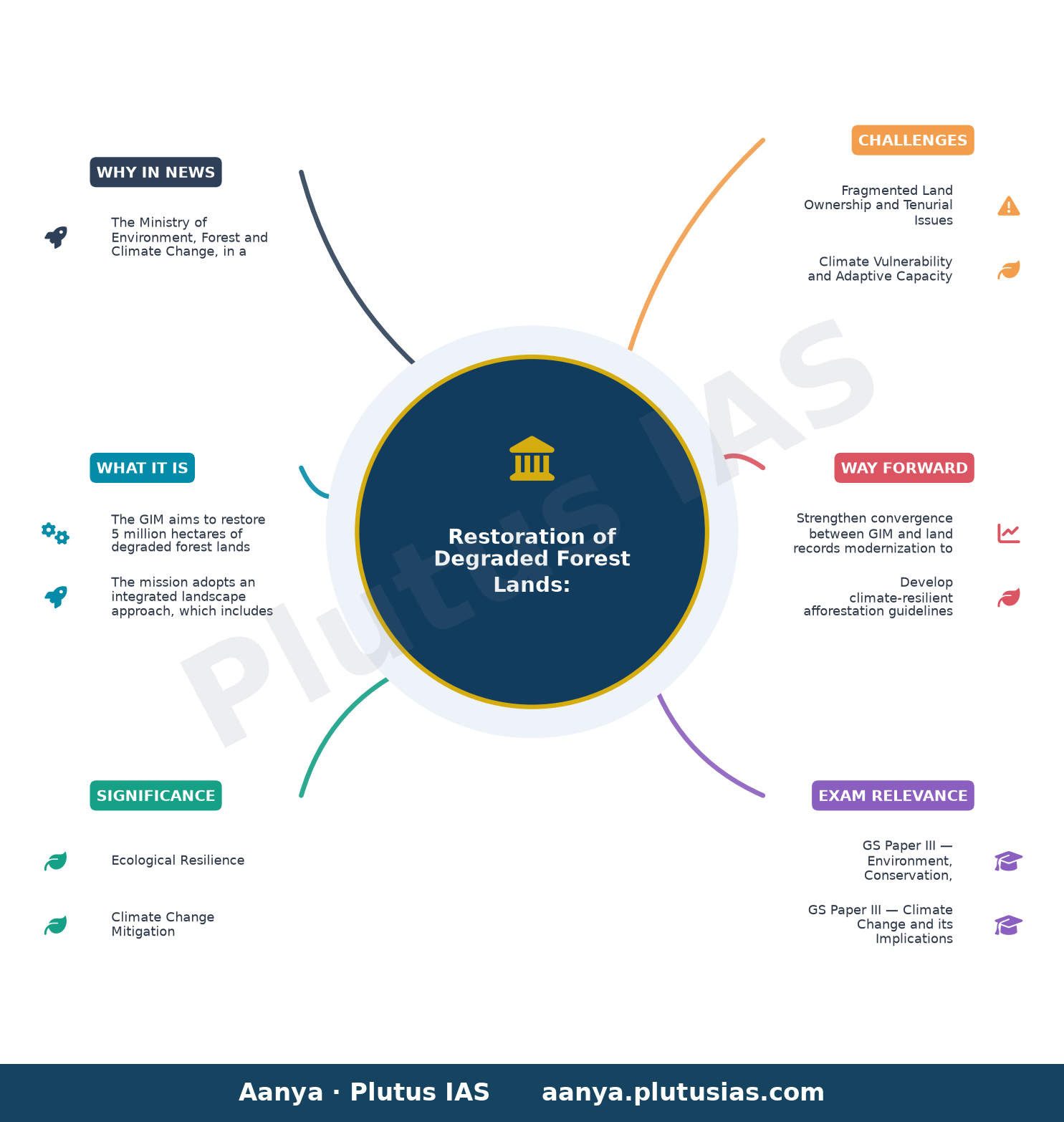
- GS Paper III — Environment, Conservation, Environmental Pollution and Degradation | GS Paper III — Climate Change and its Implications | GS Paper III — Government Policies and Interventions for Development in various sectors
- Prelims: Green India Mission (GIM), National Action Plan on Climate Change (NAPCC), Compensatory Afforestation Fund Management and Planning Authority (CAMPA), Joint Forest Management Committees (JFMCs), Village Forest Committees (VFCs), India State of Forest Report (ISFR), Geo-tagging of afforestation sites, Urban Forest Scheme (Nagar Van Yojana), Forest Survey of India (FSI), Geo-spatial monitoring of afforestation
- Essay: Sustainable forest management as a tool for climate resilience and biodiversity conservation, Community participation in environmental governance: Lessons from forest restoration programmes
Quick Revision: The Green India Mission (GIM), operational since 2015-16 under the NAPCC, restores degraded forest lands through an integrated landscape approach, utilising community institutions, and geo-spatial technologies for monitoring and accountability.
Why is this in the news?
The Ministry of Environment, Forest and Climate Change, in a written reply to a parliamentary question on 10 August 2026, provided an update on the implementation status of the Green India Mission (GIM), including the extent of degraded forest land restored, financial allocations, and the multi-tiered monitoring mechanisms employed to ensure ecological restoration and accountability. The response highlighted the integration of technological tools such as geo-tagging, GIS mapping, and remote sensing in tracking afforestation activities and assessing survival rates of planted saplings.
Background
- The GIM was operationalised in 2015-16 as a centrally sponsored scheme under the NAPCC, with the objective of restoring degraded forest lands and non-forest landscapes through an integrated landscape approach.
- Degraded forest lands in India, estimated to cover approximately 14% of the total forest area, pose significant challenges to biodiversity conservation, carbon sequestration, and ecosystem services.
- The Compensatory Afforestation Fund Act, 2016, and the Compensatory Afforestation Fund Management and Planning Authority (CAMPA) provide the financial framework for compensatory afforestation and forest restoration activities.
- Urbanisation and industrialisation have led to fragmentation of forest landscapes, necessitating restoration of both rural and urban green spaces to mitigate micro-climate impacts and improve air quality.
What is the Green India Mission (GIM)?
- The GIM aims to restore 5 million hectares of degraded forest lands and enhance forest cover by 1 million hectares, thereby improving ecosystem services, biodiversity conservation, and carbon sequestration.
- The mission adopts an integrated landscape approach, which includes restoration of degraded forests, afforestation of non-forest lands, and promotion of sustainable forest management practices.
- The GIM is implemented in a decentralised manner, with activities executed through local institutions such as Joint Forest Management Committees (JFMCs), Village Forest Committees (VFCs), and community-based organisations.
- The mission promotes the use of technology for monitoring, including geo-tagging of afforestation sites, GIS-based mapping, drone surveillance, and remote sensing for assessing forest cover and survival rates of planted saplings.
- The GIM also includes livelihood enhancement activities such as nursery development, skill training, and support to self-help groups to ensure community engagement and sustainability of restoration efforts.
- The Forest Survey of India (FSI) conducts biennial assessments of forest cover using remote sensing and ground verification, the findings of which are published in the India State of Forest Report (ISFR).
Key Features
| Feature | Significance |
|---|---|
| Integrated Landscape Approach under GIM | Adopts a holistic, multi-stakeholder framework to restore degraded forests and non-forest sites, ensuring ecological connectivity and resilience. |
| Geographical Spread (18 States/UTs) | Demonstrates pan-India implementation across diverse ecological zones, from Himalayan states to coastal and central regions. |
| Community Participation (JFMCs, VFCs, SHGs) | Leverages local institutions for planning, execution, and post-plantation maintenance, ensuring ownership and sustainability. |
| Multi-level Monitoring System | Combines remote sensing (FSI), GIS mapping, geotagging, drone surveillance, and third-party audits to ensure transparency and accountability. |
| Fund Allocation (₹57.08 crore for FY 2026-27) | Provides targeted financial support to states for approved restoration activities, aligning with the mission’s operational priorities. |
Why it Matters
Ecological Resilience
- Enhances carbon sequestration by restoring degraded lands, contributing to India’s NDCs under the Paris Agreement.
- Improves biodiversity conservation by creating corridors and habitats for flora and fauna in fragmented landscapes.
- Supports watershed management and soil conservation, mitigating desertification and land degradation.
Climate Change Mitigation
- Reduces atmospheric CO₂ through afforestation and ecosystem restoration, aligning with India’s climate action commitments.
- Strengthens climate adaptation by restoring ecosystem services such as water regulation and micro-climate stabilization.
- Contributes to the National Action Plan on Climate Change (NAPCC) by addressing land-use change impacts.
Socio-Economic Benefits
- Generates rural employment through afforestation, nursery development, and maintenance activities.
- Enhances livelihoods via community-based forest management and allied income-generating activities.
- Supports the ‘Green Urban India’ initiative by integrating urban forestry (Nagar Van Yojana) with rural restoration.
Institutional Strengthening
- Empowers local institutions (JFMCs, VFCs) in participatory governance, fostering decentralized environmental management.
- Enhances inter-departmental coordination between forest, environment, and rural development authorities.
- Promotes data-driven decision-making through advanced monitoring technologies (GIS, drones, remote sensing).
Challenges
1. Fragmented Land Ownership and Tenurial Issues
- Degraded lands often fall under multiple ownership categories (private, community, forest), complicating restoration efforts.
- Lack of clear land titles in some regions leads to disputes and delays in project implementation.
- Need for convergence with land records modernization (e.g., Digital Land Records Mission) to streamline processes.
UPSC Link: Land Reforms (GS-III)
2. Climate Vulnerability and Adaptive Capacity
- Increased frequency of extreme weather events (droughts, floods) threatens sapling survival rates in restoration sites.
- Regional disparities in adaptive capacity require tailored interventions based on local climate risks.
- Integration with climate-resilient afforestation practices (e.g., drought-tolerant species) is essential.
UPSC Link: Climate Change (GS-III)
3. Monitoring and Verification Gaps
- Remote sensing and geotagging provide macro-level data but may miss micro-level failures in plantation survival.
- Third-party audits, while robust, are resource-intensive and require periodic capacity-building.
- Standardization of monitoring protocols across states to ensure comparability and transparency.
UPSC Link: Environmental Governance (GS-III)
4. Funding and Resource Constraints
- Limited state budgets for maintenance post-plantation, leading to high mortality rates in some regions.
- Need for innovative financing mechanisms (e.g., green bonds, CSR partnerships) to supplement government funds.
- Ensuring timely release of central funds to states to avoid project delays.
UPSC Link: Public Finance (GS-III)
5. Community Engagement and Behavioral Barriers
- Low awareness among local communities about the long-term benefits of restoration, leading to apathy or resistance.
- Competing land-use priorities (e.g., agriculture, construction) may divert resources from restoration activities.
- Strengthening participatory planning through awareness campaigns and incentive mechanisms.
UPSC Link: People’s Participation (GS-II)
6. Technological and Capacity Gaps
- Limited technical expertise in some states for GIS mapping, drone surveillance, and data analytics.
- Need for training programs for forest department staff and local institutions on modern restoration techniques.
- Leveraging ISRO’s remote sensing capabilities for real-time monitoring and assessment.
UPSC Link: Science & Technology (GS-III)
Challenges — UPSC Perspective
| Issue | Concern |
|---|---|
| Land Tenure Insecurity | Delays in project approvals due to unclear ownership of degraded lands. |
| Extreme Weather Events | Reduced sapling survival rates in drought-prone or flood-affected areas. |
| Monitoring Accuracy | Gaps in ground-level verification despite advanced remote sensing tools. |
| Maintenance Funding | High post-plantation mortality due to insufficient state budgets for upkeep. |
| Community Apathy | Low participation in restoration activities due to lack of awareness or competing priorities. |
| Technical Capacity | Shortage of skilled personnel for advanced monitoring and restoration techniques. |
Government Initiatives — Must-Memorise for Prelims
- National Mission for a Green India (GIM) under NAPCC
- Nagar Van Yojana (NVY) for urban afforestation
- Compensatory Afforestation Fund Management and Planning Authority (CAMPA) for fund disbursal
Way Forward
- Strengthen convergence between GIM and land records modernization to resolve tenurial disputes and accelerate project approvals.
- Develop climate-resilient afforestation guidelines tailored to regional vulnerability assessments.
- Enhance post-plantation maintenance funding by integrating state budgets with CAMPA and CSR contributions.
- Expand capacity-building programs for forest department staff and local institutions on GIS, drone surveillance, and community engagement.
- Promote participatory monitoring through mobile-based apps and community-led audits to improve transparency.
- Leverage ISRO’s remote sensing capabilities for real-time monitoring of restoration sites and early detection of failures.
- Incentivize private sector participation through green bonds and CSR partnerships for large-scale restoration projects.
- Integrate GIM with other flagship schemes (e.g., MGNREGS) to create livelihood opportunities in restoration activities.
UPSC Value Addition
Keywords for Mains Answer-Writing
Green India Mission (GIM) · National Action Plan on Climate Change (NAPCC) · Degraded forest land restoration · Integrated landscape approach · Joint Forest Management Committees (JFMCs) · Nagar Van Yojana (NVY) · Eco-restoration · Community-based forest management · Geotagging and GIS-based monitoring · India State of Forest Report (ISFR) · Climate change mitigation · Sustainable forest management · Forest Survey of India (FSI) · Third-party monitoring · Drone-based monitoring
Concept Flow
Degraded Land Identification → Integrated Landscape Planning (GIM) → Community Participation (JFMCs/VFCs) → Afforestation & Maintenance → Multi-level Monitoring (GIS/Drone/Third-party) → Climate Resilience & Biodiversity Benefits → Socio-Economic Upliftment
Prelims Practice Questions
Q1. Consider the following statements regarding the Green India Mission (GIM):
1. GIM is one of the nine missions under the National Action Plan on Climate Change (NAPCC).
2. GIM aims to restore degraded forest lands and non-forest sites through an integrated landscape approach.
3. Under GIM, monitoring is solely dependent on ground-level inspections by state forest departments.
4. GIM includes livelihood-linked activities for local communities such as nursery preparation and post-plantation care.
How many of the above statements are correct?
- Only one
- Only two
- Only three
- All four
Answer: Only three — Statements 1, 2, and 4 are correct. Statement 3 is incorrect as GIM employs multi-level monitoring systems, including geotagging, GIS-based mapping, and drone-based surveillance, alongside ground-level inspections.
Q2. Assertion (A): The Nagar Van Yojana (NVY) aims to enhance urban greenery and improve local micro-climates.
Reason (R): NVY focuses on developing urban forests and urban orchards in 600 and 400 cities respectively by 2026-27.
- Both A and R are true, and R is the correct explanation of A.
- Both A and R are true, but R is not the correct explanation of A.
- A is true, but R is false.
- A is false, but R is true.
Answer: Both A and R are true, but R is not the correct explanation of A. — Both the assertion and reason are correct. The NVY’s objective is to increase urban greenery and improve micro-climates, and the reason accurately states its targets for urban forests and orchards.
Q3. Match the following initiatives with their respective objectives:
Column I (Initiative) | Column II (Objective)
— | —
A. Green India Mission (GIM) | 1. Development of urban forests and orchards
B. Nagar Van Yojana (NVY) | 2. Restoration of degraded forest lands using an integrated landscape approach
C. Joint Forest Management Committees (JFMCs) | 3. Community-based forest management for restoration and livelihood support
D. India State of Forest Report (ISFR) | 4. Biennial assessment of forest cover using remote sensing and ground verification
- A-2, B-1, C-3, D-4
- A-1, B-2, C-3, D-4
- A-3, B-1, C-2, D-4
- A-4, B-2, C-1, D-3
Answer: A-2, B-1, C-3, D-4 — A-2 (GIM aims to restore degraded forest lands), B-1 (NVY aims to develop urban forests and orchards), C-3 (JFMCs facilitate community-based forest management), D-4 (ISFR assesses forest cover biennially).
Mains Practice Question
✍ The Green India Mission (GIM) represents a paradigm shift in India’s approach to forest conservation and climate change mitigation by adopting an integrated landscape approach. Critically examine the objectives, implementation mechanisms, and monitoring strategies of GIM. Also, assess its potential impact on India’s Nationally Determined Contributions (NDCs) under the Paris Agreement. (15 Marks)
Approach: MODEL-ANSWER SKELETON:
1. **Introduction (2 marks)**
– Define GIM as one of the nine missions under NAPCC, launched in 2015-16.
– State its primary objective: restoration of degraded forest lands and non-forest sites using an integrated landscape approach to enhance biodiversity, carbon sequestration, and climate resilience.
– Mention its alignment with India’s NDCs under the Paris Agreement (e.g., increasing forest cover to 33% of total land area).
2. **Objectives and Implementation (4 marks)**
– **Integrated Landscape Approach**: Explain the holistic model combining afforestation, agroforestry, soil conservation, and livelihood support.
– **Targeted Regions**: Highlight the 17 states and 1 UT covered, with specific achievements (e.g., 1,84,467 hectares restored).
– **Community Involvement**: Discuss the role of JFMCs, VFCs, and SHGs in implementation and livelihood generation (e.g., nursery preparation, post-plantation care).
– **Nagar Van Yojana (NVY)**: Link urban greening initiatives (600 urban forests, 400 urban orchards) to micro-climate improvement and air quality enhancement.
3. **Monitoring and Evaluation (4 marks)**
– **Multi-level Monitoring**: Describe the use of geotagging, GIS-based mapping, drone surveillance, and third-party audits.
– **Institutional Mechanisms**: Role of FSI in biennial assessments (ISFR), state forest departments, and CAMPA funds.
– **Corrective Measures**: Explain how survival rates of planted saplings are monitored, and gaps are filled through re-planting and maintenance.
4. **Impact and Challenges (3 marks)**
– **Climate Mitigation**: Discuss GIM’s contribution to carbon sequestration, biodiversity conservation, and resilience against climate change.
– **Limitations**: Address challenges such as land tenure issues, slow bureaucratic processes, and ensuring long-term community participation.
– **NDC Alignment**: Evaluate how GIM supports India’s NDC targets (e.g., 2.5 to 3 billion tonnes of additional carbon sink by 2030).
5. **Conclusion (2 marks)**
– Summarize GIM’s significance as a model for sustainable forest management.
– Emphasize the need for continued funding, technological integration, and stakeholder collaboration to achieve its goals.
Source: PIB (Press Information Bureau)
Generated by AanyaAi for educational purpose.

- PM Modi Praises Youth-Led Nasha Mukt Yuva Abhiyan Momentum - September 27, 2026
- राजनाथ सिंह का बड़ा बयान: भारत किसी की ज़मीन कब्ज़ा नहीं करेगा, लेकिन सुरक्षा पर होगा कठोर - September 27, 2026
- Exercise Tarang Shakti 2026: India’s Mega Multi-Nation Air Power Showcase - September 27, 2026

No Comments