


11 Aug UP TTZ Industries: 10 Key Parameters for New Units in Taj Trapezium Zone
✎ The Taj Trapezium Zone (TTZ) is a legally protected area around the Taj Mahal where industrial activities are regulated under the Environment (Protection) Act, 1986, with mandatory environmental clearances, emission standards…
Subject Relevance — Where This Topic Fits
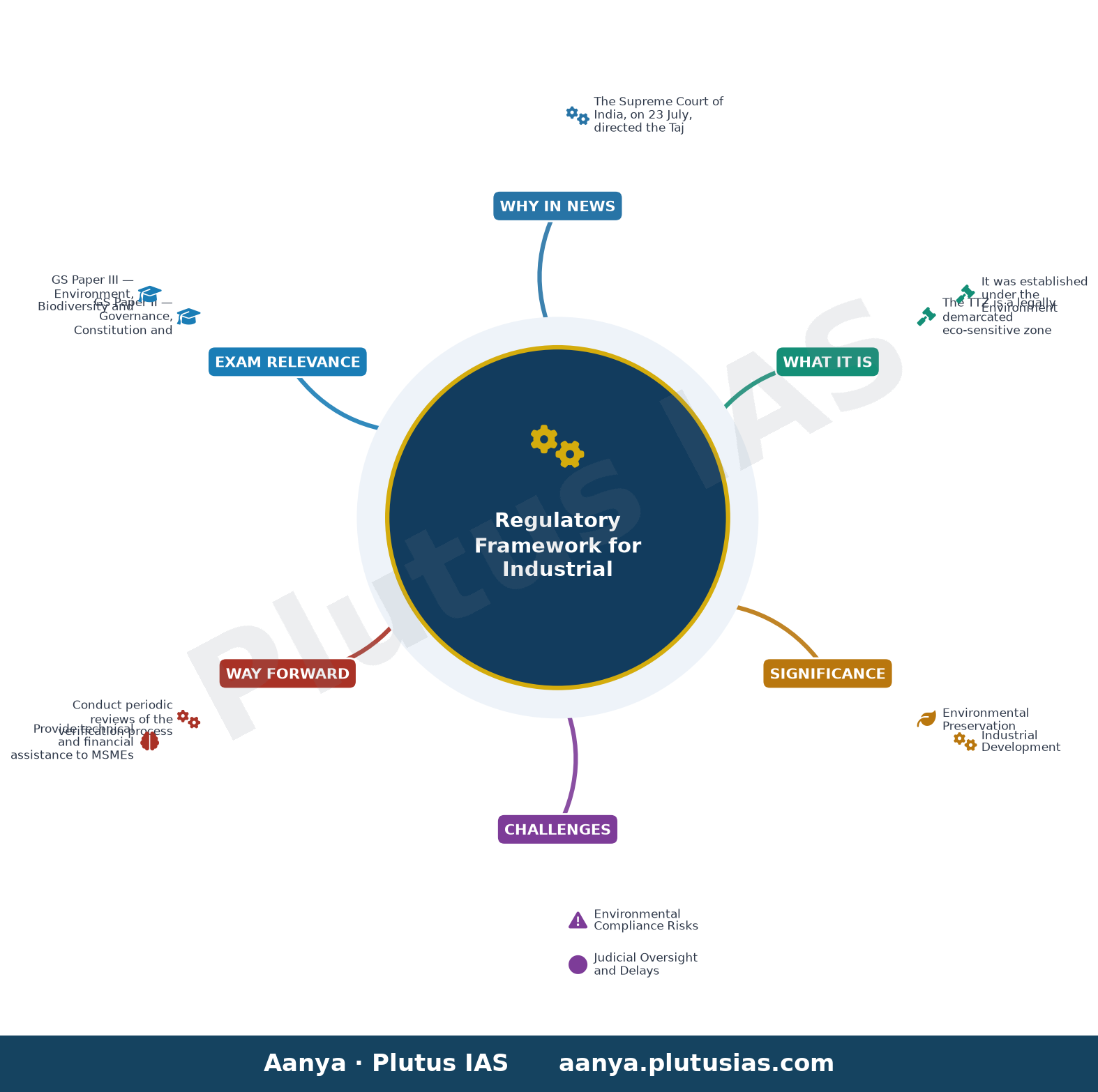
- GS Paper II — Governance, Constitution and Polity (Judicial Review and Environmental Governance) | GS Paper III — Environment, Biodiversity and Climate Change (Industrial Pollution Control and Conservation of Heritage Sites)
- Prelims: Taj Trapezium Zone (TTZ), Supreme Court directives on industrial activity, Environmental Clearance (EC), Air Pollution Index (API), Pollution Control Boards (PCB), National Environmental Engineering Research Institute (NEERI), Central Empowered Committee (CEC), MSMEs, Industrial Expansion, Heritage Conservation, Taj Mahal, Agra
- Essay: Environmental Conservation vs. Industrial Development: Balancing Economic Growth and Ecological Sustainability, Judicial Activism in Environmental Governance: The Role of the Supreme Court in Protecting Heritage Sites
Quick Revision: The Taj Trapezium Zone (TTZ) is a legally protected area around the Taj Mahal where industrial activities are regulated under the Environment (Protection) Act, 1986, with mandatory environmental clearances, emission standards, and Supreme Court oversight to prevent degradation of the monument.
Why is this in the news?
The Supreme Court of India, on 23 July, directed the Taj Trapezium Zone (TTZ) Authority to initiate a survey to assess the feasibility of permitting new industrial units and expansion of existing ones within the TTZ. This directive follows a two-year moratorium on such activities, underscoring the delicate balance between industrial development and the preservation of the Taj Mahal, a UNESCO World Heritage Site. A joint team comprising officials from the Pollution Control Board, District Industries Centre, and district administration has commenced verification of 208 MSME units across 10 critical parameters, including land-use compliance, project feasibility, and air pollution mitigation. The outcome of this survey will determine the regulatory pathway for industrial activities in one of India’s most environmentally sensitive zones.
Background
- The Taj Trapezium Zone (TTZ) is a defined area of 10,400 square kilometres surrounding the Taj Mahal in Agra, Uttar Pradesh, designated to protect the monument from environmental degradation.
- The TTZ was established under the Environment (Protection) Act, 1986, and is governed by the Taj Trapezium Zone (In-Air Quality) Authority, constituted in 1998.
- The Supreme Court, in its landmark judgment in *M.C. Mehta v. Union of India* (1996), directed the closure of polluting industries in the TTZ to prevent damage to the Taj Mahal, leading to stringent environmental regulations.
- A two-year moratorium on new industrial units and expansion of existing ones in the TTZ was imposed by the Supreme Court to facilitate environmental assessment and compliance verification.
- The TTZ Authority, chaired by the Divisional Commissioner of Agra, is the nodal body responsible for implementing environmental safeguards and granting permissions for industrial activities.
- The National Environmental Engineering Research Institute (NEERI) and the Central Empowered Committee (CEC) play advisory roles in assessing environmental impacts and recommending regulatory measures.
What is the Taj Trapezium Zone (TTZ)?
- The TTZ is a legally demarcated eco-sensitive zone of 10,400 sq km around the Taj Mahal, spanning parts of Uttar Pradesh and Rajasthan, to protect the monument from air pollution, acid rain, and particulate matter.
- It was established under the Environment (Protection) Act, 1986, and is administered by the Taj Trapezium Zone (In-Air Quality) Authority, a statutory body under the Ministry of Environment, Forest and Climate Change.
- The primary objective of the TTZ is to regulate industrial, vehicular, and construction activities to minimise emissions of sulphur dioxide (SO₂), nitrogen oxides (NOₓ), and particulate matter (PM), which are known to corrode the marble of the Taj Mahal.
- The TTZ Authority enforces emission standards, monitors air quality, and approves or rejects industrial projects based on their environmental impact assessment (EIA).
- Industrial units in the TTZ are required to install and maintain state-of-the-art pollution control equipment, including electrostatic precipitators, scrubbers, and continuous emission monitoring systems (CEMS).
- The Supreme Court has repeatedly intervened in matters related to the TTZ, issuing directives to close polluting industries, mandate the use of cleaner fuels, and impose penalties for non-compliance.
- The TTZ is also a model for integrated environmental governance, combining judicial oversight, statutory regulation, and inter-agency coordination to balance development and conservation.
Key Features
| Feature | Significance |
|---|---|
| Survey of industrial units in TTZ | Ensures compliance with environmental and land-use norms before granting permissions for new or expanded industrial activity. |
| Ten-point verification framework | Covers geo-use, project feasibility, air pollution control, effluent treatment, and other critical parameters to safeguard the Taj Mahal’s ecological zone. |
| Joint inspection by multiple agencies | Involves the Pollution Control Board, District Industry Centre, and district administration to ensure multi-stakeholder oversight. |
| Supreme Court directives | The apex court’s July 23, 2026 order mandated the resumption of industrial approvals under strict environmental safeguards after a two-year moratorium. |
| Role of TTZ Authority and CEC/NEERI | The TTZ Authority, chaired by the Divisional Commissioner, coordinates with the Central Empowered Committee and NEERI for technical and environmental clearance. |
Why it Matters
Environmental Preservation
- The Taj Trapezium Zone (TTZ) is a 10,400 sq. km eco-sensitive area designated to protect the Taj Mahal and its surrounding environment from industrial pollution.
- Stringent verification ensures that industrial expansion does not compromise air quality, water resources, or the structural integrity of heritage monuments.
- The Supreme Court’s intervention underscores the judiciary’s role in balancing economic development with environmental conservation.
Industrial Development
- The survey facilitates the revival of stalled industrial units, particularly MSMEs, by allowing expansion and increased power allocation under legal compliance.
- This measure is expected to boost local employment, entrepreneurship, and regional economic growth while adhering to environmental standards.
- The process integrates industrial policy with environmental governance, promoting sustainable industrialisation.
Institutional Coordination
- The joint inspection model exemplifies inter-departmental collaboration between pollution control, industry promotion, and district administration.
- Technical inputs from NEERI and the CEC ensure that industrial activities meet national environmental norms, including air and water quality standards.
- The TTZ Authority acts as a nodal body, streamlining approvals while maintaining oversight of environmental safeguards.
Challenges
1. Environmental Compliance Risks
- Industrial units may struggle to meet the stringent ten-point verification criteria, particularly for air pollution control and effluent treatment.
- Historical non-compliance by some units could pose challenges in obtaining necessary clearances despite the survey process.
- Balancing industrial growth with heritage conservation remains a persistent challenge in eco-sensitive zones.
UPSC Link: GS-III: Environmental Pollution
2. Judicial Oversight and Delays
- The Supreme Court’s prior moratorium on industrial activities in TTZ highlights the risks of prolonged legal interventions delaying economic activities.
- The resumption of approvals is contingent on strict compliance, which may introduce procedural delays for applicants.
- Ensuring timely clearances without compromising environmental standards remains a governance challenge.
UPSC Link: GS-II: Judiciary and Governance
3. Technical and Financial Constraints
- Small and medium enterprises (SMEs) may face financial and technical barriers in upgrading pollution control infrastructure to meet verification standards.
- The requirement for increased power allocation for expansion could strain local power distribution systems.
- Ensuring equitable access to clearances for all eligible units, including those with historical non-compliance, is a logistical challenge.
UPSC Link: GS-III: MSMEs and Infrastructure
4. Land Use and Geo-Spatial Planning
- Verifying geo-use compliance requires accurate land records and zoning maps, which may be outdated or disputed in some areas.
- Urban sprawl and agricultural encroachments near TTZ boundaries can complicate land-use verification.
- Ensuring that industrial expansion does not encroach upon protected or agricultural lands is critical.
UPSC Link: GS-I: Urbanisation and Land Reforms
Challenges — UPSC Perspective
| Issue | Concern |
|---|---|
| Air pollution control | Ensuring industrial units meet stringent emission norms to prevent degradation of air quality in TTZ. |
| Effluent treatment | Verifying that industries have adequate effluent treatment plants to prevent water pollution. |
| Power allocation | Balancing increased power demand from expanding units with local grid capacity and environmental impact. |
| Land-use verification | Confirming that industrial expansion complies with designated land-use plans and does not encroach on protected areas. |
| Historical non-compliance | Addressing legacy issues of units with past environmental violations while processing new clearances. |
| Inter-agency coordination | Ensuring seamless collaboration between pollution control, industry promotion, and district administration for efficient verification. |
Way Forward
- Conduct periodic reviews of the verification process to identify bottlenecks and streamline clearances for compliant units.
- Provide technical and financial assistance to MSMEs for upgrading pollution control infrastructure to meet TTZ standards.
- Strengthen land records and geo-spatial mapping in TTZ to ensure accurate verification of geo-use compliance.
- Enhance public awareness campaigns to educate industries and local communities about environmental norms and compliance requirements.
- Establish a grievance redressal mechanism for units facing delays or disputes in the clearance process.
- Integrate real-time monitoring systems for air and water quality to ensure continuous compliance by industrial units.
- Promote research and innovation in low-pollution industrial technologies tailored for heritage-sensitive zones.
- Foster inter-state coordination to address transboundary pollution concerns affecting the TTZ.
UPSC Value Addition
Keywords for Mains Answer-Writing
Taj Trapezium Zone (TTZ) · Industrial regulation in ecologically sensitive areas · Supreme Court directives on environmental protection · Pollution control mechanisms · Environmental Impact Assessment (EIA) · MSME sector compliance · Taj Mahal conservation · Air quality management in industrial zones · Central Empowered Committee (CEC) · National Environmental Engineering Research Institute (NEERI)
Constitutional & Policy Linkages
- Article 48A: Directive Principle of State Policy on environmental protection and improvement of environment.
- Article 51A(g): Fundamental Duty to protect and improve the natural environment.
Concept Flow
Supreme Court imposes moratorium on industrial activities in TTZ due to environmental degradation concerns. → Supreme Court directs resumption of industrial approvals with stringent environmental safeguards on July 23, 2026. → TTZ Authority, led by Divisional Commissioner, coordinates joint inspections by Pollution Control Board, District Industry Centre, and district administration. → Industrial units undergo ten-point verification covering geo-use, project feasibility, air/water pollution control, and effluent treatment. → Units meeting verification criteria receive clearances for expansion or new establishment, subject to ongoing compliance monitoring. → Environmental and heritage conservation outcomes are assessed periodically to ensure sustainable industrial development in TTZ.
Prelims Practice Questions
Q1. Consider the following statements regarding the Taj Trapezium Zone (TTZ):
1. TTZ is a defined area around the Taj Mahal designated for environmental protection.
2. The Supreme Court has imposed a blanket ban on all industrial activities within TTZ.
3. The Central Empowered Committee (CEC) and NEERI are involved in the regulation of industries in TTZ.
4. The TTZ includes parts of Uttar Pradesh, Rajasthan, Haryana, and Delhi.
How many of the above statements are correct?
- Only one
- Only two
- Only three
- All
Answer: Only three — Statements 1 and 3 are correct. Statement 2 is incorrect as the Supreme Court has not imposed a blanket ban but has regulated industrial activities through specific directives. Statement 4 is incorrect as TTZ primarily includes parts of Uttar Pradesh and Rajasthan, with limited inclusion of Haryana and Delhi.
Q2. Assertion (A): The National Environmental Engineering Research Institute (NEERI) is a statutory body under the Ministry of Environment, Forest and Climate Change.
Reason (R): NEERI provides technical expertise for environmental impact assessments and pollution control measures in India.
Options:
A. Both A and R are true, and R is the correct explanation of A.
B. Both A and R are true, but R is not the correct explanation of A.
C. A is true, but R is false.
D. A is false, but R is true.
- A
- B
- C
- D
Answer: C — Assertion (A) is false as NEERI is an autonomous research institute, not a statutory body. Reason (R) is true as NEERI does provide technical expertise for environmental assessments and pollution control.
Q3. Match the following regulatory bodies with their primary functions in the context of environmental governance in India:
Column I (Regulatory Body) | Column II (Primary Function)
1. Central Pollution Control Board (CPCB) | A. Conducts environmental impact assessments and provides technical expertise
2. National Green Tribunal (NGT) | B. Formulates policies and enforces environmental laws
3. Central Empowered Committee (CEC) | C. Adjudicates disputes related to environmental protection
4. National Environmental Engineering Research Institute (NEERI) | D. Monitors and enforces pollution control standards
Options:
A. 1-D, 2-C, 3-B, 4-A
B. 1-B, 2-C, 3-D, 4-A
C. 1-D, 2-A, 3-C, 4-B
D. 1-A, 2-B, 3-D, 4-C
- A
- B
- C
- D
Answer: A — 1-D: CPCB monitors and enforces pollution control standards. 2-C: NGT adjudicates disputes related to environmental protection. 3-B: CEC formulates policies and enforces environmental laws. 4-A: NEERI conducts environmental impact assessments and provides technical expertise.
Mains Practice Question
✍ The Supreme Court’s directive to lift the moratorium on new industrial units in the Taj Trapezium Zone (TTZ) is a critical step toward balancing economic development and environmental conservation. Critically examine the regulatory framework governing industrial activities in ecologically sensitive areas like TTZ, with reference to the role of judicial intervention, statutory bodies, and compliance mechanisms. (15 Marks)
Approach: MODEL-ANSWER SKELETON:
1. **Introduction**: Define TTZ and its ecological significance (Taj Mahal as a UNESCO World Heritage Site; air pollution threats from industrial emissions).
2. **Judicial Intervention**: Discuss the Supreme Court’s role in regulating TTZ through directives (e.g., 2015 judgment restricting industries; 2026 directive lifting moratorium). Highlight the balance between development and conservation.
3. **Statutory Framework**:
– **Environment Protection Act, 1986**: Powers of the Central Government to declare ecologically sensitive areas.
– **Air (Prevention and Control of Pollution) Act, 1981**: Role of State Pollution Control Boards (SPCBs) in monitoring emissions.
– **Environmental Impact Assessment (EIA) Notification, 2006**: Mandatory clearance for industrial projects in sensitive zones.
– **National Green Tribunal (NGT)**: Adjudication of environmental disputes and enforcement of compliance.
4. **Institutional Mechanisms**:
– **Central Pollution Control Board (CPCB)**: Sets standards and monitors pollution.
– **Central Empowered Committee (CEC)**: Advises on environmental compliance and policy.
– **National Environmental Engineering Research Institute (NEERI)**: Provides technical assessments for pollution control.
5. **Compliance Mechanisms**:
– **Surveys and Verification**: 10-parameter checks (e.g., air pollution scores, effluent treatment plants) as mentioned in the TTZ survey.
– **MSME Sector**: Challenges faced by small-scale industries in meeting compliance (e.g., effluent treatment, emission norms).
6. **Critique and Challenges**:
– **Enforcement Gaps**: Delayed compliance, lack of technical capacity in SPCBs, and corruption.
– **Economic vs. Ecological Trade-offs**: Pressure from industrial lobbies vs. environmental degradation.
– **Public Participation**: Role of NGOs and local communities in monitoring compliance (e.g., PILs filed in NGT).
7. **Conclusion**: Reiterate the need for a balanced approach—strict enforcement of environmental norms while facilitating sustainable industrial growth. Highlight the importance of judicial activism in environmental governance.
Source: amarujala.com
Generated by AanyaAi for educational purpose.

- एसजीबी 2018-19 सीरीज़ VI की premature redemption 12 अगस्त 2026 को: जानें ₹15,102 प्रति यूनिट मूल्य - August 11, 2026
- SGB 2018-19 Series VI: ₹15,102 Redemption Price on Aug 12, 2026 - August 11, 2026
- नासा ने इसरो को चंद्रमा आधार कार्यक्रम में शामिल होने का दिया न्योता, जानिए पूरा मामला - August 11, 2026

No Comments