


11 Aug UPSC Focus: Government Initiatives for Menstrual Health & Hygiene in India
✎ The Menstrual Hygiene Scheme (MHS) under the National Health Mission (NHM) is a centrally sponsored initiative that promotes menstrual health and hygiene among adolescent girls through awareness creation, affordable sanitary…
Subject Relevance — Where This Topic Fits
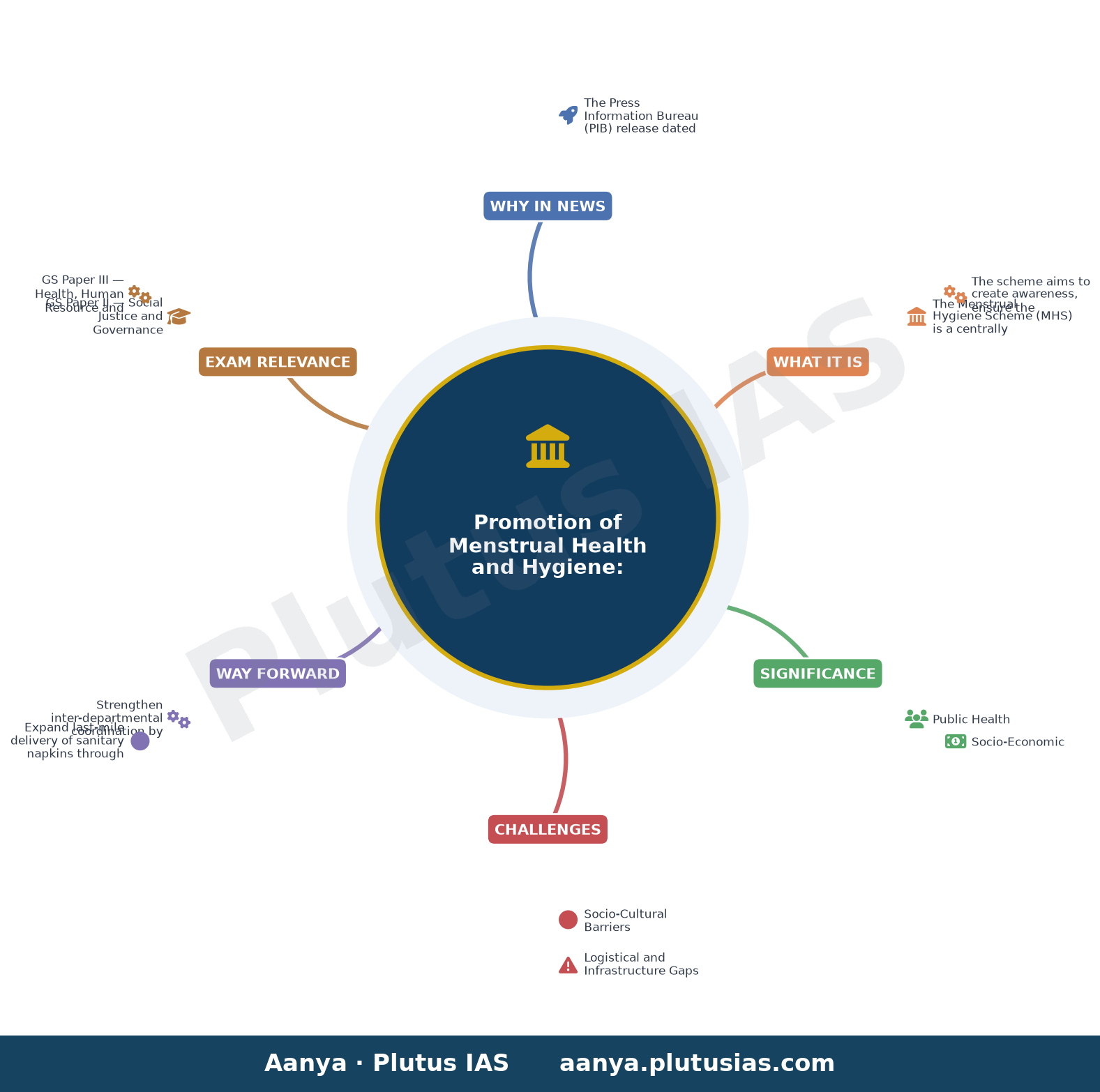
- GS Paper II — Social Justice and Governance | GS Paper III — Health, Human Resource and Development
- Prelims: Menstrual Hygiene Scheme (MHS), National Health Mission (NHM), Rashtriya Kishor Swasthya Karyakram (RKSK), Swachh Bharat Mission (SBM), Sustainable Development Goal 3 (SDG 3), Sustainable Development Goal 6 (SDG 6)
- Essay: The interplay between public health governance and gender equity: A case study of menstrual health initiatives in India, Sustainable development through inclusive health policies: Lessons from India’s menstrual hygiene programmes
Quick Revision: The Menstrual Hygiene Scheme (MHS) under the National Health Mission (NHM) is a centrally sponsored initiative that promotes menstrual health and hygiene among adolescent girls through awareness creation, affordable sanitary napkin distribution, safe disposal mechanisms, and counselling, with financial support extended to states/UTs based on their Annual Programme Implementation Plans (PIPs).
Why is this in the news?
The Press Information Bureau (PIB) release dated 11 August 2026 highlights the institutional framework and implementation modalities of the Menstrual Hygiene Scheme (MHS) under the National Health Mission (NHM) to promote menstrual health and hygiene among adolescent girls in India. This initiative assumes significance in the context of India’s commitment to achieving Sustainable Development Goals (SDGs) 3 (Good Health and Well-being) and 6 (Clean Water and Sanitation), while addressing gender disparities in health access and education.
Background
- Menstrual health and hygiene management (MHM) is recognised as a critical public health and human rights issue globally, with significant implications for gender equality, education, and economic participation.
- India’s National Health Policy (2017) and the National Health Mission (NHM) framework prioritise adolescent health, including menstrual hygiene, as a key component of reproductive and child health strategies.
- The Menstrual Hygiene Scheme (MHS) was launched under the NHM to address the challenges of affordability, accessibility, and awareness regarding menstrual hygiene products and practices among adolescent girls.
- The Rashtriya Kishor Swasthya Karyakram (RKSK) (2014) integrates menstrual health education and services within a broader adolescent health programme, recognising the need for a holistic approach.
- The Swachh Bharat Mission (SBM) also contributes to MHM by promoting sanitation infrastructure in schools and communities, ensuring safe disposal of menstrual waste.
- India’s commitment to the Sustainable Development Goals (SDGs), particularly SDG 3 (Good Health and Well-being) and SDG 6 (Clean Water and Sanitation), underscores the importance of scaling up MHM interventions.
What is the Menstrual Hygiene Scheme (MHS) and its institutional framework under the National Health Mission (NHM)?
- The Menstrual Hygiene Scheme (MHS) is a centrally sponsored programme implemented by the Ministry of Health and Family Welfare (MoHFW) to promote menstrual health and hygiene among adolescent girls.
- The scheme aims to create awareness, ensure the availability of quality and affordable sanitary napkins, provide safe and environmentally friendly disposal mechanisms, and offer counselling on safe menstrual practices.
- Financial assistance under the MHS is extended to states and Union Territories (UTs) based on their proposals submitted in the Annual Programme Implementation Plans (PIPs) under the NHM framework, ensuring state-specific customisation and accountability.
- The NHM employs a robust, multi-tiered monitoring mechanism to track the implementation and impact of the MHS, including reviews during meetings of the National Programme Coordination Committee (NPCC) against approved state-wise targets.
- Annual Common Review Missions (CRMs) under the NHM provide an independent, ground-level assessment of programme implementation, health system strengthening, and progress on key indicators related to menstrual health and hygiene.
- The scheme integrates Information, Education, and Communication (IEC) activities, community engagement, and frontline health worker involvement to enhance awareness and behaviour change among adolescent girls and their communities.
- The MHS aligns with the broader objectives of the Rashtriya Kishor Swasthya Karyakram (RKSK), which promotes adolescent health through a life-cycle approach, including menstrual health education and services.
- State governments and UTs are responsible for implementing school-based menstrual hygiene policies, ensuring access to safe, effective, and affordable menstrual hygiene measures for school-going girls through coordinated inter-departmental action.
Key Features
| Feature | Significance |
|---|---|
| Implementation of Menstrual Hygiene Scheme (MHS) under NHM | Ensures targeted interventions for adolescent girls through structured annual programme implementation plans (PIPs) in states/UTs. |
| Multi-tiered monitoring framework | Facilitates real-time tracking of progress via National Health Council (NPCC) meetings and state-wise performance reviews against approved targets. |
| IEC (Information, Education, Communication) activities | Drives awareness generation, sensitization, and behaviour change through health facilities, community platforms, and digital dissemination. |
| Coordinated inter-departmental action | Bridges gaps between health, education, and rural development sectors to ensure policy coherence in menstrual health management. |
| Annual Common Review Mission (CRM) | Provides independent, ground-level assessment of programme implementation, health system strengthening, and key indicator progress. |
Why it Matters
Public Health
- Reduces incidence of reproductive tract infections (RTIs) and urinary tract infections (UTIs) among adolescent girls through improved hygiene practices.
- Enhances school attendance and academic performance by addressing menstrual health barriers.
- Promotes gender-inclusive health systems by integrating menstrual health into primary healthcare delivery.
Socio-Economic
- Lowers out-of-pocket expenditure on menstrual hygiene products by ensuring affordability and availability of quality sanitary napkins.
- Empowers adolescent girls economically by reducing absenteeism from schools and workplaces during menstruation.
- Supports Sustainable Development Goal (SDG) 3 (Good Health and Well-being) and SDG 4 (Quality Education) targets.
Environmental
- Encourages adoption of eco-friendly menstrual waste management practices through safe disposal mechanisms.
- Reduces environmental pollution from non-biodegradable menstrual waste by promoting sustainable alternatives.
Governance
- Demonstrates India’s commitment to the constitutional directive principles under Article 47 (raising the level of nutrition and public health).
- Strengthens federal cooperation between the Centre and states/UTs for health policy implementation.
Challenges
1. Socio-Cultural Barriers
- Persistent taboos and stigma associated with menstruation hinder open discussions and adoption of hygienic practices.
- Limited community-level sensitization due to entrenched traditional beliefs and lack of awareness.
UPSC Link: GS-I (Social Issues)
2. Logistical and Infrastructure Gaps
- Inadequate access to sanitary napkins in rural and remote areas due to distribution bottlenecks.
- Lack of dedicated menstrual hygiene management (MHM) infrastructure in schools and public spaces.
UPSC Link: GS-II (Health Infrastructure)
3. Monitoring and Evaluation Constraints
- Variability in data collection methodologies across states/UTs complicates comparative performance assessment.
- Delayed reporting and underutilization of digital monitoring tools in grassroots health systems.
UPSC Link: GS-II (Governance)
4. Affordability and Supply Chain Issues
- Price sensitivity of low-income households limits consistent access to quality menstrual products.
- Supply chain disruptions and quality control lapses in local production of sanitary napkins.
UPSC Link: GS-III (Economic Development)
5. Inter-Ministerial Coordination Challenges
- Fragmented implementation due to overlapping mandates of multiple ministries (e.g., Health, Women and Child Development, Education).
- Lack of standardized guidelines for cross-sectoral collaboration on menstrual health policies.
UPSC Link: GS-II (Governance)
Challenges — UPSC Perspective
| Issue | Concern |
|---|---|
| Taboo and Stigma | Hinders open dialogue and adoption of hygienic practices among adolescents. |
| Rural-Urban Divide | Limited access to sanitary products and awareness in rural areas compared to urban centres. |
| School Infrastructure Gaps | Inadequate WASH (Water, Sanitation, and Hygiene) facilities in schools for menstrual hygiene management. |
| Supply Chain Bottlenecks | Irregular distribution of sanitary napkins due to logistical challenges in remote regions. |
| Data Disparities | Lack of standardized metrics for tracking menstrual health outcomes across states. |
| Affordability Constraints | High cost of branded sanitary napkins restricts usage among low-income groups. |
Government Initiatives — Must-Memorise for Prelims
- Menstrual Hygiene Scheme (MHS) under National Health Mission (NHM)
- Rashtriya Kishor Swasthya Karyakram (RKSK)
Way Forward
- Strengthen inter-departmental coordination by establishing a dedicated MHM task force under the National Health Council (NPCC).
- Expand last-mile delivery of sanitary napkins through Self-Help Groups (SHGs) and local NGOs in underserved regions.
- Integrate menstrual health education into school curricula with mandatory practical demonstrations on hygiene practices.
- Leverage digital platforms (e.g., Arogya Setu, UMANG) to disseminate IEC content and monitor programme reach.
- Introduce a performance-linked funding mechanism for states to incentivize timely and effective implementation.
- Conduct periodic third-party audits of sanitary napkin supply chains to ensure quality and affordability.
- Promote public-private partnerships (PPPs) for local manufacturing of eco-friendly sanitary products.
- Enhance WASH infrastructure in schools by mandating separate toilets with water supply and disposal facilities.
UPSC Value Addition
Keywords for Mains Answer-Writing
Menstrual Health and Hygiene (MHH) · National Health Mission (NHM) · Menstrual Hygiene Scheme (MHS) · Adolescent health · Information, Education and Communication (IEC) · Multi-stakeholder coordination · Sustainable Development Goals (SDG) 3 and 6 · School-based interventions · Sanitary napkin distribution · Environmentally safe disposal · Monitoring under NHM · National Health Council (NHC) · Annual Programme Implementation Plans (PIP) · Community health workers · Public health governance
Constitutional & Policy Linkages
- Article 47 (Directive Principles of State Policy) – Raising the level of nutrition and public health.
Concept Flow
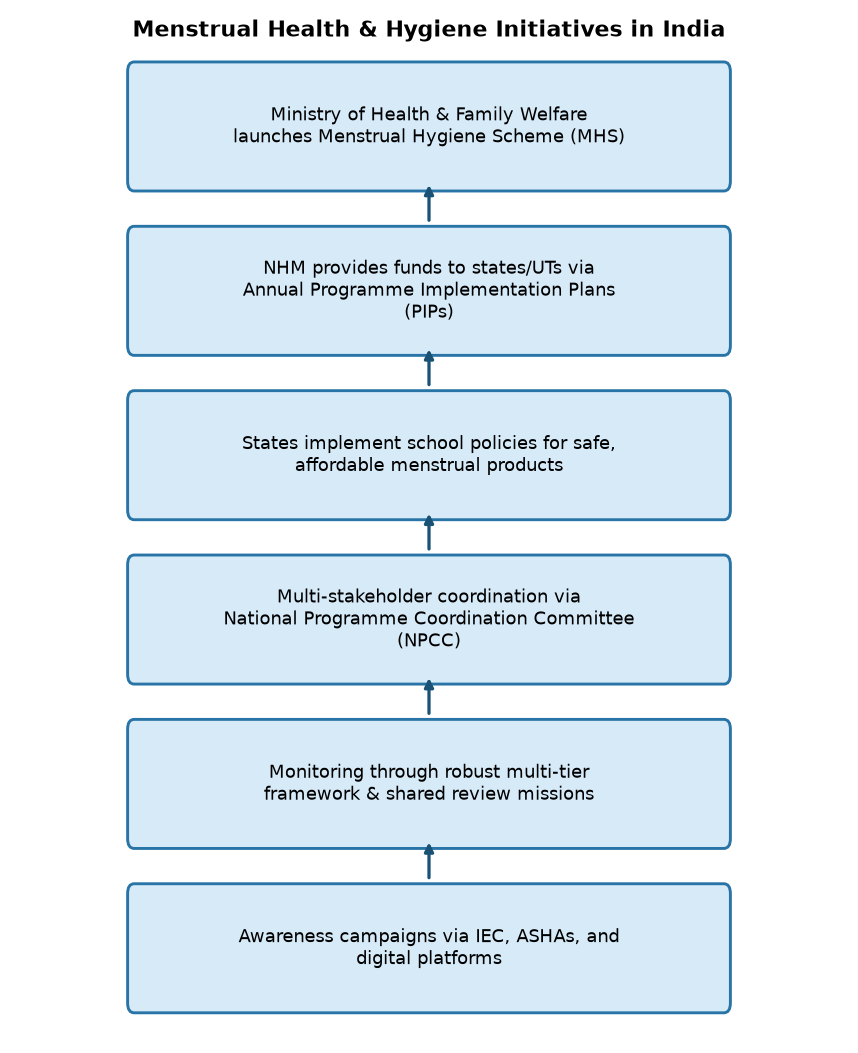
Menstrual health taboos and poor hygiene practices → Government launches Menstrual Hygiene Scheme (MHS) under NHM → States/UTs submit Annual Programme Implementation Plans (PIPs) → Central funding and technical support provided → IEC activities and awareness campaigns conducted → Monitoring via NPCC and CRM → Evaluation of outcomes (e.g., reduced RTIs, improved school attendance) → Feedback loop for policy refinement.
Prelims Practice Questions
Q1. Consider the following statements regarding the Menstrual Hygiene Scheme (MHS) under the National Health Mission (NHM):
1. The scheme is implemented by the Ministry of Women and Child Development.
2. It focuses on providing quality and affordable sanitary napkins to adolescent girls.
3. The scheme includes provisions for environmentally safe disposal of menstrual waste.
4. Monitoring is conducted through a single-tier framework involving only the central government.
How many of the above statements are correct?
- Only one
- Only two
- Only three
- All four
Answer: Only three — Statements 2 and 3 are correct as per the scheme’s objectives. Statement 1 is incorrect because the scheme is implemented by the Ministry of Health and Family Welfare. Statement 4 is incorrect as monitoring is multi-tiered and involves states/UTs and the National Health Council.
Q2. Assertion (A): The National Health Mission (NHM) provides financial assistance to states/UTs for menstrual hygiene schemes under their Annual Programme Implementation Plans (PIP).
Reason (R): The NHM operates through a decentralised governance model that empowers states to design and implement health programmes according to local needs.
Options:
A. Both A and R are true, and R is the correct explanation of A.
B. Both A and R are true, but R is NOT the correct explanation of A.
C. A is true, but R is false.
D. A is false, but R is true.
Answer: ? — Both the Assertion (A) and Reason (R) are true. The NHM indeed provides financial assistance to states/UTs for menstrual hygiene schemes under PIPs, and the NHM’s decentralised governance model empowers states to tailor programmes to local needs, making R the correct explanation of A.
Q3. Match the following initiatives with their respective implementing agencies:
Column I (Initiative) Column II (Implementing Agency)
1. Menstrual Hygiene Scheme (MHS) A. Ministry of Health and Family Welfare
2. Swachh Bharat Mission (Gramin) B. Ministry of Drinking Water and Sanitation
3. Rashtriya Kishor Swasthya Karyakram (RKSK) C. Ministry of Women and Child Development
4. Ujjwala Yojana D. Ministry of Rural Development
Options:
A. 1-A, 2-B, 3-C, 4-D
B. 1-A, 2-B, 3-D, 4-C
C. 1-B, 2-A, 3-C, 4-D
D. 1-A, 2-D, 3-B, 4-C
Answer: ? — 1-A: Menstrual Hygiene Scheme is implemented by the Ministry of Health and Family Welfare. 2-B: Swachh Bharat Mission (Gramin) is implemented by the Ministry of Drinking Water and Sanitation. 3-C: Rashtriya Kishor Swasthya Karyakram is implemented by the Ministry of Health and Family Welfare but focuses on adolescent health, aligning with MHH. 4-D: Ujjwala Yojana is implemented by the Ministry of Rural Development.
Mains Practice Question
✍ The promotion of menstrual health and hygiene (MHH) in India is a multi-dimensional public health challenge that requires coordinated action across sectors. Critically examine the institutional mechanisms and policy frameworks under the National Health Mission (NHM) that address MHH, with particular reference to the Menstrual Hygiene Scheme (MHS). Also, assess the effectiveness of these mechanisms in ensuring universal access to safe menstrual health practices among adolescent girls.(15 Marks)
Approach: Introduction (2 marks): Define MHH and its significance in public health (SDG 3 and 6). Highlight the need for coordinated action across ministries and stakeholders. Institutional Mechanisms under NHM (4 marks): 1. Role of Ministry of Health and Family Welfare in implementing MHS. 2. Financial assistance to states/UTs via Annual Programme Implementation Plans (PIP). 3. Multi-stakeholder coordination involving Ministry of Drinking Water and Sanitation, Ministry of Women and Child Development, and state governments. 4. Role of National Health Council (NHC) in monitoring and review. Policy Frameworks and Implementation (5 marks): 1. Objectives of MHS: awareness creation, provision of quality and affordable sanitary napkins, safe disposal, and counselling. 2. School-based interventions: integration of MHH in school health programmes and policies. 3. Information, Education and Communication (IEC) activities and community health worker involvement. 4. Monitoring mechanisms: multi-tiered framework, Annual Shared Review Missions (SRM), and state-wise reviews with NHC. Effectiveness and Challenges (4 marks): 1. Strengths: decentralised governance, financial support to states, and focus on adolescent health. 2. Challenges: regional disparities, stigma, environmental concerns, and last-mile delivery issues. 3. Data on reach and impact (if available in official reports). Conclusion (1 mark): Summarise the need for continued multi-sectoral coordination and innovation to address MHH effectively.
Source: PIB (Press Information Bureau)
Generated by AanyaAi for educational purpose.

- आईआईटी रुड़की में रुटैग 2.0 की तीसरी वार्षिक समीक्षा बैठक: ग्रामीण विकास में तकनीकी बदलाव - September 26, 2026
- UPSC Exam: PM’s Scientific Advisor Reviews RUTAG 2.0 Projects at IIT Roorkee - September 26, 2026
- यूपीएससी के लिए: ‘मेरा स्वास्थ्य, मेरा गौरव’ अभियान से जानें युवाओं में नशामुक्ति का महत्व - September 26, 2026

No Comments