


11 Aug RBI Cancels Registration of 59 NBFCs: Key Implications for UPSC & State PCS
Reserve Bank of IndiaCertificate of RegistrationNon-Banking Financial CompanyRegulatory normsFinancial system✎ Section 45-IA (6) of the RBI Act, 1934 empowers the RBI to cancel the Certificate of Registration of NBFCs for non-compliance with regulatory norms, ensuring adherence to prudential standards and financial discipline.
Subject Relevance — Where This Topic Fits
- GS Paper III — Indian Economy
- Prelims: NBFC, CoR, RBI Act 1934, Section 45-IA, financial regulation, prudential norms
Quick Revision: Section 45-IA (6) of the RBI Act, 1934 empowers the RBI to cancel the Certificate of Registration of NBFCs for non-compliance with regulatory norms, ensuring adherence to prudential standards and financial discipline.
Why is this in the news?
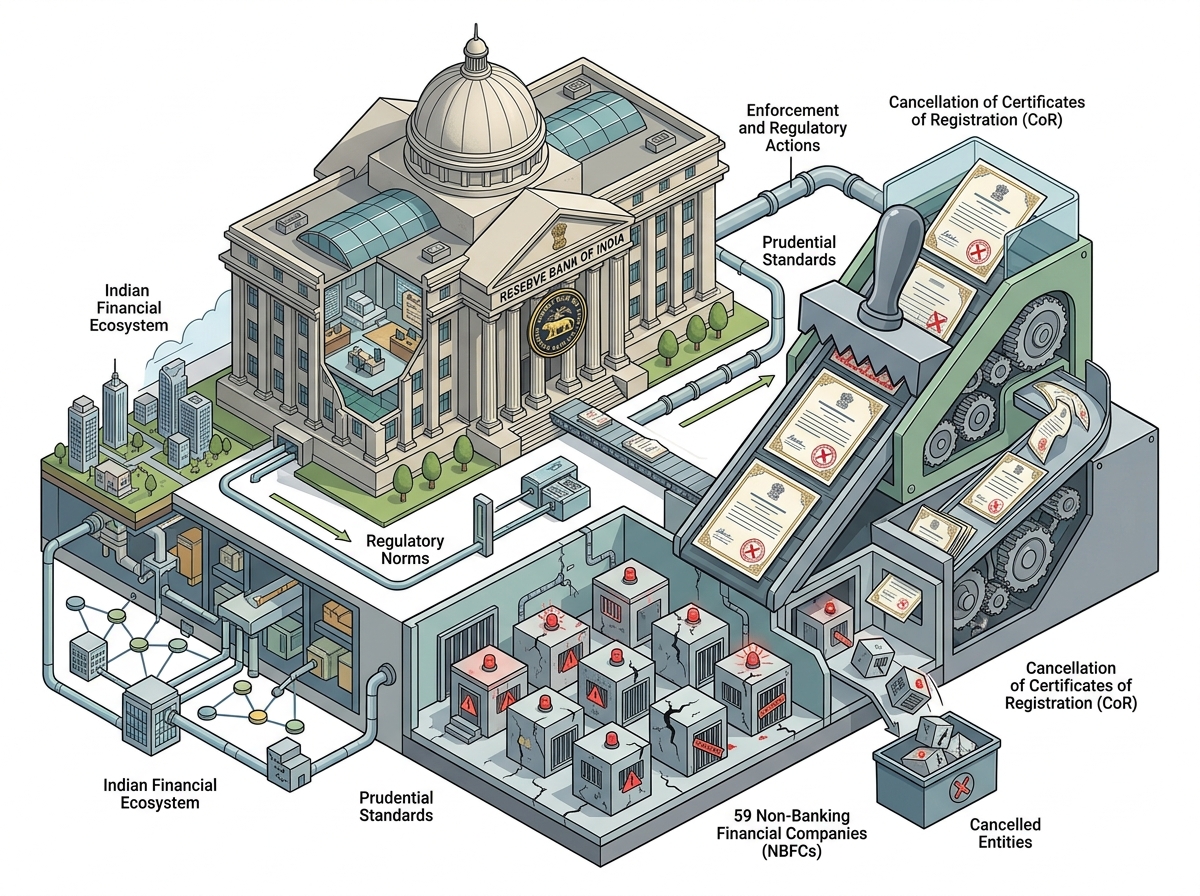
The Reserve Bank of India (RBI) recently cancelled the Certificates of Registration (CoR) of 59 Non-Banking Financial Companies (NBFCs) under Section 45-IA (6) of the Reserve Bank of India Act, 1934, citing non-compliance with regulatory norms. This action underscores the RBI’s commitment to enforcing financial discipline and safeguarding the integrity of the financial system by curbing the operations of non-compliant NBFCs.
Background
- NBFCs play a critical role in India’s financial ecosystem by providing credit, investment, and other financial services, complementing the banking sector.
- The RBI regulates NBFCs under the Reserve Bank of India Act, 1934, and the RBI (Non-Banking Financial Companies) Directions, 2016, to ensure systemic stability and depositor protection.
- Non-compliance with regulatory norms, including failure to adhere to prudential standards or submit required disclosures, can lead to the cancellation of their CoR.
- The RBI’s supervisory actions, such as cancelling CoRs, are part of its broader mandate to maintain financial stability and prevent systemic risks.
- This action follows a pattern of regulatory vigilance, including the cancellation of NBFC registrations in previous years for similar reasons.
- The cancellation of CoRs does not imply financial insolvency but signifies regulatory non-compliance requiring cessation of financial activities.
What are Non-Banking Financial Companies (NBFCs)?
- NBFCs are financial institutions engaged in activities such as lending, investment, leasing, hire-purchase, or chit fund operations, but do not hold a banking license.
- They are regulated by the RBI under the RBI Act, 1934, and are required to register with the RBI to operate legally in India.
- NBFCs are classified into different categories based on their size, activities, and risk profiles, such as Asset Finance Companies (AFCs), Investment Companies (ICs), and Loan Companies (LCs).
- Unlike banks, NBFCs cannot accept demand deposits but can accept time deposits, issue debentures, and provide credit facilities.
- The RBI imposes prudential norms on NBFCs, including capital adequacy requirements, liquidity ratios, and exposure limits, to mitigate financial risks.
- The Certificate of Registration (CoR) is a mandatory license issued by the RBI, enabling NBFCs to conduct financial activities legally.
- Failure to comply with regulatory norms, such as non-submission of audited financial statements or violation of prudential standards, can result in the cancellation of the CoR.
- The RBI’s regulatory framework for NBFCs aims to balance financial inclusion with systemic stability, ensuring that NBFCs operate within a robust governance framework.
Key Features
| Feature | Significance |
|---|---|
| Cancellation of CoR under Section 45-IA(6) of RBI Act, 1934 | Demonstrates RBI’s supervisory authority to enforce compliance among NBFCs by revoking registration for regulatory breaches. |
| Geographical concentration in West Bengal and Maharashtra | Highlights regional clustering of NBFCs, necessitating targeted oversight and risk assessment in these jurisdictions. |
| Cancellation dates spanning multiple years (1998–2019) | Indicates long-standing non-compliance or failure to meet evolving regulatory standards over time. |
| Public disclosure of cancelled entities | Enhances transparency and deters unscrupulous entities from operating under false pretences. |
Why it Matters
Regulatory Governance
- Reinforces RBI’s mandate under the Reserve Bank of India Act, 1934, to regulate and supervise NBFCs, ensuring systemic stability.
- Signals stricter enforcement of compliance norms, particularly for smaller NBFCs with weaker governance structures.
- Aligns with global best practices where financial regulators periodically review and revoke licenses of non-compliant entities.
Financial Stability
- Reduces potential systemic risks by removing entities engaged in non-transparent or unsustainable financial activities.
- Prevents misallocation of credit and protects depositors and investors from fraudulent or poorly managed NBFCs.
- Supports the integrity of the financial ecosystem by curbing shadow banking risks.
Consumer Protection
- Safeguards the interests of borrowers and depositors by eliminating entities operating without regulatory oversight.
- Mitigates the risk of financial loss due to unregulated lending practices or mismanagement.
- Enhances trust in the NBFC sector by demonstrating RBI’s commitment to disciplining errant players.
Challenges
1. Regulatory Arbitrage
- Smaller NBFCs may exploit regulatory gaps or loopholes to evade oversight, necessitating proactive surveillance.
- Requires continuous adaptation of regulatory frameworks to address evolving business models and risks.
- Demands robust data analytics to identify non-compliant entities before they pose systemic threats.
UPSC Link: Financial Regulation in India
2. Enforcement Bottlenecks
- Delays in cancellation proceedings may allow non-compliant entities to continue operations, exacerbating risks.
- Resource constraints within RBI may limit the frequency and depth of inspections, particularly for smaller NBFCs.
- Legal challenges from cancelled entities could prolong disputes, delaying regulatory action.
UPSC Link: Role of RBI in Financial Oversight
3. Consumer Awareness Gaps
- Limited financial literacy among borrowers may prevent timely identification of unregulated NBFCs.
- Need for public awareness campaigns to educate stakeholders about RBI’s regulatory actions and safeguards.
- Ensuring accessibility of cancellation lists in regional languages to reach diverse audiences.
UPSC Link: Financial Inclusion and Consumer Protection
4. Sectoral Fragmentation
- Diverse business models within NBFCs (e.g., investment, microfinance, hire-purchase) complicate uniform regulation.
- Regional disparities in NBFC concentration may require tailored supervisory approaches.
- Interlinkages between NBFCs and banks or other financial entities can amplify contagion risks.
UPSC Link: NBFCs and Financial Intermediation
Challenges — UPSC Perspective
| Issue | Concern |
|---|---|
| Non-compliance over time | Failure to meet evolving regulatory standards, particularly for long-standing NBFCs. |
| Regional clustering of cancelled NBFCs | Concentration in West Bengal and Maharashtra may indicate localized governance weaknesses. |
| Resource constraints in RBI oversight | Limited capacity to monitor and inspect all NBFCs, especially smaller entities. |
| Public awareness deficits | Borrowers may unknowingly engage with unregulated NBFCs, risking financial loss. |
Way Forward
- Enhance RBI’s supervisory capacity through digital tools for real-time monitoring of NBFC compliance.
- Strengthen regional offices of RBI to conduct targeted inspections in high-risk jurisdictions.
- Launch public awareness campaigns in regional languages to educate borrowers about regulated vs. unregulated NBFCs.
- Streamline cancellation procedures to reduce delays and ensure timely enforcement.
- Collaborate with state governments to address governance gaps in regions with high NBFC concentrations.
- Develop a graded regulatory framework for NBFCs based on size, risk, and systemic importance.
- Publish periodic reports on the health of the NBFC sector to maintain transparency and stakeholder trust.
UPSC Value Addition
Keywords for Mains Answer-Writing
Non-Banking Financial Companies (NBFCs) · Reserve Bank of India (RBI) · Certificate of Registration (CoR) · Regulation of NBFCs · Financial Sector Regulation · Financial Stability · Corporate Governance in NBFCs · Prudential Norms · Section 45-IA of RBI Act, 1934 · Financial Inclusion and Regulation · Compliance and Enforcement in Financial Sector · Risk Management in NBFCs
Concept Flow
Regulatory non-compliance by NBFCs → RBI’s supervisory review under RBI Act, 1934 → Identification of violations → Cancellation of Certificate of Registration (CoR) → Removal of entity from regulated sector → Protection of depositors/investors → Reinforcement of systemic stability.
Prelims Practice Questions
Q1. Consider the following statements regarding the Reserve Bank of India (RBI) and its regulatory powers over Non-Banking Financial Companies (NBFCs):
1. The RBI can cancel the Certificate of Registration (CoR) of an NBFC under Section 45-IA(6) of the RBI Act, 1934.
2. The RBI’s regulatory powers over NBFCs are derived from the Companies Act, 2013.
3. The cancellation of CoR implies that the NBFC can no longer operate in the financial sector.
4. The RBI’s action is subject to judicial review under the writ jurisdiction of High Courts and the Supreme Court.
How many of the above statements are correct?
- Only one
- Only two
- Only three
- All four
Answer: All four — Statements 1, 3, and 4 are correct. The RBI’s power to cancel CoR is explicitly granted under Section 45-IA(6) of the RBI Act, 1934. Cancellation of CoR effectively prohibits the NBFC from engaging in financial activities. The RBI’s actions are subject to judicial review under Articles 226 and 32 of the Constitution. Statement 2 is incorrect as the RBI’s powers are derived from the RBI Act, 1934, not the Companies Act, 2013.
Q2. Assertion (A): The Reserve Bank of India (RBI) is the sole authority to grant and cancel the Certificate of Registration (CoR) for Non-Banking Financial Companies (NBFCs) in India.
Reason (R): The RBI Act, 1934, empowers the RBI to regulate and supervise NBFCs to ensure financial stability and protect depositors’ interests.
- Both A and R are true, and R is the correct explanation of A.
- Both A and R are true, but R is NOT the correct explanation of A.
- A is true, but R is false.
- A is false, but R is true.
Answer: Both A and R are true, but R is NOT the correct explanation of A. — Both the Assertion (A) and Reason (R) are true, and the Reason (R) correctly explains the Assertion (A). The RBI Act, 1934, vests the RBI with exclusive powers to grant and cancel CoR for NBFCs under Section 45-IA, and these powers are exercised to maintain financial stability and depositor protection.
Mains Practice Question
✍ The Reserve Bank of India (RBI) recently cancelled the Certificate of Registration (CoR) of 59 Non-Banking Financial Companies (NBFCs) for non-compliance with regulatory norms. In this context, critically examine the regulatory framework governing NBFCs in India, highlighting the role of the RBI, the significance of CoR, and the implications of such cancellations for financial stability and corporate governance. (15 Marks)
Approach: MODEL-ANSWER SKELETON:
1. **Regulatory Framework for NBFCs**:
– Statutory basis: RBI Act, 1934 (Sections 45-IA, 45-IB, 45-IC), Reserve Bank of India (Registration of Non-Banking Financial Companies) Directions, 2016.
– Categories of NBFCs: Investment and Credit Companies (NBFC-ICC), Asset Finance Companies (NBFC-AFC), Micro-Finance Institutions (NBFC-MFI), etc.
– Prudential norms: Capital adequacy, asset classification, income recognition, provisioning (RBI Master Directions).
2. **Role of the RBI**:
– Granting and cancellation of CoR under Section 45-IA(6) of the RBI Act, 1934.
– Supervisory powers: On-site inspections, off-site monitoring, and enforcement actions (e.g., imposition of penalties, directions for rectification).
– Objectives: Financial stability, depositor protection, and systemic risk mitigation.
3. **Significance of Certificate of Registration (CoR)**:
– Legal authorization to operate as an NBFC in India.
– Compliance with fit-and-proper criteria for promoters and directors (RBI Guidelines).
– Mandatory adherence to prudential norms and reporting requirements.
4. **Implications of CoR Cancellation**:
– **For Financial Stability**: Prevents systemic risks by removing non-compliant entities from the financial ecosystem.
– **For Corporate Governance**: Enforces accountability and transparency among NBFCs.
– **For Depositors and Investors**: Protects interests by ensuring only compliant NBFCs operate in the market.
– **For the NBFC Sector**: May lead to consolidation, reducing fragmentation and improving sectoral resilience.
5. **Challenges and Criticisms**:
– Delayed enforcement actions and regulatory arbitrage.
– Impact on credit access for underserved segments due to strict compliance.
– Need for balanced regulation to foster financial inclusion while ensuring stability.
6. **Recent Trends and Data**:
– Cite RBI’s Annual Report 2025-26 or recent Financial Stability Reports on NBFC sector risks.
– Reference to RBI’s 2023 Directions on Scale-Based Regulation (SBR) for NBFCs.
7. **Conclusion**:
– RBI’s actions are a necessary tool for maintaining financial discipline.
– However, regulatory clarity and timely interventions are essential to avoid unintended consequences on credit flow and financial inclusion.
Source: RBI
Generated by AanyaAi for educational purpose.

- एआई से वैश्विक खतरा: मानवता के लिए गंभीर चुनौती और समाधान - October 2, 2026
- Maharashtra’s ₹10,520 Cr BharatNet Revamp: Key for UPSC & State PCS - October 2, 2026
- गुजरात सरकार द्वारा मालधारियों के स्थानांतरण की घोषणा, जानिए पूरा विवरण - October 2, 2026

No Comments