


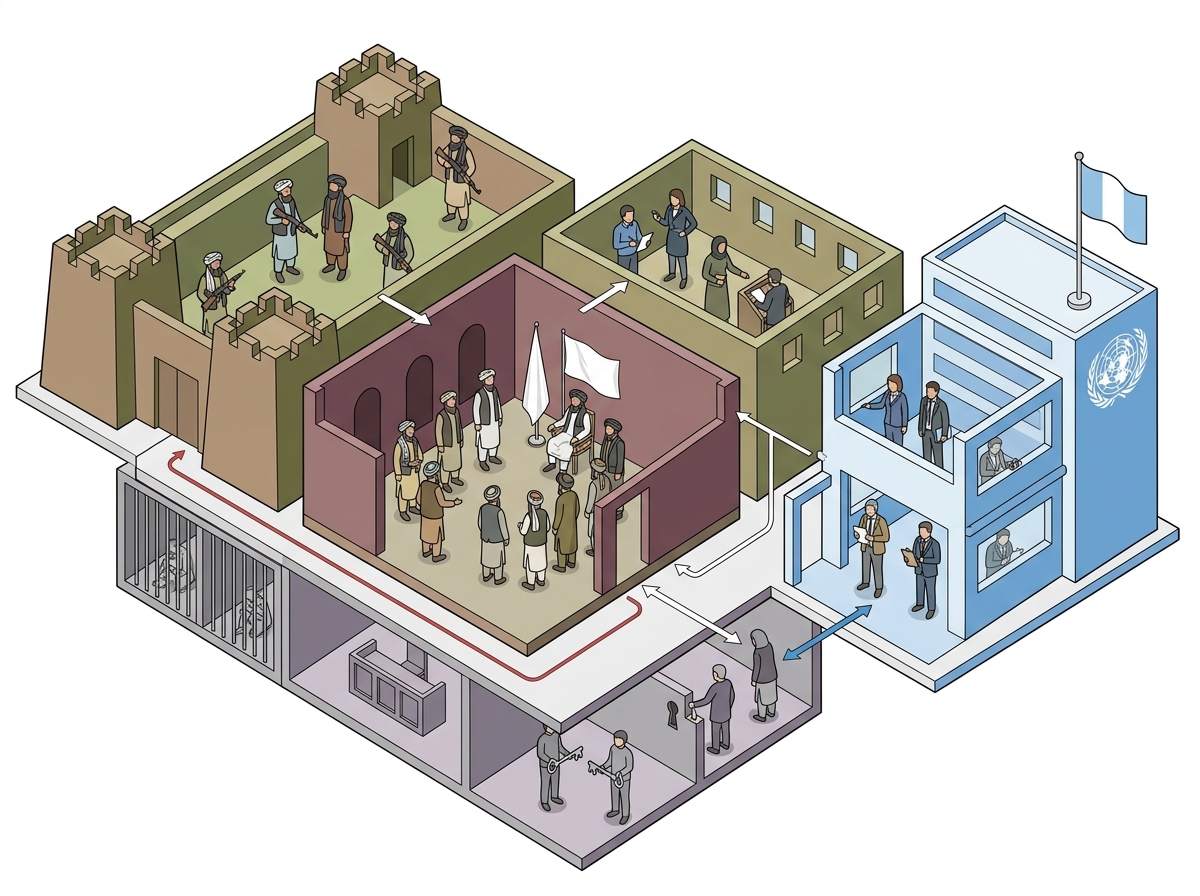
11 Aug UN Urges Taliban to Address Security Forces Abuses in Afghanistan
UNAMA reportTaliban security forcesSecurity and Filtration CommissionMinistry of Propagation of VirtueState institutionsHuman rights abuses✎ Accountability in security institutions is a cornerstone of good governance and human rights protection, requiring transparent oversight, legal clarity, and the rule of law to ensure public trust and deter abuses.
Subject Relevance — Where This Topic Fits
- GS Paper II — International Relations (Accountability Mechanisms, UN Peacekeeping, Human Rights) | GS Paper II — Polity and Governance (Rule of Law, Constitutionalism, Human Rights) | GS Paper III — Security Sector Reforms, Internal Security Challenges
- Prelims: UNAMA (United Nations Assistance Mission in Afghanistan), De facto authorities, Sharia Law in governance, Security Sector Reforms, Human Rights Violations, Accountability Mechanisms, Morality Police, Supreme Court (Afghanistan)
- Essay: The Role of International Institutions in Upholding Human Rights in Conflict Zones, Balancing Sovereignty and Accountability: Challenges in Post-Conflict Governance
Quick Revision: Accountability in security institutions is a cornerstone of good governance and human rights protection, requiring transparent oversight, legal clarity, and the rule of law to ensure public trust and deter abuses.
Why is this in the news?
The United Nations Assistance Mission in Afghanistan (UNAMA) has publicly highlighted the lack of transparency and accountability in Afghanistan’s security institutions under Taliban rule, five years after their takeover. The report underscores systemic deficiencies in oversight, the absence of public information on investigations into human rights abuses, and the erosion of public trust in state institutions, necessitating urgent reforms to align governance with international legal obligations.
Background
- The Taliban seized control of Afghanistan in August 2021, marking the end of the Islamic Republic of Afghanistan and the suspension of its constitution.
- The Taliban established de facto governance structures, including the Security and Filtration Commission and the Ministry of Propagation of Virtue and Prevention of Vice, based on their interpretation of Sharia law.
- UNAMA, established by the UN Security Council in 2002, continues to monitor governance, rule of law, human rights, and security in Afghanistan despite the change in political authority.
- The suspension of the constitution has led to the annulment of existing laws, creating a legal vacuum and complicating accountability mechanisms.
- UN agencies, including UN Women and the UN Security Council, have consistently raised concerns about human rights violations, arbitrary detentions, and systemic discrimination, particularly against women and girls.
- The lack of transparency in investigations and disciplinary actions has undermined public confidence in state institutions and weakened deterrence against abuses.
Accountability and Transparency in Security Institutions: Concepts and Context
- Accountability in governance refers to the obligation of institutions to justify their actions, accept responsibility for failures, and ensure redress for violations of rights or laws.
- Transparency is the principle that governance processes, decisions, and actions must be open to public scrutiny, enabling oversight and trust-building.
- Security sector reforms (SSR) aim to improve the effectiveness, efficiency, and accountability of security institutions, including police, judiciary, and military, in line with democratic principles and human rights standards.
- The absence of a constitution or codified legal framework in Afghanistan has created a vacuum in defining the rules governing the use of force, arrest, detention, and searches, exacerbating accountability deficits.
- International human rights law, including the International Covenant on Civil and Political Rights (ICCPR) and the Convention on the Elimination of All Forms of Discrimination Against Women (CEDAW), obligates states to ensure accountability for human rights violations, regardless of their governance structure.
- The role of UNAMA is critical in monitoring compliance with international obligations, documenting abuses, and advocating for reforms to strengthen rule of law and human rights in Afghanistan.
- The concept of ‘de facto authorities’ refers to entities exercising effective control over a territory without international recognition, complicating their engagement with international legal frameworks and accountability mechanisms.
- The principle of ‘complementarity’ in international law requires domestic authorities to investigate and prosecute international crimes, failing which the International Criminal Court (ICC) may intervene, though Afghanistan is not a state party to the Rome Statute.
UPSC Value Addition
Keywords for Mains Answer-Writing
Accountability in governance · Rule of law and transparency · Human rights violations · UN Assistance Mission in Afghanistan (UNAMA) · De facto authorities and legal obligations · International humanitarian law · Supreme Court and judicial accountability · Security forces and oversight mechanisms · Women’s rights and discrimination · State legitimacy and public trust · Accountability in non-democratic regimes · International obligations and reintegration · Victims’ rights and justice · Sharia-based legal frameworks · UN human rights monitoring mechanisms
Prelims Practice Questions
Q1. Consider the following statements regarding the United Nations Assistance Mission in Afghanistan (UNAMA):
1. UNAMA was established to monitor governance, rule of law, security, and human rights in Afghanistan.
2. UNAMA has the mandate to investigate and prosecute human rights violations in Afghanistan.
3. UNAMA reports highlight a significant lack of public information on investigations into human rights violations.
How many of the above statements are correct?
- Only one
- Only two
- All three
- None
Answer: Only two — Statement 1 is correct as UNAMA was indeed established to monitor governance, rule of law, security, and human rights. Statement 2 is incorrect because UNAMA does not have the mandate to prosecute violations; it monitors and reports. Statement 3 is correct as UNAMA reports highlight insufficient transparency on investigations.
Q2. Assertion (A): The suspension of the constitution in Afghanistan has led to a blanket annulment of all former laws.
Reason (R): The de facto authorities replaced the former democratic constitution with Sharia-based legal frameworks.
In the context of the above statements, which of the following is correct?
- Both A and R are true, and R is the correct explanation of A.
- Both A and R are true, but R is not the correct explanation of A.
- A is true, but R is false.
- A is false, but R is true.
Answer: Both A and R are true, and R is the correct explanation of A. — Assertion (A) is correct as the suspension of the constitution did result in the annulment of former laws. Reason (R) is also correct and directly explains why the annulment occurred, as the de facto authorities replaced the constitution with Sharia-based frameworks.
Q3. Match the following institutions with their respective roles in Afghanistan’s governance:
Column I (Institution) | Column II (Role)
1. Supreme Court | A. Monitors governance, rule of law, and human rights
2. UNAMA | B. Enforces Sharia-based legal frameworks
3. Ministry of Propagation of Virtue and Prevention of Vice | C. Replaced the former democratic constitution
4. Security and Filtration Commission | D. Investigates and addresses complaints against security personnel
Select the correct match:
- 1-A, 2-B, 3-C, 4-D
- 1-D, 2-A, 3-B, 4-C
- 1-B, 2-A, 3-D, 4-C
- 1-C, 2-A, 3-B, 4-D
Answer: 1-D, 2-A, 3-B, 4-C — 1-D (Supreme Court in Afghanistan, under de facto authorities, investigates complaints against security personnel), 2-A (UNAMA monitors governance, rule of law, and human rights), 3-B (Ministry of Propagation of Virtue and Prevention of Vice enforces Sharia-based legal frameworks), 4-C (Security and Filtration Commission was set up to replace the former democratic constitution).
Mains Practice Question
✍ Critically examine the challenges to accountability in governance under de facto authorities in Afghanistan, with particular reference to the role of UNAMA and the suspension of the constitution. Also, analyse the implications of these challenges for state legitimacy and international reintegration. (15 Marks)
Approach: MODEL-ANSWER SKELETON:
1. **Introduction (2 marks)**: Define accountability in governance and its importance for state legitimacy and international reintegration. Briefly introduce the context of Afghanistan under de facto authorities and the role of UNAMA.
2. **Challenges to Accountability (5 marks)**:
– **Suspension of the Constitution**: Explain how the annulment of former laws has created a legal vacuum, undermining institutional frameworks for accountability (cite UNAMA reports).
– **Lack of Transparency**: Discuss the absence of public information on complaints, investigations, and disciplinary actions, as highlighted by UNAMA. Reference the roles of the Security and Filtration Commission and the Ministry of Propagation of Virtue and Prevention of Vice.
– **Institutional Constraints**: Explain the barriers to reporting misconduct, including fear of reprisals, lack of trust in institutions, and restrictions on women (link to victims’ rights).
– **Judicial and Legal Gaps**: Analyse the absence of a functioning Supreme Court or clear rules governing the use of force, arrest, and detention.
3. **Role of UNAMA (4 marks)**:
– Discuss UNAMA’s mandate to monitor governance, rule of law, and human rights in Afghanistan.
– Highlight UNAMA’s recommendations, such as clarifying rules for the use of force, arrest, and detention, and strengthening accountability mechanisms.
– Explain how UNAMA’s reports serve as a tool for international scrutiny and pressure.
4. **Implications for State Legitimacy and International Reintegration (4 marks)**:
– **State Legitimacy**: Argue that the lack of accountability corrodes public trust and weakens the state’s moral and legal authority (reference Georgette Gagnon’s statement on confidence and deterrence).
– **International Obligations**: Discuss Afghanistan’s compliance with international human rights standards and the consequences of non-compliance for reintegration into the global community.
– **Pathways to Reform**: Suggest measures such as establishing clear legal frameworks, ensuring judicial independence, and fostering transparency to restore legitimacy.
5. **Conclusion (2 marks)**: Summarise the key challenges and the importance of accountability for Afghanistan’s future stability and reintegration. Emphasise the need for a balanced approach that respects cultural and legal contexts while upholding human rights.
Source: news.un.org
Generated by AanyaAi for educational purpose.

- PM Modi Praises Youth-Led Nasha Mukt Yuva Abhiyan Momentum - September 27, 2026
- राजनाथ सिंह का बड़ा बयान: भारत किसी की ज़मीन कब्ज़ा नहीं करेगा, लेकिन सुरक्षा पर होगा कठोर - September 27, 2026
- Exercise Tarang Shakti 2026: India’s Mega Multi-Nation Air Power Showcase - September 27, 2026

No Comments